The model works. The dashboard is accurate. The pilot line hit its ROI target within the projected timeframe. Eighteen months later, the system is still physically installed and quietly bypassed — operators have gone back to the paper checklist they trust, the maintenance manager still schedules PM on the old calendar, and the AI recommendation engine generates alerts nobody reads. This is not a rare failure story. Industry research consistently finds a large share of manufacturing AI pilots stuck in exactly this state — technically functional, operationally abandoned — and the root cause is almost never the model. It's that the technical deployment finished and the change management never started, treated as an afterthought to be figured out once the hardware was already installed and the go-live date had already passed. See how iFactory's deployment engineering team builds adoption planning into the rollout from day one, not as a follow-up project once the technology is already installed.
Implementation, ROI & Strategy · Change Management
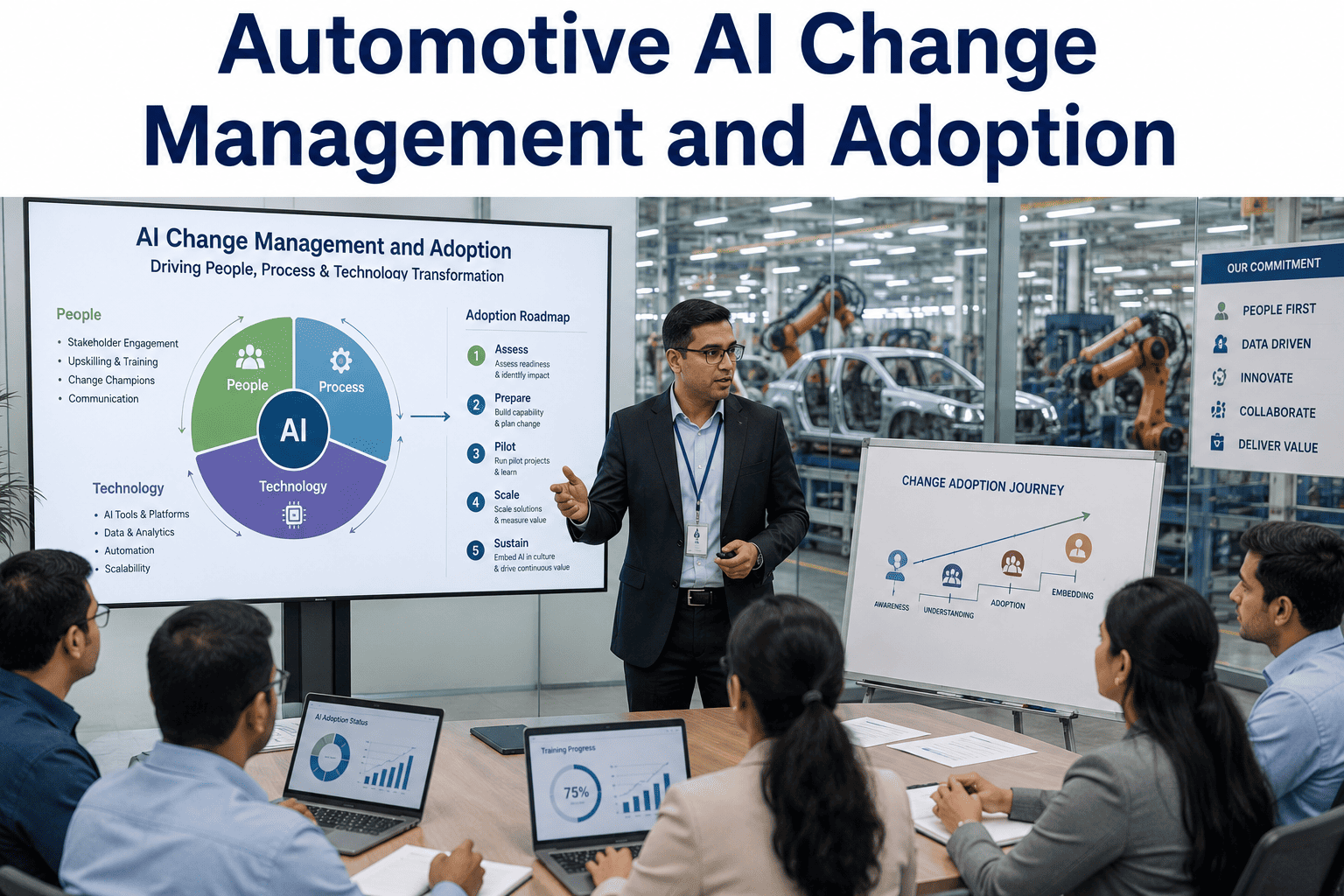
Automotive AI Change Management and Adoption
The AI technology works. The hard part is people. A change-management playbook built for the factory floor specifically — where adoption runs on trust and demonstrated reliability, not a training deck and a go-live date.
Training happens after go-live, hardware sits bypassed within months
×
No named adoption owner — only a technical install lead
vs.
✓
Adoption planning starts alongside the technical pilot
✓
A named change owner with real floor-level authority
Why This Fails Differently
Manufacturing AI Adoption Isn't a Software Rollout Problem
Most change management frameworks were built for corporate software adoption — a new CRM, a new expense tool, something a knowledge worker learns from a training video and starts using within days. Shop-floor AI adoption doesn't follow that curve, and treating it like it does is one of the most consistent reasons rollouts stall. A change program borrowed wholesale from a corporate software playbook will consistently misjudge both the timeline and the starting level of trust it needs to plan around.
01
Trust Is Earned in Weeks, Not Days
A maintenance technician or quality inspector needs to see a system perform reliably across real, messy production conditions before they'll modify a routine built on years of hands-on judgment — no training session accelerates that timeline.
02
The Workforce Skews Toward Lower Digital Comfort
Manufacturing workforces trend older and less digitally native than typical corporate software users, which means onboarding needs to be hands-on and demonstrated, not a self-service video someone is expected to complete unsupervised.
03
A Bypassed System Is Invisible Until Someone Looks
Corporate software that goes unused generates an obvious usage-analytics red flag. A factory-floor AI system quietly bypassed in favor of the old paper process can run for months before anyone in leadership realizes the hardware is present but operationally irrelevant.
04
Skepticism Is the Default Starting Position, Not the Exception
Surveys of manufacturing workers consistently find broad skepticism toward AI-driven decision-making — this isn't a fringe reaction from a few resistant individuals, it's the realistic baseline a change program needs to plan around from day one.
The Budget Reality
Change Management Isn't a Line Item You Add Later — It's a Percentage of the Project
15–20%
Recommended share of automation project budget allocated to change management, training, and workflow redesign
~30%
Reported share of AI project budget one major manufacturer dedicates specifically to shop-floor training and adoption
18 mo
Typical window before an under-supported pilot is either fully bypassed or quietly abandoned
These figures share a common implication: change management on a manufacturing AI project isn't a modest addition to the technical budget, it's a substantial fraction of the total investment. A project plan that allocates 90 percent of budget to hardware, software, and integration and treats training as an afterthought funded from whatever remains is structurally set up to produce exactly the "hardware present, workflow bypassed" outcome this failure mode describes. Framing the change management allocation as a percentage from the outset, rather than a residual line item, is a small planning discipline that consistently predicts which rollouts survive past the eighteen-month mark.
The dashed line in this chart represents an assumption baked into far too many rollout plans without anyone stating it explicitly: that trust is switched on the moment the system goes live, the same way a software license activates. The solid curve represents what actually happens — a slow, uneven climb built on weeks of the system proving itself against real conditions, real edge cases, and the operator's own judgment being confirmed or corrected in real time. A rollout plan built around the dashed-line assumption schedules training for launch week and considers the project complete once the ribbon is cut. A rollout plan built around the solid curve schedules structured trust-building activity for the following two to three months, with a named owner responsible for making sure that curve actually climbs rather than flattening out early.
Adoption Doesn't Happen at Go-Live
The Trust Curve Takes Weeks. Plan the Rollout Around That Timeline, Not the Install Date.
iFactory's deployment engineering team builds a structured adoption timeline alongside every technical rollout — so trust is being earned on the floor while the system is being installed, not scrambled together after go-live.
Why This Belongs in the Business Case, Not Just the Rollout Plan
A capital appropriation request for a manufacturing AI project typically justifies its cost against the technology's projected performance — reduced downtime, improved yield, faster changeovers. That projected value is entirely contingent on the system actually being used as designed, which makes the change management allocation a direct input to whether the projected ROI is ever realized, not a separate line item competing against it for budget.
A technically successful pilot that gets bypassed within eighteen months delivers close to zero of its projected ROI, regardless of how accurate the underlying model was during the pilot phase — the capital was spent, the projected value was never captured, and the project shows up in next year's budget review as a cautionary example rather than a success story. Framing change management spend as protecting the ROI already promised in the business case, rather than as an optional add-on, tends to make the budget conversation considerably easier.
The Playbook
Four Stages That Build Trust Before Asking for Behavior Change
These four stages follow directly from the trust curve above — each one addresses a specific reason that curve stays flat instead of climbing, and skipping any of them tends to produce a rollout that looks complete on the project timeline while remaining functionally inactive on the floor.
Stage 1
Involve Operators Before the System Is Built, Not After
Bring the people who will actually use the system into scoping conversations early — what "working correctly" looks like from their vantage point, what existing routine the new system needs to respect or improve on, and what would make them trust a recommendation enough to act on it. A system designed without this input tends to solve the problem leadership sees, not the problem the floor actually experiences.
Stage 2
Run in Advisory Mode Before Autonomous Mode
Deploy the system to make recommendations a human still approves and acts on, rather than taking autonomous action from day one — this gives operators weeks of direct evidence that the system's judgment is reliable before being asked to trust it without a human check in the loop, and it builds the track record that later autonomous operation depends on.
Stage 3
Name a Change Owner With Real Authority, Not Just a Technical Lead
The person responsible for the technical deployment is frequently not the right person to own adoption — that requires someone with standing on the floor, credibility with the workforce, and the authority to address a workflow conflict as it comes up, not escalate it through a project management chain that responds weeks later.
Stage 4
Close the Feedback Loop Visibly and Quickly
When an operator flags that a recommendation was wrong or a workflow step doesn't make sense in practice, that feedback needs to visibly change something within a reasonably short window — a system that appears to ignore floor-level feedback teaches the workforce that their input doesn't matter, which is precisely the impression that kills long-term trust and adoption.
Field Perspective
“
Every stalled AI deployment I've been called in to fix looks the same underneath. The technology works — I've rarely found the model itself was the problem. What's missing is almost always a name. Ask "whose job is it to make sure the floor actually trusts and uses this system" and too often nobody has a clear answer, because that responsibility quietly fell between the technical project lead and whoever runs general plant operations. Change management isn't a phase you run after deployment. It's a role, with a name attached, from the day the project starts — and the projects that get that one thing right are the ones I almost never get called back to fix, because the trust curve actually climbed the way it was supposed to instead of flattening out somewhere around week three.
Renee Okafor-Bergström
Organizational Change Lead · 13 years leading technology adoption programs across automotive manufacturing and industrial operations
Common Questions
Frequently Asked Questions
Why do manufacturing AI pilots stall even when the technology performs accurately?
Industry research consistently finds that a substantial share of manufacturing AI pilots remain stuck in pilot status well over a year after launch, and the root cause is rarely the underlying model or algorithm — it's that change management was deferred until after technical deployment rather than built in from the start. A system can be perfectly accurate and still fail to change behavior on the floor if operators were never given the weeks of demonstrated reliability needed to trust it, or if nobody with real authority owned the responsibility for driving adoption once the technical team's work was done. This gap tends to be invisible to leadership for a surprisingly long time, since a bypassed system still shows up as "deployed" on a project status report even while it produces none of its projected value. Book a change readiness review to assess where your current or planned rollout stands against this pattern.
How much of an AI project budget should realistically go toward change management and training?
Industry guidance commonly recommends allocating 15 to 20 percent of a manufacturing automation project's total budget to change management, training, and workflow redesign specifically, with at least one major manufacturer reporting figures closer to 30 percent of AI project budget dedicated to shop-floor training and adoption. Treating change management as a modest afterthought funded from whatever remains after hardware and software costs are covered is one of the most consistent predictors of a rollout that ends up technically installed but operationally bypassed within the first year or two.
Should a new AI system run in fully autonomous mode from the day it's deployed?
Generally no — running a new system in advisory mode first, where it generates a recommendation a human still reviews and acts on, gives the workforce a period of directly observing the system's judgment before being asked to trust it without a human check in the loop. This staged approach also produces the demonstrated-reliability track record that operators need before they'll willingly hand over more autonomous decision-making, and it gives the deployment team a lower-stakes window to catch and correct any real-world edge cases the system handles poorly before those edge cases become autonomous decisions with no human review.
Who should actually own AI adoption on the floor — the technical project lead, or someone else?
The technical project lead responsible for the deployment itself is frequently not the right person to also own adoption, since driving genuine behavior change on the floor requires standing and credibility with the workforce, plus the authority to resolve a workflow conflict quickly rather than escalating it through a project management chain. A dedicated change owner — someone with real floor-level credibility and decision authority — is one of the more consistent differentiators between rollouts that stick and rollouts that quietly get bypassed once the technical team moves on to the next project. Talk to solutions engineering about structuring change ownership into your next deployment from the start.
How do you know if an AI system has already become quietly bypassed rather than genuinely adopted?
Unlike corporate software, where a usage-analytics dashboard makes low adoption immediately visible, a factory-floor AI system can be technically running while operators have reverted to a parallel paper or manual process, and this can persist for months before it surfaces to leadership. Warning signs include system-generated alerts or recommendations with no corresponding follow-up action logged, maintenance or quality teams referencing an old process or checklist in conversation without mentioning the new system, and a gap between the system's activity logs and any actual operational decisions that changed as a result. Actively auditing for this gap, rather than assuming installation equals adoption, is the only reliable way to catch it early.
Build Adoption Into the Rollout, Not After It
The Technology Isn't the Hard Part. Getting the Floor to Trust and Use It Is.
iFactory's deployment engineering team plans change management alongside every technical rollout — a named adoption owner, an advisory-mode trust-building period, and a closed feedback loop — so the system is still in active use eighteen months after go-live, not quietly bypassed.