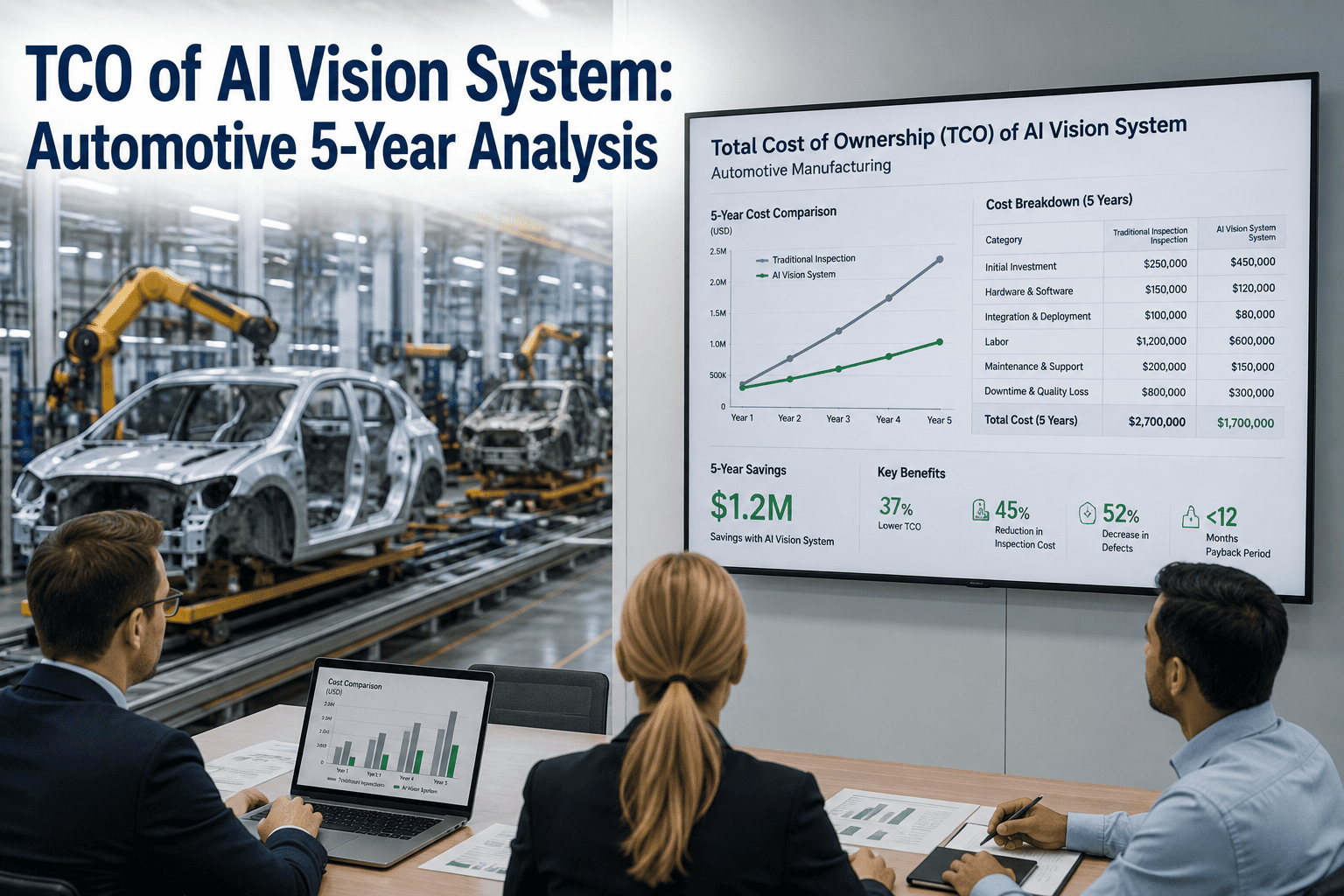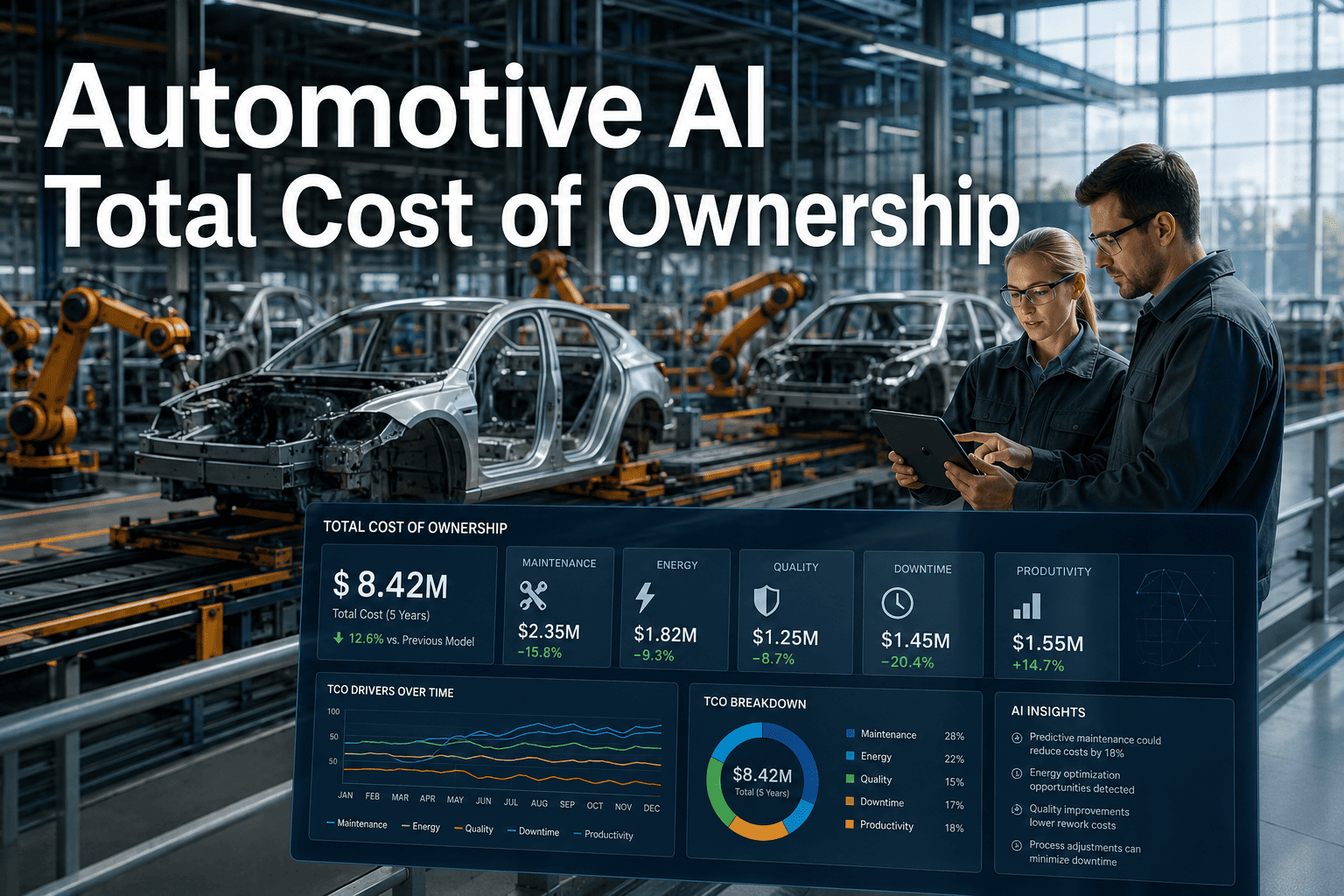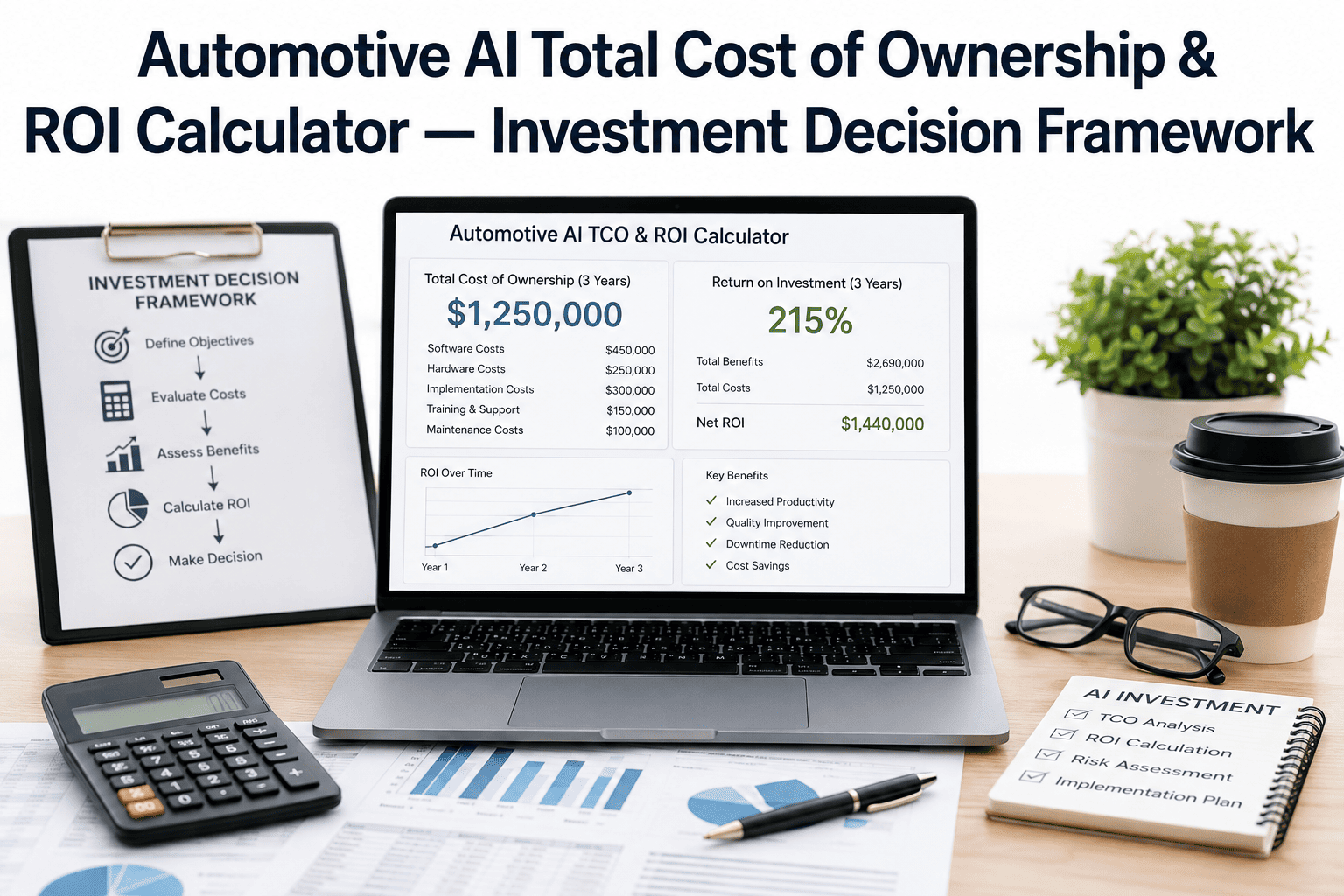
Every automotive AI proposal eventually lands on the same finance desk question, what does this actually cost once licensing, integration, training, and ongoing model maintenance are all added up, and when does the plant actually see the money back. Vendors quoting only a software subscription number are leaving out the majority of the real total cost of ownership, and plants that skip a proper TCO model often end up justifying a purchase on optimistic payback assumptions that do not survive a finance committee review. A rigorous total cost of ownership and ROI framework puts every cost and every benefit on the same table so the investment decision can be made on real numbers rather than a vendor's headline claim.
Model the Real Total Cost of Ownership Before You Sign an AI Contract
A complete TCO and ROI framework covering payback period, NPV, and IRR across predictive maintenance, quality inspection, and production optimization investments.
Why Software Subscription Price Is Only Part of the Story
A common mistake in evaluating automotive AI investments is comparing vendors purely on their quoted annual license fee, which typically represents well under half of the actual first-year total cost once integration engineering, sensor or hardware gaps, data pipeline work, staff training, and change management time are all accounted for. A cheaper license with a difficult integration path can easily end up costing more in year one than a more expensive platform that connects cleanly to existing PLC and MES infrastructure.
On the benefit side, the same discipline applies. A benefit estimate based only on labor savings while ignoring quality improvement, scrap reduction, and avoided downtime will understate the real return, sometimes badly enough to make a genuinely good investment look marginal on paper. A complete TCO and ROI model puts both sides, full cost and full benefit, on the same footing so the investment decision reflects reality.
iFactory provides a complete TCO breakdown alongside every proposal, so your finance team sees the full picture before approval, not just the license line.
Five Cost Categories in a Complete TCO Model
Software Licensing
The recurring subscription or license fee, typically scaled by number of lines, assets, or users covered.
Integration Engineering
One-time cost to connect PLC, MES, and sensor data sources into the platform, heavily dependent on existing infrastructure maturity.
Hardware and Sensors
Any cameras, accelerometers, or edge computing hardware needed to capture data not already available from existing systems.
Training and Change Management
Time investment to train operators, engineers, and maintenance staff on new workflows and dashboards.
Ongoing Model Maintenance
Continued model retraining and tuning as product mix, equipment, or process conditions evolve over the life of the deployment.
Sample TCO Comparison: Year One vs Three-Year Total
| Cost Category | Year One | Years Two and Three (combined) | Three-Year Total |
|---|---|---|---|
| Software licensing | $60,000 | $120,000 | $180,000 |
| Integration engineering | $85,000 | $10,000 | $95,000 |
| Hardware and sensors | $45,000 | $15,000 | $60,000 |
| Training and change management | $20,000 | $8,000 | $28,000 |
| Ongoing model maintenance | $15,000 | $40,000 | $55,000 |
| Total cost of ownership | $225,000 | $193,000 | $418,000 |
Three Financial Metrics That Matter to Finance Approval
Payback Period
Months until cumulative benefit equals cumulative cost. Most predictive maintenance and quality inspection deployments in automotive plants achieve payback within 12 to 18 months.
Net Present Value
Total value created over the evaluation period, discounted to today's dollars, giving finance a single comparable figure across competing capital projects.
Internal Rate of Return
The effective annual return generated by the investment, useful for comparing an AI deployment against other capital allocation options competing for the same budget.
Get a payback period, NPV, and IRR model built from your own plant's cost and benefit data, not a generic industry assumption.
Building the Benefit Side of the Model Correctly
The benefit side of a TCO model deserves the same rigor as the cost side, and the most common error is collapsing every benefit into a single generic labor savings figure. A complete benefit model separates labor savings, scrap and rework cost avoidance, unplanned downtime cost avoidance, and quality-related warranty cost avoidance into distinct line items, each grounded in the plant's own historical data rather than a vendor-supplied industry average. This separation matters because it allows a finance reviewer to challenge any single assumption without invalidating the entire model, which builds far more credibility than a single bundled number that cannot be decomposed under scrutiny.
It is also worth explicitly modeling a conservative, base, and optimistic scenario rather than presenting a single point estimate, since finance committees are generally more comfortable approving an investment when they can see the downside case still produces an acceptable return, rather than only seeing the best-case number that made it into the original vendor pitch.
Frequently Asked Questions
What typically gets left out of a vendor's initial cost quote?
Integration engineering time, any hardware or sensor gaps not already covered by existing infrastructure, internal staff training hours, and ongoing model retraining costs are the categories most frequently missing from a vendor's headline software price. These categories can add substantially to first-year cost, which is why requesting a full TCO breakdown before signing is essential rather than assuming the quoted subscription fee represents total cost.
How is payback period different from ROI as a decision metric?
Payback period tells you how long until the investment breaks even in raw dollar terms, while ROI and IRR express the overall return generated relative to the capital invested, accounting for the full evaluation period rather than just the breakeven point. Both matter for different reasons, payback period matters to a plant manager focused on near-term cash flow, while NPV and IRR matter more to a finance team comparing this investment against other competing capital projects.
Should the TCO model include the cost of doing nothing?
Yes, and this is frequently overlooked. The cost of maintaining the status quo, continued unplanned downtime, ongoing scrap rates, and the labor cost of manual inspection or data reconciliation, should be modeled explicitly as the baseline against which the AI investment's benefits are measured, rather than assuming the current state carries no cost simply because it requires no new spending decision.
How should ongoing model maintenance costs be estimated?
Model maintenance costs typically scale with how frequently the underlying process changes, a line with stable product mix and equipment requires less retraining than one with frequent product changeovers or new part introductions. A reasonable starting estimate is a percentage of the initial model development cost allocated annually, refined over time as actual retraining frequency becomes clear from operating the system. Our support team can help benchmark this against similar deployments.
Can this TCO framework be used to compare multiple vendors fairly?
Yes, this is one of its primary uses, since requiring every vendor to break down cost into the same five categories, licensing, integration, hardware, training, and maintenance, prevents any single vendor from winning purely on a lower headline license price while hiding a more expensive integration path. Book a demo to see how this framework applies to your specific vendor comparison.
Build a defensible TCO and ROI model for your next AI investment decision. Book a demo with your own plant's numbers.