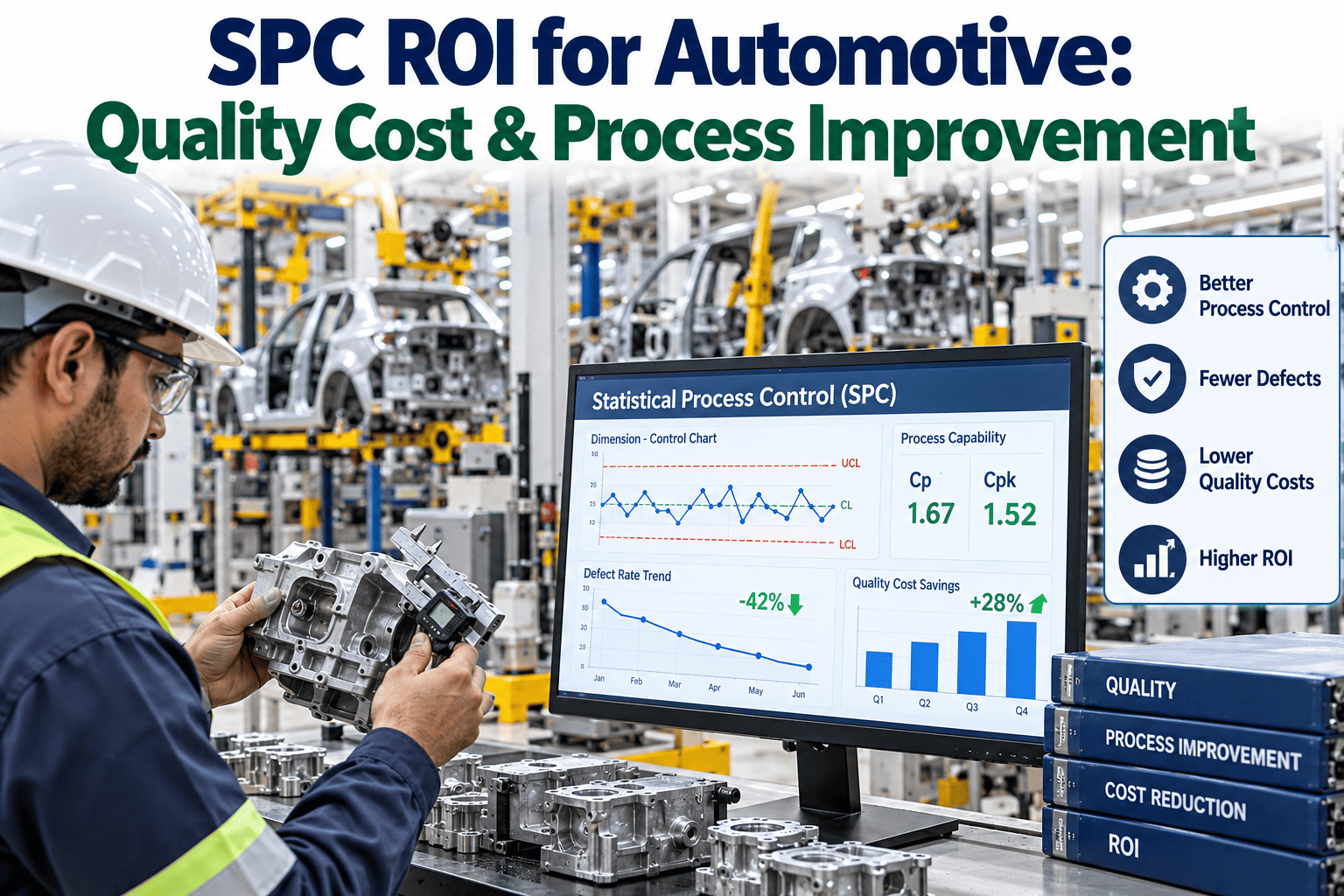
Statistical process control gets purchased for compliance reasons far more often than for the financial return it actually delivers, and that framing quietly costs automotive suppliers the internal budget fight every single time. A plant quality manager asking for SPC software funded as "what IATF 16949 requires" is competing against every other capital request in the plant using the weakest possible argument, when the real case is that a properly implemented SPC program pays for itself through defect reduction, scrap savings, and reduced firefighting well before the audit benefit even enters the conversation. Finance teams evaluating capital requests respond to quantified payback periods, not compliance obligations, and a proposal framed around the latter is competing on the weakest possible footing against other projects in the plant that come with a clear dollar return attached. The problem is that most quality teams have never actually built that financial case, because nobody connected the dots between control chart data and the dollar figures finance actually responds to. This guide walks through exactly how to calculate real SPC ROI using data your plant already generates. If you want help building this business case for your own plant, you can book a demo with iFactory's team.
SPC DASHBOARD · AUTOMOTIVE QUALITY · ROI
Build the Financial Case for SPC Beyond Compliance Alone
iFactory's SPC dashboard turns control chart data into a quantified defect reduction, scrap savings, and process improvement case that justifies the investment on its own merits.
WHERE THE RETURN COMES FROM
Three Financial Levers a Working SPC Program Actually Pulls
SPC ROI is not a single number pulled from an industry brochure. It is the sum of three distinct savings categories, each measurable against your plant's own baseline once control charts are actually being used to catch process drift before it produces defective parts. Weighting these three categories will vary by plant depending on your current defect profile, existing quality staffing levels, and how frequently customer audits currently surface findings, so the right business case is always built from your own numbers rather than a generic industry average applied uniformly.
1
Defect Reduction
Catching a process shift via control limits before it produces out-of-spec parts prevents the scrap, rework, and containment cost of a defect that would otherwise have shipped or been caught downstream.
2
Reduced Firefighting Time
Quality engineers spend measurably less time on reactive root cause investigations when process capability is monitored continuously rather than discovered only after a customer complaint.
3
Audit and Warranty Cost Avoidance
Documented process control reduces the frequency and severity of customer audit findings and provides the traceability needed to resolve warranty claims faster and more cheaply.
THE COST CASCADE
Where a Defect Costs the Least Versus Where It Costs the Most
The entire financial case for SPC rests on a simple principle: a process shift caught by a control chart before it produces a defective part costs almost nothing to correct, while the same underlying shift caught downstream multiplies in cost at every stage it travels. This cascade is the single most persuasive piece of the ROI argument, because it does not require projecting hypothetical future savings; it simply reframes defects the plant is already experiencing today in terms of where in this cascade they were actually caught, and how much cheaper the same defect would have been to address one or two stages earlier.
Caught by Control Chart
$25
Process adjustment before any nonconforming part is produced
Caught In-Station
$140
Rework or scrap of the single affected part before it leaves the operation
Caught Downstream In-Plant
$620
Containment sweep across the affected lot plus labor to sort and rework
Caught at Customer
$5,400+
Formal containment, 8D response, potential line-down charge back
See Your Own Cost Cascade Modeled Against Real Plant Data
iFactory will walk through your specific defect history to build a realistic ROI estimate for a working SPC program.
BUILDING THE BUSINESS CASE
A Practical Four-Step Method for Calculating Your Plant's SPC ROI
Building a credible ROI figure does not require a finance degree, just a disciplined walk through your own historical defect and scrap data using the framework below. Each of these four steps can typically be completed using data already sitting in your existing quality management system or ERP, meaning the business case itself can usually be built within a week or two of effort rather than requiring a lengthy separate data collection project before the proposal can even be drafted.
Step 1
Pull Twelve Months of Scrap and Rework Cost
Start with existing quality cost data for the specific characteristics or processes you are proposing to bring under SPC monitoring.
Step 2
Estimate the Preventable Share
Review past nonconformances to estimate what percentage would realistically have been caught earlier by a control chart showing process drift.
Step 3
Apply the Cost Cascade Multiplier
Multiply the preventable share by the cost difference between where defects are currently caught and where SPC would catch them instead.
Step 4
Add Audit and Firefighting Time Savings
Layer in the estimated value of reduced quality engineer time spent on reactive investigation and customer audit preparation.
MEASURED RESULTS
Outcomes From Automotive Suppliers Running an Active SPC Program
The figures below reflect aggregated results from automotive manufacturing plants that moved from a paper-based or minimally used SPC system to continuous, actively monitored control charting.
34%
Reduction in Scrap Cost on Monitored Characteristics
Process shifts caught via control limits prevented a meaningful share of defects that previously reached scrap or rework.
6.2 Months
Typical Payback Period
Combining scrap reduction, firefighting time savings, and reduced audit preparation cost against the program investment.
48%
Fewer Customer Containment Events
Earlier detection at the process level prevented defects from reaching the point where formal customer containment was required.
FREQUENTLY ASKED QUESTIONS
Questions Automotive Quality Managers Ask While Building an SPC Business Case
How do we estimate the preventable share of past defects without a lengthy formal study?
A practical starting estimate can be built by reviewing the last twelve to eighteen months of nonconformance reports for the specific characteristics under consideration and classifying each one as either a gradual process drift that a control chart would likely have flagged in advance, or a sudden, discrete event such as a tooling break that a control chart would not have predicted. Most automotive processes show a meaningful share of defects falling into the gradual drift category, and this classification exercise, while not a rigorous statistical study, is usually sufficient to build a credible, defensible estimate for an initial budget proposal.
Book a demo to walk through this classification using your own defect history.
Should the ROI case include IATF 16949 compliance value at all, or focus purely on financial return?
Compliance value is worth mentioning as a secondary point since it does carry real cost avoidance value in the form of reduced audit finding risk, but leading the business case with financial return from defect reduction and firefighting time savings tends to be significantly more persuasive to plant leadership and finance, since compliance alone frames SPC as a cost of doing business rather than an investment with a measurable payback, which is a much harder sell in a competitive capital allocation process.
Contact support to discuss how to frame both angles in your specific proposal.
How quickly can we expect to see the projected savings actually materialize after implementation?
Most plants see measurable scrap reduction within the first two to three months of active control chart monitoring on a given characteristic, since this benefit depends primarily on operators and engineers actually responding to out-of-control signals rather than requiring a lengthy ramp period, while the firefighting time savings and audit preparation benefits typically build more gradually over six to twelve months as documented process history accumulates and reduces the investigative burden during customer audits and warranty claim resolution.
Book a demo to discuss a realistic timeline for your specific processes.
Does the ROI calculation change significantly if we are already running SPC but it is not being actively used?
Yes, and this is actually one of the more common starting points, since many automotive plants already have SPC software or paper charts in place to satisfy IATF 16949 documentation requirements but the charts are not being actively monitored or acted upon in real time, meaning the plant is paying the cost of the program without capturing the return, and the ROI case in this scenario should focus specifically on the incremental value of moving from passive documentation to active, real-time monitoring rather than justifying SPC as a new capability from scratch.
Contact support to discuss transitioning from passive to active SPC use.
How many characteristics should the initial ROI case and pilot cover to keep the scope manageable?
Starting with three to five characteristics that have both a documented history of nonconformance cost and a clear, quantifiable relationship between process drift and defect occurrence tends to produce the strongest initial business case, since a narrower scope makes the before-and-after comparison cleaner and faster to demonstrate than attempting to build a case across dozens of characteristics simultaneously, where dilution across many lower-impact characteristics can make the overall return look less compelling than it actually is on the highest-value ones.
Book a demo to help select the right initial characteristics for your case.
Turn Your SPC Investment Into a Defensible Financial Case
iFactory will help you calculate real ROI from your own scrap and defect data. Book a demo to build a business case finance will actually approve.