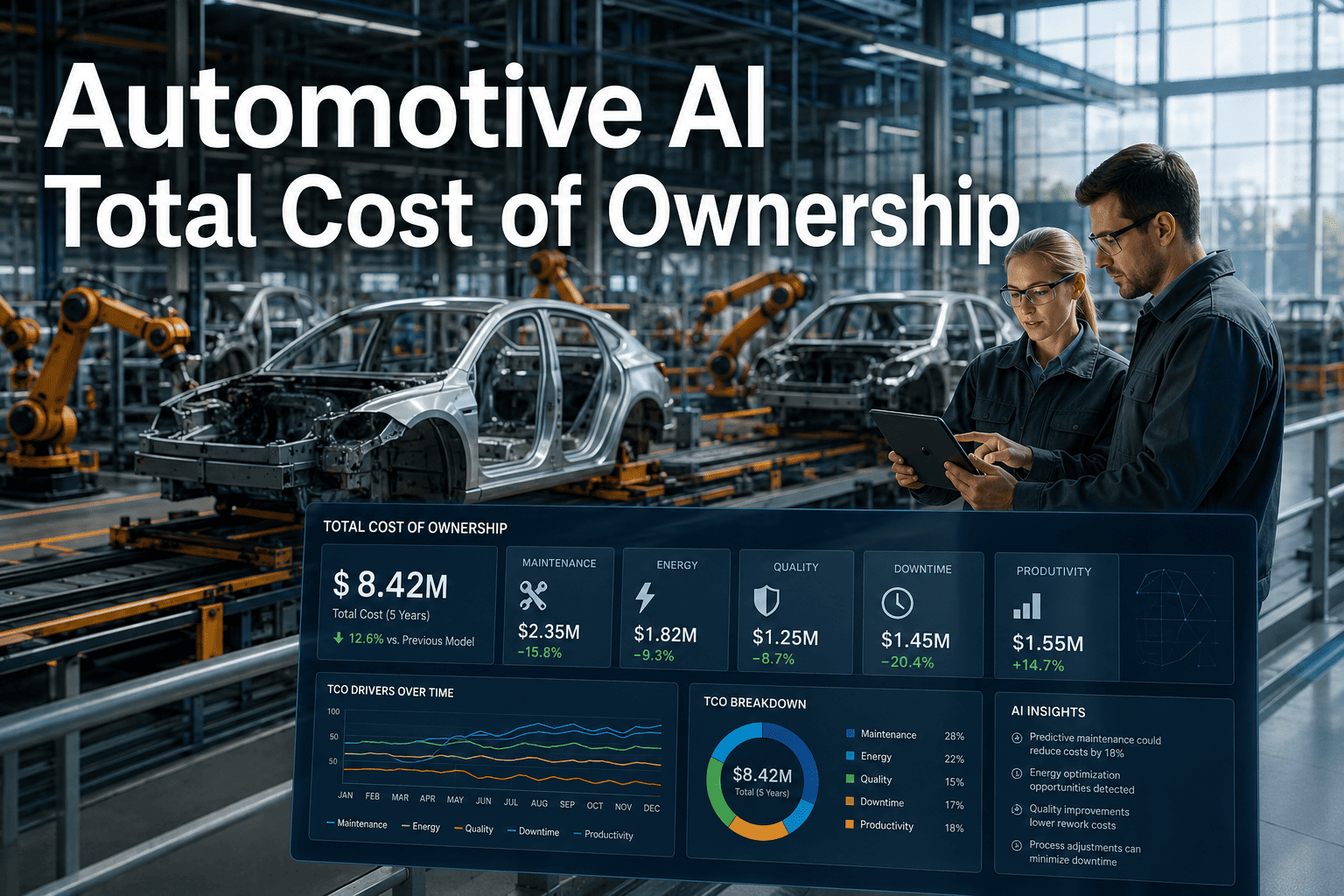
In the race to achieve Industry 4.0 maturity, automotive manufacturers are aggressively deploying artificial intelligence across production lines, supply chains, and quality assurance. Yet, beneath the promise of predictive maintenance and defect detection lies a complex financial landscape that few vendors transparently address. The total cost of ownership (TCO) for automotive AI extends far beyond initial software licensing—encompassing hardware infrastructure, data engineering, model retraining, and ongoing operational support. For CIOs and plant directors, a miscalculation in any of these dimensions can erode ROI by 30% or more within the first three years. This comprehensive guide dissects every cost layer, from GPU clusters to MLOps personnel, providing an evidence-based framework for budget planning. Whether you are evaluating on-premise deployments or hybrid cloud architectures, understanding the true TCO is critical to securing executive buy-in and avoiding costly overruns. Book a Demo to explore how iFactory's transparent pricing model aligns with your operational scale.
Automotive AI Total Cost of Ownership
A transparent, multi-year TCO breakdown for enterprise AI deployment in automotive manufacturing.
Hardware Infrastructure
On-premise GPU clusters, edge devices, and networking gear form the backbone of automotive AI. A mid-sized plant typically requires 8–16 NVIDIA A100 GPUs, costing $150K–$400K upfront. Edge inference nodes for real-time defect detection add $50K–$120K. Cooling and power infrastructure upgrades can add 20% to hardware CAPEX. Total first-year hardware investment: $250K–$600K.
Software Licensing
AI platform licenses, MLOps tools, and data management software constitute recurring costs. Enterprise-grade solutions like Dataiku or Sagemaker run $50K–$150K annually per site. Additional costs for computer vision libraries (e.g., custom models) add $30K–$80K per year. Total three-year software licensing: $240K–$690K.
Data Engineering & Labeling
High-quality labeled datasets are the lifeblood of AI. Automotive image annotation for defect detection costs $0.50–$2 per image, with typical projects requiring 100K–500K images. Data pipeline setup and integration with MES/SCADA systems add $80K–$200K. Total first-year data costs: $130K–$500K.
Personnel & Talent
AI teams require ML engineers, data scientists, and MLOps specialists. Annual salary costs for a 5-person team range $500K–$900K. Training existing plant personnel on AI tools adds $20K–$50K per year. Total three-year personnel costs: $1.56M–$2.85M.
Ongoing Maintenance & Upgrades
Model retraining, infrastructure refresh, and security patches are ongoing. Annual maintenance typically runs 15–25% of initial CAPEX. For a $500K hardware setup, that's $75K–$125K yearly. Total three-year maintenance: $225K–$375K.
Integration & Change Management
Connecting AI to legacy ERP, MES, and PLC systems requires custom middleware and API development. Integration costs range $100K–$250K. Change management programs, including workshops and documentation, add $30K–$60K. Total: $130K–$310K.
Deconstructing the Hardware Cost Layer
Hardware remains the most visible yet often underestimated cost in automotive AI TCO. A typical deployment for a stamping plant with 20 cameras requires at least 4 edge servers with NVIDIA Jetson AGX Orin modules, priced at $15K each. Centralized training clusters demand 8–16 GPUs (A100 or H100), with each GPU costing $15K–$30K. Storage systems for high-resolution images add $50K–$100K. Networking upgrades to support 10GbE or 25GbE links add another $20K–$40K. Cooling and power—often overlooked—require $10K–$30K in HVAC upgrades and $5K–$15K in electrical work. Total hardware CAPEX: $300K–$700K. Leasing options can reduce upfront burden but increase TCO by 15–20% over three years. For a comprehensive hardware cost assessment tailored to your plant's sensor count and production volume, Book a Demo.
Software Licensing Models: Perpetual vs. Subscription
Software licensing is a major TCO driver, with vendors offering perpetual, subscription, or consumption-based models. Perpetual licenses for AI platforms like Cognite or C3.ai range $200K–$500K upfront, plus 20% annual maintenance. Subscription models (SaaS) cost $150K–$400K per year, including updates and support. Consumption-based pricing (per inference, per data point) can be unpredictable, ranging $0.01–$0.10 per inference—potentially $100K–$500K annually for high-volume plants. Hidden costs include premium support tiers ($20K–$60K/year) and integration fees. Over three years, subscription models can be 10–20% cheaper for plants with rapid scaling needs, while perpetual licenses favor stable, long-term deployments. Evaluate your growth trajectory before committing. For a detailed software cost comparison, Get Support.
Data Engineering: The Unseen TCO Multiplier
Data preparation consumes 60–80% of AI project time and budget. In automotive, this means collecting images from multiple camera angles, labeling defects (scratch, dent, misalignment), and normalizing data from disparate sources. Image annotation costs $0.50–$2 per image, with 100K–500K images needed for robust models. Data pipeline development—extracting data from MES, SCADA, and vision systems—adds $80K–$200K. Data storage and versioning (using tools like DVC or LakeFS) cost $10K–$30K annually. Data drift monitoring and re-labeling add $20K–$50K per year. Total three-year data engineering costs: $250K–$800K. Automating annotation with pre-trained models can reduce costs by 40%, but requires initial investment. For a data cost optimization strategy, Book a Demo.
Three-Year TCO Timeline: From Pilot to Scale
Pilot deployment on 2–3 production lines. Hardware: $300K–$600K. Software: $80K–$150K. Data & labeling: $100K–$300K. Personnel: $500K–$800K. Integration: $100K–$200K. Total: $1.08M–$2.05M.
Scale to 8–10 lines. Additional hardware: $200K–$400K. Software renewal: $80K–$150K. Data maintenance: $50K–$100K. Personnel: $500K–$800K. Maintenance: $100K–$200K. Total: $930K–$1.65M.
Full plant deployment (20+ lines). Hardware refresh: $100K–$200K. Software renewal: $80K–$150K. Data optimization: $30K–$80K. Personnel: $500K–$800K. Maintenance: $100K–$200K. Total: $810K–$1.43M.
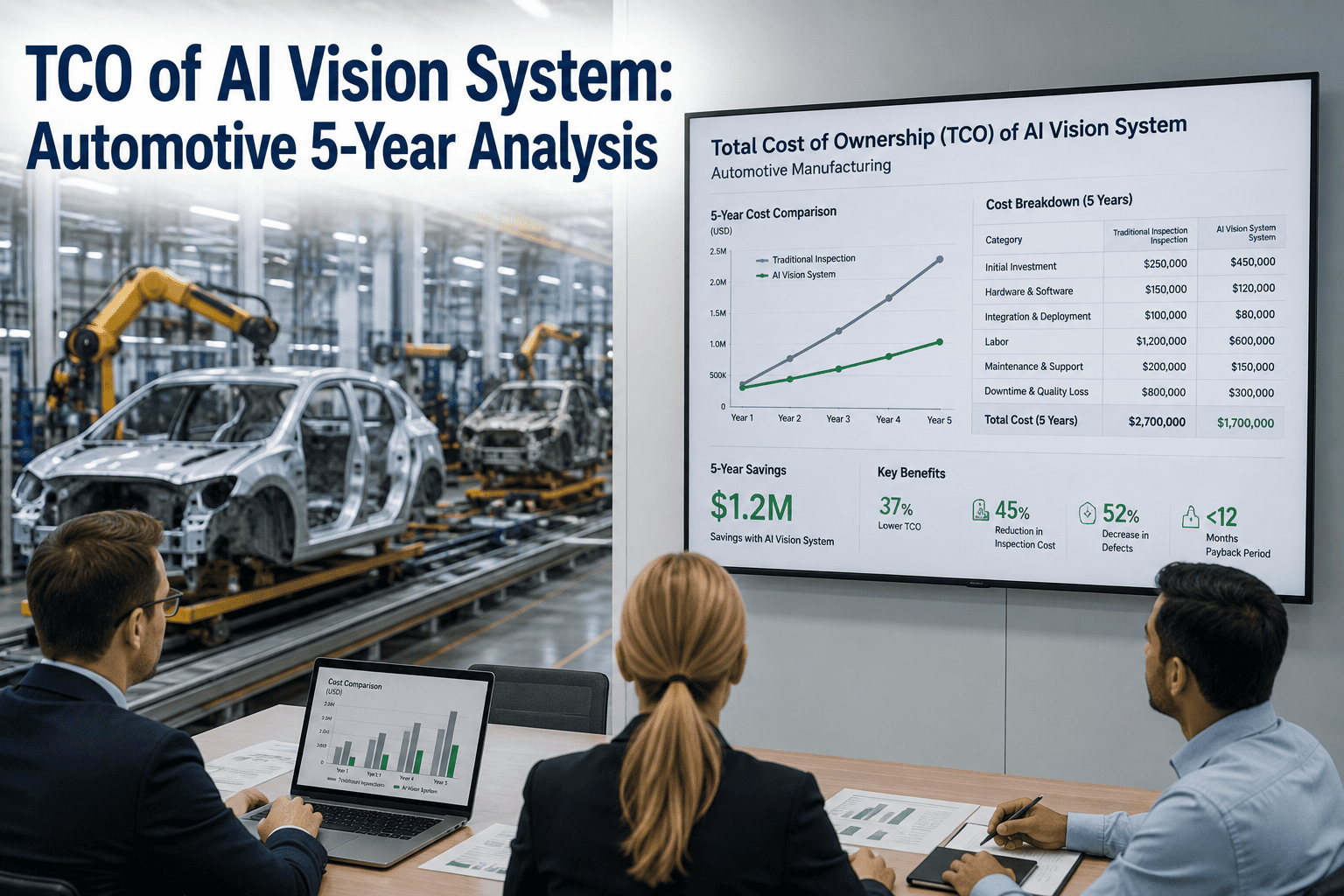
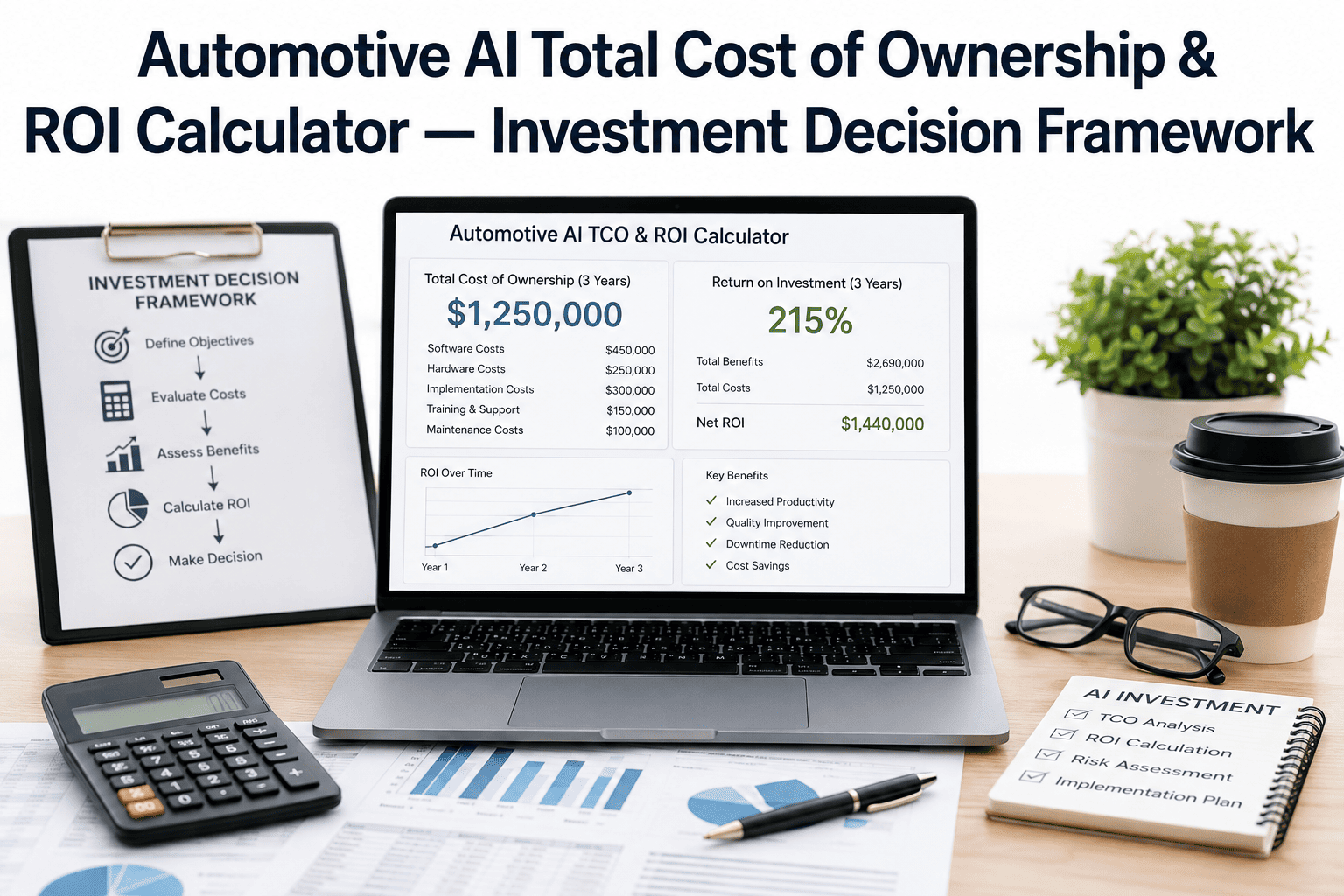
Cumulative three-year TCO: $2.82M–$5.13M. Break-even typically occurs at 18–24 months, driven by defect reduction (30–50%) and downtime savings ($1M–$3M annually). For a personalized TCO projection, Get Support.
Ready to Optimize Your AI Investment?
Get a tailored TCO analysis for your automotive plant. Our experts map costs to your specific production scale and AI use cases.
Detailed TCO Breakdown by Component (3-Year View)
| Component | Year 1 | Year 2 | Year 3 | Total | % of TCO |
|---|---|---|---|---|---|
| Hardware | $450K | $300K | $150K | $900K | 25% |
| Software | $115K | $115K | $115K | $345K | 10% |
| Data Engineering | $200K | $75K | $55K | $330K | 9% |
| Personnel | $650K | $650K | $650K | $1.95M | 54% |
| Maintenance | $150K | $150K | $150K | $450K | 12% |
Personnel costs dominate, highlighting the need for efficient MLOps and automation. Hardware costs decrease as infrastructure matures. Note: Data engineering costs drop after initial pipeline setup. For a detailed breakdown of your specific cost structure, Book a Demo.
Hidden Costs: What Vendors Often Omit
Vendor proposals frequently exclude integration, data migration, and change management costs. Integration with legacy PLCs and MES systems can add $100K–$250K. Data migration from on-premise silos to a unified data lake adds $50K–$150K. Change management—training operators, creating documentation, and managing resistance—adds $30K–$60K. Compliance and audit readiness (GDPR, ISO 27001) add $20K–$50K. These hidden costs can inflate TCO by 20–35%. Always request a detailed scope of work that includes these items. For a transparent cost breakdown, Get Support.
Total Cost of Ownership vs. Total Value of Ownership
TCO should be balanced against total value of ownership (TVO). AI-driven defect reduction (30–50%) can save $500K–$2M annually in rework and scrap. Predictive maintenance reduces unplanned downtime by 40–60%, saving $1M–$3M per year. Improved OEE (overall equipment effectiveness) by 5–10% translates to $2M–$5M in additional output. When TVO is factored, the payback period for AI investments is typically 12–18 months. However, TVO is highly dependent on deployment scale and data quality. For a TVO analysis tailored to your plant, Book a Demo.
Frequently Asked Questions
What is the typical three-year TCO for automotive AI in a mid-sized plant?
For a plant with 10–15 production lines and 20–30 inspection cameras, the three-year TCO ranges from $2.8M to $5.1M. This includes hardware (GPUs, edge servers) at $300K–$700K, software licensing at $240K–$690K, data engineering at $250K–$800K, personnel at $1.56M–$2.85M, and maintenance at $225K–$375K. Hidden costs like integration and change management add $130K–$310K. The wide range reflects variations in data volume, existing infrastructure, and vendor pricing. For a precise estimate based on your plant's specific parameters, Book a Demo.
How can we reduce AI TCO without compromising performance?
Cost reduction strategies include using pre-trained models to minimize data labeling (saving 30–50% on data costs), adopting edge computing to reduce cloud inference expenses (saving 20–40% on compute), and leveraging open-source MLOps tools like MLflow or Kubeflow to cut software licensing costs by 50–70%. Additionally, implementing automated data pipelines reduces manual engineering effort, and training internal talent reduces reliance on expensive external consultants. A phased deployment—starting with a pilot on 2–3 lines—allows you to validate ROI before scaling, preventing overinvestment. For a tailored cost optimization roadmap, Get Support.
What are the biggest hidden costs in automotive AI projects?
The most commonly overlooked costs include data integration with legacy systems (PLC, MES, SCADA), which can add $100K–$250K; data migration and cleaning, costing $50K–$150K; and change management programs, which require $30K–$60K. Additionally, ongoing model retraining due to data drift can add $20K–$50K per year, and hardware maintenance and refresh cycles add 15–25% of initial CAPEX annually. Compliance and security audits (GDPR, ISO 27001) add $20K–$50K. To avoid surprises, always request a comprehensive TCO model that includes these items. For a transparent cost analysis, Book a Demo.
How does on-premise AI TCO compare to cloud-based AI?
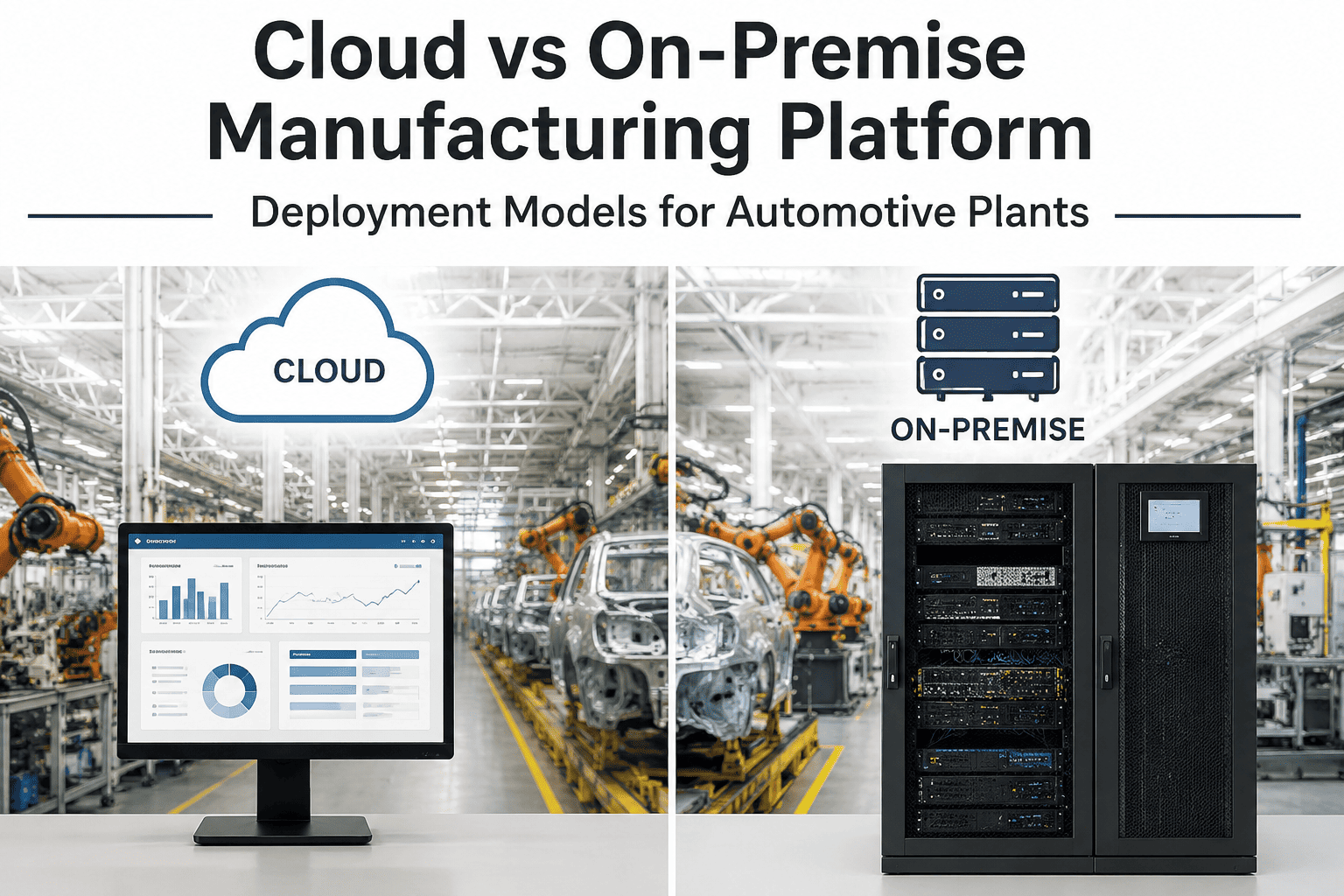
On-premise AI requires significant upfront CAPEX ($300K–$700K for hardware) but offers predictable costs and data sovereignty. Over three years, on-premise TCO ranges $2.5M–$4.5M. Cloud-based AI (using services like AWS SageMaker or Azure ML) has lower upfront costs (pay-as-you-go) but can accumulate 20–40% higher operational costs due to data egress fees, GPU instance costs, and storage. For high-volume inference (>1M inferences/day), cloud costs can exceed on-premise by 30–50% over three years. Hybrid approaches—training on-premise and inferring at the edge—often provide the best balance. For a cloud vs. on-premise TCO comparison for your specific workload, Get Support.
What ROI can we expect from automotive AI, and how does it offset TCO?
Automotive AI typically delivers 3–5x ROI over three years, driven by defect reduction (30–50% decrease in rework and scrap, saving $500K–$2M annually), predictive maintenance (40–60% reduction in unplanned downtime, saving $1M–$3M per year), and OEE improvements (5–10% gain, adding $2M–$5M in output). The break-even point is usually 12–18 months. However, ROI is contingent on data quality, model accuracy, and organizational adoption. Plants with mature data infrastructure and strong change management programs achieve higher returns. To calculate the ROI for your specific plant, Book a Demo.
Master Your AI TCO Today
Take control of your automotive AI investment with transparent cost modeling and expert guidance. Let's build a budget that works for your plant.