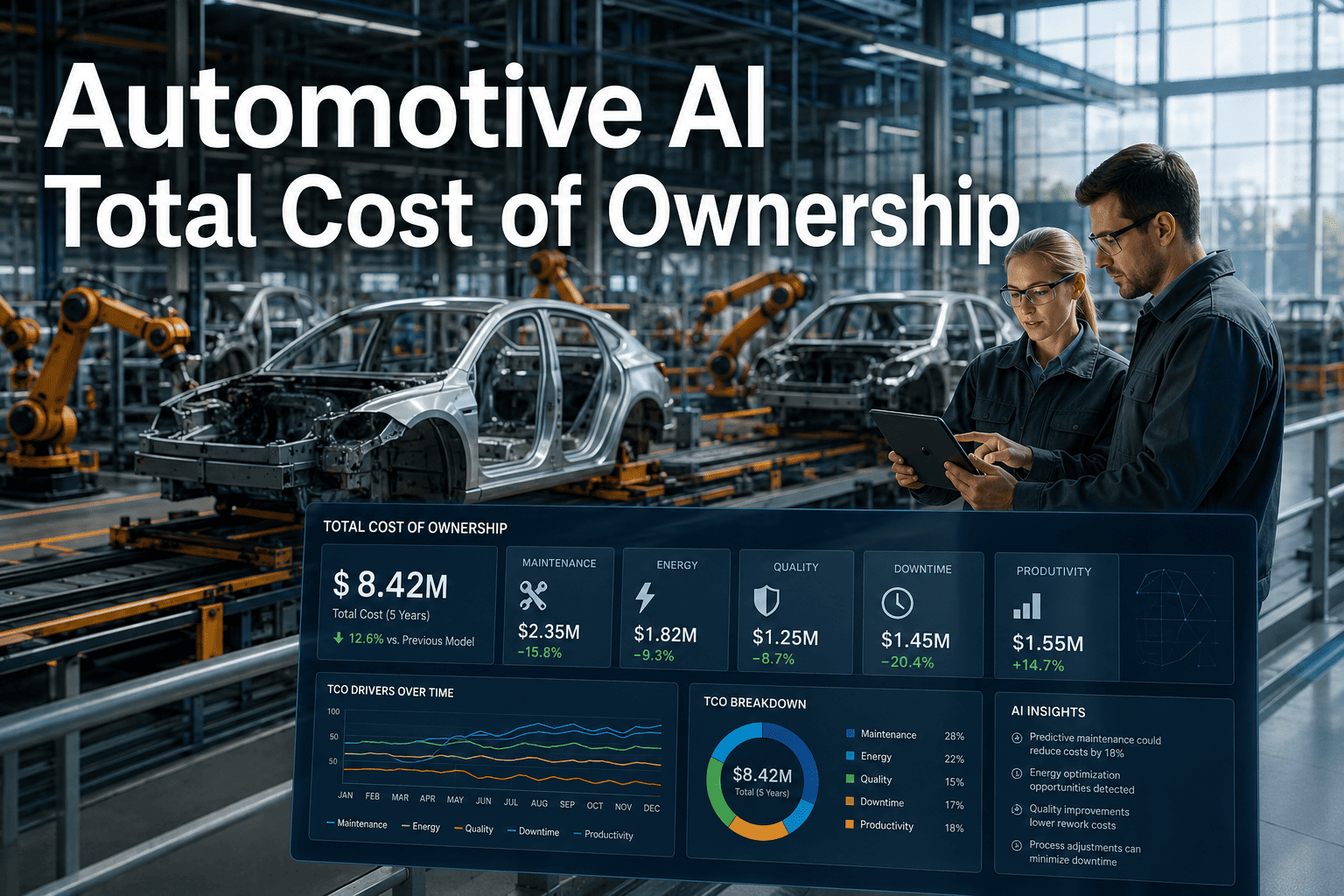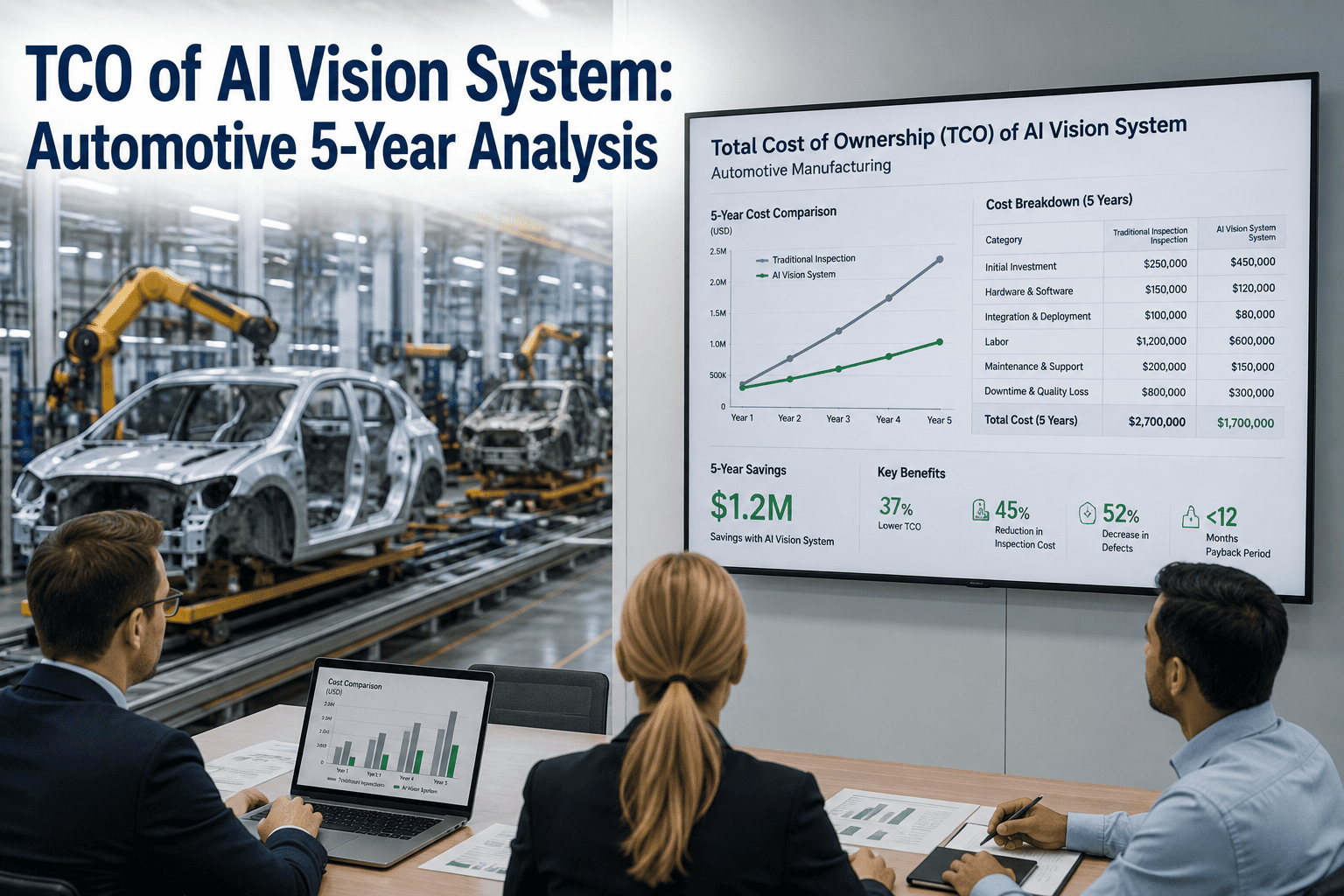
The purchase order for an AI vision system rarely reflects what the system actually costs a plant over its working life. Hardware and software licensing are the numbers that get quoted in a sales conversation, but integration labor, ongoing maintenance, and periodic retraining as products and defect types change are the numbers that determine whether the investment stays affordable five years in. iFactory's deployment planning team builds five-year total cost of ownership models with automotive manufacturers before a single camera goes on the line, precisely because the sticker price is rarely where the real cost lives.
The Quote Covers Year One. Four More Years of Cost Are Still Coming.
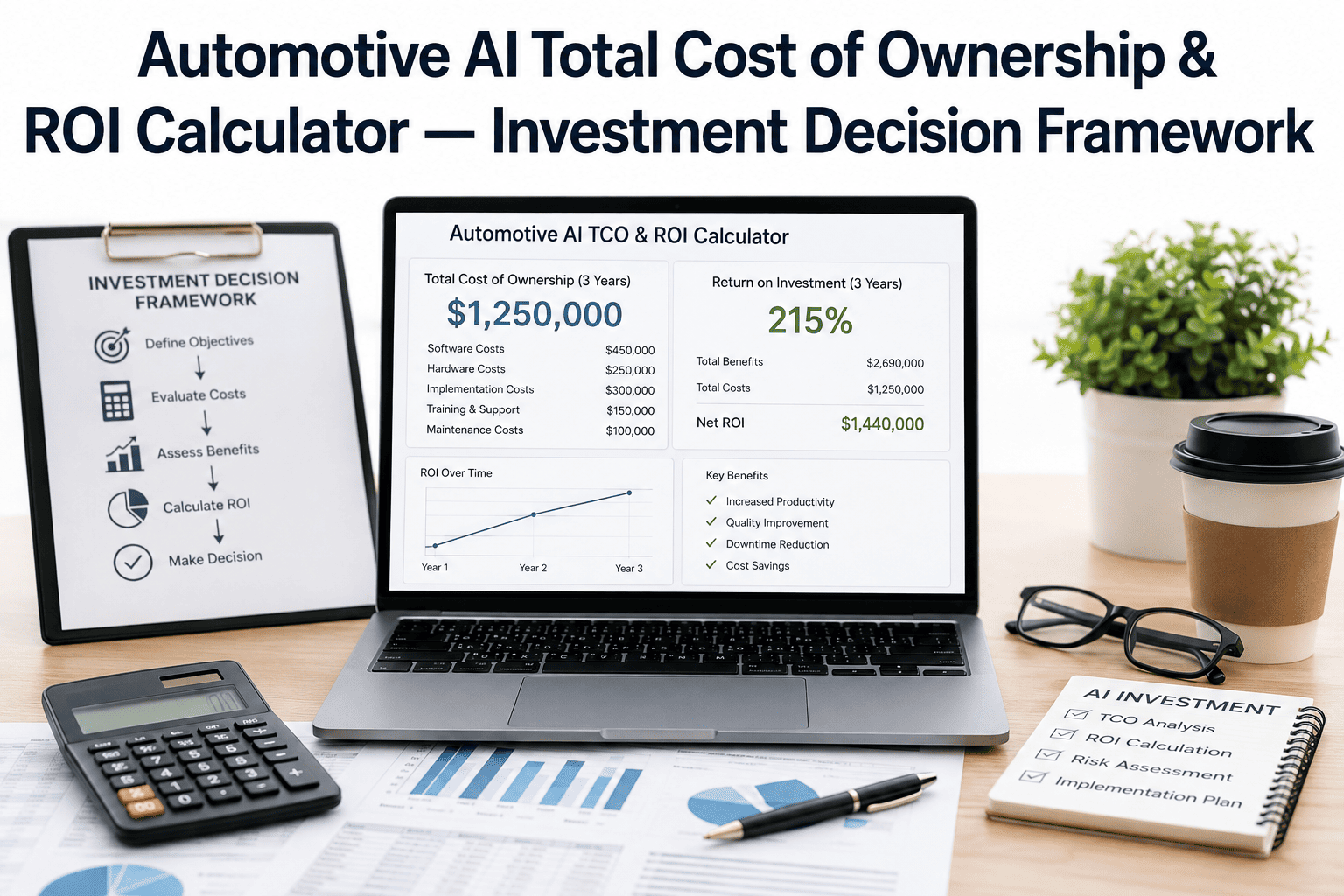
A realistic total cost of ownership model spans hardware, software, integration, maintenance, and retraining across the system's full working life — not just the capital line item that gets approved at kickoff.
The Five Cost Categories a TCO Model Needs
Most vision system proposals lead with hardware and software cost because those are the easiest numbers to quote up front. A complete five-year model needs three more categories that rarely appear on the initial proposal but consistently show up on the invoice — and skipping them is the single most common reason a plant's actual spend outpaces its original budget.
Hardware
Cameras, lighting, mounting fixtures, and edge compute — largely a one-time cost in year one, with a smaller recurring replacement cost as components reach end of life.
Software Licensing
Platform and model licensing, typically structured as an annual or per-station recurring fee rather than a one-time purchase, which needs to be modeled across the full five years.
Integration Labor
Engineering time to connect the vision system to line controls, MES, and existing quality workflows — frequently underestimated because it's treated as a project cost rather than budgeted separately.
Maintenance & Retraining
Ongoing calibration, lighting adjustment, and model retraining whenever a product changes or a new defect type appears — the category most often missing entirely from year-one budgets.
Where Automotive Plants Underbudget Most Often
Integration labor and retraining are the two categories that most consistently exceed initial estimates, for related reasons. Integration labor is underestimated because it's easy to price the vision hardware and software but hard to anticipate how many engineering hours a specific line's existing controls architecture will actually require to connect cleanly. Retraining is underestimated because plants tend to budget for the system as it exists at go-live, without planning for the fact that automotive products change — a facelift, a new trim option, or a supplier material change can all require a model retraining cycle that wasn't in the original scope.
| Cost Category | Typically Quoted Upfront | Actual 5-Year Pattern |
|---|---|---|
| Hardware | Yes, in initial proposal | One-time in Year 1, minor replacement thereafter |
| Software Licensing | Yes, as annual fee | Recurring every year, often per-station |
| Integration Labor | Partially, often underscoped | Concentrated in Year 1, spikes with line changes |
| Maintenance | Rarely itemized separately | Steady recurring cost from Year 1 onward |
| Retraining | Almost never included | Recurs whenever product or defect patterns shift |
The pattern that emerges across a realistic five-year model isn't a flat annual cost — it's a heavier year one driven by hardware and integration, followed by lower but steady years two and three, and then a bump in years four and five as hardware components reach replacement age and product changes trigger retraining cycles. A model that assumes flat annual spend across all five years is usually wrong in both directions: too high in the middle years, too low at the edges.
Get a Five-Year Cost Model Before You Commit Capital
iFactory builds a full TCO projection across hardware, software, integration, maintenance, and retraining for your specific line, so budget approval reflects the real five-year picture.
Buy vs. Subscribe: How Licensing Structure Changes the Curve
Vision systems are typically sold under one of two commercial models, and the choice materially changes the shape of the five-year cost curve even when the total five-year spend ends up similar.
Building the Model: A Step-by-Step Approach
Price hardware and software separately for each year
Don't blend hardware and software into a single figure — they behave differently over five years and need to be tracked as separate line items.
Estimate integration labor against your specific line
Get a scoped estimate against your actual controls architecture and existing MES integration, not a generic per-station average from the vendor's standard proposal.
Budget maintenance as a recurring line from year one
Calibration, lighting upkeep, and routine servicing start immediately at deployment and should be modeled every year, not just after a warranty period ends.
Plan for at least one retraining cycle per product change
Map your product roadmap against the five-year window and budget a retraining cycle for each anticipated facelift, trim change, or material substitution.
Compare total five-year cost against the ROI case
Weigh the full five-year TCO against the quality and productivity savings the system is expected to generate, rather than comparing only the year-one purchase price.
A Composite Scenario: The Budget That Ran Out in Year Three
A stamping plant deployed an AI vision system for surface defect detection with a budget built entirely around the vendor's initial hardware and software quote, approved as a capital project with no separate operating line for maintenance or retraining. The system performed well through its first eighteen months, catching defects the previous manual process had missed consistently.
In year three, the plant's OEM customer introduced a design change to the stamped panel, altering its surface geometry enough that the existing detection model's accuracy dropped noticeably. Retraining the model required a scoped engineering engagement that hadn't been budgeted anywhere, because the original TCO model had stopped at year one. The plant absorbed the retraining cost as an unplanned expense, and the delay in approving that unplanned spend meant several weeks of reduced detection accuracy before the model was corrected. The plant's subsequent budgeting cycle for its next vision deployment built in a dedicated retraining reserve tied to the OEM's known product change cadence, closing the exact gap that had caught them off guard the first time.
Model the Full Five Years Before You Sign
iFactory helps automotive plants build a realistic total cost of ownership projection that accounts for integration, maintenance, and retraining — not just the year-one quote.
Frequently Asked Questions
What percentage of five-year vision system cost is typically hardware?
Hardware is usually the largest single component in year one, but across the full five-year window it typically settles to somewhere between a quarter and a third of total cost once software, integration, maintenance, and retraining are all accounted for properly. Visit support to get a category breakdown modeled against your own line.
How much should be budgeted for retraining over five years?
It depends heavily on your product change cadence — a line producing a stable product with infrequent design changes needs far less retraining budget than a line supporting frequent facelifts or multiple trim variants, so this figure should be mapped against your actual product roadmap rather than a flat industry percentage.
Is a subscription model cheaper than a capital purchase over five years?
Not necessarily — subscription models often have a lower upfront cost and easier approval path, but cumulative five-year spend can end up similar to or higher than a capital purchase, depending on what's bundled into the recurring fee. Book a demo to compare both structures against your specific deployment.
Why is integration labor so often underestimated in vendor quotes?
Vendor quotes are typically built around a standard or average integration scope, which doesn't account for how much a specific line's existing controls architecture, MES connections, or legacy systems will add to the engineering effort — a line with older or nonstandard infrastructure frequently requires more integration hours than the vendor's baseline estimate assumes.
How does TCO modeling connect to the ROI business case for a vision system?
A complete ROI case needs both sides of the equation — the total five-year cost from the TCO model and the projected quality or productivity savings — compared against each other, since a system that looks affordable on a year-one quote can look very different once integration, maintenance, and retraining are added across five years. Contact support to connect your TCO model to a full ROI projection.