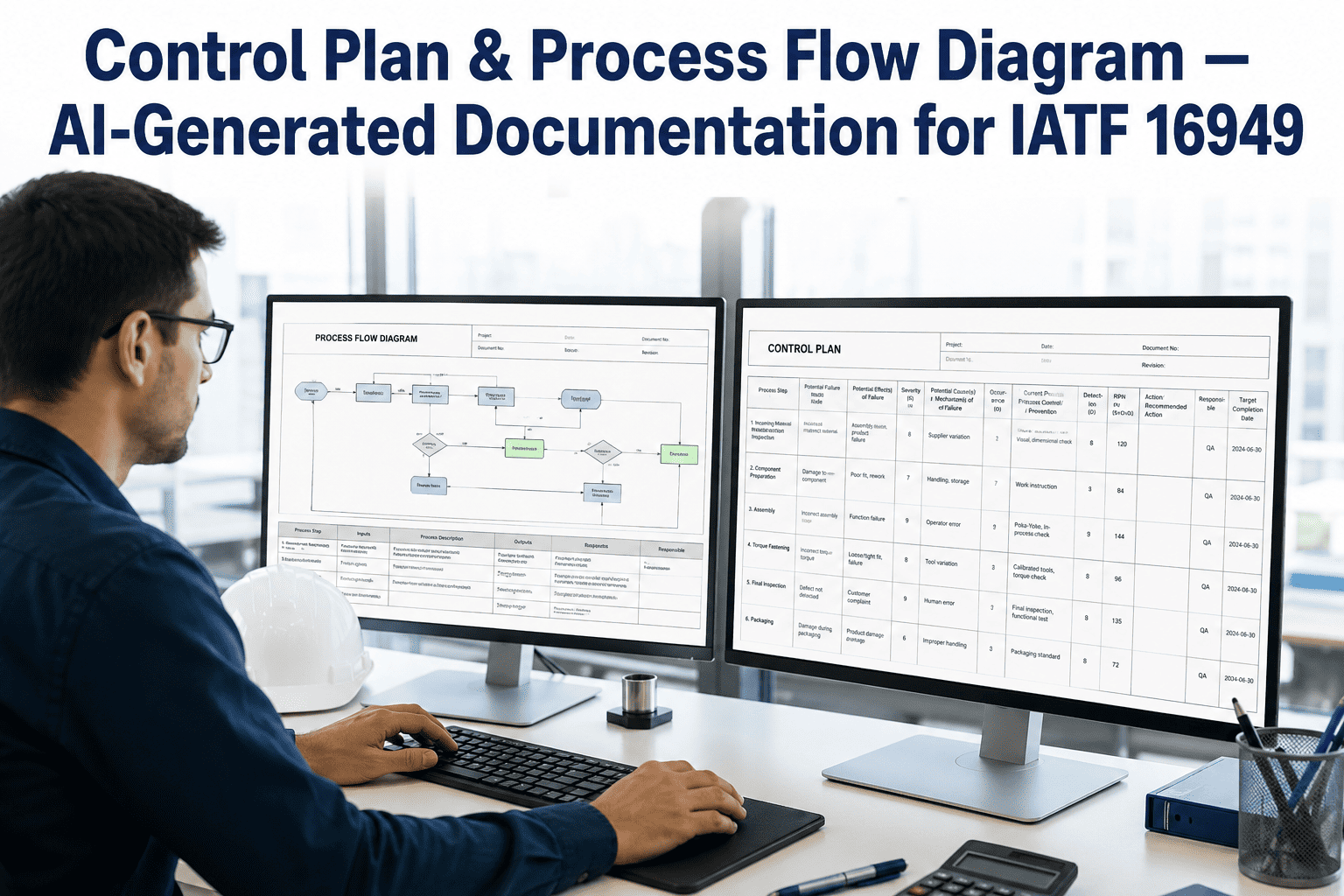
In the high-stakes world of automotive manufacturing, compliance with IATF 16949 is not just a regulatory checkbox—it is the backbone of operational excellence and supply chain trust. Control plans and process flow diagrams are the twin pillars of this standard, yet they are often managed as static, disconnected documents that quickly become obsolete. With the advent of AI-driven documentation, manufacturers can now generate and maintain these critical artifacts with unprecedented accuracy and efficiency. Our platform leverages advanced machine learning to automatically link control plan characteristics to PFMEA risk items, inspection methods, and reaction plans, creating a living documentation ecosystem that evolves with your processes. This eliminates manual rework, reduces audit preparation time, and ensures that every characteristic is traceable to its risk origin. For compliance officers and quality managers, this means a paradigm shift from reactive document control to proactive, intelligent compliance management. Book a Demo to see how AI transforms your documentation workflow.
Transform Your Compliance Documentation Today
Automate control plans and process flows with AI. Reduce audit prep time by 70%.
The Critical Role of Control Plans in IATF 16949
Control plans are the operational blueprints that define how product characteristics and process parameters are monitored and controlled to ensure conformity. Under IATF 16949 clause 8.5.1.1, control plans must be developed for all manufacturing processes, including subcontracted ones. They must address all phases of production, from raw material receipt to final inspection, and cover every critical and significant characteristic identified in the PFMEA. Traditional control plan creation is labor-intensive, requiring manual cross-referencing of PFMEA risk items, process flow steps, and customer-specific requirements. This often leads to inconsistencies, omissions, and a lack of traceability that can result in non-conformities during audits. AI-powered generation solves this by automatically parsing PFMEA data, extracting risk items, and mapping them to control methods, sample sizes, and reaction plans. The result is a control plan that is not only compliant but also dynamically linked to the risk assessment, ensuring that any change in risk triggers a corresponding update in the control strategy.
Process Flow Diagrams: The Foundation of Process Understanding
A process flow diagram (PFD) provides a visual representation of the sequence of operations, decision points, and material flows within a manufacturing process. It is the starting point for any quality planning activity and is required by IATF 16949 clause 8.3.3.2. The PFD must include all process steps, including incoming material inspection, storage, production, assembly, testing, and shipping. It must also identify key process parameters, product characteristics, and control points. Traditionally, creating a PFD involves manual drafting and multiple iterations to align with PFMEA and control plan data. This disjointed approach can lead to discrepancies between the diagram and actual process documentation. AI-driven PFD generation uses natural language processing to interpret process descriptions and automatically create a standardized diagram that is fully linked to the PFMEA and control plan. Any change in the process flow is automatically reflected in the risk assessment and control strategy, ensuring a single source of truth for all documentation.
AI-Powered Linking: From PFMEA to Control Plan to Reaction Plan
The true power of AI in automotive compliance lies in its ability to create seamless, bidirectional links between PFMEA, control plans, and reaction plans. In a traditional setup, a change in a PFMEA failure mode requires manual updates to the control plan and reaction plan, a process that is error-prone and time-consuming. Our AI engine automatically detects changes in risk assessments and propagates them across all linked documents. For example, if a failure mode's severity rating is increased, the AI can recommend tightening the control method or adding a new inspection point. The reaction plan is also updated to reflect the new risk level, specifying containment actions, responsible personnel, and escalation procedures. This dynamic linking ensures that documentation is always current and that audit trails are complete. Compliance officers can trust that every control plan characteristic has a direct lineage to a PFMEA risk item and a corresponding reaction plan, satisfying the most stringent IATF 16949 requirements.
Automated Risk Mapping
AI parses PFMEA data to automatically map failure modes to control plan characteristics, ensuring no risk is overlooked.
Dynamic Reaction Plans
Reaction plans are automatically generated and updated based on risk severity, with clear escalation paths and containment actions.
Real-Time Consistency
Any change in PFMEA triggers updates in control plans and process flows, maintaining a single source of truth.
Experience Living Documentation in Action
See how AI keeps your control plans and process flows perfectly aligned with PFMEA. Book a personalized demo now.
Inspection Methods and Sample Plans: AI-Optimized Quality Control
Selecting the right inspection method and sample size is critical for effective process control. IATF 16949 requires that control plans specify the inspection method, sample size, and frequency for each characteristic. Traditional approaches often rely on generic guidelines or historical practices, which may not be optimal for the specific process risk. AI can analyze historical inspection data, process capability indices, and PFMEA risk ratings to recommend the most effective inspection method—whether it be variable gaging, attribute inspection, or statistical process control. The sample size and frequency are dynamically adjusted based on real-time process performance, reducing waste while maintaining high detection capability. For example, if a process shows a Cpk greater than 1.67, the AI may recommend reducing the sample frequency, freeing up resources for higher-risk areas. This data-driven approach optimizes quality control, reduces inspection costs, and ensures compliance with customer-specific requirements.
| Characteristic Type | Inspection Method | Sample Size | Frequency |
|---|---|---|---|
| Critical Safety | Variable Gage (CMM) | 5 pieces | Every 30 minutes |
| Key Product | Attribute (Go/No-Go) | 10 pieces | Every hour |
| Process Parameter | SPC (X-bar R Chart) | 3 pieces | Every 2 hours |
| Visual Inspection | Manual (Training Required) | 100% | Continuous |
Reaction Plans: From Reactive to Proactive Escalation
A reaction plan defines the actions to be taken when a control limit is exceeded or a non-conformance is detected. Under IATF 16949 clause 8.5.1.1, reaction plans must be documented and include containment actions, root cause analysis, and corrective actions. Traditional reaction plans are often static and may not be tailored to the specific risk level of the characteristic. AI-driven reaction plans are dynamic, automatically adjusting based on the severity of the deviation and the history of the process. For example, a single out-of-control point on a critical safety characteristic may trigger an immediate line shutdown and a mandatory 100% inspection of the last 100 parts. In contrast, a minor deviation on a non-critical characteristic may trigger a simple adjustment and increased monitoring. The AI also learns from past incidents, improving the reaction plan over time to prevent recurrence. This proactive approach reduces downtime, minimizes scrap, and demonstrates a robust quality management system to auditors.
Deviation Detected
AI monitors control limits in real-time and alerts the operator when a characteristic exceeds its limit.
Automated Escalation
Based on risk severity, the system triggers an escalation to the appropriate team—operator, supervisor, or quality engineer.
Containment Action
The AI recommends specific containment actions, such as sorting suspect material or stopping production.
Root Cause Analysis
The system guides the team through a structured root cause analysis, linking to PFMEA failure modes for faster resolution.
Corrective Action & Closure
Corrective actions are documented and linked to the control plan, with effectiveness verified through ongoing monitoring.
Living Documentation: Auto-Updating with Every Process Change
The concept of living documentation is central to modern IATF 16949 compliance. It means that all quality documents—PFMEA, control plan, process flow diagram, and reaction plans—are automatically updated whenever a process change occurs. This eliminates the need for manual document reviews and ensures that the documentation always reflects the current state of the process. Our AI platform monitors process data, engineering changes, and customer requirements in real-time. When a change is detected, the system automatically updates the relevant documents and notifies the quality team. For example, if a new inspection method is implemented, the control plan is updated, the PFMEA is reviewed for new risks, and the reaction plan is adjusted accordingly. This level of automation ensures that compliance is maintained without burdening the quality team with administrative tasks. Auditors can see a complete, up-to-date trail of changes, demonstrating a robust change management system.
AI-Generated Templates: Starting with a Solid Foundation
Creating a control plan from scratch can be daunting, especially for new processes or products. AI-generated templates provide a solid starting point, populated with industry-standard controls and common failure modes. The AI analyzes the process description, product specifications, and customer requirements to generate a draft control plan that is tailored to the specific application. The compliance officer can then review and customize the plan, adding company-specific details or customer-specific requirements. This reduces the time to create a control plan from days to hours, while ensuring that no critical characteristic is missed. The templates are continuously updated based on best practices and feedback from thousands of implementations, making them smarter over time. For example, the AI might suggest a new inspection method based on the latest industry standards or recommend a sample size that aligns with the process capability index.
Compliance Dashboards: Real-Time Visibility into Documentation Health
Compliance officers need real-time visibility into the health of their documentation system. Our platform provides a comprehensive dashboard that shows the status of all control plans, process flows, and PFMEA links. The dashboard highlights any gaps, such as characteristics without a linked PFMEA risk, or control plans that have not been updated after a process change. It also tracks key performance indicators, such as the percentage of control plans that are up-to-date, the number of open reaction plans, and the average time to close a corrective action. This visibility enables proactive management of compliance, allowing quality teams to address issues before they become audit findings. The dashboard can be customized to show data at the plant, line, or process level, providing a holistic view of the quality management system.
Audit Readiness: Always Prepared for Customer and Third-Party Audits
One of the biggest challenges for compliance officers is preparing for audits, which often require days of gathering and reviewing documentation. With AI-driven living documentation, your system is always audit-ready. All documents are automatically version-controlled, with a complete audit trail of changes, approvals, and effective dates. During an audit, you can instantly pull up the current control plan for any process, along with its linked PFMEA and reaction plan. The system can also generate a compliance report that maps each IATF 16949 clause to the corresponding documentation, demonstrating full compliance. This not only reduces the stress of audit preparation but also impresses auditors with the robustness of your quality management system. For example, a major Tier 1 supplier reduced their audit preparation time from two weeks to two hours after implementing our platform.
Integration with Existing Systems: ERP, MES, and QMS
Our AI platform seamlessly integrates with your existing enterprise systems, including ERP, MES, and legacy QMS. This ensures that control plans and process flows are not isolated documents but are part of a connected digital thread. For example, when a new product is introduced in the ERP, the platform automatically generates a draft control plan and process flow based on the product specifications. Similarly, real-time data from the MES is used to update control plan statistics, such as Cpk and Ppk, and to trigger reaction plans when process deviations occur. This integration eliminates manual data entry, reduces errors, and ensures that all systems are synchronized. Compliance officers can trust that the documentation reflects the actual production environment, not a theoretical ideal.
ERP Integration
Automatically generate control plans from product BOMs and routing data in your ERP system.
MES Integration
Real-time process data updates control plan statistics and triggers automated reaction plans.
QMS Integration
Sync with your existing QMS for centralized document control and audit management.
Frequently Asked Questions
How does AI ensure that control plan characteristics are correctly linked to PFMEA risk items?
Our AI uses natural language processing and semantic matching to analyze the PFMEA data, identifying failure modes, causes, and effects. It then maps these to the corresponding control plan characteristics based on the product and process descriptions. The system also learns from user corrections and feedback, improving its accuracy over time. Each link is validated against IATF 16949 requirements and can be manually reviewed by the compliance officer. For example, if a PFMEA identifies a risk of porosity in a casting, the AI will automatically link it to a control plan characteristic for density or visual inspection. This ensures that every risk item has a corresponding control method, satisfying clause 8.5.1.1 of the standard. Contact support for more details on the mapping algorithm.
Can the AI generate process flow diagrams for complex assembly processes with multiple branches?
Yes, our AI is capable of generating process flow diagrams for even the most complex assembly processes, including those with multiple branches, decision points, and parallel operations. The system uses a graph-based algorithm that models the process as a directed acyclic graph, ensuring that all paths are logically consistent. It can handle up to 500 process steps per diagram, with automatic layout optimization for readability. The diagram is generated in a standardized format that can be exported to PDF, Visio, or directly integrated into your QMS. For example, an automotive seat assembly process with 200 steps and 15 decision points was successfully diagrammed in under 10 minutes. Book a Demo to see a live example of a complex process flow generation.
What happens when a process change is made? How does the system update the documentation?
When a process change is detected—either through an engineering change order, a sensor data anomaly, or a manual input—the AI system automatically triggers a review of all linked documentation. It first updates the process flow diagram to reflect the new sequence of operations. Then, it re-evaluates the PFMEA for any new or modified risks based on the change. Finally, it adjusts the control plan and reaction plans accordingly. The system generates a change log that documents every modification, including the reason for the change and the approval status. This ensures a complete audit trail that satisfies IATF 16949 requirements for change management. For example, if a new drilling operation is added, the AI will update the PFD, analyze the new risk of burrs, and add a corresponding inspection step to the control plan. Learn more about change management in our support documentation.
How does the AI handle customer-specific requirements (CSRs) in control plans?
Customer-specific requirements are a critical aspect of IATF 16949 compliance, and our AI is designed to handle them seamlessly. The system allows you to upload CSR documents, which are then parsed by the AI to extract specific requirements such as inspection methods, sample sizes, or documentation formats. These requirements are automatically incorporated into the control plan generation process, ensuring that the output meets the customer's expectations. The AI also flags any conflicts between CSRs and the standard control plan, allowing the compliance officer to make informed decisions. For example, if a customer requires a specific type of gage for a characteristic, the AI will prioritize that method over the default recommendation. Book a Demo to see how CSRs are integrated into the control plan.
What level of customization is available for the generated control plans and process flows?
Our platform offers extensive customization options to meet the unique needs of your organization. You can define custom templates, add company-specific fields, and modify the layout and branding of the documents. The AI learns from your customizations and applies them consistently across all new documents. For process flow diagrams, you can choose from multiple visual styles, including swimlanes, top-down, or left-to-right orientation. You can also add annotations, callouts, and custom symbols. The control plan can be customized to include additional columns for special characteristics, customer codes, or internal notes. All customizations are saved as part of your company profile, ensuring that every new document adheres to your standards. Contact support to discuss your specific customization requirements.
Ready to Revolutionize Your Compliance Process?
Join leading automotive suppliers who trust our AI to keep their documentation compliant and current. Book your demo today.