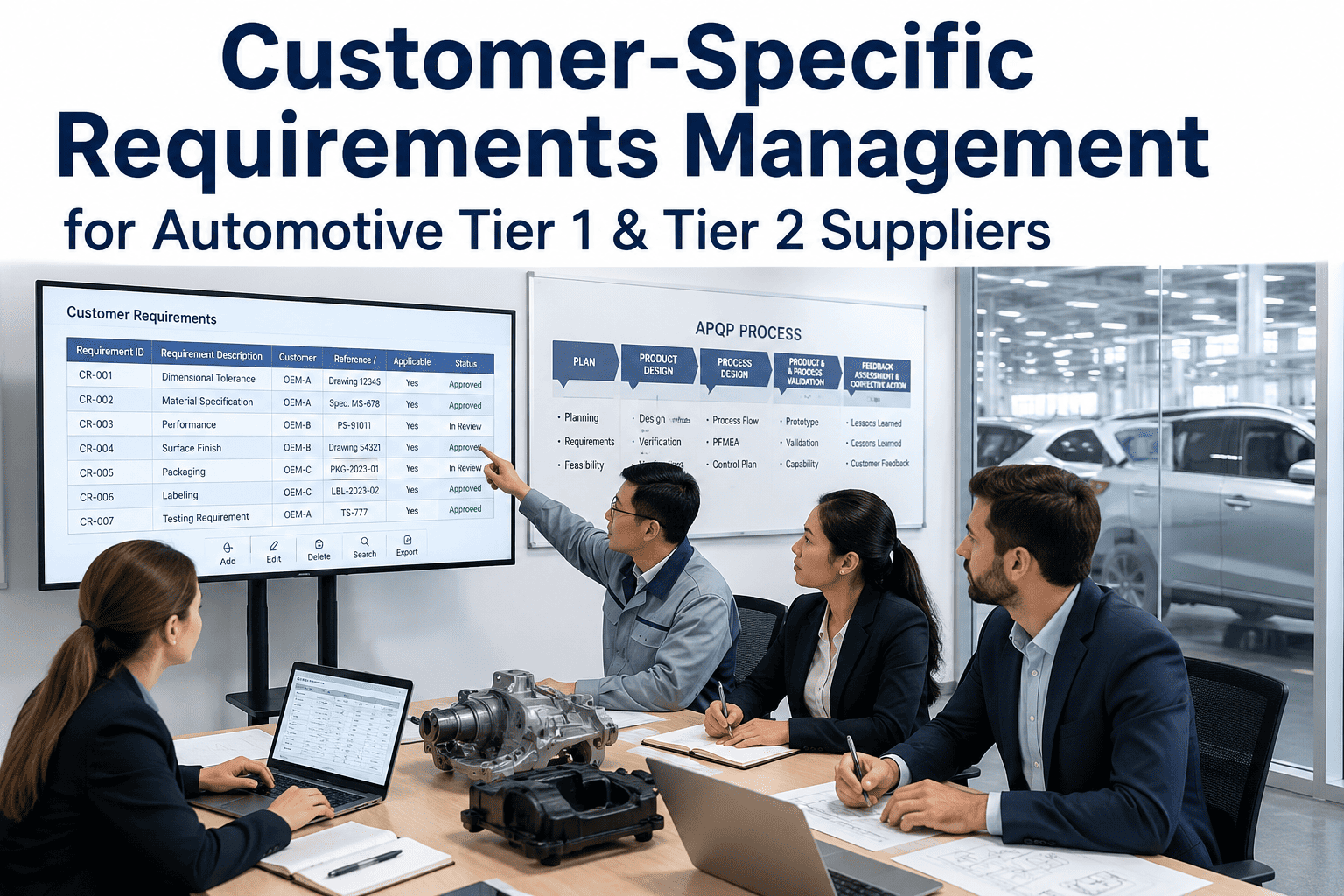
In the highly regulated automotive supply chain, compliance with Customer-Specific Requirements (CSRs) is a non-negotiable pillar of operational excellence. For Tier 1 and Tier 2 suppliers, each OEM—whether GM, Ford, Stellantis, Toyota, or VW—imposes a unique matrix of technical, quality, and documentation standards that extend far beyond the baseline IATF 16949 framework. Mismanagement of these requirements can lead to costly audit non-conformances, production delays, and even loss of contracts. Our AI-driven platform, iFactory, offers an intelligent CSR management system that automates the mapping, tracking, and verification of all OEM-specific mandates, ensuring your organization remains audit-ready at all times. Book a Demo to see how we can transform your compliance workflow.
Master Every OEM Requirement with Precision
Eliminate audit gaps and streamline compliance across GM, Ford, Stellantis, Toyota, and VW programs. Our AI automates CSR mapping, verification, and reporting.
The CSR Complexity Crisis in Automotive Supply Chains
Automotive suppliers face a labyrinth of overlapping, often contradictory, customer-specific requirements. Each OEM publishes its own set of CSRs, which can change with little notice, creating a dynamic compliance environment that manual tracking methods cannot handle. The consequences of non-compliance are severe: rejected shipments, line stoppages, and financial penalties. Our research indicates that over 60% of IATF 16949 audit non-conformances stem from improperly managed CSRs. This section dissects the core challenges suppliers must overcome.
Volatile Requirement Updates
OEMs like Ford and Stellantis update their CSRs quarterly, often without centralized notification. Suppliers must constantly monitor multiple portals and documents to stay current. A single missed update can render a production process non-compliant, leading to costly rework and potential loss of business.
Cross-OEM Inconsistencies
A requirement for PPAP documentation may differ between GM and Toyota. For example, GM's CSR AIAG-4 mandates specific submission levels, while Toyota's TS-001 requires additional traceability data. Harmonizing these differences manually is error-prone and resource-intensive.
Audit Evidence Gaps
During IATF 16949 audits, compliance officers must provide clear, traceable evidence that each CSR has been reviewed, implemented, and verified. Without a systematic CSR management tool, assembling this evidence becomes a frantic, last-minute scramble, often resulting in major non-conformances.
Supplier Cascade Complexity
Tier 1 suppliers must flow down relevant CSRs to their Tier 2 and Tier 3 partners. This cascade is rarely automated, leading to gaps in the supply chain. A non-compliant lower-tier supplier can jeopardize the entire production program.
AI-Powered CSR Mapping: The iFactory Advantage
iFactory's CSR management module leverages artificial intelligence to automate the entire lifecycle of customer-specific requirements. From ingestion to verification, our platform ensures that every OEM mandate is captured, understood, and implemented across your organization. Below, we detail the key capabilities that set iFactory apart.
Automated Requirement Ingestion
Our AI continuously monitors OEM portals (e.g., GM SupplyPower, Ford Supplier Portal, Stellantis eSupplier) and automatically extracts new or updated CSRs. The system parses PDFs, web pages, and spreadsheets, structuring requirements into a searchable, standardized format. This eliminates manual data entry and reduces the risk of oversight.
Intelligent Cross-Reference Engine
The platform compares each new CSR against your existing quality management system (QMS) documents, procedures, and work instructions. It identifies gaps, overlaps, and conflicts, providing a clear compliance score for each requirement. For example, if VW Formel Q requires a specific control plan layout, iFactory flags any deviation in your current documentation.
Real-Time Compliance Dashboard
A centralized dashboard displays the status of every active CSR across all OEM programs. Color-coded indicators show compliance levels, pending actions, and upcoming deadlines. Drill-down capabilities allow compliance officers to view evidence files, audit trails, and responsible parties for each requirement.
Automated Evidence Collection
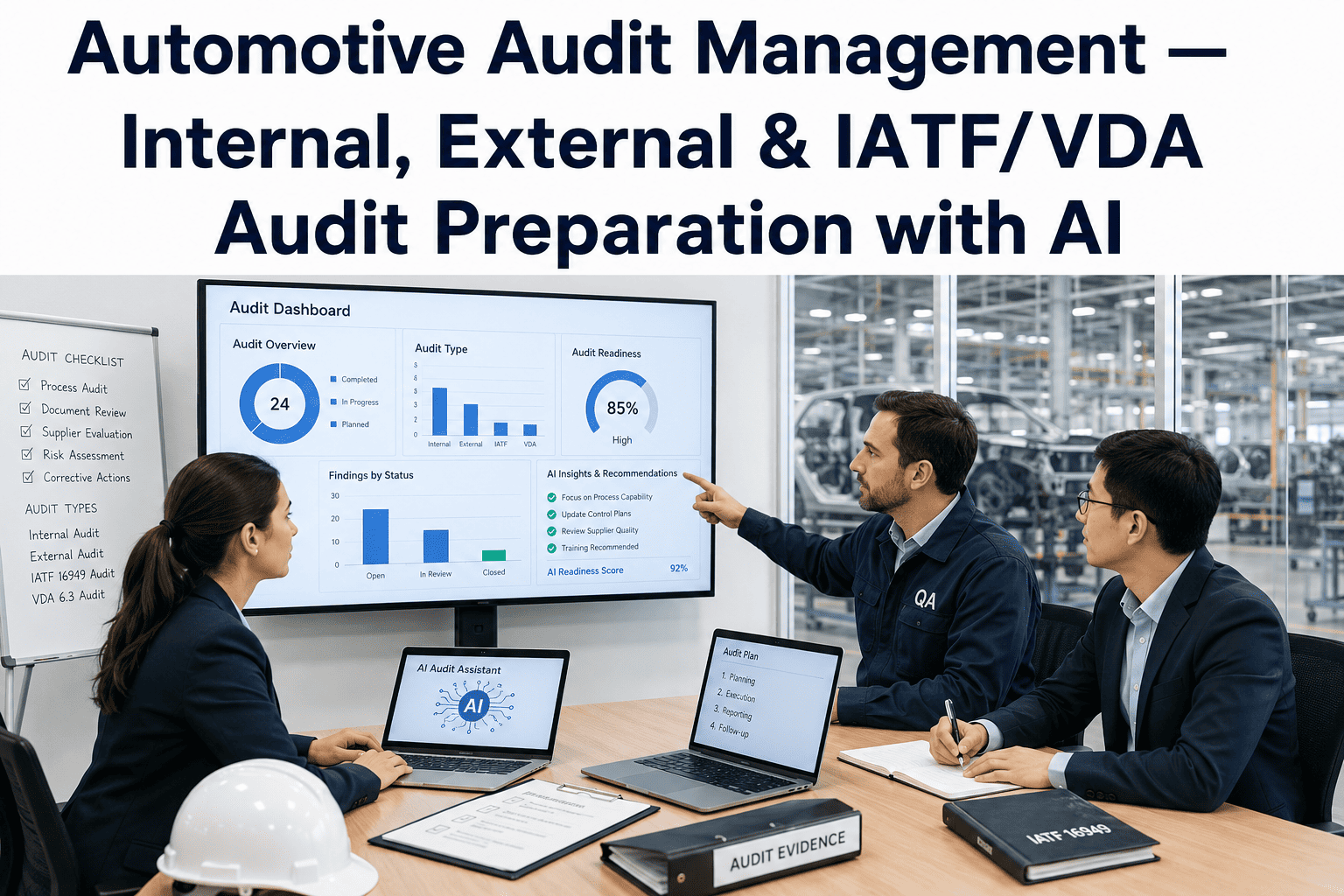
When an audit is scheduled, iFactory automatically compiles a comprehensive evidence package for each CSR. This includes linked QMS documents, training records, production data, and supplier certificates. The system generates an audit-ready report that satisfies IATF 16949 clause 7.5.3.2 requirements for documented information.
Manual vs. AI-Driven CSR Management
The table below quantifies the operational impact of adopting an automated CSR management system. Data is based on aggregated benchmarks from iFactory implementations across 15 automotive suppliers.
| Criteria | Manual Process | iFactory AI Platform |
|---|---|---|
| Requirement ingestion speed | 4-6 hours per update | Real-time |
| Cross-reference accuracy | ~75% | >99% |
| Audit preparation time | 2-3 weeks | 2-3 hours |
| Non-conformance rate (audits) | 15-20% | <3% |
| Supplier cascade completion | 60% | 95% |
| Compliance reporting frequency | Monthly | Continuous |
Achieve Zero-Defect Compliance
Stop chasing CSRs manually. Let AI handle the complexity. Your next IATF 16949 audit will be your smoothest yet.
Deep Dive: Key OEM CSR Programs
Understanding the specific nuances of each major OEM's CSR program is critical for targeted compliance. Below, we analyze the requirements from five key automotive manufacturers, highlighting the unique challenges and how iFactory addresses them.
General Motors (GM CSR)
GM's customer-specific requirements are documented in the GM CSR AIAG-4, which covers PPAP, control plans, and part approval. A key challenge is the dynamic nature of GM's Supplier Quality Requirements, which are updated biannually. iFactory's ingestion engine automatically pulls these updates and cross-references them with your existing PPAP submissions, flagging any gaps in documentation or testing. For example, GM mandates specific dimensional measurement protocols that must be followed exactly; our system verifies that your inspection plans align.
Ford Motor Company (Ford CSR)
Ford's CSR program is governed by the Ford Motor Company Customer-Specific Requirements document, which emphasizes process control and continuous improvement. Ford requires suppliers to implement a robust problem-solving methodology (e.g., 8D) and maintain specific metrics for OEE. iFactory maps these requirements to your production data, providing real-time dashboards that show compliance with Ford's key performance indicators. The platform also tracks Ford's specific audit scheduling requirements, ensuring you are never caught off guard.
Stellantis (Stellantis Requirements)
Stellantis, formed from the merger of FCA and PSA, has a complex set of CSRs that combine elements from both legacy companies. Their requirements often include specific testing protocols for emissions and safety systems. iFactory's AI analyzes the historical context of each requirement, identifying which legacy standard it originates from and ensuring that both FCA and PSA specific clauses are addressed. The platform also manages Stellantis's rigorous supplier self-assessment requirements, automating the submission process.
Toyota (Toyota Supplier Requirements)
Toyota's CSR program, known as the Toyota Production System (TPS) supplier requirements, focuses heavily on kaizen, waste reduction, and standardization. Their requirements include specific documentation for process flow, standard work, and JIT delivery. iFactory's compliance engine maps these TPS principles to your operational metrics, providing a visual representation of how well your processes align with Toyota's expectations. The platform also tracks Toyota's unique quality gate requirements for new model introductions.
Volkswagen (VW Formel Q)
VW's Formel Q (Formula Q) is one of the most comprehensive CSR programs in the industry, covering everything from supplier qualification to series production quality. It includes specific requirements for process audits (VDA 6.3) and product audits (VDA 6.5). iFactory's system integrates directly with VDA standards, automatically checking that your audit schedules and reports meet Formel Q specifications. The platform also manages VW's specific requirements for part traceability and batch documentation.
Implementing iFactory for CSR Management
Deploying our AI-powered CSR module is a structured process designed to minimize disruption and maximize value. The following steps outline the typical implementation roadmap.
Discovery & Requirement Mapping
Our team works with your compliance officers to catalog all active OEM CSRs, identify existing QMS documents, and map current workflows. This phase includes a gap analysis to highlight immediate compliance risks.
Platform Configuration
We configure the iFactory ingestion engine to monitor your specific OEM portals and document formats. Custom cross-reference rules are built to match your internal procedures and documentation structure.
Integration & Data Sync
The platform integrates with your existing ERP, QMS, and MES systems to pull real-time production and quality data. This ensures that compliance evidence is always current and accurate.
Training & Go-Live
We provide comprehensive training for your compliance team, including hands-on sessions with the dashboard, reporting tools, and audit preparation features. Post go-live, we offer 24/7 support to ensure smooth operation.
Frequently Asked Questions
How does iFactory handle CSR updates from OEMs that are not publicly available?
Our platform uses a combination of automated web scraping and manual verification for OEM portals that require authenticated access. For each client, we configure secure connections to their specific OEM portals (e.g., GM SupplyPower, Ford Supplier Portal). The AI monitors these portals for new document uploads or changes to existing requirements. In cases where an OEM issues a communication via email or a private network, our system can ingest those formats as well. For more details on supported integrations, visit our support page. We continuously expand our coverage to include all major automotive OEMs and regional variations.
Can iFactory map CSRs to specific IATF 16949 clauses for audit traceability?
Yes, this is a core feature. iFactory's intelligent cross-reference engine automatically links each CSR to the relevant IATF 16949 clauses. For example, a Ford CSR requiring specific control plan methodology is mapped to IATF 16949 clause 8.5.1.2. The platform maintains a dynamic library of these mappings, which are updated as standards evolve. During an audit, you can generate a report that shows, for each IATF clause, which CSRs are applicable and what evidence has been collected. This dramatically simplifies the audit process and ensures no requirement is overlooked. To see a demo of this mapping, book a demo today.
What if we have multiple plants, each with different OEM customers?
iFactory is designed for multi-site, multi-OEM environments. The platform allows you to create separate compliance profiles for each plant, each with its own set of applicable CSRs. A central dashboard provides a consolidated view across all sites, while drill-down filters let you focus on specific locations or OEM programs. The system automatically cascades relevant CSRs to each plant based on their customer portfolio. For instance, if Plant A supplies GM and Plant B supplies Toyota, the platform ensures that only GM CSRs are applied to Plant A and Toyota CSRs to Plant B. This eliminates confusion and ensures site-specific compliance. For a detailed walkthrough, contact our support team.
How does iFactory ensure data security for sensitive OEM requirements?
Data security is paramount. iFactory operates on a SOC 2 Type II compliant infrastructure with end-to-end encryption for all data at rest and in transit. Access to CSR data is role-based, ensuring that only authorized personnel can view or modify requirements. The platform also supports single sign-on (SSO) integration with your corporate identity management system. All OEM documents are stored in a secure, isolated environment with audit logging of every access event. We also offer on-premise deployment options for clients with strict data residency requirements. For more information on our security certifications, visit our support page.
Can iFactory generate reports for multiple OEM audits simultaneously?
Absolutely. The platform's reporting engine can generate consolidated audit evidence packages that cover multiple OEM programs in a single report. For example, if you are being audited by both GM and VW in the same quarter, iFactory can produce a combined evidence pack that shows compliance with both sets of CSRs, clearly indicating which evidence applies to which OEM. The report is structured to align with IATF 16949 audit checklists, making it easy for auditors to verify compliance. You can also schedule automatic report generation and distribution to key stakeholders. To see a sample report, book a demo.
Transform Your Compliance Operations
Join leading Tier 1 suppliers who have eliminated audit anxiety. Let iFactory automate your CSR management and ensure IATF 16949 success.