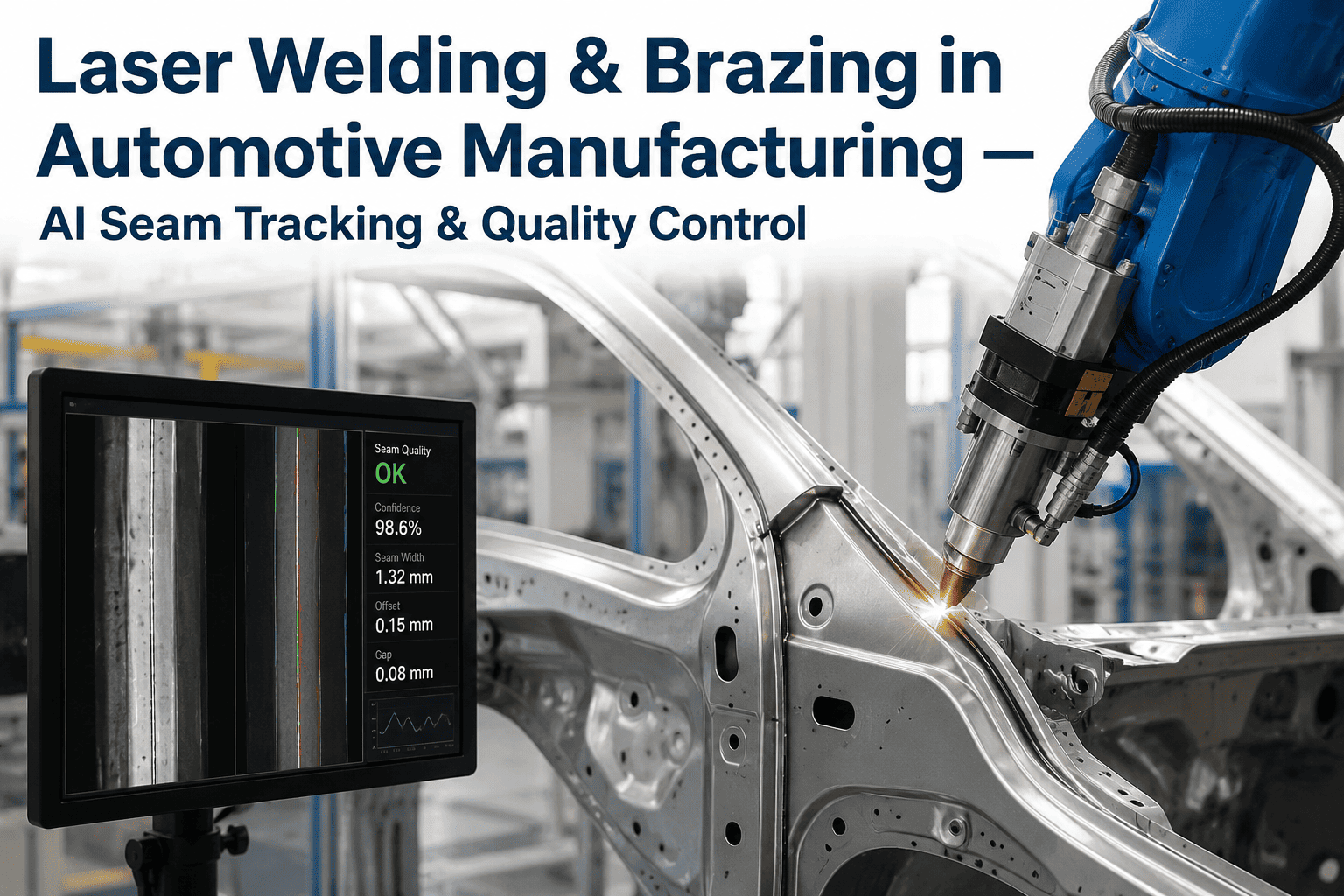
A remote laser welding cell running at full line speed lays down a roof-to-side-panel joint in well under two seconds, and inside that window the beam has to stay locked onto a seam that is moving, thermally distorting, and rarely presents the same fit-up twice in a row. Process engineers running laser welding and laser brazing on roof ditch joints, trunk lids, and structural body panels know that the gap between "the robot program says the seam is here" and "the seam is actually here" is where most weld defects are born. AI seam tracking closes that gap by reading the actual joint geometry in real time and adjusting beam position, focus, and power before a gap, offset, or penetration miss ever reaches the next station. Book a demo to see seam tracking running against live joint data from your own panel geometry.
AUTOMOTIVE BODY SHOP · LASER JOINING AI
Stop Chasing Seam Drift After the Weld Is Already Down
iFactory's AI tracks beam alignment, joint fit-up, and penetration depth in real time across laser welding and brazing stations, so corrections happen mid-weld instead of at teardown.
The Precision Problem
Why Laser Seams Are Harder to Hold Than Spot Welds Ever Were
Resistance spot welding forgives a certain amount of part variation because the two electrodes physically clamp the stack before current ever flows. Laser welding and laser brazing offer no such mechanical mercy. The beam has to find a joint that may have shifted from panel stamping variation, fixture wear, or upstream thermal distortion from an earlier weld pass, and it has to find it while moving at production line speed. A gap of even a few tenths of a millimeter beyond spec can mean incomplete fusion on a structural joint or a visible cosmetic flaw on a roof ditch seam that customers see every time they open the door.
This is precisely why remote laser welding cells, despite offering dramatic cycle time advantages over resistance spot welding, have historically demanded more process engineering attention per station than almost any other body shop operation. A programmed weld path assumes nominal part geometry, and nominal geometry is an increasingly rare thing to find on a high-mix production line running multiple body styles down the same station. Seam tracking exists to close that gap between the programmed path and the part that actually shows up.
Laser brazing adds a second layer of difficulty on top of seam location. Brazing depends on precise wire feed synchronization with beam travel speed to build a consistent, paintable bead — typically on visible joints like roof-to-side-panel seams where surface finish directly affects how a customer perceives build quality. Get the wire feed rate even slightly out of sync with a seam that has drifted off the programmed path, and the result is an uneven bead that requires manual rework before the panel can move to paint.
Where Seam Tracking Applies
The Joint Types Where AI Tracking Earns Its Place
Not every laser joint on a body-in-white needs the same level of real-time correction, but the joints where seam tracking delivers the clearest return share a common trait: tight tolerance stacked with high visibility or high structural consequence. Book a demo to walk through which of your specific joints would benefit most from continuous tracking.
Cosmetic
Roof Ditch Joint
A fully visible seam running the length of the roofline where bead consistency, gap control, and surface finish directly influence perceived vehicle quality at the showroom.
Cosmetic
Trunk Lid Seam
Requires tight gap tolerance to maintain panel flushness and consistent shut lines, where even minor beam drift shows up as a visible cosmetic defect after paint.
Structural
B-Pillar to Rocker Joint
A crash-relevant structural weld where penetration depth directly affects load path performance, making real-time penetration monitoring a safety-critical capability rather than a cosmetic convenience.
Structural
Underbody Reinforcement Welds
Hidden from view but structurally critical, these joints depend entirely on process data rather than visual inspection to confirm adequate fusion and penetration.
Brazing
Roof-to-Side-Panel Brazed Seam
Combines seam location accuracy with wire feed synchronization, since brazing quality depends on both beam alignment and consistent filler material deposition along the tracked path.
Structural
Door Ring Laser Welds
Increasingly common in unibody architectures, these joints tie major structural assemblies together and carry tight penetration and offset tolerances across long weld lengths.
Inside the Correction Loop
How Real-Time Seam Tracking Actually Works
Seam tracking is often described as a single capability, but it is really a closed loop running through three distinct functions in continuous sequence, each one feeding the next fast enough to correct beam position before the fusion zone reaches a problem area.
1
Joint Geometry Sensing
A leading sensor ahead of the beam continuously reads actual joint position, gap width, and edge offset, capturing the real geometry rather than the geometry assumed by the robot program.
2
Deviation Calculation
The model compares sensed joint position against the programmed path in real time, calculating exactly how far and in which direction the actual seam has drifted from nominal.
3
Beam Position Correction
Galvo mirrors or robot trajectory adjust beam position on the fly to follow the actual joint, keeping the fusion zone centered on the real seam rather than the theoretical one.
4
Penetration and Power Adjustment
Where gap width has changed, laser power and focus adjust in parallel to maintain target penetration depth, preventing the underfill or burn-through that a fixed power setting would produce.
5
Weld Quality Logging
Every correction, deviation, and penetration estimate is logged against the specific part serial number, building a traceable quality record without requiring a separate offline inspection step.
Weld vs Braze
Laser Welding and Laser Brazing — Where Tracking Priorities Differ
Laser welding and laser brazing share the same fundamental need for accurate seam location, but the process variables that matter most downstream of that tracking diverge in ways that matter to how a monitoring system should be tuned for each application.
Process Comparison — What Real-Time Tracking Prioritizes
Measurable Impact
What Changes on the Line Once Tracking Goes Live
The value of real-time seam tracking shows up in a few specific, measurable places rather than as a vague quality improvement. Book a demo to see these figures modeled against your own current defect and rework data.
45%
Typical reduction in weld defects caught at inline inspection versus fixed-path programs
2 sec
Approximate correction window available per joint on a full-speed remote welding cell
100%
Of welded parts carry a traceable quality record instead of a spot-check sample
30%
Common reduction in manual rework hours on cosmetic brazed seams
Getting Started
Rolling Out Seam Tracking Without Stopping the Line
Process engineers evaluating seam tracking are usually less concerned with whether the technology works and more concerned with how disruptive the rollout will be to a station that is already running production. The honest answer is that integration effort depends heavily on what sensing hardware, if any, is already present on the welding head, and how much historical weld data exists to calibrate deviation thresholds against.
1
Sensor Compatibility Assessment
Evaluate whether existing laser heads support a leading vision or optical triangulation sensor, or whether a retrofit sensor package is needed before tracking can begin.
2
Joint-Specific Calibration
Calibrate deviation thresholds and correction limits separately for each joint type, since a roof ditch seam and a structural rocker joint tolerate different magnitudes of correction.
3
Shadow Mode Validation
Run tracking in observation mode alongside the existing fixed-path program first, comparing recommended corrections against actual weld outcomes before enabling live correction.
4
Live Correction and Traceability Rollout
Enable real-time correction on the highest-value joints first, connecting weld quality logs to your existing MES for full part-level traceability.
A Shift on the Line
What a Seam Drift Actually Looks Like at 6:40 on a Tuesday Morning
SCENE
The night shift changeover on a mixed-model roof line has just finished. A fresh coil of side panel stock came off a different supplier lot than the batch run overnight, and the first fifteen bodies of the morning show a roof ditch seam that sits fractions of a millimeter narrower than the seam that ran an hour earlier. On a fixed-path program, nobody notices until the parts reach visual inspection three stations later, and by then there are close to forty panels in the queue that may need rework. With seam tracking active, the leading sensor reads the actual joint width on body four, the deviation calculation flags a trend rather than a one-off blip, and the beam power adjusts automatically to hold penetration steady against the new material batch — the kind of correction that happens without anyone in the body shop ever knowing a supplier lot changed.
This is the ordinary, unglamorous version of what seam tracking is for. It's rarely a single dramatic save — it's dozens of small, automatic corrections across a shift that never become a visible defect, a rework ticket, or a conversation with a supplier about a lot change nobody flagged in advance.
Common Misconceptions
Seam Tracking — What It Is, and What It Isn't
Misconception
Seam tracking is only useful for correcting robot programming errors.
Reality
Most of the deviation it corrects for comes from part-to-part material and fixture variation that no robot program, however well written, can anticipate in advance.
Misconception
Adding tracking will slow the weld cycle down.
Reality
Correction happens within the existing beam travel window; the sensor reads ahead of the fusion point rather than pausing the process to inspect after the fact.
Misconception
Once a line is running well, tracking data has no further use.
Reality
Logged deviation trends become one of the earliest warning signs of upstream stamping die wear or fixture drift, often well before those issues show up anywhere else.
SEE YOUR JOINT DATA IN ACTION
Model Seam Tracking Against Your Own Body Shop Layout
We'll walk through which stations on your line stand to gain the most from real-time beam correction and traceable weld quality logging.
Frequently Asked Questions
Laser Welding and Brazing Seam Tracking — FAQs
Does seam tracking require replacing our existing laser welding heads?
Not usually. Most remote laser welding heads already accommodate an add-on sensor package for joint geometry sensing without requiring a full head replacement. Compatibility depends on your specific laser system and mounting configuration, which is exactly the kind of detail worth reviewing before committing to a rollout plan.
How does tracking handle laser brazing's wire feed requirement differently from welding?
Brazing tracking correlates seam position corrections with wire feed rate in real time, since a corrected beam path without a matching wire feed adjustment produces an inconsistent bead. Welding tracking, by contrast, focuses correction primarily on beam power and penetration rather than a filler material feed rate.
Book a demo to see both correction modes side by side.
Can this run on a mixed-model line with multiple body styles at the same station?
Yes. Since the system tracks actual joint geometry rather than relying purely on a fixed programmed path, it adapts to part-to-part variation across different body styles run through the same station, which is one of the main reasons high-mix lines see the strongest return on real-time tracking.
What happens when a joint deviates beyond the correction system's limits?
When deviation exceeds the calibrated correction range, the system flags the part rather than attempting a correction that would risk producing an out-of-spec weld, routing that specific part for manual review instead of allowing a marginal weld to pass through undetected to the next station.
How long does a typical body shop take to get from shadow mode to live correction?
Most body shops move from initial sensor calibration through shadow mode validation to live correction within four to eight weeks per station, depending on how many joint types are being tracked and how much historical weld data is available to calibrate thresholds against.
AUTOMOTIVE BODY SHOP · LASER JOINING AI
Give Every Laser Joint the Same Precision, Part After Part
iFactory's AI seam tracking keeps laser welding and brazing locked onto the actual joint in real time, with full traceability built into every weld.


.png)