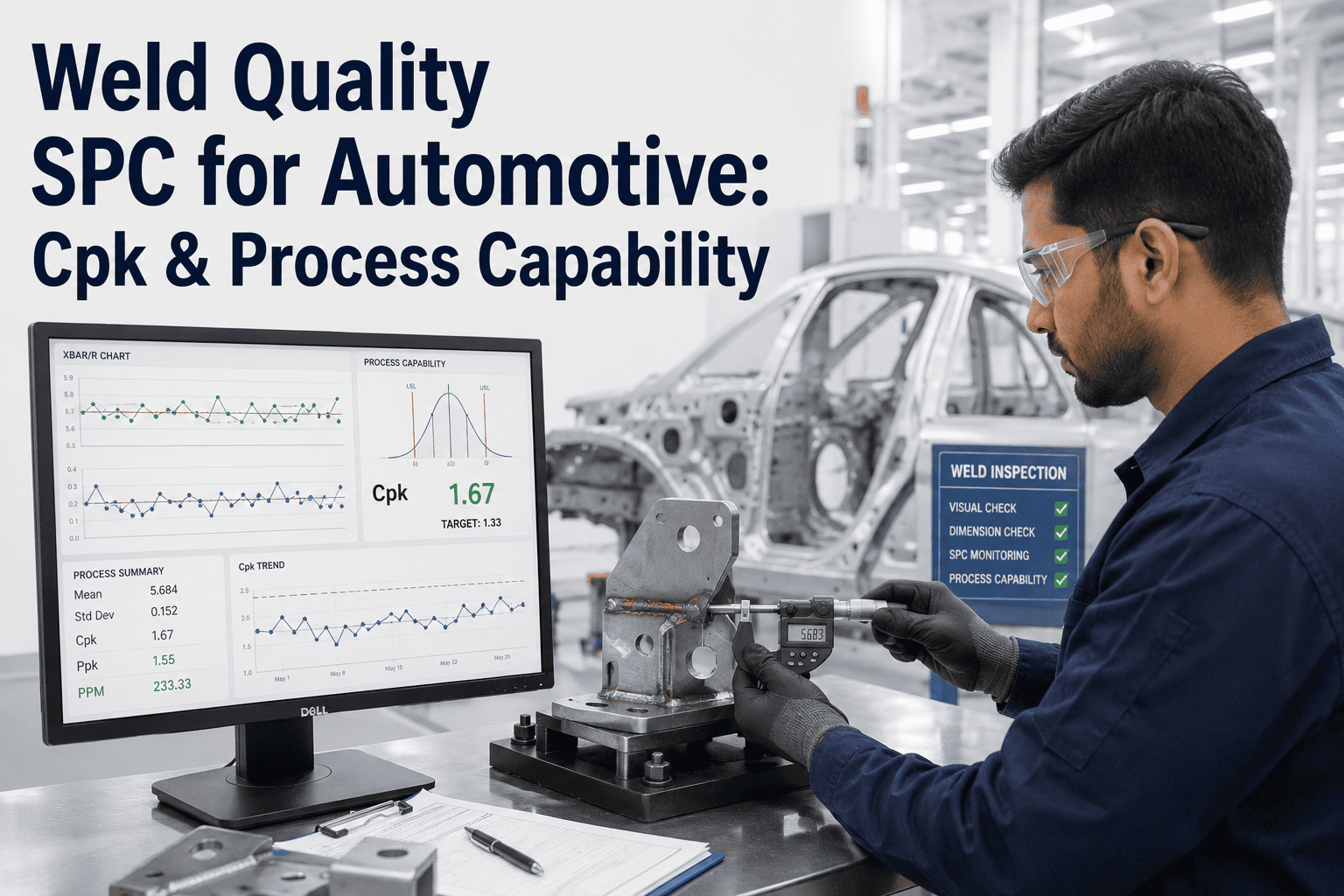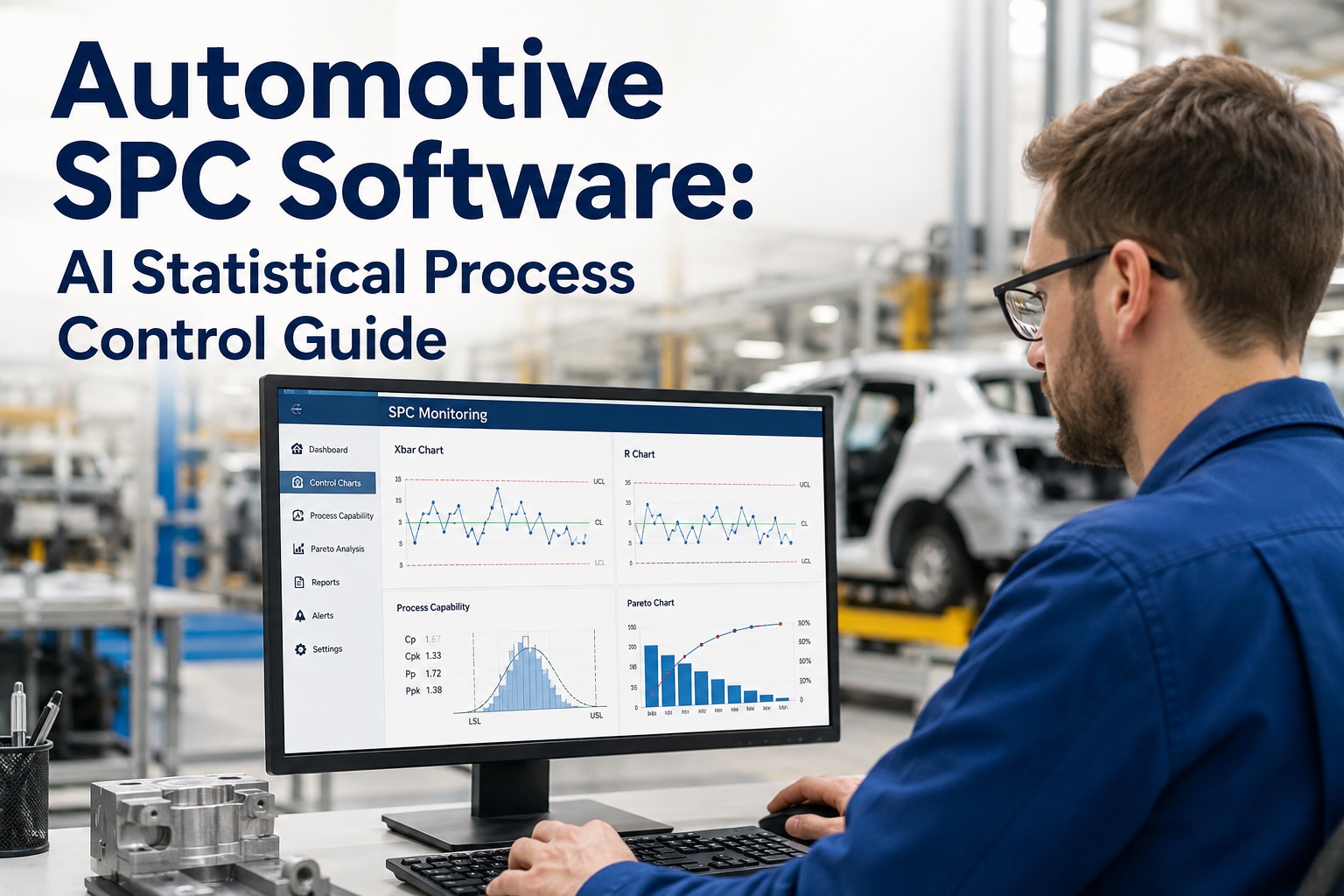
Here is the uncomfortable math most automotive plants run on: a process sitting at Cpk 0.9 is mathematically producing 2,700 defective parts per million — even while 97.3% of units sail through inspection. Inspection asks "is this part good?" SPC asks the only question that scales: "is the process making good parts stable and capable?" The trouble is that most plants still run SPC the 1931 way — manual sampling that grabs 5–10 readings an hour from a line making thousands of parts, so by the time a control chart signals out-of-control, hundreds of bad parts already exist. This guide covers how modern automotive SPC software works, why AI-native SPC catches drift before defects, the Cpk-to-ppm reality every quality engineer should have memorized, and how iFactory replaces legacy SAP MII and SAP PCo data plumbing with continuous, on-premise AI monitoring.
Automotive SPC Software: The AI Statistical Process Control Guide
Real-time control charts, continuous Cp/Cpk tracking, Western Electric & Nelson rules, and AI alerts that catch process drift before a single out-of-spec part reaches your customer. IATF 16949 audit-ready, on-premise so your data stays in the plant — a modern alternative to SAP MII and SAP PCo. Live in 6–12 weeks.
Inspection vs SPC — Why Only One Scales
This is the distinction that separates plants running SPC well from plants running it badly. Inspection is a verdict on a finished part. SPC is a verdict on the process that made it. A plant can post 99% inspection pass rates and still be running at Cpk 0.9 — quietly shipping 2,700 ppm defective because inspection samples can't catch every drift. SPC monitors the process itself, so drift is caught before the defective parts exist rather than after they're already in a customer's bin.
"Is this part good or bad?"
- Checks finished parts, after the fact
- Samples miss between-check drift
- 99% pass rate can still hide 2,700 ppm
- Cost rises with every part inspected
"Is the process stable and capable?"
- Monitors the process, not just output
- Catches drift before defects exist
- Cpk quantifies true capability in ppm
- Scales with volume — the only one that does
The Cpk Ladder: What Capability Actually Costs in PPM
Every quality engineer should have this table memorized. Cpk isn't an abstract score — it maps directly to defective parts per million, straight from the statistical tables. Moving a process from Cpk 1.0 to 1.67 cuts defect rates roughly 4,500-fold. This is why automotive and aerospace customers demand Cpk ≥ 1.67, and why "good enough" capability quietly bleeds money.
Want to see your real Cpk drift live, sample by sample? Book a 30-minute demo and iFactory's quality engineers will show continuous rolling Cpk on your own process data — and where you're losing capability today. Sessions available this week.
The Manual-Sampling Gap — and How AI Closes It
The reason most SPC programs underperform isn't the statistics — Shewhart's math has held for 95 years. It's the sampling cadence. Manual SPC grabs a handful of readings per hour while the line produces thousands of parts. Everything between checks is invisible, so an out-of-control signal arrives only after the damage is done. AI-native SPC updates control charts continuously from sensor data, detecting drift before it crosses a limit.
The manual program catches the drift only at the breach — after hundreds of out-of-spec parts. Continuous AI monitoring sees the same drift signature while the process is still in-spec, alerts within seconds, and lets the operator correct before a single defect is produced. That's the mechanism behind 68% fewer out-of-control events and 2–8 week failure prediction.
What Modern Automotive SPC Software Includes
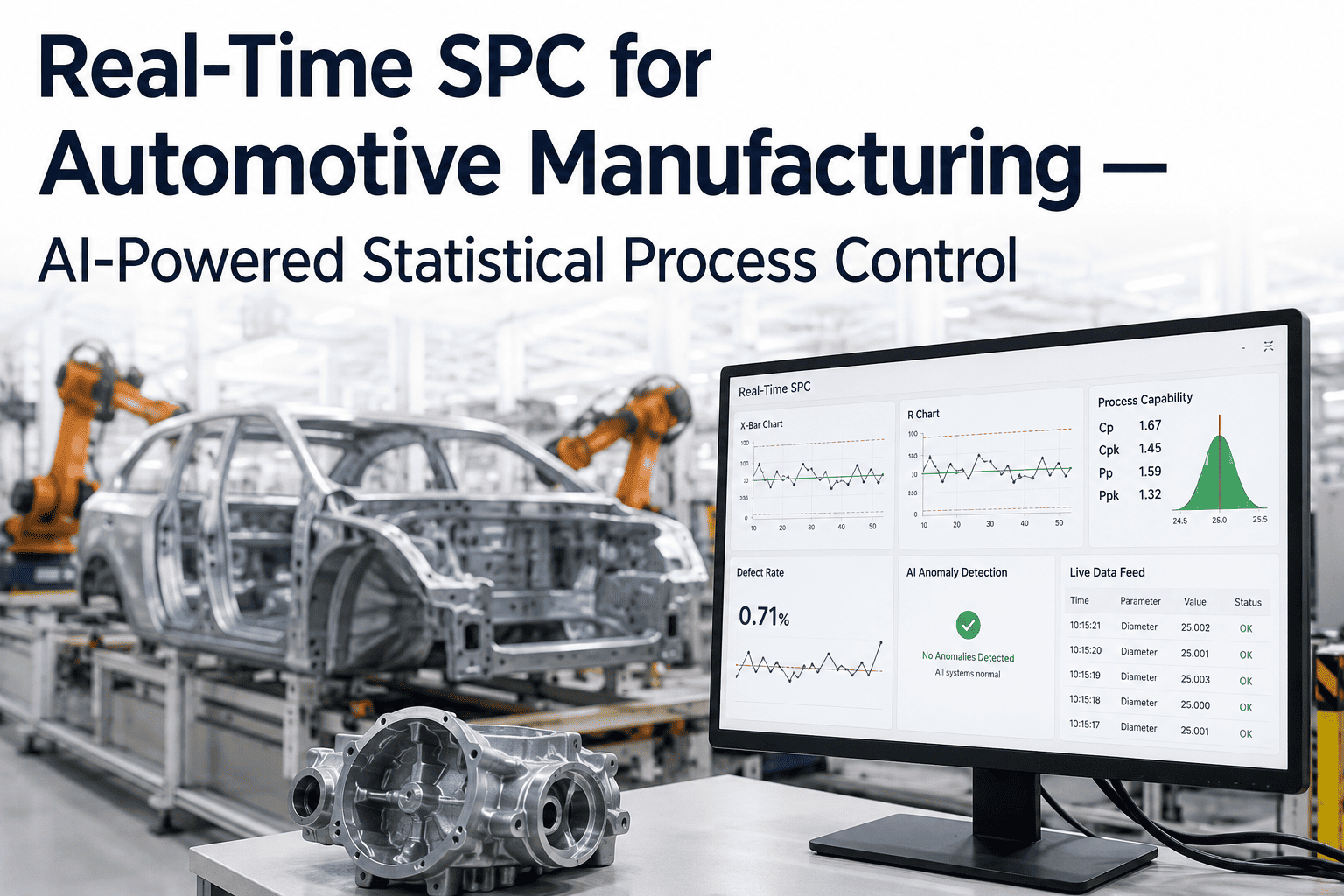
Live control charts
X̄–R, X̄–S, I-MR and more, updating in real time from sensor and gauge data instead of scheduled studies.
Rolling Cp/Cpk & Pp/Ppk
Capability indices trended sample-by-sample so you see drift live — Cp, Cpk, Pp, Ppk, Cpm, PPM, DPMO.
Rule-set detection
Automatic Western Electric, Nelson, and Wheeler rule violations flagged the moment they occur.
AI drift prediction
ML on historical SPC plus equipment, material, and environment signals predicts failures 2–8 weeks out.
IATF audit packs
Signed Cpk studies, documented OOC response actions, version-controlled limits — audit-ready by default.
Shop-floor integration
OPC-UA, Modbus, MQTT to CNCs, PLCs, CMMs (Zeiss, Hexagon, Mitutoyo) and digital gauges; SAP/Oracle sync.
Not sure which charts and capability indices your OEM customers require? Ask iFactory Support with your part families and customer-specific requirements, and the team will map the exact SPC and PPAP outputs you need — typically a response within 3 business days.
Replacing SAP MII and SAP PCo Plumbing
In many automotive plants, the SPC pipeline runs through SAP PCo collecting OPC tags and SAP MII processing them into charts. With MII maintenance winding down and PCo acting purely as middleware, that stack is increasingly legacy plumbing — designed to move tags, not to predict. iFactory connects to the same data sources directly and adds the intelligence layer SAP never had, so you keep your equipment investment while upgrading from data transport to predictive quality.
- Middleware moves tags, adds no intelligence
- Fixed-limit charts, reactive alarms
- MII maintenance winding down
- Capability studies run on a schedule
- Direct OPC-UA / Modbus / MQTT connection
- Adaptive limits, drift predicted ahead
- On-premise, air-gap capable, your data stays put
- Rolling Cpk continuous, not scheduled
On-Premise or Cloud — Same SPC Engine
For automotive, on-premise is the default: process data carries IP and OEM-confidential detail, and edge inference keeps pace with line speed. Cloud is available for multi-plant capability benchmarking, with identical SPC intelligence either way.
iFactory On-Premise Appliance The automotive default — data sovereignty + speed
- Pre-configured NVIDIA AI server — racked, loaded, ready.
- Continuous edge monitoring — keeps pace with line speed.
- Air-gap capable — process data never leaves the plant.
- Runs through WAN outages — SPC never goes dark.
iFactory Cloud For multi-plant capability benchmarking
- Fully managed — no on-site hardware to maintain.
- Same SPC engine — rolling Cpk, rules, AI prediction.
- Cross-plant Cpk benchmarking — compare capability site to site.
- Fastest start — first plant live in 2–4 weeks.
Wondering whether on-premise, cloud, or hybrid fits your data-residency and OEM-audit needs? Schedule a demo — bring your constraints and iFactory will recommend a deployment model live, including the rack, power, and network you'd need for the on-premise appliance. Slots open this week.
99% pass rates can still hide 2,700 ppm. SPC is how you see it.
Inspection grades parts; SPC grades the process that makes them — and only AI-native, continuous SPC catches drift before defects exist. iFactory delivers real-time control charts, rolling Cpk, rule detection, and 2–8 week drift prediction on a pre-configured on-premise appliance, replacing SAP MII and PCo plumbing. Live in 6–12 weeks, with ROI proven on one line first.
Frequently Asked Questions
What's the difference between SPC and inspection?
Inspection asks whether a finished part is good or bad; SPC asks whether the process making those parts is stable and capable. A plant can hit 99% inspection pass rates while running at Cpk 0.9, which is mathematically 2,700 ppm defective. SPC monitors the process itself, so drift is caught before defective parts exist — and unlike inspection, it scales with production volume rather than adding cost per part.
What Cpk does automotive require?
Industry-capable processes target Cpk ≥ 1.33 (about 63 ppm). Automotive and aerospace customers under IATF 16949 typically demand Cpk ≥ 1.67, which is roughly 0.6 ppm and equivalent to 5σ capability. iFactory calculates rolling Cpk continuously and alerts the moment capability drifts below your target, rather than discovering it at a scheduled capability study.
How is AI-powered SPC different from traditional SPC?
Traditional SPC is reactive — it flags a problem after a control limit is breached. AI-powered SPC is predictive: machine learning analyzes historical SPC data alongside equipment, material, and environmental signals to forecast failures 2–8 weeks ahead, and updates charts continuously instead of from sparse manual samples. Plants report 68% fewer out-of-control events versus manual programs.
Is this a replacement for SAP MII and SAP PCo?
It replaces the SPC and intelligence layer while connecting directly to your existing equipment. SAP PCo is middleware that moves OPC tags; SAP MII processes them into charts. iFactory connects to the same PLCs, gauges, and historians over OPC-UA, Modbus, and MQTT, adds predictive analytics SAP never had, and syncs results back to SAP or MES. A demo is the fastest way to see the integration — schedule one here.
Do we need new measurement equipment to start?
Usually not. iFactory connects to existing CNCs, PLCs, CMMs (Zeiss, Hexagon, Mitutoyo), digital gauges, and IoT sensors over standard protocols, so most plants start with the instrumentation they already have. If you're unsure whether your setup qualifies, contact iFactory Support with your equipment list and the team will confirm before you commit.
How do I book a demo or get an SPC assessment?
Two routes. For a live walkthrough on your own process data, schedule a 30-minute demo — it covers rolling Cpk, control charts, AI drift prediction, and SAP/MES integration, plus a sized ROI estimate. For a written capability or integration check, contact iFactory Support and expect a response within about 3 business days. No obligation either way.
Stop measuring parts. Start measuring capability.
The 2026 automotive SPC baseline is continuous, AI-native, on-premise: real-time control charts, rolling Cpk, rule detection, and 2–8 week drift prediction — replacing SAP MII and PCo plumbing without touching your equipment investment. Live in 6–12 weeks, ROI proven on one line first. The next step is a 30-minute demo against your own process data. Sessions available this week.