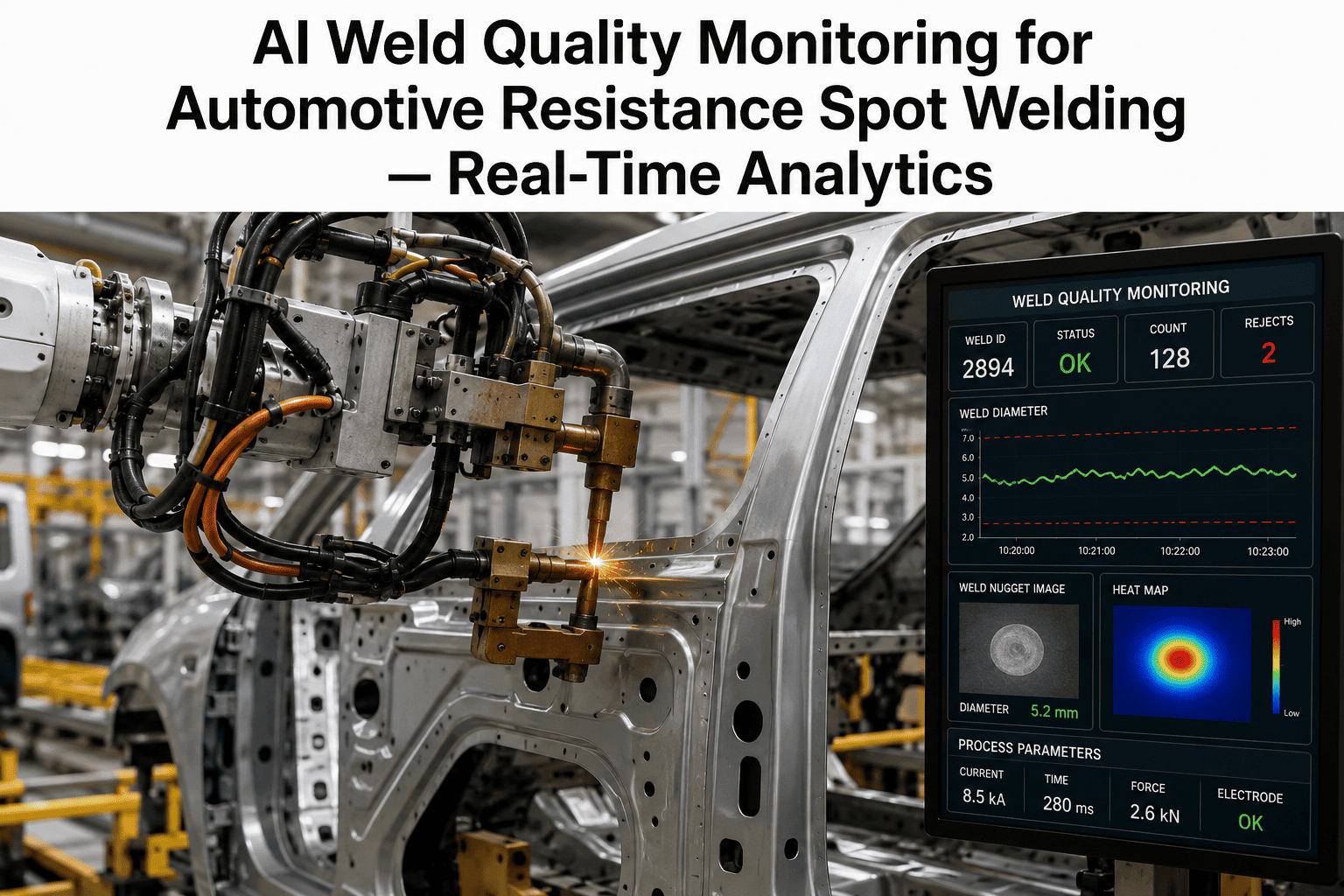
A single passenger car body carries roughly 4,300 spot welds, and every one of them depends on an electrode tip that is, by design, wearing down with each pull of the trigger. Copper alloy tips mushroom and flatten under repeated thermal and mechanical cycling, and as the tip face grows, current density at the weld spot drops — which means a weld that passed spec on Monday can silently fall short of nugget strength by Wednesday if nobody adjusts for the wear. Tip dressing restores the electrode geometry, but on most lines the timing is still set by a fixed interval or an operator's judgment call rather than the electrode's actual condition, which means some tips get dressed too early, wasting copper and dresser blade life, and others get dressed too late, after weld quality has already drifted. Predicting electrode life from weld current, tip resistance, and dresser cycle data turns that guesswork into a maintenance schedule that matches wear to reality. See how condition-based tip dressing changes your weld cell uptime with a Book a Demo.
Every Electrode Wears at a Different Rate. Your Maintenance Schedule Shouldn't Treat Them the Same.
AI-driven electrode life prediction correlates welding current compensation, tip resistance, and cap wear across every gun on the line — flagging the specific electrodes approaching end-of-life instead of dressing an entire cell on a fixed calendar interval.
Why Electrode Wear Is Invisible Until the Weld Fails
Resistance spot welding concentrates current through the electrode tip to generate the heat that fuses two sheets of steel into a single nugget. As the tip mushrooms — flattening and widening from repeated thermal cycling and mechanical pressure — that same current spreads across a larger contact area, dropping current density below the level the weld schedule was calibrated for. Most controllers don't measure the tip directly; they measure the weld outcome after the fact, which means degraded electrode condition often shows up first as a marginal or failed weld rather than as an early warning that would have let maintenance intervene before a defect occurred.
Four Stages Every Tip Passes Through Between Dressings
Electrode degradation follows a predictable arc, and the signals that mark each stage are exactly what current, resistance, and pressure sensors are positioned to catch. The challenge is not detecting wear — it's catching it early enough in the curve that the correction happens on a planned break instead of a production stop.
Fresh Tip
Full-diameter contact face, baseline current density, weld nugget within specification with margin to spare.
Early Mushrooming
Tip face begins widening, current compensation kicks in to hold nugget size, resistance signature starts to shift.
Compensation Limit
Controller is adding as much current as the schedule allows, nugget size holding but with shrinking margin.
Undersized Nugget
Compensation exhausted, nugget diameter drops below spec, weld fails destructive or ultrasonic testing.
Catch Stage Two Before It Becomes Stage Four
iFactory correlates weld current compensation, shunt path resistance, and cap wear across every gun so maintenance replaces tips on a planned schedule, not an emergency one.
The Signals That Predict Tip Wear Before Nugget Size Drops
No single sensor tells the whole story of electrode condition, which is why prediction models combine several process signals that each degrade in a characteristic pattern as the tip wears. Tracking them together produces a far more reliable early-warning signal than watching any one variable in isolation.
The amount of extra current the controller is already adding to hold nugget size steady as tip face area increases.
Electrical resistance at the weld point shifts predictably as the copper alloy tip surface oxidizes and deforms.
Current leaking through adjacent already-welded spots instead of the intended nugget, which increases as spacing and tip condition change.
Number of dressing passes since tip replacement, tracked against the point where copper removal begins compromising tip geometry.
Why Calendar-Based Dressing Wastes Copper on Some Guns and Risks Defects on Others
A fixed dressing interval — every 200 welds, every shift, every fixed count — is set to protect the worst-case gun on the line, which means every other gun gets dressed more often than it needs to be. Each dressing pass removes a thin layer of copper from the tip face, and tips have a finite number of dressings before they're too short to use, so over-dressing a gun that's still performing well shortens its usable life for no quality benefit. Meanwhile a gun under unusually heavy load — welding higher-strength steel or running more cycles per shift than its neighbors — can wear past acceptable limits before the fixed interval comes around.
| Factor | Fixed-Interval Dressing | Condition-Based (AI) Dressing |
|---|---|---|
| Dressing frequency | Same for every gun, regardless of load | Matched to each gun's actual wear rate |
| Copper waste on low-wear guns | High — dressed more often than needed | Minimized — dressed only when needed |
| Risk on high-wear guns | Can wear past spec between intervals | Flagged before nugget size drops |
| Electrode life (reported gains) | Baseline | Up to 3x extension in field trials |
| Unplanned stops for weld failure | Occurs when interval misses actual wear | Reduced — replacement scheduled on breaks |
We used to dress every gun on a fixed count regardless of what it was actually welding that shift. Once we started tracking current compensation and resistance per gun, we found three cells that were wearing tips almost twice as fast as the rest of the line — high-strength steel applications nobody had flagged for a shorter interval. Fixing those three cells cut our destructive test failures by more than a quarter without changing anything else on the line.
Frequently Asked Questions
Q: How far in advance can electrode wear actually be predicted?
By correlating weld current compensation, tip resistance, and pneumatic cylinder pressure, the model typically predicts tip wear and electrode degradation 24 to 48 hours before nugget strength would drop below specification, giving maintenance a planned window to replace tips during a scheduled break instead of reacting to a failed weld on the line. The exact lead time depends on production rate and how heavily loaded a given gun is, since higher-cycle guns wear through their remaining margin faster.
Q: Do we need additional sensors installed on our existing weld guns?
In most cases the signals used for prediction — weld current, voltage, resistance, and cylinder pressure — are already available from the weld controller and don't require new hardware on the gun itself. Integration typically connects to the existing controller data stream rather than retrofitting sensors onto each electrode, which keeps deployment time and disruption to the weld cell minimal. Reach out to Support with your controller make and model to confirm compatibility.
Q: Does this replace the tip dresser, or just tell us when to use it?
The prediction system doesn't replace your existing tip dresser hardware — it changes the timing decision that triggers a dressing cycle, shifting from a fixed count or calendar schedule to a condition-based trigger derived from each gun's actual wear signature. The dresser itself, whether a mechanical blade or an abrasive system, continues operating exactly as it does today, just on a schedule matched to real wear instead of a worst-case assumption.
Q: What's the difference between tip wear and a full electrode failure?
Tip wear is the gradual mushrooming and flattening that tip dressing corrects, restoring the electrode's geometry without replacing the electrode itself. A full electrode failure — cracking, excessive shortening after repeated dressings, or contamination — requires replacing the entire tip rather than dressing it, and the same wear-tracking data helps distinguish which condition a given electrode is approaching so maintenance brings the right part to the gun. Discuss both failure modes with Support to configure alerts for each separately.
Q: Can this work across guns from different manufacturers on the same line?
Yes — the prediction model is built from process signals like current, resistance, and pressure rather than gun-specific proprietary data, so it works across mixed fleets of weld guns from different manufacturers as long as those signals are accessible from the controller. Many body shops run guns from multiple vendors across different model years, and a wear model trained per-application handles that variation without requiring a single-vendor line. Schedule a Book a Demo to see how mixed-fleet monitoring is configured.
Turn Electrode Wear Into a Scheduled Task, Not a Line Stop
Extend tip life, cut destructive test failures, and replace tips on planned breaks instead of emergency stops.