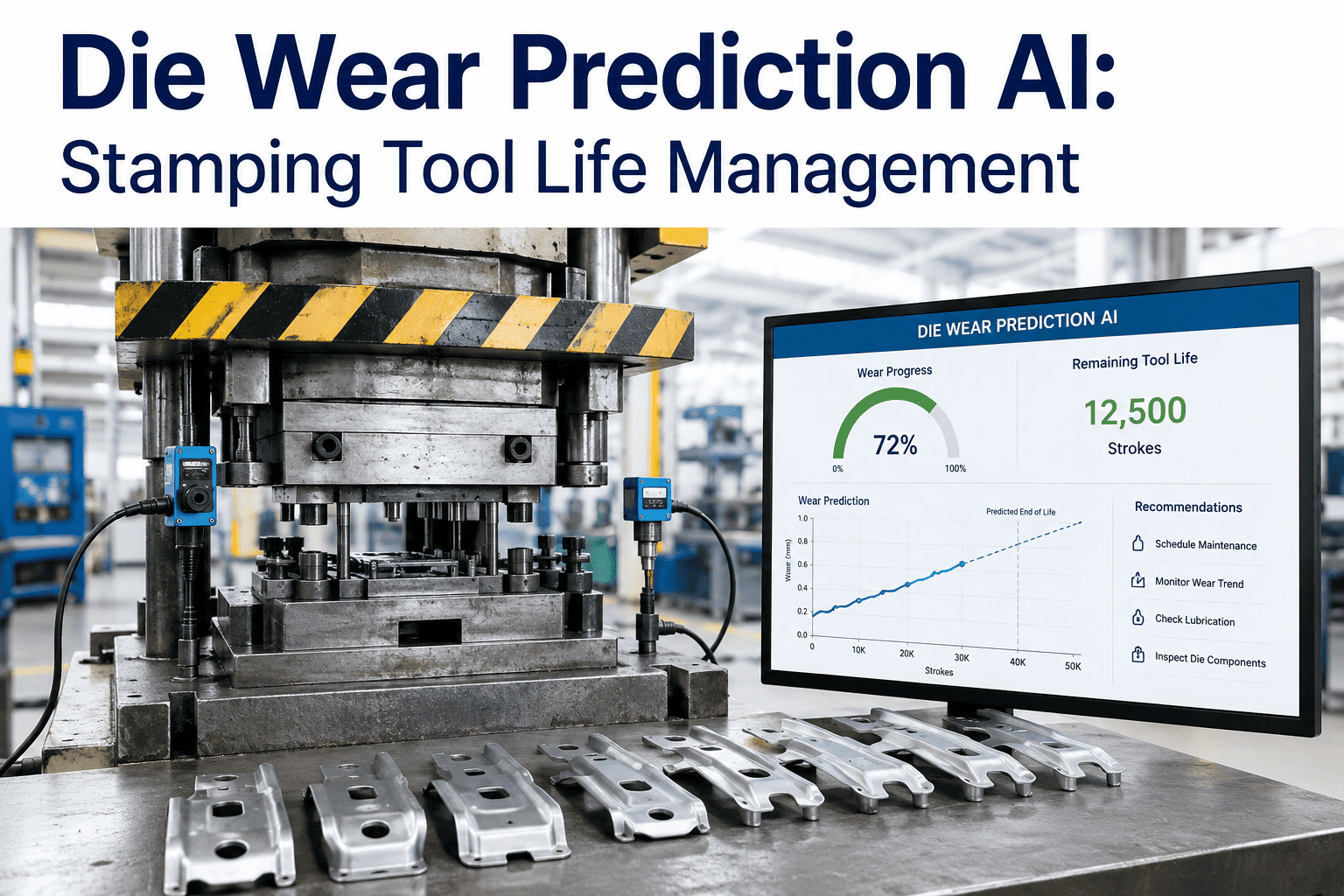
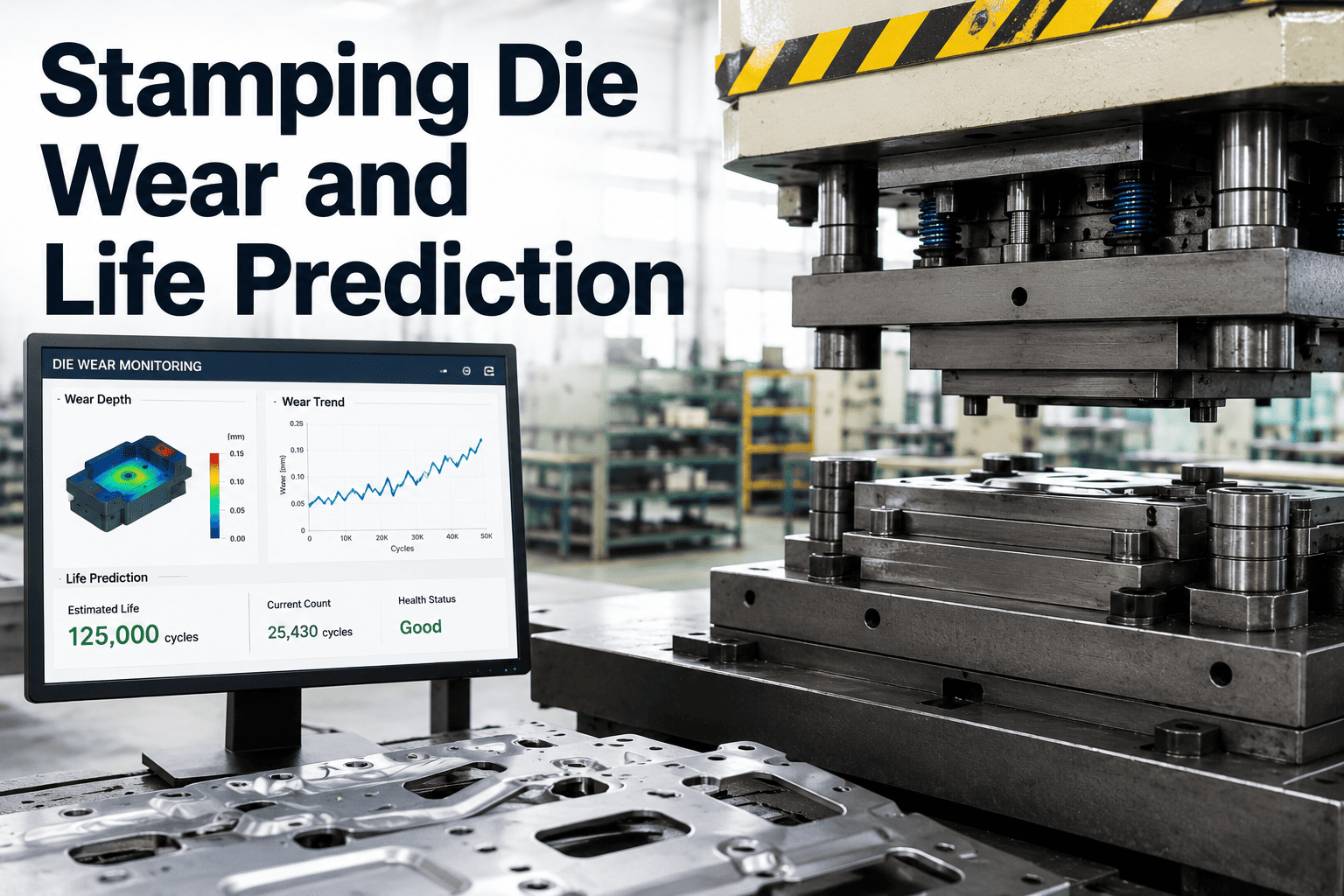
Every stamping die has a real remaining life at any given moment, but almost no plant actually knows what that number is — instead, dies get serviced on a fixed stroke-count schedule that treats a die run on abrasive high-strength steel the same as one run on soft aluminum, or replaced reactively once a part defect finally makes the wear impossible to ignore. Both approaches leave value on the table: the fixed schedule wastes good die life by servicing early, while the reactive approach risks scrap and downtime by servicing late. The gap between those two failure modes is exactly where die wear prediction earns its value, replacing a guess with an actual estimate grounded in how the die is really wearing. iFactory's die wear prediction platform is built to close that gap continuously.
Stamping Tool Life Management
Knowing Your Die's Real Remaining Life, Not Just Its Stroke Count
Fixed maintenance schedules waste good die life. Reactive replacement risks scrap. See how AI wear prediction replaces both with an actual estimate.
The Problem With Stroke-Count Maintenance Schedules
A fixed stroke-count schedule assumes every die wears at the same rate regardless of material hardness, part geometry, lubrication consistency, or press condition — an assumption that rarely holds up in practice. The result is that some dies get pulled for service while they still have significant usable life left, while others wearing faster than expected run past the point where quality starts to degrade before anyone notices.
New Die
Baseline established
Early Wear
Signature drift begins
Progressive Wear
Predictive window opens
Service Threshold
Schedule service before defects appear
Illustrative die wear progression — the predictive window between early drift and the service threshold is where AI gives maintenance real lead time.
What AI Actually Reads to Predict Wear
01
Force Signature Drift
Gradual changes in the shape and peak of the force curve across thousands of strokes.
02
Part Dimensional Trend
Small dimensional drift in produced parts that correlates with progressive die surface wear.
03
Material and Lubrication Context
Material hardness and lubrication consistency data that affect how fast a given die wears.
04
Historical Wear Patterns
How this die and similar dies have worn in the past, used to calibrate the prediction model.
From Signal to Maintenance Schedule
1
Establish Baseline
Capture the new-die signature as the reference point for wear comparison
2
Track Drift Continuously
Monitor force and dimensional signals stroke by stroke against the baseline
3
Estimate Remaining Life
Model projects when the die will reach the quality-affecting wear threshold
4
Schedule Proactively
Maintenance planned around actual remaining life instead of a fixed calendar or stroke count
Want to see what a wear prediction model would estimate for your highest-use dies? Talk to our team about a tool life assessment.
Fixed Schedule vs. Predictive Life Management
| Aspect | Fixed Stroke-Count Schedule | Predictive Life Management |
|---|
| Service timing basis | Same interval regardless of actual wear | Based on real wear rate for each die |
| Risk of early service | High — wastes usable die life | Low — service timed to actual condition |
| Risk of late service | Possible if wear is faster than assumed | Low — drift flagged well before defects appear |
| Planning visibility | Fixed calendar, no lead time flexibility | Remaining-life estimate enables proactive planning |
What Predictive Tool Life Management Delivers
Longer
Usable die life extracted before service is needed
Fewer
Quality escapes caused by unexpected die wear
Better
Maintenance planning with real lead time instead of surprise stops
Common Pitfalls in Tool Life Programs
One Schedule for All Dies
Applying the same service interval to dies running very different materials ignores how differently they actually wear.
No Baseline Signature Captured
Without a clean new-die reference signature, wear drift is much harder to measure accurately.
Ignoring Lubrication Variability
Inconsistent lubrication can mimic or mask wear signatures if it isn't accounted for in the model.
Reactive Culture Persists
Even with prediction available, teams sometimes wait for a defect to appear before acting on an early warning.
Frequently Asked Questions
How accurate can die wear prediction realistically be?
Accuracy improves significantly once the model has enough historical data on how a specific die and material combination actually wears, so early predictions on a new die or new material should be treated as a starting estimate that sharpens over time rather than a precise number from day one.
Our team can walk through how the model typically calibrates on your dies.
Does this replace the need for a preventive maintenance program entirely?
No, it replaces a fixed, one-size-fits-all interval with a condition-based schedule, but the underlying discipline of planned, proactive maintenance stays the same. The change is in how the timing gets decided, not whether maintenance planning happens at all.
What data is needed to get started on a specific die?
A clean baseline signature from a new or recently refurbished die is the most valuable starting point, along with force and, ideally, part dimensional data collected consistently over enough strokes to establish a meaningful wear trend.
Can this work for dies that already have significant wear history?
Yes, though the model benefits from as much historical signal data as is available — even without a perfect new-die baseline, tracking drift from the current condition forward can still surface meaningful early warning signs going forward.
Where should a plant start applying this approach?
Start with your highest-use or highest-cost dies, since that's where the combination of wear risk and downtime cost makes the value of predictive scheduling most immediately visible.
Book a demo to see how that prioritization typically works.
Stop Guessing When a Die Actually Needs Service.
Predict Real Remaining Die Life Instead of Following a Fixed Schedule
Bring your current die service history and force signature data. We'll show you what a predictive wear model could reveal about your highest-use tooling.