A bin of randomly oriented stamped brackets looks trivial to a human picking parts by hand, and completely intractable to a traditional fixed-position robot that expects every part presented in the exact same orientation every time. This gap is why so many automotive part handling operations still rely on manual bin picking or expensive structured presentation systems like vibratory bowl feeders and custom part trays, even in plants that have automated nearly everything else on the line. The irony is that bin picking is often one of the last manual or semi-manual tasks remaining precisely because it was assumed to be the hardest to automate, when in practice it is now one of the more mature applications of vision-guided robotics available. Vision-guided bin picking closes this gap by giving the robot the ability to see the actual jumbled contents of a bin, identify individual parts, calculate their exact position and orientation in three dimensions, and plan a collision-free grasp in real time, eliminating the need for expensive structured presentation hardware entirely. If manual bin picking or bowl feeders are limiting your automation flexibility, you can book a demo to see how iFactory's vision-guided picking handles randomly presented automotive parts.
Pick Randomly Oriented Parts Directly From a Bin, No Structured Presentation Required
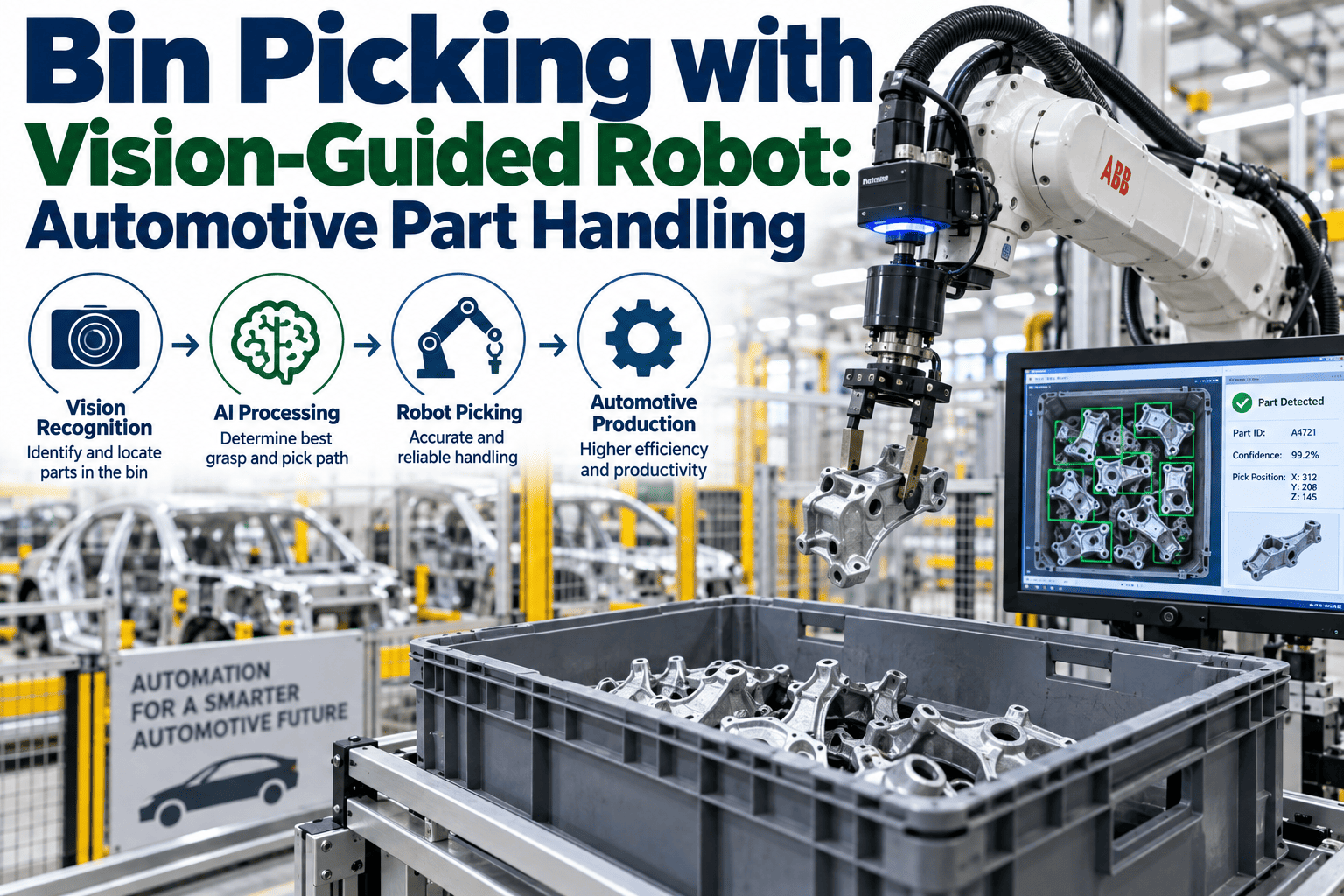
iFactory's vision-guided bin picking system identifies parts, calculates 3D pose, and plans a collision-free grasp in real time, eliminating the cost and inflexibility of structured part presentation.
From Bin Capture to Successful Grasp in Four Stages
Vision-guided bin picking combines 3D sensing, object recognition, and real-time path planning into a continuous pipeline that runs on every pick cycle. Each stage below happens automatically within the robot's normal cycle time, and the entire sequence is designed to complete fast enough that it does not become the bottleneck in an otherwise automated line, matching or approaching the cycle times achieved with structured presentation for comparable part sizes and weights.
What Vision-Guided Picking Replaces on the Automotive Floor
The comparison below outlines how vision-guided bin picking changes the economics and flexibility of part presentation compared to the structured approaches most plants rely on today.
| Factor | Structured Presentation | Vision-Guided Bin Picking |
|---|---|---|
| Tooling Investment per Part | Custom trays, bowl feeders, or fixtures required for each part number | Minimal part-specific tooling, primarily software-side configuration |
| Changeover Time for New Parts | Hours to days for new fixture design, fabrication, and installation | Hours for model training and validation using existing hardware |
| Floor Space Required | Additional footprint for feeder or fixture staging equipment | Standard bin or container footprint, no additional staging hardware |
| Handling of Mixed Part Batches | Requires separate structured presentation per part number | Can handle mixed bins with appropriate model training per part type |
| Sensitivity to Part Damage | Rigid fixtures can be intolerant of minor part-to-part variation | Adapts pose estimation to natural variation within tolerance |
Part Characteristics That Make Bin Picking More Challenging
Not every part is equally easy to pick from a jumbled bin. Understanding which characteristics increase difficulty helps set realistic expectations and informs how a system should be configured for your specific parts. A thorough evaluation of your actual part catalog against these four characteristics before deployment is one of the most reliable ways to avoid an unpleasant surprise during commissioning, since a part that looks straightforward in a photograph can turn out to combine two or more of these challenging characteristics at once.
Reflective or Metallic Surfaces
Bare metal stampings can create difficult lighting conditions for 3D sensing, addressed through specialized lighting and sensor configuration tuned to the surface finish.
Nested or Interlocking Parts
Parts that naturally nest or interlock in a bin require more sophisticated separation logic to identify individual pick candidates accurately.
Thin or Flat Geometries
Parts with minimal height variation present a thinner profile for 3D sensing, requiring higher sensor resolution to achieve reliable pose estimation.
Symmetric or Featureless Parts
Parts lacking distinct visual features can create ambiguity in orientation detection, addressed through model training on subtle geometric cues.
Results From Automotive Bin Picking Deployments
The figures below reflect aggregated performance data from vision-guided bin picking systems deployed on automotive part handling applications across a range of part types and bin configurations.