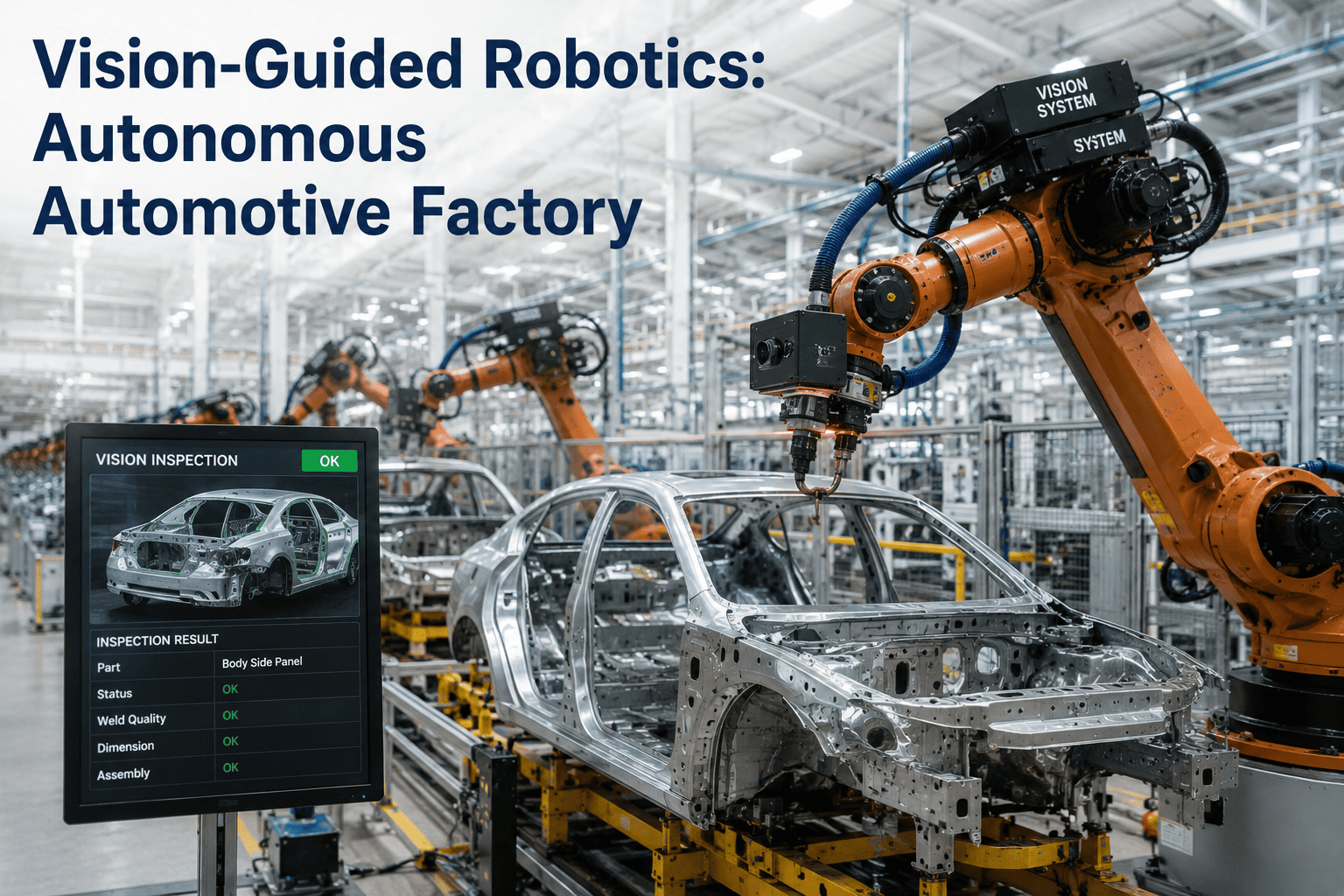
Ask an automotive plant manager what "autonomous factory" means and the answer usually starts with robots that don't need a fence around them. That's part of it, but the more consequential shift already underway is quieter than that image suggests — it's robots that adjust their own behavior in response to what they see, without an engineer rewriting the program every time a part varies or a process drifts. Vision-guided robotics is the technology doing that adjustment today, on production lines right now, and the trajectory from where it sits today to genuinely self-adapting, continuously learning production is clearer than the phrase "autonomous factory" usually gets credit for. iFactory's engineering team works at the leading edge of that trajectory with automotive plants that are building toward it deliberately rather than waiting for a finished product to arrive.
Where Vision-Guided Robotics Is Taking the Autonomous Automotive Factory
Self-adapting robots, continuous learning from production data, and lights-out operation aren't a distant concept for automotive manufacturing — they're the next several stages of a trajectory that vision-guided robotics is already on today. This page maps that trajectory stage by stage.
Vision Guidance Has Already Redefined "Automated," Not Yet "Autonomous"
Most vision-guided robotics deployed on automotive lines today operate within a well-defined envelope — they locate a part, adjust a pre-programmed path to that part's actual position, and execute a task an engineer designed in advance. That's a meaningful leap beyond fixed-path automation, which can't tolerate part variation at all, but it's still fundamentally supervised automation. The robot adapts to where the part is; it doesn't yet decide what to do differently when it encounters something the engineer didn't anticipate, and it doesn't yet improve its own performance from one shift to the next without a human retraining the model.
Understanding that distinction matters for plants making automation investment decisions today, because it clarifies what current-generation vision-guided robotics can and can't promise. It's a substantial and provable improvement over fixed automation for handling part variation and catching position-dependent defects, and it's the foundation the next stages build on — but it's not yet the self-directing, continuously learning system the phrase "autonomous factory" often implies. Being honest about that distinction is part of what makes a realistic automation roadmap credible rather than aspirational marketing.
This gap between "automated" and "autonomous" isn't a marketing nuance — it's the entire basis for how a plant should plan its next several years of investment. A plant that budgets for current-generation supervised vision guidance, understanding clearly what it delivers and what it doesn't yet deliver, makes better near-term decisions than one that budgets against a vaguer promise of full autonomy and finds itself disappointed when the deployed system still requires the human oversight that supervised guidance was always going to require. The trajectory described in the rest of this page is real, but it unfolds over years of incremental capability additions, not a single product purchase that arrives fully autonomous out of the box.
Four Stages From Supervised Vision Guidance to Lights-Out Production
The path from today's vision-guided robotics to genuinely autonomous production isn't a single leap — it's a sequence of capability additions, each of which is already technically demonstrated somewhere in the industry even if not yet standard practice on most lines. The roadmap below reflects the general sequence iFactory sees plants moving through.
See How Continuous Model Refinement Works in a Live Automotive Cell
iFactory can show you how production data feeds back into detection models today, on the same vision-guided robotics platform your plant would deploy — bring your current automation footprint and we'll map the realistic next stage.
What "Self-Improving" Actually Means on a Production Floor
Continuous learning is one of the most overused phrases in industrial automation marketing, and it's worth being specific about what it actually looks like in a functioning automotive cell rather than treating it as a black box that improves itself indefinitely without oversight. The mechanisms below reflect the realistic, currently-deployable version of continuous learning, distinct from the fully unsupervised version still on the horizon.
What Has to Be True Before a Cell Can Run Genuinely Unattended
Lights-out manufacturing gets discussed as a single milestone, but it's really a set of independent capabilities that all have to be true simultaneously before a cell can run without a human present for an extended shift. Automotive lines are further along on some of these than others.
| Requirement | Current State | Gap to Close |
|---|---|---|
| Reliable defect detection | Strong on trained defect types | Novel defect recognition |
| Self-diagnosis of faults | Basic fault codes | Root-cause classification |
| Autonomous material handling | Mature for standard parts | Exception handling for jams |
| Safe unattended operation | Proven in fenced cells | Broader unfenced envelopes |
| Remote intervention capability | Growing, plant-specific | Standardized remote control |
The pattern across every row is consistent: the underlying technology exists in some form today, but reliability at the level required for genuinely unattended operation — where a rare failure mode still needs a safe, graceful response rather than a hard stop or an undetected quality escape — is the harder engineering problem than the core capability itself. This is why the realistic path to lights-out production runs through progressively longer unattended windows validated in production, not a single switch flipped from supervised to autonomous.
Different automotive processes will likely reach lights-out readiness at different speeds, which matters for how a plant sequences its investment. Material handling and simple part transfer, where the cost of a rare failure is a jam or a stopped line rather than a safety-critical quality escape, is generally closer to genuine unattended readiness than welding, fastening, or final inspection processes where an undetected error has much higher downstream cost. Sequencing lights-out pilots by starting with the lower-risk processes, and treating the safety-critical stations as later-stage candidates once the underlying self-diagnosis and drift-detection capability has been proven elsewhere in the plant, is a more defensible rollout strategy than attempting a uniform push across every process simultaneously.
How Automotive Plants Are Building Toward This Today
Plants don't need to wait for Stage 4 lights-out capability to start building toward it, and the plants making the most credible progress are the ones treating each stage as a deliberate capability build rather than waiting passively for a vendor to deliver a finished autonomous product.
What Happens to the Operator's Role as Cells Get More Autonomous
The workforce conversation around autonomous manufacturing tends to jump straight to headcount, but the more accurate near-term picture for automotive plants is a shift in what the operator role actually does, not simply a reduction in how many people fill it. As a vision-guided cell moves from Stage 1 supervised guidance toward Stage 2 continuous learning and Stage 3 cross-station coordination, the tasks that disappear are largely the repetitive inspection and adjustment tasks the vision system now handles directly — the tasks that grow are exception handling, model performance review, and the judgment calls the system is deliberately designed to escalate rather than resolve on its own.
Plants moving through this trajectory successfully tend to invest in retraining operators toward those higher-judgment roles well before the automation reaches the point where it demands them, rather than waiting until the transition is already underway and scrambling to build the new skill set under production pressure. An operator who has spent a career doing manual visual inspection has genuine, transferable expertise in what a defect actually looks like and what causes it — that expertise doesn't become worthless when a camera takes over the repetitive inspection task, it becomes the input that trains and validates the vision model, and later, the judgment that reviews the exceptions the model flags as uncertain. Framing the transition this way, as a shift in what expertise gets applied to rather than a simple replacement, tends to produce both better model performance and a smoother organizational transition than treating automation and workforce planning as separate tracks.
The Data Foundation Every Later Stage Depends On
Every stage in the trajectory beyond Stage 1 depends on a data infrastructure decision made at Stage 1 — specifically, whether the plant is capturing and retaining production inspection data in a form that's usable for retraining, cross-station correlation, and drift analysis later, or whether that data is discarded after each cycle's pass/fail decision is made. Plants that treat data retention as an afterthought at initial deployment routinely find themselves re-architecting the entire data pipeline when they later want to add continuous learning, because the historical data needed to bootstrap a meaningful retraining dataset simply doesn't exist yet.
The practical recommendation is straightforward even if it adds some upfront engineering cost: design the data retention and MES integration layer for the Stage 2 and Stage 3 capabilities from the very first Stage 1 deployment, even if those later capabilities won't be activated for a year or more. Storage cost for inspection images and metadata is a small fraction of the cost of re-engineering a data pipeline after the fact, and a plant that has been quietly accumulating a well-labeled production dataset for a year has a substantial head start when it decides to activate continuous learning, compared to a plant starting that data collection from zero at the point of decision.
This same data foundation is also what makes cross-station coordination possible when the plant is ready for Stage 3. A detection event at one station can only meaningfully inform a decision at another station if both are writing to a common, well-structured data layer with consistent identifiers — the same VIN-level traceability that a mature MES integration requires for quality compliance today turns out to be the same infrastructure that cross-station learning depends on tomorrow, which is one more reason the integration work described elsewhere on this site pays forward into the autonomy trajectory rather than being a separate, disconnected investment. Plants that build this data layer with an eye toward both purposes from the start typically find the incremental cost of doing so small compared to the cost of retrofitting it once a second use case appears.
Frequently Asked Questions
Start on the Trajectory Toward Autonomous Production Today
iFactory deploys production-proven vision-guided robotics today while structuring the data and integration foundation your plant will need for continuous learning and cross-station coordination as those capabilities mature. Book a demo to see the current state of the platform, or talk to our automation engineering team about mapping your specific trajectory.