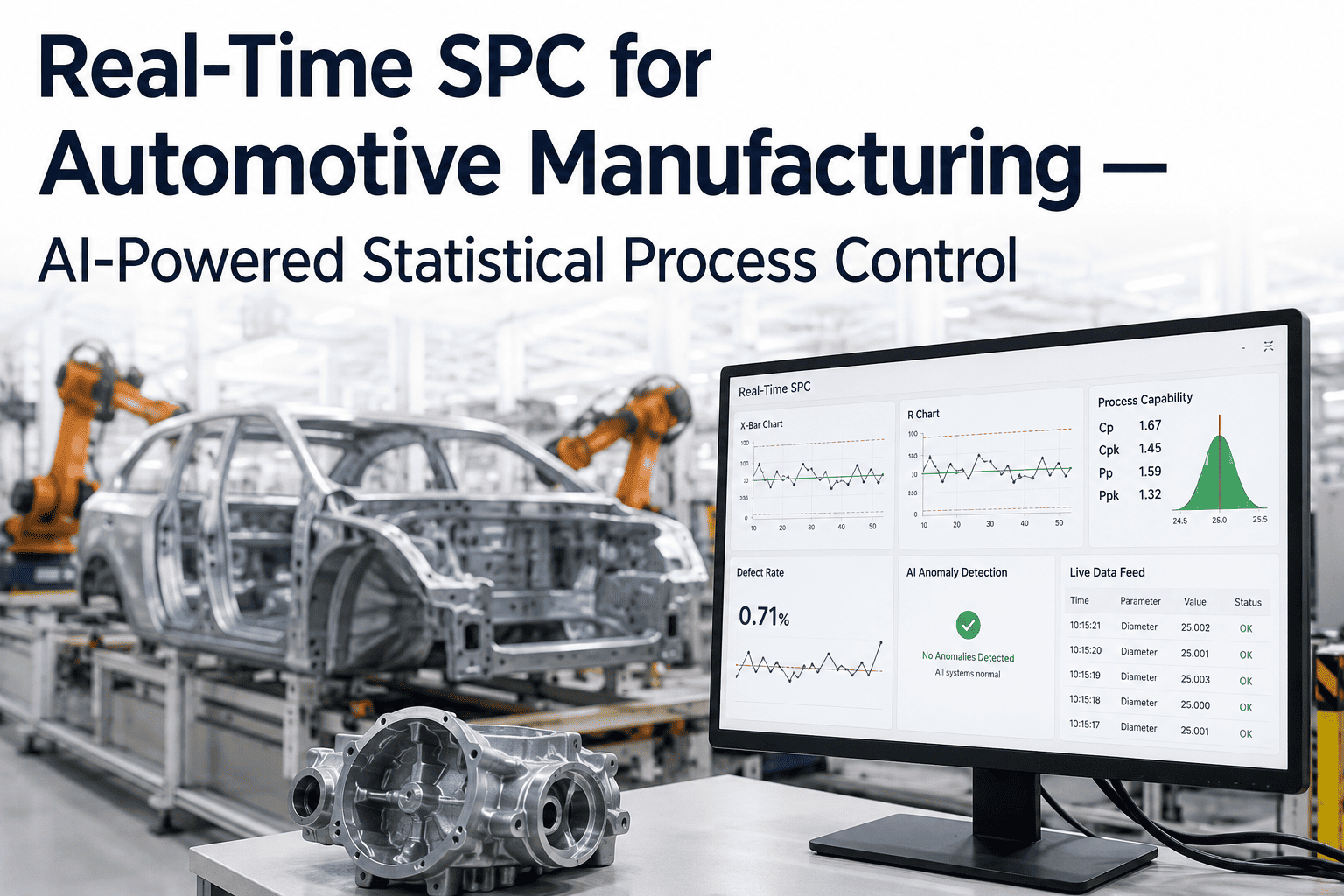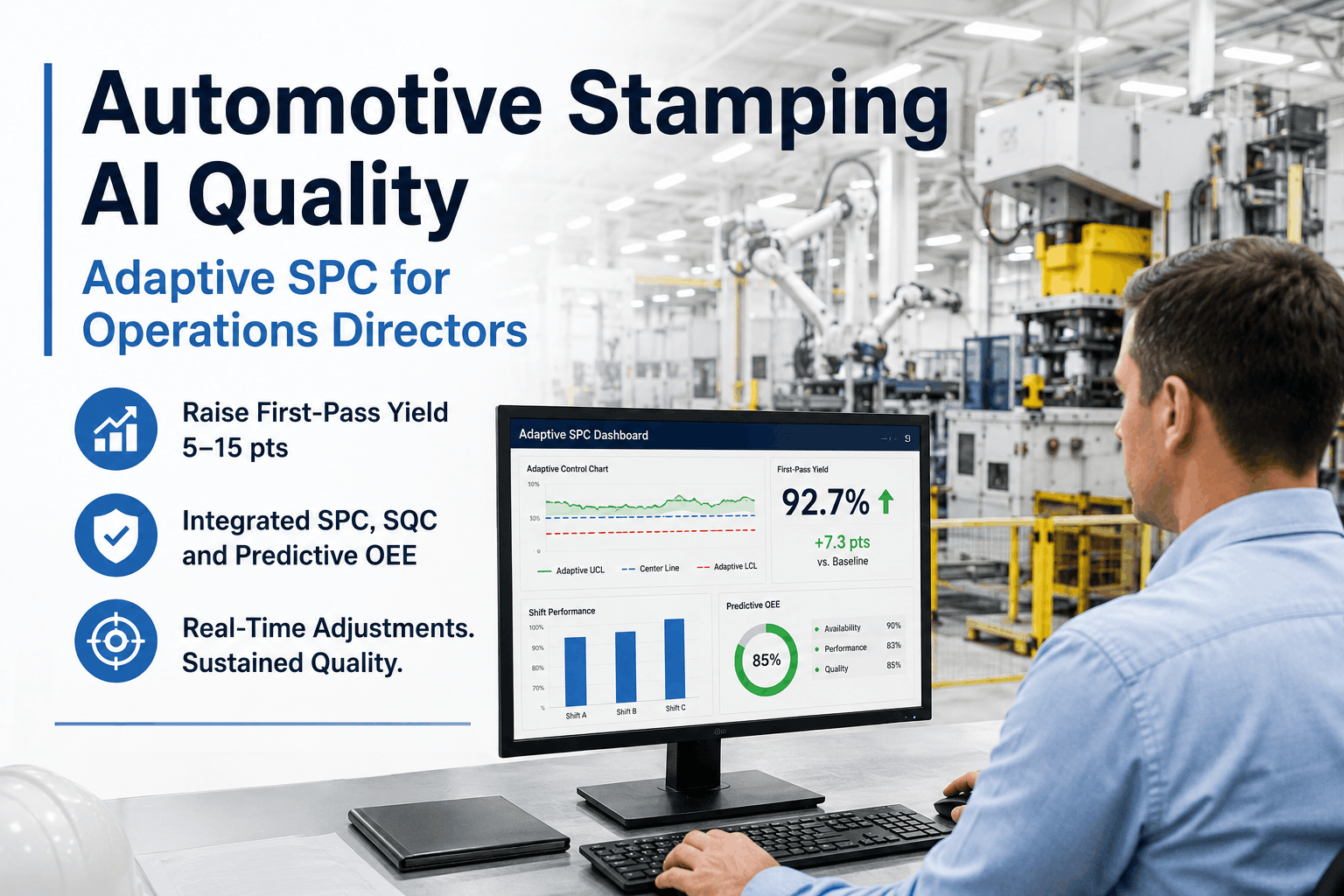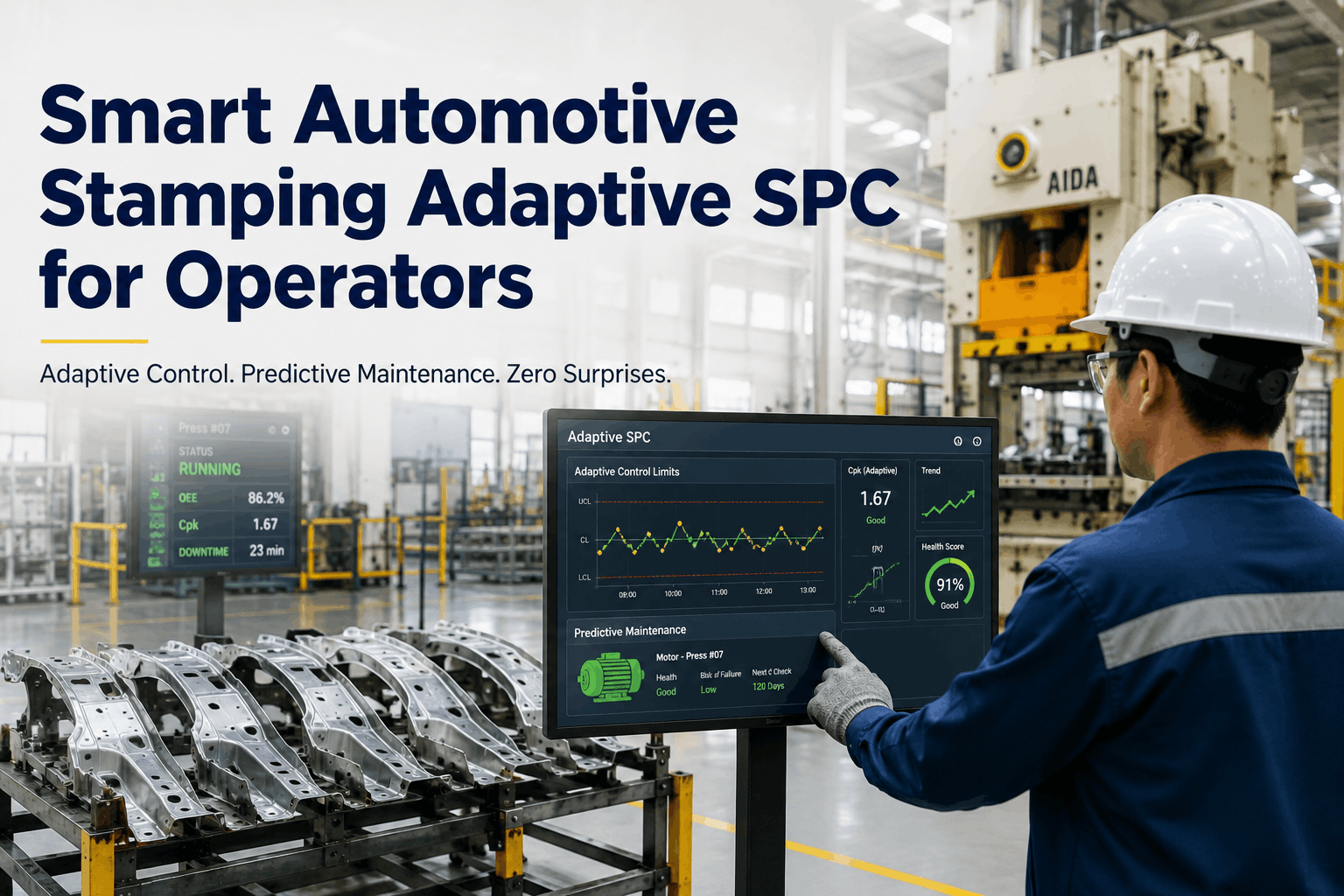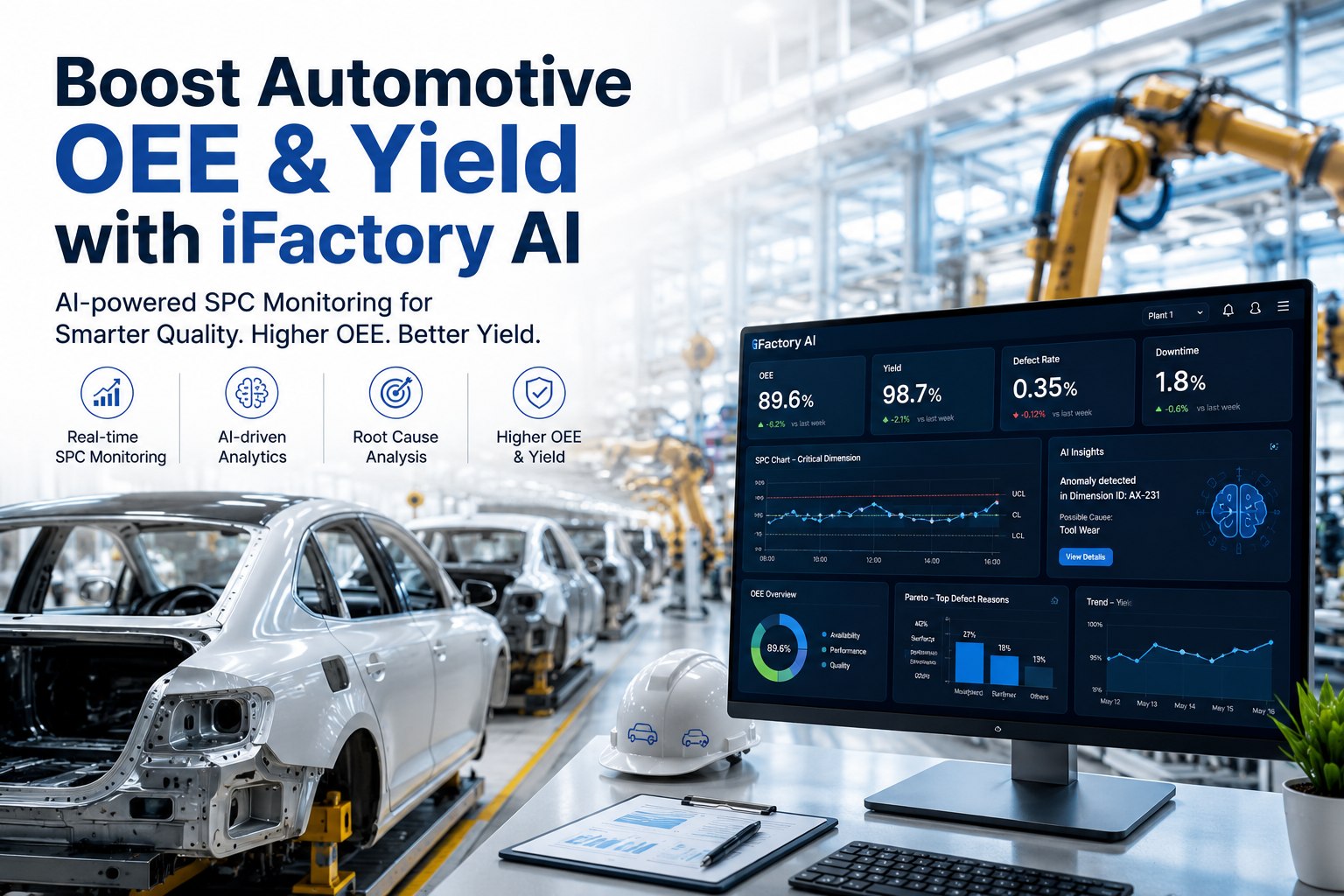
Statistical Process Control in automotive plants was designed in an era when shift reports were the fastest feedback loop available. SAP xMII inherited that paradigm and built dashboards around it — static three-sigma limits computed at baseline, batch-style refresh cycles measured in hours, and false alarms that quality engineers learned to ignore because the math never tracked the actual process state. The cost of that legacy approach is now measurable: 30–40% of "out of control" signals are nuisance, OEE leaks slip past undetected, and customer PPM drifts upward because the first-pass yield problem on Line 4 was already three shifts old by the time it appeared in a Monday morning dashboard. iFactory AI replaces SAP xMII with real-time adaptive SPC purpose-built for automotive — limits that breathe with verified process state, multivariate detection across body / paint / assembly / EV battery / finishing, and an operator AI assistant that converts SPC events into actionable instructions inside the shift. This is automotive industry 4.0 SPC for the connected car manufacturing era, designed for the smart factory operating model. On-prem turnkey appliance or fully-managed cloud.
Boost Automotive OEE & Yield with iFactory AI SPC Monitoring
Real-time adaptive SPC purpose-built for body shop, paint shop, assembly, EV battery, and finishing. Replaces static SAP xMII charts with multivariate limits that track verified process state. AI-driven OEE recovery, yield improvement, autonomous root cause. 12-week deployment on a turnkey NVIDIA appliance or fully-managed cloud.
Why Static SPC Fails Automotive Manufacturing
Three architectural limitations of SAP xMII SPC make it structurally unable to meet 2026 automotive quality demands. Each shows up as quantifiable OEE and yield damage on the plant floor.
Batch refresh cycles
SAP xMII dashboards refresh every 1–4 hours. Quality issues caught here are already 1–4 hours of bad units deep. Real-time competitive plants now respond in seconds.
Static three-sigma limits
Limits computed at baseline never track process state changes — shift transitions, tool wear, ambient variation. Real signal lost in nuisance alarm noise.
Univariate analysis
Process variables analyzed one at a time. Correlated automotive variables — torque, speed, temperature, fixture position — produce defects in combination that single-variable charts miss entirely.
Curious how much OEE your plant is currently losing to static SPC false alarms? Schedule a 30-minute working session — iFactory's automotive practice will quantify your specific false-alarm cost and yield impact during the call.
Real-Time Adaptive SPC — How It Actually Works
The control chart comparison below shows the same shift on the same line, run through static SAP xMII SPC and through iFactory's adaptive engine. Same process, same data, completely different signal quality.
Want this comparison run against your actual production data? Book a demo this week — iFactory's automotive practice will run live adaptive SPC against your historical data during the session, no obligation.
Five Automotive SPC Monitoring Zones
Each automotive plant zone has its own SPC requirements — different signal density, different defect modes, different decision latency. iFactory ships with zone-specific models pre-loaded.
Body Shop
Weld parameters, robot torque, fixture position correlation. Adaptive limits track electrode wear cycles.
Paint Shop
Booth temperature, humidity, paint lot, gun pressure correlated multivariately. Color drift caught before customer escalation.
Assembly
Torque tool histograms, station-level cycle time, fastener calibration drift. Operator AI assist for first-time-right.
EV Battery
Cell formation cycles, module weld, pack-level test correlated cross-layer. Cell-to-pack causal attribution native.
Finishing & QC
Final inspection AI vision linked to upstream SPC events. Single quality record across all zones.
Want zone-by-zone OEE and yield impact modeled for your specific plant configuration? Contact iFactory support with your zone setup — the automotive team will return projected outcomes per zone within 3 business days, no obligation.
The Operator AI Assistant — What Changes On The Floor
Real-time SPC is only useful if the operator knows what to do about an event. iFactory's operator AI copilot converts SPC events into context-aware instructions immediately, with the upstream cause already identified.
Want to see the operator AI copilot answer natural-language queries against a real shop floor scenario? Schedule a demo this week — bring a recent quality issue from your plant and iFactory will show it run live during the session.
Migrating from SAP xMII — The Practical Path
SAP xMII mainstream maintenance ends December 2027. Automotive plants migrating to AI-native SPC follow a workload-by-workload pattern that preserves SAP S/4HANA integration and the quality team's sequencing control.
Inventory xMII Workloads
Catalog existing SPC charts, dashboards, batch records, custom transactions, BLS scripts. Map each to its iFactory replacement.
Deploy Appliance
NVIDIA appliance racked or cloud tenant provisioned. Read-only connectivity to SAP xMII, MES, PCo, LIMS, line cameras.
Parallel SPC Run
Adaptive SPC runs in shadow mode alongside SAP xMII. Quality team validates parity per zone before cutover.
Workload Cutover
Zone-by-zone migration at quality team's pace. SAP xMII held as fallback. Operator AI activated on first console.
Decommission xMII
SAP xMII retired per workload. AI SPC scaled plant-wide. ROI documented and signed off.
Want a custom workload-by-workload migration plan for your specific xMII estate? Reach out to iFactory support — share your current SAP xMII inventory and receive a step-by-step replacement roadmap with timeline within 3 business days.
12-Week Deployment Timeline
Connect
NVIDIA appliance racked or cloud provisioned. Read-only connectivity established. Automotive SPC models pre-loaded.
First Adaptive SPC
Adaptive limits active across body, paint, assembly, EV battery, finishing. Shadow mode for parity validation.
Plant-Wide
All zones cut over. Operator AI live. SAP xMII held as fallback during stabilization. ROI documented.
Want a tailored 12-week deployment quote with full BOM sized for your specific plant scale? Book a demo this week — the session output is a complete quote plus ROI projection ready for your buying committee.
Documented OEE & Yield Outcomes
Real-time adaptive SPC is the upgrade SAP xMII cannot configure into existence.
iFactory AI replaces SAP xMII with adaptive multivariate SPC purpose-built for automotive plant analytics. Body, paint, assembly, EV battery, finishing — all on one platform, with shop floor analytics and operator AI on every console. Next-gen manufacturing AI on a NVIDIA appliance or fully-managed cloud, your choice. 12-week deployment.
FAQ — Automotive SPC Monitoring
What makes adaptive SPC limits different from rolling-window averages?
Rolling-window averages adjust to recent data but still apply a univariate static-shape limit. Adaptive multivariate limits track verified process state — they expand or tighten based on which operating regime the line is in (warm-up, steady state, shift transition, tool refresh, ambient drift). The limit reflects what "in control" actually means right now, not what it meant at last quarter's recalibration. Result is 60–80% false alarm reduction and real signal captured earlier. Book a demo to see the difference live.
Does iFactory ship on-prem only or is cloud available?
Both. On-prem (turnkey NVIDIA appliance with 99.9% uptime SLA) is the recommended default for automotive plants with line-speed AI vision, sub-second SPC inference requirements, or data sovereignty needs. Fully-managed cloud is available for multi-plant automotive groups consolidating governance. Same platform, same adaptive SPC engine, same operator AI on either deployment. Many groups deploy hybrid — on-prem at high-volume final assembly, cloud at component plants.
Can we keep SAP S/4HANA and just replace the xMII layer?
Yes — this is the standard pattern. iFactory replaces the SAP xMII application and SPC layer while integrating natively with SAP S/4HANA for production orders, BOM, materials, customer fulfillment, and financial reporting. No forced S/4 change. Upward data flow to ERP is preserved through iFactory's S/4HANA adapter library. The migration touches xMII only.
How does this work for EV battery cell-to-pack quality?
The adaptive SPC engine treats cell, module, and pack levels as connected layers. A pack-level test deviation is automatically attributed back through module weld parameters, BMS firmware, and individual cell formation cycle anomalies. Cross-layer causal attribution that previously required days of forensic engineering happens in seconds with confidence intervals on each contributing factor. EV battery PPM reductions of 72% are typical.
What about our custom xMII transactions and BLS scripts?
Inventoried during Step 01 of the migration and mapped to configured iFactory workflows in Step 02. Configurable workflows replace custom xMII transactions with lower-maintenance equivalents. Where a transaction encodes critical quality or process logic exactly, that logic carries to iFactory configuration during parallel run (Step 03) with parity validation before cutover.
What does the demo session cover?
30-minute working session with iFactory's automotive practice. Walks through adaptive SPC against your historical data, multivariate detection live, operator AI copilot in action, causal attribution scenarios, and EV battery cross-layer flow where applicable. Output is a tailored ROI projection and 12-week deployment quote with full BOM for your specific plant. Slots open this week.
Boost OEE and yield by moving SPC from descriptive to prescriptive.
iFactory AI replaces SAP xMII with real-time adaptive SPC and operator AI copilot purpose-built for automotive. Body, paint, assembly, EV battery, finishing — one platform, one data layer. 12-week deployment on a turnkey NVIDIA appliance or fully-managed cloud.