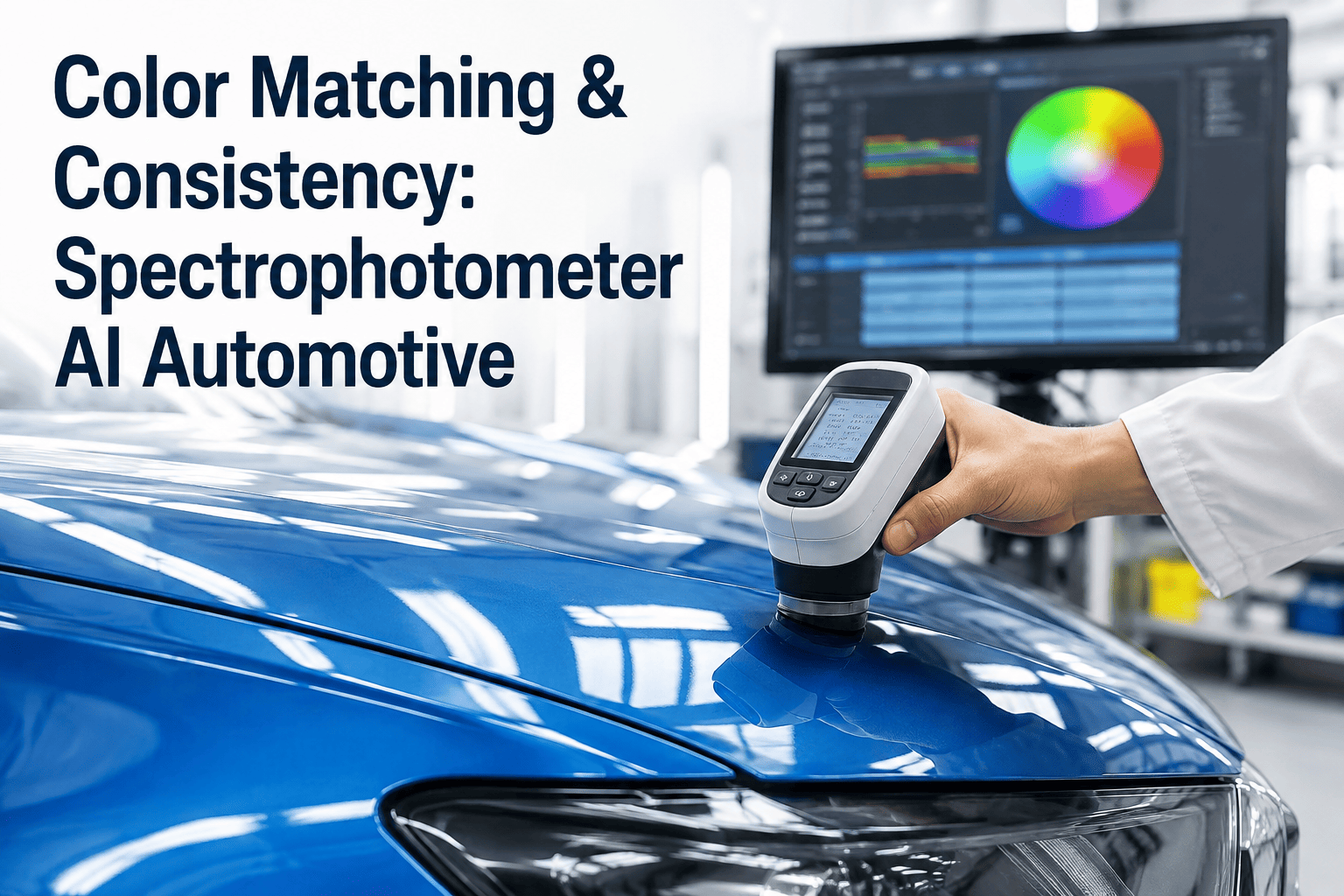
A body panel can be completely free of scratches, orange peel, and every other visible surface defect and still fail quality if it simply reads as the wrong shade next to the panel beside it. Color consistency is a different measurement problem than defect detection, because the target is not finding an anomaly against a clean baseline — it is measuring how close every single body comes to a precise color standard across an entire production run, shift after shift, batch after batch. A wave-scan instrument can tell you the answer for one sample area once per shift, but that leaves every other body and every other panel unmeasured between spot checks. AI-paired spectrophotometer systems close that gap by measuring color continuously rather than periodically, and seeing this against your own color standards is the fastest way to know where your current process actually stands.
Spectrophotometer AI · Color Consistency · Automotive Paint
Measuring Color Consistency Continuously, Not Once Per Shift
AI-paired spectrophotometer systems measure Delta E, gloss, and metallic flake orientation on every painted body, replacing spot-check sampling with continuous verification.
Understanding Delta E
What a Delta E Reading Actually Means on the Line
Delta E is the standard measurement of the perceptible difference between a measured color and its target standard. The scale below shows roughly how each range translates into what a human eye can actually perceive.
0 – 1
Not perceptible to the human eye — effectively a perfect match
1 – 2
Perceptible only under close, direct comparison side by side
2 – 4
Noticeable to a trained eye — typical upper limit for OEM acceptance
4+
Clearly visible mismatch — reject threshold for most color programs
What Gets Measured
Four Signals Behind Every Color Consistency Reading
Color matching is not a single number. A full measurement combines several signals that together explain why a panel does or does not match its target standard.
Delta E Color Difference
The core measurement of perceptible color deviation from the target standard, calculated across the visible spectrum rather than a single wavelength.
Gloss Level
Surface reflectance measured at a standard angle, since two panels can share identical color values but look different if gloss level drifts.
Metallic Flake Orientation
For metallic and pearl finishes, the angle and density of flake alignment affects how color appears to shift across viewing angles — measured at multiple angles rather than one.
Batch Variation Tracking
Readings are logged against paint batch and mix date, so a slow drift traced back to a specific supplier lot can be caught before it spreads across a full production run.
Measure Every Body Against Your Brand Color Standard
iFactory pairs spectrophotometer measurement with AI vision to check color, gloss, and flake orientation continuously across your full production line.
Spot Check vs. Continuous
Sampling Instruments vs. Continuous AI Measurement
Factor
Handheld Wave-Scan Sampling
AI-Paired Continuous Measurement
Measurement frequency
Once per body or once per shift on a sample area
Every panel of every body, continuously
Batch drift detection
Delayed until the next scheduled sample catches it
Flagged as soon as readings begin trending off standard
Traceability
Logged manually against a sample record
Every reading tied automatically to VIN and batch
Defect correlation
Color data lives separately from defect inspection data
Color and surface defect data combined in one system
From the Field
Catching a Batch Drift Before It Reached the Full Run
We used to find out about a color batch problem when a dealer called about a fleet order looking slightly off next to older units already delivered. By the time our once-per-shift wave-scan sample caught anything, a few hundred bodies had already gone through. With continuous measurement, we caught a gradual Delta E drift on a metallic silver about forty bodies in, traced it to a mixing ratio issue on a new paint batch, and corrected it before it ever reached a customer.
— Paint Quality Engineer, Automotive OEM Supplier
Frequently Asked Questions
Color Matching and Consistency — Common Questions
What Delta E threshold should we use as our reject standard?
Most OEM color programs set the reject threshold somewhere in the range where deviation becomes noticeable to a trained eye under standard viewing conditions, though the exact number varies by brand color standard and vehicle segment. Premium segments and highly visible colors like solid white or black typically use tighter thresholds than colors where minor variation is less perceptible, and thresholds should be set per color program rather than applied uniformly across the fleet.
Can this system replace our handheld spectrophotometer entirely?
Continuous AI measurement covers the ongoing production monitoring role that handheld sampling previously handled, but many plants keep a handheld unit on hand for spot verification, new color program calibration, and situations where a body needs an off-line check away from the main inspection zone.
Contact support to talk through how the two typically coexist.
How does the system handle metallic and pearl finishes differently from solid colors?
Metallic and pearl finishes require measurement at multiple viewing angles because flake orientation changes how the color appears to shift as the viewing angle changes, an effect called flop that solid colors do not exhibit. The measurement system captures readings across several angles for these finishes rather than the single-angle reading that works fine for solid colors, and the underlying model is trained separately for each finish category.
Can color data be traced back to a specific paint batch or supplier lot?
Yes, every measurement is logged against the paint batch and mix date active at the time, which is what makes it possible to trace a gradual color drift back to a specific supplier lot rather than treating each off-standard reading as an isolated incident. This traceability becomes valuable during supplier quality discussions since the data shows exactly when a drift began and how it progressed.
Does color measurement slow down the production line?
No, measurement is designed to run at line speed as part of the same inspection pass that checks for surface defects, rather than as a separate station that requires the body to stop or slow down. This is one of the main advantages over handheld sampling, which inherently requires pulling a body aside or pausing briefly for a manual reading.
Book a demo to see the combined inspection pass in action.
Know Your Color Consistency on Every Body, Not Just the Sample
AI-paired spectrophotometer measurement tracks Delta E, gloss, and flake orientation continuously, catching batch drift before it spreads across a production run.