Automotive Color Match and Consistency Control

By James Smith on August 1, 2026

automotive-color-match-ai-paint-shop

A bumper arrives from an outside supplier, gets bolted onto a freshly painted body, and under the showroom lights the two panels read as two different colors. Nobody on the line did anything wrong — the paint was mixed to spec, the booth ran at the right temperature, the cure oven hit its numbers. The problem is that color consistency across paint lines, supplier parts, and shifts is one of the hardest quality problems in automotive finishing, because human eyes and even single-angle instruments miss the metallic flop and pearlescent shift that show up under real-world light. Our color quality specialists can walk through how AI-assisted color grading closes that gap before a vehicle ever reaches a dealer lot.

Paint Shop & Surface Finishing

Why Two "Identical" Paint Colors Still Don't Match

Metallic and pearlescent finishes scatter light differently depending on viewing angle, which means a color that passes inspection head-on can visibly mismatch at a 45-degree glance — exactly how a customer walks around their car in the lot.
Where Mismatch Gets Noticed
Body-to-bumper fascia joints
Door-to-fender panel gaps
Mirror caps from outside suppliers
Roof-to-pillar trim sections

Color Is a Spec, Not an Impression

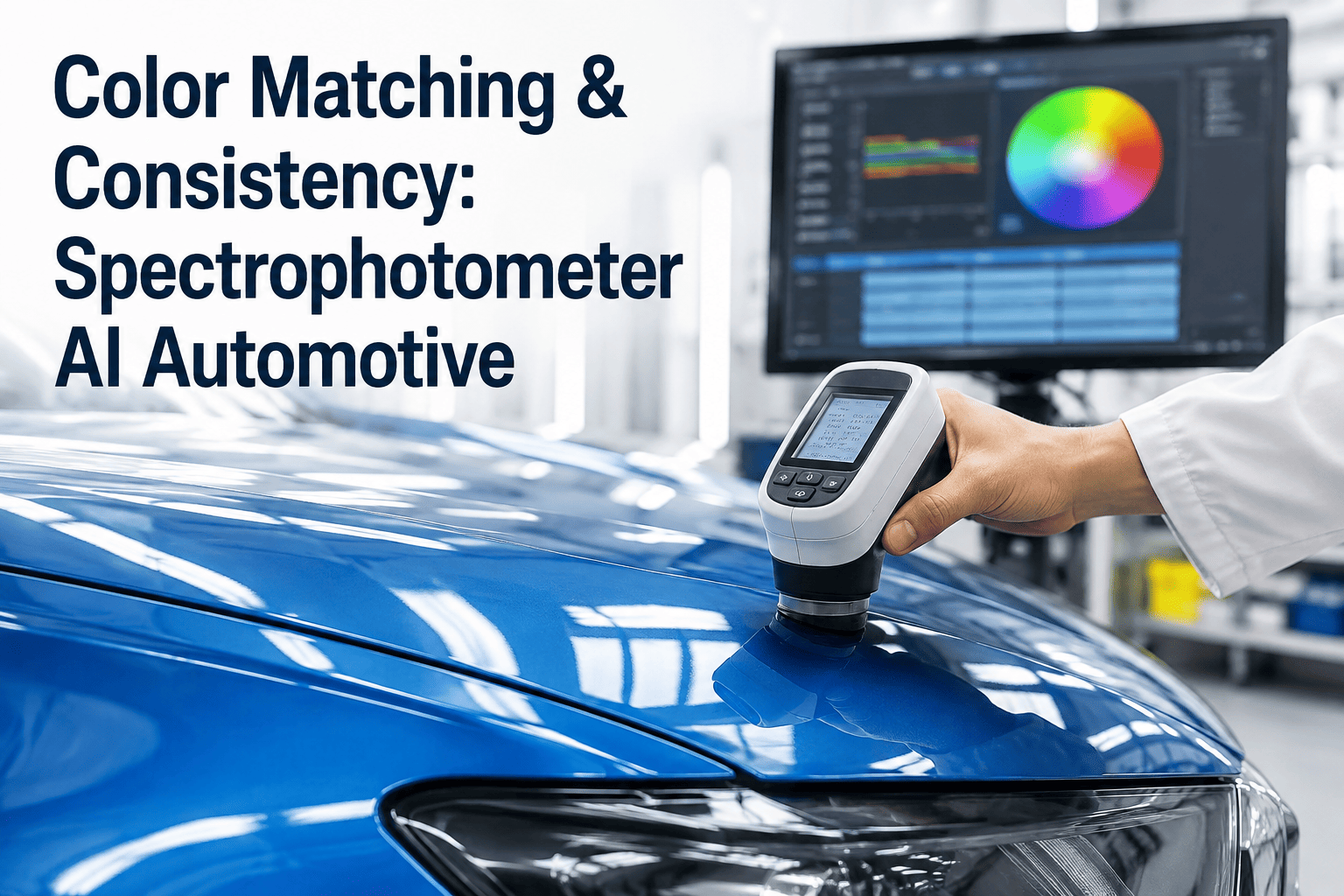
Every production color has a target Delta-E tolerance, a numeric measure of how far a sample can drift from the master standard before it counts as a visible mismatch. The problem is that most shops still verify color with handheld single-angle spectrophotometers spot-checked on a sample of bodies, which catches gross drift but misses the angle-dependent flop that metallic flake and pearlescent pigment introduce. A panel can read perfectly on-axis and still fail at the 15 and 110 degree angles a customer's eye naturally sweeps across in daylight.

AI-assisted color grading changes the sampling math entirely. Instead of spot-checking a handful of bodies per shift, multi-angle imaging paired with a trained model can grade every body, panel, and supplier part that moves through the line, flagging Delta-E drift the moment it starts trending rather than after enough bodies have shipped to trigger a warranty pattern.

12
viewing angles typical multi-angle color sensors capture per reading
100%
of bodies inspectable with automated inline color grading vs. sample checks
3-5x
more mismatch events caught before shipment with multi-angle grading
<1 sec
typical per-panel grading time for an automated inline color station

Grading Every Source That Feeds a Color Match

Color mismatch rarely comes from one place. It shows up at the intersection of the paint line's own batch-to-batch drift, the outside supplier's independently mixed fascia and mirror parts, and the natural aging curve of paint booths as spray equipment wears. A useful color control system separates these sources instead of treating every mismatch report as one undifferentiated quality bucket.

In-Line Body Color
Graded panel-by-panel as bodies exit the paint booth, compared against the current master standard for that color code.
Supplier Fascia & Trim
Incoming inspection grades bumpers, mirror caps, and cladding against the same master standard before they reach final assembly.
Repair & Touch-Up
Any panel reworked after a defect finding gets re-graded before it moves forward, closing the loop that manual sign-off often skips.
Booth-to-Booth Drift
Grading trends by booth and shift surface slow drift in atomization or film build long before it becomes a visible mismatch.
Curious how many of your current mismatch escapes trace back to supplier parts rather than your own line? Book a walkthrough to see a source breakdown on your own data.

Delta-E Tolerance Bands by Application Zone

Not every surface carries the same tolerance. A hood or door panel under direct, close-range customer view demands a tighter Delta-E band than a lower rocker panel or an underbody bracket that is rarely inspected at all. Applying one blanket tolerance across the whole body either wastes inspection effort on low-visibility zones or, more dangerously, lets a high-visibility panel slip through on a tolerance that was really meant for a part nobody looks at closely.

Body ZoneCustomer VisibilityTypical Delta-E Tolerance
Hood, doors, roofHigh — direct eye-level viewTightest band, angle-checked
Bumper fascia, mirror capsHigh — often supplier-sourcedMatched to body panel band
Rocker panels, lower claddingModerate — angled, lower viewModerate band
Underbody, wheel wellsLow — rarely inspected visuallyWidest acceptable band

What an AI Color Grading Model Actually Learns

A color grading model is trained against the plant's own master standards, not a generic color library, because the same nominal color code can carry small, acceptable variation between plants due to differences in booth humidity, gun setup, and even regional pigment lots. The model learns the boundary between normal batch variation and a genuine mismatch by training on a large set of graded historical panels, including both accepted and rejected examples, so it captures the plant's actual tolerance rather than a textbook definition of the color.

Once trained, the model scores incoming images against that learned boundary and returns both a pass or fail call and a Delta-E value the quality team can trend over time. This trending is often more valuable than the individual pass or fail call, because a color that is still passing but sliding steadily closer to the tolerance edge is an early warning that something upstream — a pigment lot, a booth temperature drift, a worn atomizer — needs attention before it produces an actual failure.

1
Multi-angle image capture at the paint booth exit or incoming dock
2
Model compares captured color against the current master standard
3
Delta-E score returned with pass, warn, or fail classification
4
Trend logged by booth, shift, and supplier for root cause review

Catching Drift Before It Becomes a Warranty Pattern

Color mismatch that reaches a customer rarely shows up as a single complaint. It tends to arrive as a cluster of warranty claims tied to a specific model, color code, and production window, by which point the root cause — a pigment lot change, a booth recalibration that drifted, a supplier's independent color adjustment — is weeks in the past and difficult to reconstruct. Continuous inline grading turns that reactive pattern into a proactive one, because the trend data shows exactly when a color code started drifting and which booth or supplier batch was involved.

This matters most for platforms that share body colors across multiple plants or that source the same fascia color from more than one supplier, since a drift in any one node can quietly desynchronize the whole network's color match without any single plant's own tolerance check catching it in isolation.

Want to see what a warranty-pattern trace would have looked like with inline color trend data? Talk to our team about reviewing a past color escape against this kind of trending.

Building the Feedback Loop Back to the Paint Booth

Grading color is only half the value. The other half is routing the finding back to the booth fast enough that an operator or process engineer can act on it before more bodies pass through the same drifting condition. A system that generates a grading report at end of shift is still catching the problem after dozens or hundreds of bodies have already been painted under the same drifting parameter.

Feedback CadenceWhat Gets CaughtTypical Response Time
Real-time booth alertSudden Delta-E jump on a single bodyWithin the same shift
Shift-end trend reportGradual drift across a shift's worth of bodiesNext shift startup
Weekly supplier trendSlow supplier-side color drift on incoming partsNext supplier review cycle

Real-time booth alerts are best reserved for sudden, sharp Delta-E jumps that indicate something changed abruptly, such as a mis-mixed batch or a clogged nozzle, since flooding operators with alerts for every minor fluctuation trains them to ignore the system entirely. Gradual drift is better served by a shift-end or daily trend view that a process engineer reviews deliberately, because the corrective action for slow drift — recalibrating a booth, adjusting a formulation — is rarely something that needs to happen mid-shift.
Frequently Asked Questions

Can AI color grading handle metallic and pearlescent finishes, or only solid colors?
Metallic and pearlescent finishes are actually where AI-assisted grading adds the most value, because these effect finishes are precisely the ones where single-angle human inspection misses angle-dependent flop that becomes visible as a customer walks around the vehicle. Multi-angle image capture paired with a trained model can evaluate sparkle, coarseness, and color travel across the same range of angles a human eye naturally sweeps, producing a more complete match verdict than a spot check ever could. Solid colors are comparatively simpler to grade since they lack this angle dependency, but the same inline system handles both without needing separate hardware or a separate workflow. Reach out to our team to discuss how this applies to your current color portfolio.
How does the system handle color from outside suppliers, like bumper fascias?
Supplier parts are graded at incoming inspection against the exact same master standard used for in-house painted panels, which closes a gap that many plants currently have where supplier color is verified against the supplier's own internal standard rather than the receiving plant's actual production color. This matters because two suppliers, or a supplier and an in-house line, can each independently pass their own tolerance check while still producing a visible mismatch once the parts are assembled together on the same vehicle. Grading everything against one shared standard removes that blind spot entirely. Book a demo to see supplier and in-house grading run side by side.
Does this replace the handheld spectrophotometer checks our quality team already does?
Inline grading is generally best positioned as a supplement to spot checks rather than a full replacement, at least during an initial rollout period, since handheld checks remain useful for spec validation, supplier audits, and situations where a panel needs a deliberate, close-range measurement outside the normal production flow. What inline grading changes is the sampling rate — moving from a handful of spot-checked bodies per shift to effectively every body — which is the coverage gap that lets slow drift and rare defects slip through a sample-based program regardless of how accurate the handheld instrument itself is. Talk to our team about how the two approaches typically work together.
What causes most color mismatch findings once a plant starts full inline grading?
The most common driver plants tend to uncover once they move to full inline grading is slow booth drift rather than a single dramatic failure — things like gradual atomizer wear, minor film build variation, or booth temperature and humidity swings that each individually stay within tolerance but compound into a visible mismatch over time. Supplier lot-to-lot pigment variation is the second most common driver, particularly for plants sourcing the same color from more than one supplier facility. Both of these patterns are specifically the kind of gradual, cumulative drift that sample-based spot checks are structurally poor at catching, which is part of why full coverage grading tends to surface them so quickly after go-live. Book a walkthrough to see a drift pattern analysis on your own historical data.
How long does it take to train a color model for a new color code launch?
Training time depends heavily on how much graded historical data already exists for a color, but a new launch color generally requires building the training set from scratch using panels graded during early production runs, since there is no historical library to draw from yet. This is typically handled by running a wider manual tolerance band during the first production weeks while the model accumulates enough graded examples, then tightening automated grading once the model has seen sufficient variation to reliably separate acceptable from unacceptable panels. Established colors with years of production history train much faster since the historical data already exists. Reach out to our team to discuss timing for an upcoming color launch.
Stop Finding Mismatch After It Ships

Grade Every Body, Every Panel, Every Supplier Part

Share your current color tolerance data and mismatch history. We'll show you where an inline, multi-angle grading system would have caught the drift before it reached a customer.
100%
Body coverage
12-Angle
Color capture
Real-Time
Drift alerts
Supplier
Parts included

Share This Story, Choose Your Platform!