Every automotive plant runs a daily production meeting. Most of them run badly. Fifteen minutes turns into forty, the same three excuses repeat from Monday to Friday, and the loss data everyone glances at was pulled from a shift-end spreadsheet that nobody trusts. A daily production meeting built around a live OEE and loss review changes the shape of that conversation entirely — it replaces opinion with a ranked list of what actually stole output yesterday, and it ends with named owners and dates instead of nods. The mechanics of that meeting, who runs it, what data it needs open before anyone speaks, and where it goes wrong, are what separate plants that shrink their loss stack month over month from plants that hold the same meeting for years and never move the number.
Turn Fifteen Minutes a Day Into Your Fastest Improvement Engine
A structured daily production meeting anchored on live OEE and ranked losses gets the right people looking at the right problem before it repeats for a second shift.
Why Most Daily Production Meetings Waste the Room
The pattern repeats across plants of every size: a supervisor reads yesterday's output number off a whiteboard, someone mentions "the usual issue on line 3," and the meeting closes without a single action being written down. The root cause is almost always data timing, not people. If the OEE figure discussed at 7 AM was assembled by hand at 9 PM the night before, it is already stale, already disputed, and already stripped of the detail needed to assign a fix.
median OEE across manufacturing plants in 2026, with automotive Tier-1 lines typically running 65–78%
the gap that manual, paper-based OEE logs typically overstate versus direct-sensor measurement
share of total losses attributable to micro-stops under five minutes — the category most meetings never see
documented OEE improvement at one Tier-1 automotive supplier after standardizing measurement across 40 sites
The Fifteen-Minute Agenda That Actually Holds
A daily production meeting that runs long has usually lost its structure. The version that works follows a fixed clock, in a fixed order, with the loss data already open on screen before the first person speaks. Nobody presents from memory.
Yesterday's OEE headline
Availability, Performance, and Quality read off the live dashboard, compared against the shift target. No debate at this stage — just the number.
Top three losses, ranked
The Pareto view of yesterday's downtime and speed loss events, sorted by minutes lost, not by who shouts loudest about them.
Root cause on loss number one
Five-minute discussion capped at the single biggest loss. Second and third losses get logged for the improvement backlog, not debated live.
Action, owner, date
One corrective action assigned to one named person with one due date. No action leaves the room unowned.
Yesterday's actions closed out
A quick status check on the previous day's assigned action before the room breaks — closes the loop and builds accountability.
Who Needs to Be in the Room — and Why
A daily production meeting fails when the wrong mix of people attends: too many observers dilute accountability, too few decision-makers means actions stall until the next day. The following roster works across most automotive plant layouts.
See a Live Loss Review Before Your Next Shift Change
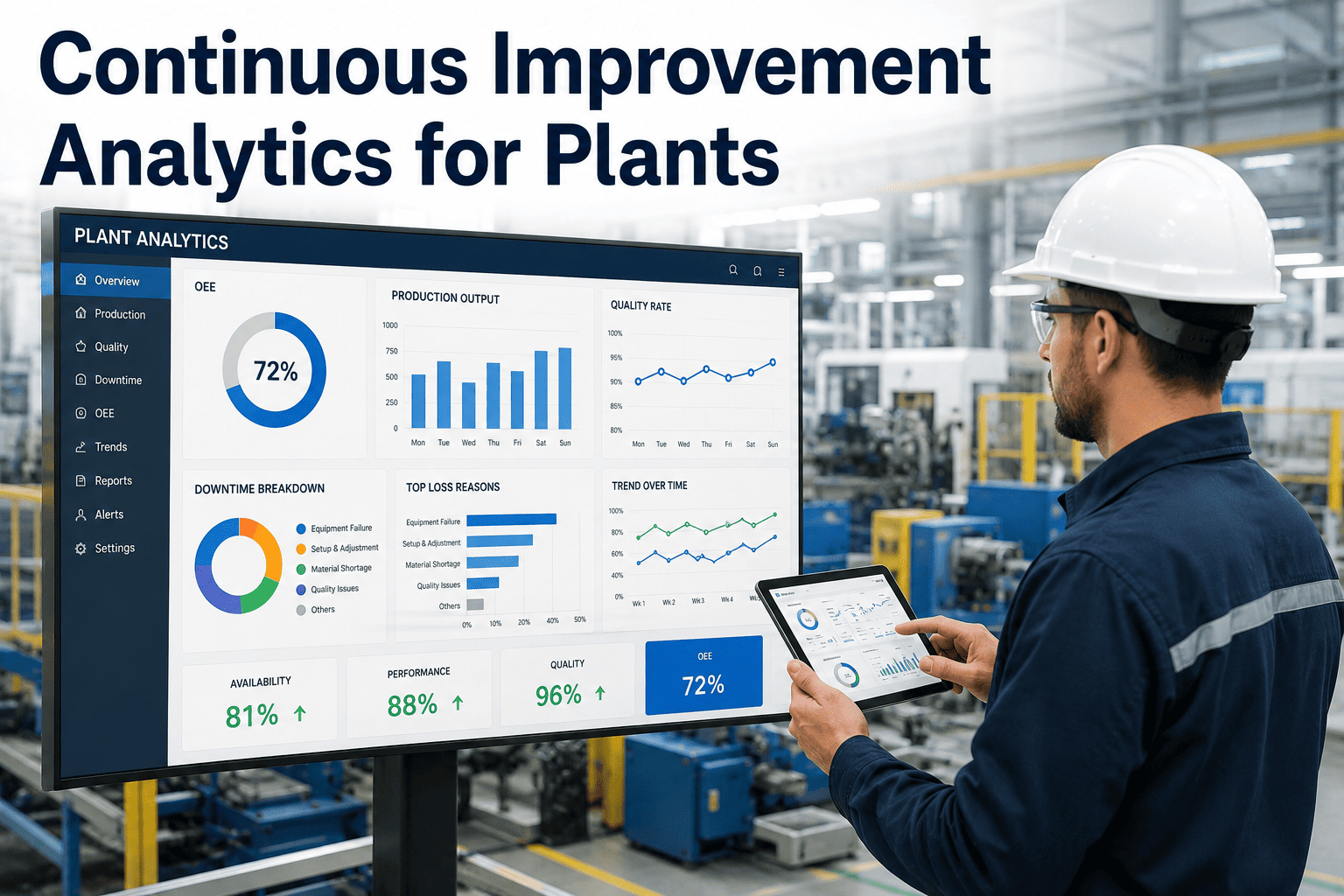
iFactory streams OEE, ranked losses, and open actions to a single screen your team can walk into and read in under two minutes — no overnight spreadsheet required.
Reading a Loss Review Without Getting Lost in It
The loss review is the heart of the meeting, and it is also where most rooms get overwhelmed by data. The fix is a fixed reading order: category first, then event, then cause. Never open with a raw event log.
Which OEE factor moved
Availability, Performance, or Quality — identify which factor dropped versus target before looking at any individual event.
Which loss category dominates
Breakdown, changeover, micro-stop, speed loss, or scrap — the Pareto chart should make the leading category obvious within seconds.
Which asset or station
Drill from category to the specific line, station, or machine responsible for the largest share of that category's minutes.
Which root cause repeats
Cross-reference against the prior five days — a loss that repeats is a process problem, not a one-off, and gets escalated differently.
Four Ways the Meeting Quietly Stops Working
A daily production meeting rarely fails all at once. It erodes through small habits that feel harmless in isolation but compound into a meeting nobody trusts within a quarter.
The data source changes mid-stream
When one week's numbers come from the MES and the next from a supervisor's tally sheet, the room stops trusting either. Lock the meeting to one live source and never switch mid-quarter.
Actions get assigned without a date
"I'll look into it" is not an action. Every item leaving the meeting needs a named owner and a calendar date, tracked visibly enough that skipping it is obvious the next day.
The meeting drifts into problem-solving
Fifteen minutes is not enough time to solve a recurring die failure. The meeting's job is to rank and assign; deep root-cause work belongs in a separate session with the right specialists.
Yesterday's actions never get reviewed
Skipping the closeout step trains the team that assignments are optional. The thirty-second status check at the end of the agenda is what makes the rest of the meeting matter.
What a Structured Review Actually Recovers
The value of a disciplined daily production meeting shows up in the trend line, not any single day. Plants that standardize the review consistently report the same pattern of gains within the first two quarters.
Faster loss visibility
A loss that used to surface in the weekly report now surfaces the next morning, cutting the average time-to-action from days to hours.
Fewer repeat stops
Once a recurring cause is visible on day three instead of day thirty, maintenance can schedule a permanent fix before it becomes a pattern.
Shared accountability
When every function sees the same ranked list, blame shifts from department politics to a shared, numeric priority list everyone agreed to.
Cleaner escalation
Plant managers reviewing weekly summaries see which daily actions stalled, giving them a clean trigger for when to step in versus when to trust the floor.
Frequently Asked Questions
How long should a daily production meeting actually run?
Fifteen minutes is the practical ceiling for a standing daily review with a cross-functional audience. Meetings that regularly run longer are almost always doing root-cause problem-solving live, which belongs in a separate, smaller working session scheduled for the specific issue. Keeping the daily meeting strictly to headline OEE, ranked losses, and action assignment protects attendance and keeps the room focused, which is exactly what a live OEE dashboard is built to support.
What if our OEE data isn't automated yet — can we still run this meeting?
Yes, but the ceiling on how useful it becomes is lower. A manually compiled report is typically eight to fifteen percentage points off from direct-sensor measurement, and the compilation lag means the meeting is reviewing data that is already twelve to eighteen hours stale. Many plants start the daily meeting habit on manual data to build the discipline, then layer in automated capture once the routine is established, which is usually when the real gains appear.
Who should own running the meeting day to day?
The shift supervisor or value stream lead typically owns the agenda and keeps time, while the plant manager attends to provide escalation authority rather than to run the meeting themselves. Rotating ownership across supervisors on different shifts also helps standardize the format faster, since each supervisor brings the discipline back to their own team.
How do we stop the same loss from showing up as "top three" every single day?
A loss that repeats for more than three consecutive days without resolution should be escalated out of the daily meeting and into a dedicated root-cause session with maintenance, quality, and engineering. The daily meeting's job is to flag the pattern quickly, not to solve chronic problems in a fifteen-minute window — treating a five-day-old repeat stop the same as a first occurrence is the most common reason improvement stalls.
Can this format work across multiple lines or only a single line?
Multi-line plants typically run a line-level version at shift change and a rolled-up plant-level version once daily, using the same ranked-loss format at both scales. The line-level meeting stays granular to individual stations, while the plant-level version aggregates to line comparisons so leadership can see which line needs support without drowning in station-level detail. Teams scaling this across several lines often book a walkthrough to see how the rollup view is configured.
Give Your Team a Meeting Worth Showing Up To
See how iFactory turns yesterday's shift data into a ranked, two-minute loss review your whole team can act on before the line restarts.