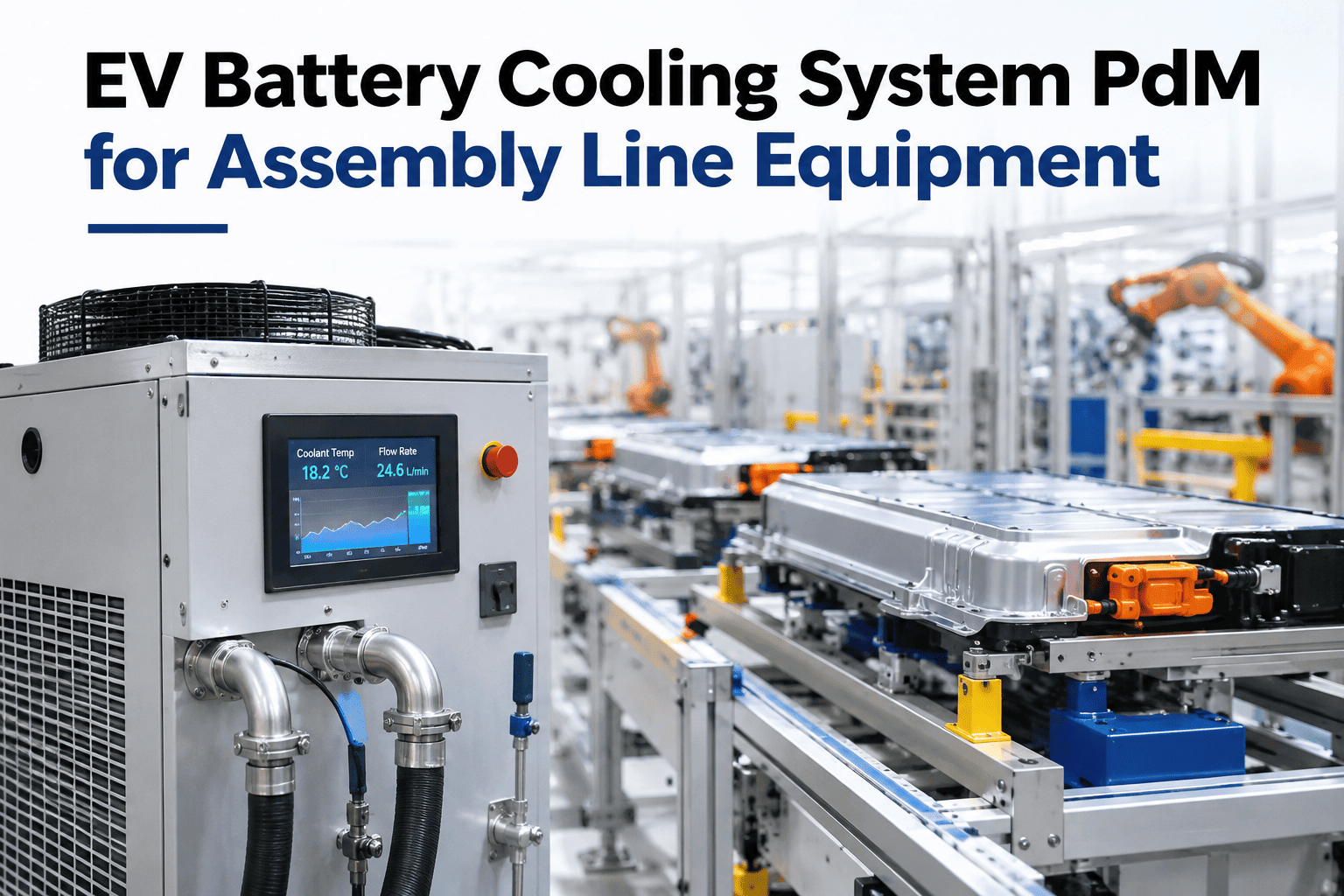
Battery cooling in a gigafactory isn't a comfort system — it's a safety-critical process that has to hold tight temperature and flow tolerances, which makes a slowly degrading chiller or a developing coolant flow restriction a very different kind of risk than it would be in a conventional HVAC setting. Catching chiller performance drift, coolant flow changes and heat exchanger degradation before they threaten that tolerance is what predictive maintenance for cooling equipment actually needs to deliver. Gigafactory engineering teams can review a cooling system PdM approach against their own equipment with iFactory AI.
Battery Cooling Runs on a Tighter Tolerance Than Most Equipment on the Floor
iFactory AI tracks chiller performance, coolant flow and heat exchanger degradation continuously, keeping gigafactory cooling systems inside their safety-critical tolerance.
Three Components, Three Different Failure Signatures
Chillers, coolant flow paths and heat exchangers each degrade in their own specific way, and a monitoring approach built for one does not automatically catch problems in another.
What Degradation Looks Like Before It Becomes a Fault
See Your Own Cooling System's Current Trend
Share recent chiller and flow data and a short session will show whether any component is trending toward a problem.
A Composite Scenario: The Flow Restriction Caught Before It Mattered
A gigafactory's cooling loop had been operating within its alarm thresholds for months, giving no indication through standard monitoring that anything was wrong. Tracking flow rate as a continuous trend rather than only checking it against a fixed alarm limit showed a gradual decline developing over several weeks, consistent with an early-stage restriction forming somewhere in the loop. Investigating and clearing the restriction before it approached the alarm threshold avoided what could have become an urgent safety-related response later — a trend iFactory AI's team can help track in your own cooling system data.
Why Trend Monitoring Matters More Here Than Elsewhere
Because battery cooling tolerances are tighter and the consequences of a failure more serious, catching degradation at the earliest possible trend stage — rather than waiting for an alarm threshold — is a meaningfully different standard than for less safety-critical equipment on the same line.
Frequently Asked Questions
Keep Your Cooling System Inside Its Safety-Critical Tolerance
iFactory AI tracks chiller performance, coolant flow and heat exchanger health as continuous trends. Book a walkthrough with your own cooling data.