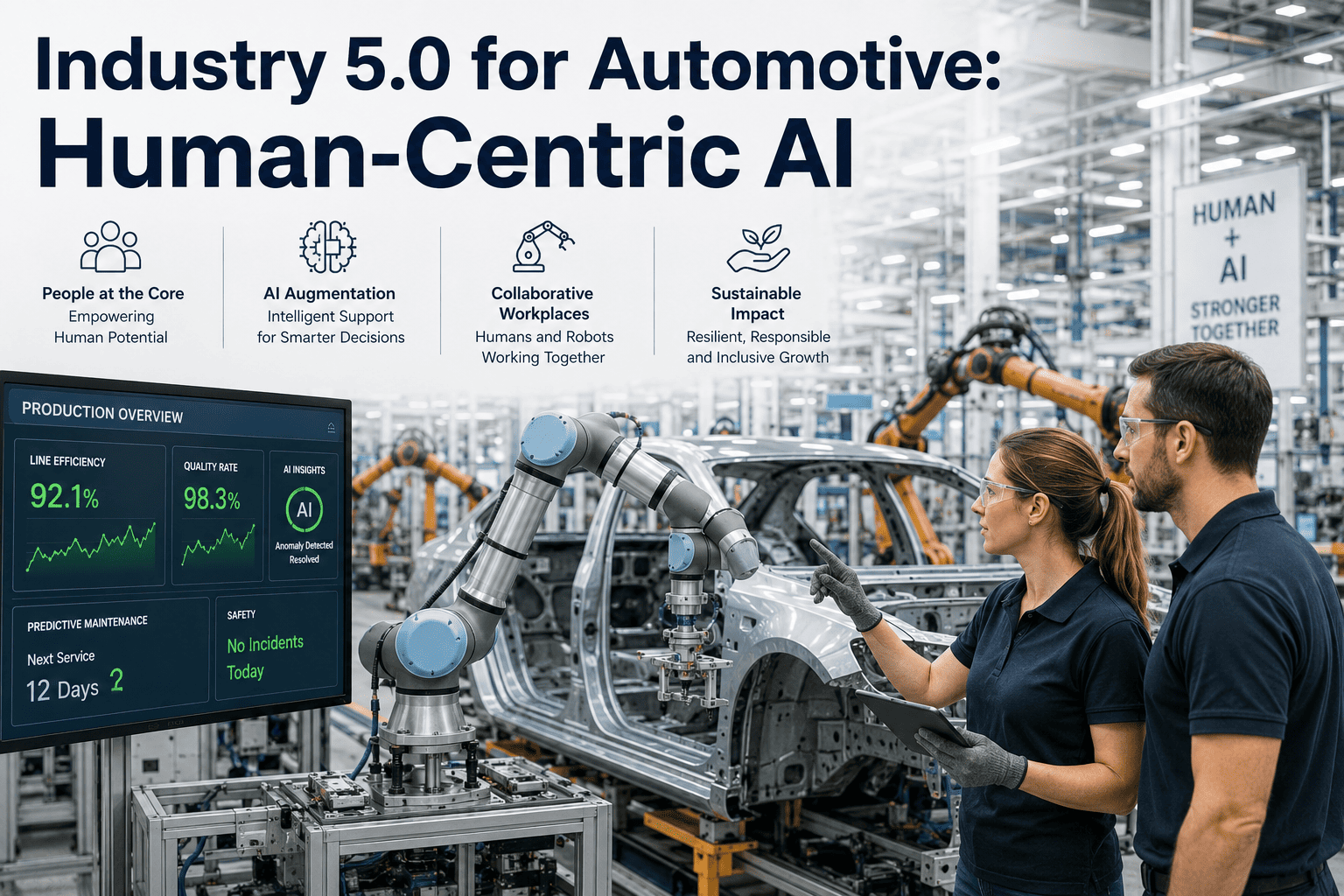
The automotive industry spent the last decade pursuing Industry 4.0 with a technology-first mindset, and the results are mixed at best. Plants have more sensors, more dashboards, and more data than ever before, yet workforce engagement scores have declined, skilled operator turnover has increased, and the AI systems that were supposed to augment human decision-making are often experienced by the shop floor as surveillance tools that add reporting burden without reducing workload. Industry 5.0 is the correction to this trajectory. It does not abandon the technology investments of 4.0 but reframes them around a different objective: technology serves the human operator, not the other way around. For transformation leads tasked with making smart factory investments actually stick, understanding this distinction is not optional. If you are building an AI strategy that your operators will actively use rather than passively resist, Book a Demo with iFactory AI to see how human-centric deployment changes adoption outcomes.
Industry 5.0 for Automotive — Building AI That Operators Actually Use
iFactory AI delivers human-centric AI platforms designed for automotive transformation leads who need technology adoption, not just technology deployment. Augmented operators, collaborative cobots, and AI systems built around human workflows.
Why Industry 4.0 Hit a People Wall in Automotive Plants
The technology-first approach of Industry 4.0 produced measurable gains in data visibility and automation, but it also produced a set of people-related failures that are now limiting further progress. Transformation leads recognize these patterns even when they are not discussed in vendor presentations. The evidence blocks below document the five most consistently reported people-side failures from Industry 4.0 programs in automotive, each of which Industry 5.0 is designed to address directly.
AI Adoption Rates Below 30 Percent on the Shop Floor
Across automotive plants that have deployed AI-assisted decision tools, actual adoption by operators and shift supervisors consistently falls between 15 and 30 percent of the target user base. The primary reason is not technical quality. It is that the tools were designed for analysts and managers, not for the people who need to use them during a shift. Interfaces require too many clicks, recommendations arrive too late for real-time decisions, and the cognitive load of interpreting AI outputs exceeds the cognitive load of just relying on experience. Industry 5.0 flips the design process by starting with the operator workflow and building AI into existing habits rather than requiring new ones.
Skilled Operator Turnover Accelerated by Technology-Driven Role Erosion
Experienced operators who spent decades developing process knowledge are being asked to interact with AI systems that reduce their role to button-pushing and data entry. The message they receive, regardless of executive intent, is that their expertise is being replaced rather than augmented. In an industry already facing a skilled workforce shortage, this perception drives experienced operators toward early retirement and makes the trade less attractive to new entrants. Industry 5.0 addresses this by positioning AI as an expertise amplifier that makes senior operators more effective and more valuable, not less.
Dashboard Proliferation Without Decision Impact
The average automotive plant now operates between 8 and 15 separate dashboard systems covering OEE, quality, energy, maintenance, safety, and production scheduling. Shift supervisors spend more time navigating between dashboards than making decisions based on dashboard data. Each system was justified individually, but collectively they create information overload that degrades rather than improves decision quality. Industry 5.0 consolidates AI-driven insights into role-specific interfaces that deliver one prioritized recommendation per decision point rather than requiring the human to synthesize data from multiple sources.
Cobot Deployment Without Workflow Integration
Collaborative robots have been installed in hundreds of automotive assembly and subassembly cells, but many operate as isolated automation islands rather than true human-robot collaboration partners. The cobot performs its task, the operator performs theirs, and the collaboration is sequential rather than simultaneous. This misses the fundamental promise of cobots, which is real-time task sharing where the robot handles what it does best and the human handles what requires judgment, dexterity, or adaptability. Industry 5.0 requires cobots to be integrated into the human workflow through AI-driven task orchestration.
Training Gaps That Turn New Technology Into New Risk
Technology deployments in automotive plants consistently underinvest in the human training component. The ratio of technology spend to training spend in typical Industry 4.0 programs is between 15:1 and 25:1. Operators receive a two-day classroom introduction to a system they will use every shift for years, with no structured ongoing skill development. The result is that operators use systems at a fraction of their capability, develop workaround habits that bypass designed workflows, and in some cases create safety risks by misinterpreting AI-generated recommendations. Industry 5.0 mandates that training investment be proportional to technology investment and that skill development be continuous, not one-time.
Three Pillars of Industry 5.0 for Automotive Manufacturing
Industry 5.0 is built on three pillars that together define a different relationship between technology and the human worker. Unlike Industry 4.0, which optimized primarily for efficiency and productivity, Industry 5.0 explicitly adds human-centricity and sustainability as co-equal objectives. For automotive transformation leads, these three pillars provide the evaluation framework for every technology investment decision: does this investment serve the human worker, does it improve resilience, and is it designed for long-term sustainability?
Human-Centricity
Technology is designed around the human operator's cognitive capacity, physical ergonomics, and decision workflow. Systems adapt to the human, not the human to the system.
AI assistants that present one prioritized action per decision point, voice-guided assembly instructions that leave hands free, and augmented reality overlays that project guidance directly onto the work surface.
Operator adoption rate above 70 percent, reduction in cognitive workload measured by task completion time under stress, and operator satisfaction scores above 4.0 on 5-point scale.
Resilience
Systems are designed to absorb disruptions rather than optimize for a single operating point. Flexibility and adaptability are valued equally with efficiency and throughput.
Production lines that reconfigure dynamically for mixed-model runs, AI-driven supply chain sensing that adjusts schedules before disruptions arrive, and human operators empowered to override AI recommendations when real-time conditions warrant it.
Recovery time from unplanned disruptions reduced by 50 percent, ability to handle 30 percent product mix variation without line rebalancing, and operator override rate as a leading indicator of system trust calibration.
Sustainability
Technology investments are evaluated for environmental and social sustainability impact alongside financial return. Long-term resource efficiency is built into system design rather than treated as a compliance afterthought.
AI-optimized energy consumption that reduces per-vehicle carbon footprint, predictive maintenance that extends asset life and reduces material waste, and digital twin simulation that eliminates physical prototype iterations.
Per-unit energy reduction of 15 to 25 percent, scrap and rework reduction contributing to material waste targets, and total cost of ownership models that include environmental externalities in investment decisions.
The Human-AI Collaboration Spectrum in Automotive Operations
One of the most consequential decisions a transformation lead makes is determining where each AI application falls on the human-AI collaboration spectrum. Getting this wrong is the single most common cause of AI rejection by the workforce. If a decision that operators believe requires human judgment is delegated to AI without adequate oversight, trust collapses. If a decision that AI could handle autonomously requires human approval for every instance, the AI becomes a bottleneck rather than an accelerator. The spectrum below defines five collaboration levels and maps them to specific automotive use cases.
Human-Only Decision
No AI involvement in the decision. The human operator uses experience, training, and available information to make the call. AI may provide background data but does not generate recommendations. In automotive, this level applies to safety-critical decisions like lockout-tagout procedures, quality containment calls on customer-facing defects, and any decision with irreversible consequences where human accountability is non-negotiable.
Auto Example: Safety stop authorization, final quality containmentAI-Informed, Human-Decides
AI analyzes data and presents relevant context, trends, or options to the human decision-maker. The human retains full authority to accept, modify, or reject the AI-provided information. This is the most common starting point for Industry 5.0 deployments because it builds operator trust through transparency without requiring operators to cede decision authority. In automotive, this level fits production scheduling adjustments, maintenance prioritization, and process parameter changes within defined safe ranges.
Auto Example: Maintenance prioritization, schedule adjustment recommendationsAI-Proposes, Human-Approves
AI generates a specific recommended action with a confidence score and supporting evidence. The human reviews the recommendation and explicitly approves or rejects it before execution. This level is where most AI value is captured in automotive operations because it scales human decision-making capacity without removing the human from the loop. The critical design requirement is that the approval step must take less than 10 seconds, or operators will begin auto-approving without reading, which defeats the human-in-the-loop purpose entirely.
Auto Example: Predictive maintenance work order generation, quality alarm triageAI-Executes, Human-Overrides
AI executes decisions autonomously within a defined boundary, and the human has the ability to override at any time. Overrides are logged and fed back into the AI system for learning. This level requires high model confidence, well-defined operational boundaries, and an override mechanism that is physically and cognitively accessible to the operator. In automotive, this applies to adaptive process control within safe parameter ranges, automated material replenishment, and cobot task adjustment based on real-time human motion tracking.
Auto Example: Adaptive process control, cobot task reallocationAI-Autonomous with Human Governance
AI operates autonomously within a defined scope, and the human role shifts from operational oversight to governance, policy setting, and exception management. The human does not review individual AI decisions but instead monitors system-level performance metrics, adjusts governance policies, and intervenes only when system-level indicators suggest the AI is operating outside its intended scope. In automotive, this level is appropriate for closed-loop quality optimization on stable processes, energy management systems, and automated inspection with human governance of model drift.
Auto Example: Energy optimization, stable-process closed-loop qualityHow Industry 5.0 Redefines Six Key Automotive Plant Roles
Industry 5.0 does not eliminate plant roles. It evolves them. The table below maps the transition for six critical automotive plant roles from their Industry 4.0 state, where technology often reduced their scope, to their Industry 5.0 state, where technology amplifies their expertise. For transformation leads, this mapping is the most important communication tool for managing workforce resistance, because it gives operators and supervisors a concrete answer to the question of what their job becomes in an AI-augmented plant.
| Plant Role | Industry 4.0 Reality | Industry 5.0 Evolution | AI Interaction Level | Key Capability Shift |
|---|---|---|---|---|
| Line Operator | Monitored dashboards, logged data, followed AI-generated instructions passively | Validates AI recommendations, makes real-time override decisions, trains new operators using AI-captured best practices | Level 3–4 | From data entry to decision validation |
| Shift Supervisor | Navigated 8–15 dashboards, synthesized information manually, reacted to escalations | Receives AI-prioritized action list, focuses judgment on highest-impact decisions, coaches operators on AI interaction | Level 2–3 | From information synthesis to judgment application |
| Maintenance Technician | Received work orders from CMMS, performed repairs based on experience and manuals | Receives AI-diagnosed fault with recommended repair procedure, validates diagnosis, provides feedback that retrains models | Level 3 | From reactive repair to validated diagnosis |
| Quality Engineer | Analyzed SPC charts, investigated escapes after the fact, wrote corrective actions | AI predicts quality deviations before they occur, engineer focuses on root cause elimination and process design improvements | Level 2–3 | From reactive investigation to predictive prevention |
| Production Scheduler | Adjusted plans in response to disruptions, manually balanced multiple constraints | AI generates optimized scenarios, scheduler evaluates trade-offs and selects based on business context AI cannot fully capture | Level 2 | From manual optimization to scenario evaluation |
| Reviewed summary dashboards, received lagging indicators, made strategic decisions on incomplete information | AI provides real-time digital twin visibility, predictive risk alerts, and scenario simulations for capital and operational decisions | Level 2 | From lagging review to predictive steering |
The Transformation Lead's Compass: Four Directions for Industry 5.0 Deployment
Deploying Industry 5.0 in an automotive plant requires simultaneous movement in four directions. Neglecting any one direction creates an imbalance that undermines the others. Technology without people investment produces tools nobody uses. People investment without technology produces trained operators with nothing new to work with. Vision without governance produces experimental projects that never scale. The compass below provides transformation leads with a framework for evaluating whether their program is balanced across all four dimensions.
Define the Human-Augmented Future State
Before selecting any technology, define what each target role looks like when AI is working as intended. What decisions does the operator make that they do not make today? What information do they see that they cannot see today? What manual tasks are removed from their workload? This future-state role definition becomes the design specification for every technology selection. Without it, technology choices are driven by vendor capability rather than human need.
Deliverable: Role evolution map for 6–10 target positionsSelect for Human Integration, Not Feature Richness
Evaluate AI and automation platforms against the human interaction requirement, not against feature comparison matrices. A platform with fewer features but better operator interface design will outperform a feature-rich platform that requires extensive training and produces cognitive overload. The technology selection criterion that matters most in Industry 5.0 is time-to-value for the human user, not breadth of capability for the IT department.
Deliverable: Technology shortlist scored on human integration criteriaInvest in Capability at Technology-Parallel Scale
The training and change management budget must be proportional to the technology budget, not a fixed percentage tacked on at the end. Industry 5.0 programs that achieve 70 percent plus adoption rates typically invest between 30 and 40 percent of total program budget in human capability development, including structured training programs, ongoing coaching, feedback loop design, and operator-to-operator knowledge transfer mechanisms powered by AI-captured best practices.
Deliverable: Capability development plan with technology-parallel milestonesBuild the Feedback and Accountability Framework
Establish governance structures that ensure AI recommendations are being validated, feedback is being captured, model performance is being monitored, and override patterns are being analyzed. The governance framework is what converts a one-time technology deployment into a continuously improving human-AI system. Without it, model drift goes undetected, operator overrides accumulate without learning, and the system degrades silently. For governance framework design support, Book a Demo with iFactory AI.
Deliverable: Governance charter with feedback loop protocols and review cadenceMeasuring Industry 5.0 Success Through Human Impact Metrics
Industry 4.0 programs measured success through OEE, throughput, and cost reduction. Those metrics remain relevant in Industry 5.0 but they are insufficient. If an AI system improves OEE by 5 points while reducing operator satisfaction by 20 points and increasing turnover by 15 percent, the net long-term impact is negative. Industry 5.0 requires a parallel set of human impact metrics that carry equal weight in program evaluation. The metrics below are organized into three categories that map directly to the three Industry 5.0 pillars.
Percentage of target users actively engaging with AI tools at least once per shift. Target above 70 percent within 90 days of deployment. Below 40 percent signals a design problem, not a training problem.
Percentage of AI recommendations that operators accept without modification. A healthy range is 60 to 80 percent. Below 50 percent means the AI is not aligned with operator judgment. Above 90 percent suggests auto-approval without critical evaluation.
Measured through task-completion-time-under-stress tests and subjective NASA-TLX assessments before and after AI deployment. Industry 5.0 systems should reduce cognitive load, not increase it through additional interface demands.
Time from unplanned disruption detection to full production resumption. Industry 5.0 target is 50 percent reduction versus Industry 4.0 baseline, measured across at least 20 disruption events to ensure statistical reliability.
Number of AI overrides per shift per operator. This metric is a leading indicator of system trust calibration. High override rates signal either model inaccuracy or mismatched collaboration level. The trend direction matters more than the absolute number.
Percentage of product mix variation the line can absorb without manual rebalancing or engineering intervention. Industry 5.0 target is 30 percent mix variation with zero line-stops for model change.
Energy consumed per vehicle or per part produced, measured at the line level. AI-optimized systems should deliver 15 to 25 percent reduction within 12 months through load balancing, idle reduction, and thermal optimization.
Percentage increase in mean time between replacement for critical assets driven by predictive maintenance and AI-optimized operating conditions. Directly measures the sustainability impact of extending useful asset life rather than replacing prematurely.
Reduction in scrap, rework, and consumable waste attributable to AI-driven process optimization. Measured as percentage reduction against pre-deployment baseline, with clear attribution methodology separating AI impact from other improvement initiatives.
The Transformation Lead's 90-Day Industry 5.0 Launch Sequence
Transformation leads do not need a three-year roadmap to start moving toward Industry 5.0. They need a 90-day sequence that produces visible evidence of human-centric AI value while building the organizational momentum for sustained investment. The sequence below is designed to produce at least one measurable human impact metric improvement within the first quarter, creating the internal case study that justifies the next phase of investment. Each phase has a specific deliverable that can be presented to leadership as proof of concept.
Listen and Map the Human Workflow
Spend the first three weeks not selecting technology but understanding the human workflow on the target line. Shadow operators across full shifts. Map every decision point where information is needed, every handoff where delays occur, and every task where cognitive overload is visible. Document the current state with enough specificity that you can measure change later. The output is a human workflow map with 15 to 25 decision points identified, each tagged with current information source, decision frequency, and estimated cognitive load. This map becomes the design input for AI integration, and it is the document that proves to operators that the program starts with their experience, not with a vendor product catalog.
Design the Human-AI Interaction for Three Decision Points
Select the three highest-impact decision points from the workflow map based on frequency, consequence of error, and current information gap. For each decision point, define the AI collaboration level from the spectrum, design the interaction format, and specify the maximum cognitive load the AI interface is allowed to add. Build paper prototypes or low-fidelity mockups and validate them with the operators who will use them. This co-design step is non-negotiable in Industry 5.0. Operators who participate in designing their AI interaction are 3.5 times more likely to adopt the final system compared to operators who receive a designed-by-IT solution. The output is three validated interaction designs ready for technical implementation.
Deploy in Shadow Mode with Structured Feedback
Deploy the three AI interactions in shadow mode, meaning the AI generates recommendations but does not yet drive actions. Operators see the AI output alongside their normal workflow and provide structured feedback through a simple mechanism: correct, partially correct, or incorrect, with an optional free-text comment. This phase builds operator familiarity with the AI output format, calibrates the models against real operator decisions, and identifies interaction design issues before they become adoption barriers. The output is a calibrated model set with documented accuracy against operator decisions and a refined interaction design based on operator feedback.
Activate, Measure, and Report
Transition from shadow mode to active mode at the collaboration level defined for each decision point. Begin measuring the human impact metrics defined in the KPI framework: adoption rate, recommendation acceptance rate, and cognitive workload score. At day 90, produce a measured outcome report that documents baseline versus current-state performance on both traditional metrics like OEE and human impact metrics like adoption rate and cognitive load. This report is the internal case study that justifies expanding the Industry 5.0 approach to additional lines and decision points. It is also the evidence that convinces skeptical operators on other lines that the program delivers tangible benefits, not just more technology to learn. For support structuring your 90-day launch, contact iFactory Support.
Industry 5.0 Automotive Transformation — FAQs for Transformation Leads
How is Industry 5.0 actually different from Industry 4.0 in practical plant terms?
The practical difference is not in the technology itself but in the design starting point. Industry 4.0 started with available technology and asked where it could be applied. Industry 5.0 starts with the human worker and asks what technology would make them more effective. In plant terms, this means AI systems designed for the operator interface first and the data architecture second, cobots integrated into human task flows rather than placed in adjacent stations, and success metrics that include operator adoption and cognitive load alongside OEE and throughput. The technology stack may be similar, but the deployment methodology, success criteria, and organizational change approach are fundamentally different. To see this difference in a live platform demo, Book a Demo with iFactory AI.
Does Industry 5.0 mean we should slow down or reduce our AI investments?
No. Industry 5.0 means redirecting AI investment toward higher-adoption, higher-impact applications rather than abandoning AI investment. Most automotive plants have significant AI budget that is producing low adoption because it was deployed without human-centric design. Industry 5.0 reallocates a portion of that budget from pure technology to human integration, training, and feedback loop design. The net effect is often more AI capability in production use, not less, because the human-centric approach achieves 70 percent adoption instead of 25 percent, which means three times more decisions are actually AI-augmented. For a budget reallocation assessment, reach out through iFactory Support.
How do we convince operators who are resistant to AI that Industry 5.0 is different?
The most effective approach is demonstrating, not explaining. Identify one high-friction decision point on a line where operators currently experience information gaps or cognitive overload. Design an AI interaction specifically for that decision point using the co-design approach where operators help shape the interface. Deploy it for one operator who volunteers, measure the workload reduction, and let that operator's experience communicate the difference to peers. Operator-to-operator testimony is exponentially more persuasive than any management presentation. The 90-day launch sequence is specifically designed to produce these early proof points that overcome resistance through demonstrated benefit rather than through persuasion.
What is the right collaboration level for quality decisions in automotive manufacturing?
Quality decisions in automotive span multiple collaboration levels depending on consequence and reversibility. In-line quality monitoring for process parameter adjustment can operate at Level 4, where AI adjusts parameters autonomously and the operator overrides if needed. Quality containment decisions for customer-facing defects should operate at Level 2, where AI provides diagnostic information but the human makes the containment call because the consequences of a wrong decision are severe and non-reversible. Root cause analysis for chronic quality issues operates at Level 2 to 3, where AI identifies patterns and suggests root causes but the quality engineer validates before committing to corrective actions. The key principle is that consequence and reversibility determine the collaboration level, not the technical capability of the AI system.
How do we measure ROI on human-centric investments that do not directly reduce costs?
Human-centric investments produce returns through three mechanisms that require different measurement approaches. First, reduced turnover: measure the cost-per-hire and training-cost-per-new-operator avoided when experienced operators stay longer because their role is evolving rather than eroding. Second, faster decision-making: measure the time from information availability to action before and after AI augmentation, and convert that time reduction into production value. Third, error reduction: measure the frequency and cost of decisions made under cognitive overload before AI assistance versus after, capturing both the direct error cost and the indirect cost of rework and investigation. When these three mechanisms are quantified, human-centric ROI typically ranges from 2.5x to 4x within 18 months. For ROI modeling specific to your plant, Book a Demo with our transformation team.
Build an AI Strategy Your Operators Will Champion, Not Resist
Connect with iFactory AI to design a human-centric AI deployment plan for your automotive plant, starting with a 90-day launch sequence that produces measurable human impact metrics alongside traditional performance gains.