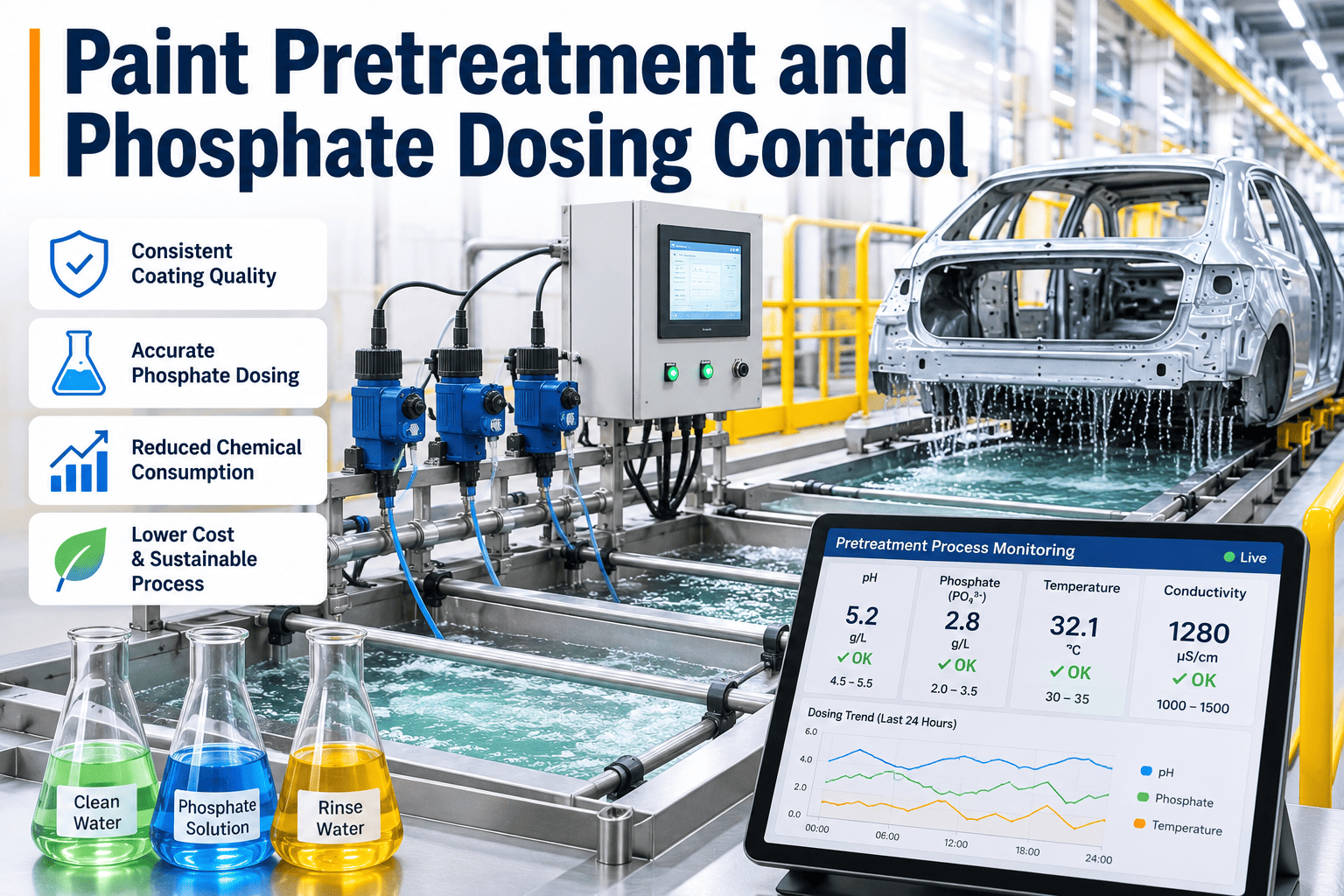
In modern paint shops, the pretreatment stage is the silent gatekeeper of finish quality. A 1-micron deviation in phosphate crystal structure can reduce paint adhesion by up to 40%, leading to costly rework and warranty claims. The chemistry of phosphating, rinsing, and passivation must be maintained within tight windows—pH, temperature, conductivity, and chemical concentration all interact non-linearly. Traditional PID controllers and manual lab sampling simply cannot keep pace with production line fluctuations. This is where AI-driven predictive dosing transforms the game. By integrating real-time sensors with machine learning models, plants can achieve sub-ppm dosing accuracy, reducing chemical waste by 25% while improving first-pass yield to over 98%. Book a Demo to see how our platform stabilizes your pretreatment bath in under 7 days.
Transform Your Pretreatment Line Today
Achieve zero-defect paint adhesion with AI-controlled phosphate dosing. Reduce chemical costs by 30% in 90 days.
Why Pretreatment Chemistry Demands AI Precision
The chemical conversion coating process—typically zinc phosphate or trication phosphate—relies on a delicate balance of accelerators, nickel, and manganese. Even a 0.1 pH shift can alter crystal morphology from dense, plate-like structures to porous, needle-like formations. The latter traps moisture and accelerates under-film corrosion. AI models trained on historical bath data can predict these shifts 15 minutes in advance, enabling proactive dosing adjustments. This section explores the fundamental chemistry and why manual control fails.
The Physics of Phosphate Crystal Growth
Phosphate crystals nucleate on metallic surfaces through a controlled electrochemical reaction. The bath's free acid ratio (FA) and total acid (TA) determine nucleation density. AI-driven dosing maintains FA/TA within 0.1% tolerance, ensuring uniform crystal size (5–10 µm). Any deviation leads to patchy coverage, which is invisible until after painting. We have seen plants reduce coating weight variation from ±3 g/m² to ±0.5 g/m² using our predictive model. The model uses multivariate analysis of temperature, conductivity, and turbidity to adjust dosing pumps in real time.
Real-Time Bath Monitoring
Continuous pH, conductivity, and temperature sensors feed data to a cloud-based AI engine. Alerts are sent when any parameter deviates beyond 1 sigma.
Predictive Dosing Algorithms
LSTM neural networks forecast chemical consumption based on production rate, part geometry, and ambient conditions. Dosing is adjusted 10 minutes ahead of need.
Closed-Loop Control
The AI directly commands dosing pumps and valves, bypassing human intervention. This reduces response time from hours to seconds.
Compliance Reporting
Automated logs of bath conditions and dosing events satisfy ISO 9001 and automotive quality audits. Reports are generated in one click.
Implementation Timeline: From Audit to Optimization
Week 1: Baseline Audit
We install wireless sensors on your existing pretreatment tanks. Data is collected for 72 hours to establish current variability.
Week 2: Model Training
Our AI models are trained on your historical lab data and real-time sensor feeds. The model learns your specific bath dynamics.
Week 3: Soft Launch
AI recommendations are displayed to operators via dashboard. Dosing adjustments are suggested, not automated, to build trust.
Week 4: Full Automation
Closed-loop control is enabled. The AI manages dosing 24/7. Plant yields stabilize within 5 days.
Chemical Savings Comparison: Manual vs AI Dosing
| Parameter | Manual Dosing | AI Dosing | Improvement |
|---|---|---|---|
| Phosphate Chemical Cost (per 1000 parts) | $45 | $32 | 29% reduction |
| Accelerator Consumption | 12 L/day | 8 L/day | 33% reduction |
| pH Variation (standard deviation) | 0.35 | 0.08 | 77% improvement |
| Coating Weight Variation | ±2.8 g/m² | ±0.6 g/m² | 79% improvement |
| Rework Rate | 8.5% | 1.2% | 86% reduction |
Case Study: Automotive Tier 1 Supplier Cuts Rework by 86%
A major automotive paint shop in the Midwest was experiencing 8.5% rework due to poor paint adhesion traced to phosphate bath instability. Their manual dosing schedule could not keep up with line speed variations. After deploying iFactory's AI system, they achieved 1.2% rework within 3 weeks. The AI detected a recurring temperature spike every afternoon due to solar loading on the building, and preemptively adjusted the accelerator feed. This reduced chemical costs by $12,000 per month and eliminated a full-time lab technician position.
Ready to Stabilize Your Pretreatment Line?
Our AI platform delivers measurable ROI in under 30 days. Join leading manufacturers who have eliminated pretreatment defects.
Advanced Process Control: Beyond PID
Traditional PID controllers assume linear process behavior, but chemical dosing is inherently non-linear. The reaction rate of phosphating depends on temperature exponentially (Arrhenius equation), while conductivity changes with dissolved solids. AI-based model predictive control (MPC) handles these non-linearities by continuously optimizing a cost function that balances chemical usage, bath stability, and production rate. Our MPC implementation reduces overshoot by 90% compared to PID, meaning the bath stays within spec 99.7% of the time.
Sensor Fusion
Combining pH, ORP, conductivity, turbidity, and temperature into a single state estimate using Kalman filtering. This eliminates sensor drift and noise.
Digital Twin Simulation
A virtual replica of your pretreatment line runs in the cloud, allowing what-if analysis. Test new chemical formulations without interrupting production.
Edge Computing
Inference runs on an edge device at the line, ensuring sub-10ms response time even if cloud connectivity is lost. Local data buffering prevents gaps.
Frequently Asked Questions
How does AI handle different part geometries in the same bath?
Our AI model is trained on surface area and shape factors derived from your production schedule. It adjusts dosing based on the total surface area entering the bath, not just part count. For example, a truck frame requires 3x the chemical of a car door. The model uses a convolutional neural network (CNN) to classify parts from camera images and scales dosing accordingly. This ensures consistent coating weight across mixed-model lines. Book a Demo to see how we handle mixed-model lines.
What sensors are required for AI implementation?
Minimum requirements are a pH probe, conductivity sensor, and temperature probe. We recommend adding an oxidation-reduction potential (ORP) sensor and a turbidity meter for advanced control. All sensors must be industrial-grade with 4-20mA output. We provide a pre-calibrated sensor package that integrates with your existing PLC via Modbus TCP. Installation typically takes one shift. Contact Support for a detailed sensor checklist.
Can the AI system integrate with existing MES or SCADA?
Yes, our platform uses open APIs (REST and OPC-UA) to connect with any MES or SCADA system. We have pre-built connectors for Siemens, Rockwell, and Ignition. The AI outputs setpoints directly to your DCS via OPC-UA, or you can use our dashboard for manual override. Data is stored in a historian for compliance and traceability. Book a Demo to see integration in action.
What is the typical ROI timeline for AI dosing?
Most customers see full ROI within 4 to 6 months. The primary savings come from chemical reduction (20-30%), lower rework (50-80% reduction), and reduced labor for lab sampling. One customer with 5 pretreatment lines saved $180,000 annually in chemical costs alone. Our ROI calculator can provide a custom estimate based on your line data. Contact Support to request a free ROI analysis.
How does the system handle bath dumping and recharging?
When a bath is dumped and recharged, the AI automatically resets its model based on the new chemistry. It uses a transfer learning approach, leveraging data from previous baths to accelerate convergence. Within 2 hours of recharge, the bath is stable and producing acceptable parts. This is a significant improvement over manual methods which often require 8-12 hours of adjustment. Book a Demo to see how we handle bath transitions.
Secure Your Paint Line's Future
Join industry leaders who have eliminated pretreatment defects with AI. Your first audit is free.