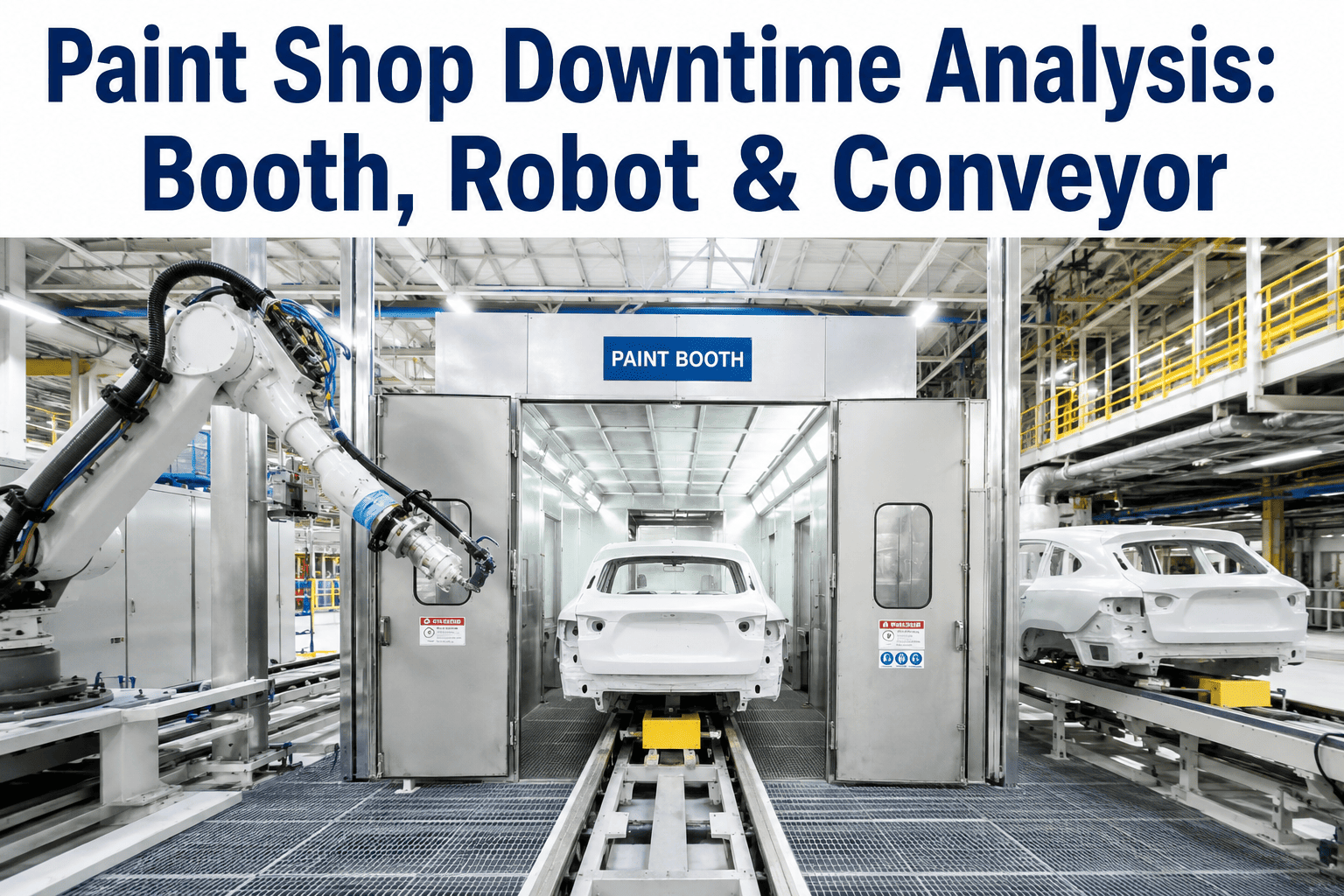
Paint shop downtime behaves differently from anywhere else in an automotive plant, because the process itself is as sensitive to environment as it is to equipment condition. A robot that runs flawlessly all morning can start faulting after lunch purely because booth humidity drifted outside spec, and a conveyor slowdown ordered to protect coating viscosity looks identical in a shift log to an unplanned mechanical fault unless the two are separated deliberately. Analyzing paint shop downtime well means treating environmental systems, application robots, and material handling as three related but distinct loss sources — not one undifferentiated "paint line down" category. This guide walks through how to tell them apart, and if you want that separation running on your own booth data, book a demo with iFactory.
Separate Environmental Loss From Mechanical Failure
Booth conditions, robot faults, and conveyor issues each drive paint shop downtime differently — knowing which one is talking matters more than knowing the line stopped.
Why Paint Shop Downtime Is Uniquely Hard to Attribute
Unlike a stamping press or a weld robot, a paint booth is a controlled environment as much as a piece of equipment. Temperature, humidity, airflow, and coating viscosity all interact, and a fault in any one of them can trigger a stop that a shift log records simply as "booth down," obscuring which underlying system actually needs attention.
A Live Environmental Snapshot
Reading booth conditions alongside downtime events, rather than separately, is what makes the difference between guessing and knowing why a robot faulted at 2 PM.
When humidity drifts near its upper limit, robots often respond with reduced-speed application or intermittent faults well before a hard stop occurs — visible only if environmental data sits next to the downtime log.
See Environmental and Downtime Data Side by Side
iFactory correlates booth conditions with equipment events automatically, so paint shop downtime gets attributed to its real cause.
Three Loss Sources, Three Different Fixes
Booth, robot, and conveyor losses each call for a different team and a different response — lumping them together sends the wrong owner chasing the wrong fix.
Environmental system
HVAC drift, filter loading, air makeup unit faults. Fix: facilities and HVAC maintenance, seasonal filter change schedules.
Application robot
Bell cup wear, electrostatic charge faults, path deviation from booth turbulence. Fix: robot maintenance and applicator PM schedule.
Conveyor / material handling
Chain wear, carrier misalignment, deliberate speed reduction for coating dwell time. Fix: mechanical maintenance, or a process parameter review if intentional.
Reading the Correlation: Environment vs. Equipment
A quick reference for separating a genuinely environmental cause from a mechanical one when a stop appears in the log.
Frequently Asked Questions
How much of paint shop downtime is typically environmental versus mechanical?
The split varies significantly by climate and season, but many plants find environmental factors contribute more to intermittent, hard-to-reproduce faults than to hard stops, while mechanical failures dominate the outright stop-the-line events. Plants in humid regions often see a seasonal pattern where environmentally correlated robot faults spike during summer months, which is exactly the kind of trend that only becomes visible once environmental and downtime data are analyzed together.
Why does a deliberate speed reduction get confused with an actual downtime event?
Because both look identical on a basic conveyor speed log — the line is simply running slower than nameplate rate. Without a flag distinguishing an intentional process-driven speed change from an unplanned slowdown, both get bucketed into "speed loss" and inflate the apparent downtime problem. Tagging planned process adjustments separately in the downtime analytics system keeps the two from being conflated.
What humidity range typically causes robot application issues?
Specific thresholds vary by coating system and robot manufacturer, but electrostatic application generally becomes less reliable as humidity climbs toward the upper end of most booths' specified range, since excess moisture affects charge transfer to the part surface. The practical takeaway is less about memorizing a universal number and more about tracking your own booth's actual fault rate against its own humidity readings to find the real threshold for your specific coating system.
Should facilities or production own paint booth environmental downtime?
Most plants split this by root cause once it's correctly attributed: facilities and HVAC maintenance own the environmental control systems themselves, while production and process engineering own the response when conditions drift, such as adjusting line speed or application parameters to compensate. Clear attribution is what makes this split workable — without it, both teams tend to assume the other is responsible.
How do we start correlating booth conditions with our downtime data?
Most paint booths already have environmental sensors feeding a building management system — the gap is usually connecting that data stream to the same timeline as equipment downtime events rather than adding new sensors. Booking a demo is the fastest way to see whether your existing sensors can be integrated directly.
Stop Guessing Whether It's the Booth or the Robot
Book a 30-minute demo and see how iFactory correlates environmental conditions with equipment events on your own paint line.