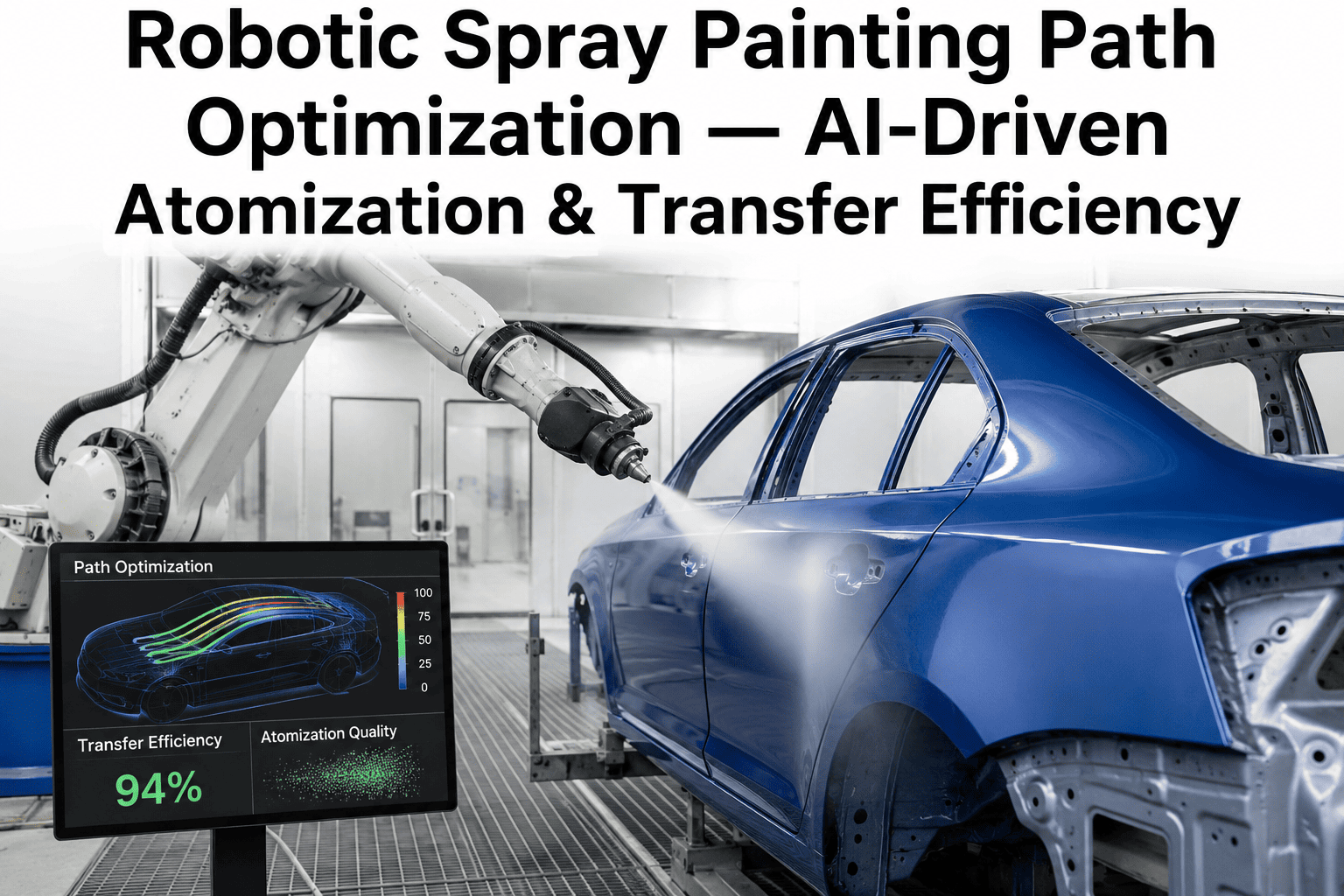
Paint robots are precise machines running imprecise recipes. The same spray gun, atomizer, and robot path get programmed once during line commissioning and then rarely revisited, even as fluid viscosity shifts with temperature, atomizer bells wear down, and booth airflow changes with the seasons. The result is a paint shop quietly losing transfer efficiency, burning more coating material than necessary, and generating overspray that shows up later as VOC compliance pressure and higher paint purchase costs. Our robotic paint specialists can review your current spray parameters against what an AI-tuned path and parameter set would actually recommend.
Paint Shop & Surface Finishing
Every Percent of Transfer Efficiency Is Paint You Don't Have to Buy
A one-point improvement in transfer efficiency across a high-volume paint shop compounds into a meaningful annual materials saving — and it comes from the same booth, the same robots, and the same coating you already run.
Coverage Map Legend
Even film build across every panel zone, from door edge to roof crown
What Actually Determines Transfer Efficiency
Transfer efficiency — the percentage of atomized paint that actually lands on the part versus what turns into overspray — is governed by a combination of gun-to-panel distance, atomizer bell speed, shaping air pressure, electrostatic charge, and the robot's travel speed along the path. Changing any one of these variables without adjusting the others tends to trade one problem for another: slow the robot down to build more film and you also increase the risk of runs and sags; raise bell speed to atomize finer and you can push more material into overspray if the shaping air isn't rebalanced to match.
Most shops set these parameters once per part number during commissioning and rarely touch them again, because manually re-optimizing five interacting variables against film build and appearance targets is a slow, trial-and-error process that few teams have time to repeat every time a coating batch, ambient humidity, or atomizer wear state shifts.
60-70%
typical transfer efficiency on non-optimized electrostatic paint robots
80-90%
achievable transfer efficiency with continuously tuned parameters
15-25%
potential reduction in coating material consumption from tuning alone
5
interacting spray variables that determine transfer efficiency
The Five Variables an AI Tuning Model Balances Together
Rather than adjusting one parameter at a time against a fixed target, an AI-assisted tuning model treats spray optimization as a joint problem, evaluating how gun distance, bell speed, shaping air, electrostatic charge, and path speed interact to produce a given film build and coverage pattern. This is closer to how an experienced paint process engineer actually thinks about the problem, just applied consistently across every part number and every shift rather than depending on one engineer's intuition.
Gun-to-Panel Distance
Closer distance increases transfer efficiency but raises the risk of uneven film build on curved surfaces.
Atomizer Bell Speed
Higher speed produces finer atomization and better appearance, but can increase overspray if shaping air isn't matched.
Shaping Air Pressure
Controls the spray pattern's width and edge definition, directly affecting how much material lands off-target.
Electrostatic Charge
Higher charge wraps paint around part edges more effectively, improving transfer on complex geometries.
Robot Path Speed
Slower travel builds more film per pass but extends cycle time and increases the risk of sags on vertical surfaces.
Want to see what your own line's parameter set is trading off right now?
Book a walkthrough to review your current settings against a tuned baseline.
Path Optimization Beyond the Spray Parameters
Transfer efficiency isn't only about the spray parameters at any single point on the path — it's also about the path itself. Robot paths programmed years ago for a part geometry that has since had minor design revisions often carry small inefficiencies, like overlapping passes on flat panels that don't need the extra coverage, or gaps near complex geometry like door handles and mirror mounts that get compensated for with a blanket increase in overall film build across the whole panel rather than a targeted fix.
Reviewing path data against actual film build measurements, panel by panel, surfaces these inefficiencies directly. A path segment that consistently reads high film build isn't necessarily wrong, but it is a candidate for either a speed increase on that segment or a reduction in overlap with the adjacent pass, both of which recover material without touching appearance quality on the areas that actually need the coverage.
| Path Issue | Typical Cause | Optimization Approach |
|---|
| Excess overlap on flat panels | Path programmed for worst-case curvature, applied uniformly | Segment-specific pass spacing based on actual panel geometry |
| Under-coverage near complex geometry | Fixed path speed doesn't slow for tight features | Variable speed control synced to geometry complexity |
| Compensating overall film build | Blanket increase to cover known weak spots | Targeted local adjustment instead of global increase |
Tuning as a Continuous Process, Not a One-Time Setup
The reason manually optimized parameters drift out of tune over time is that the inputs they were tuned against keep changing. Coating viscosity shifts with ambient temperature and humidity even within the same batch. Atomizer bells wear gradually, changing their spray pattern in ways too subtle to notice shift to shift but significant over months. Booth airflow changes seasonally as HVAC systems adjust for outside conditions. None of these shifts are dramatic enough to trigger a quality alarm on their own, but together they slowly erode the transfer efficiency a line was originally commissioned to achieve.
1
Continuous film build and coverage measurement per panel zone
2
Model compares actual results against target film build and appearance
3
Parameter adjustments recommended for the five spray variables
4
Trend tracked over time to catch equipment wear before it drifts far
A continuous tuning process treats this drift as expected rather than exceptional, checking parameter performance on a rolling basis and recommending small corrective adjustments before the drift accumulates into a visible appearance issue or a measurable material waste increase. This is a meaningfully different operating model than the traditional approach of re-tuning only when a defect rate or material consumption number crosses a threshold that triggers an investigation.
What Overspray Reduction Means Beyond Materials Cost
Reduced overspray has a second, less obvious benefit beyond direct paint savings: it reduces the load on booth filtration and VOC abatement systems, which extends filter life and reduces the volume of volatile organic compounds the abatement system has to process per vehicle. For plants operating close to their permitted VOC emission limits, even a modest transfer efficiency improvement can create meaningful headroom for production volume growth without triggering a permit modification.
15-25%
Materials Cost Reduction
Direct savings from improved transfer efficiency reducing coating consumption per vehicle.
Lower
VOC Abatement Load
Less overspray means less volatile organic compound volume for the abatement system to process.
Extended
Filter Service Life
Reduced overspray load on booth filtration extends replacement intervals and lowers maintenance cost.
Not sure how close your booth is running to its VOC permit ceiling?
Talk to our team about reviewing transfer efficiency alongside your current emissions data.
Frequently Asked Questions
Does spray parameter tuning require changing our existing paint robots or booth equipment?
Parameter tuning typically works with the robot and booth hardware already installed, since the five key variables — gun distance, bell speed, shaping air, electrostatic charge, and path speed — are all software-adjustable parameters on modern paint robot controllers rather than physical equipment changes. The optimization work focuses on recommending better values for these existing controls based on continuous film build and coverage data, rather than requiring new atomizers, guns, or booth infrastructure. Equipment replacement only becomes a consideration if a specific atomizer has worn well beyond its useful service life.
Reach out to our team to review compatibility with your current robot platform.
How is film build and coverage actually measured to feed the tuning model?
Film build measurement typically combines wet film thickness sensors positioned at key points in the booth with periodic dry film thickness spot checks used to calibrate and validate the inline readings against ground truth. Coverage pattern data comes from the same measurement points tracked across the full panel surface rather than a single spot, which is what allows the model to identify zone-specific issues like under-coverage near complex geometry rather than only a single average film build number for the whole vehicle. This measurement layer is what makes continuous tuning possible, since without it there's no reliable feedback loop to tune against.
Book a demo to see how this measurement layer integrates with your booth.
Will faster or slower robot paths affect our current cycle time and line rate?
Path optimization is generally designed to work within the existing cycle time envelope rather than requiring a line rate change, since the goal is redistributing speed across path segments — slowing slightly where complex geometry needs it, speeding up slightly on flat panels that are currently over-covered — rather than uniformly slowing the whole path down. In most cases the net effect on total cycle time per vehicle is neutral or even slightly favorable, because reducing unnecessary overlap on simple panels frees up time that can be applied where it's actually needed. Any recommended change that would affect overall line rate is flagged separately for review rather than applied automatically.
Talk to our team about how this would interact with your current takt time.
How quickly does the system detect atomizer wear before it affects paint quality?
Atomizer wear tends to show up first as a subtle, gradual shift in spray pattern width or a small increase in overspray at a given parameter set, well before it becomes visible enough to affect appearance quality or trigger a defect finding. Continuous trending of transfer efficiency and coverage pattern by individual robot and atomizer typically surfaces this drift over a period of days to weeks, depending on how quickly the specific atomizer is wearing, which gives maintenance teams a scheduling window to plan a bell replacement during normal preventive maintenance rather than reacting to a quality escape.
Book a walkthrough to see an example atomizer wear trend.
Can this be applied selectively to just our highest-volume color or part number first?
Starting with a single high-volume color or part number is a common and reasonable rollout approach, since it lets the process engineering team validate the tuning recommendations against a smaller, well-understood scope before expanding coverage across the full color and part portfolio. High-volume colors also tend to produce the fastest measurable materials savings, since even a modest per-vehicle improvement compounds quickly at high production volume, which makes them a practical starting point for demonstrating value before a broader rollout.
Reach out to discuss a phased rollout plan for your specific paint mix.
Stop Guessing at Spray Parameters
Tune Every Robot Continuously, Not Once at Commissioning
Share your current transfer efficiency and coating consumption data. We'll show you what a continuously tuned parameter set would recover in materials cost and VOC headroom.
Continuous
Drift monitoring
Per-Panel
Coverage tracking
15-25%
Materials savings potential