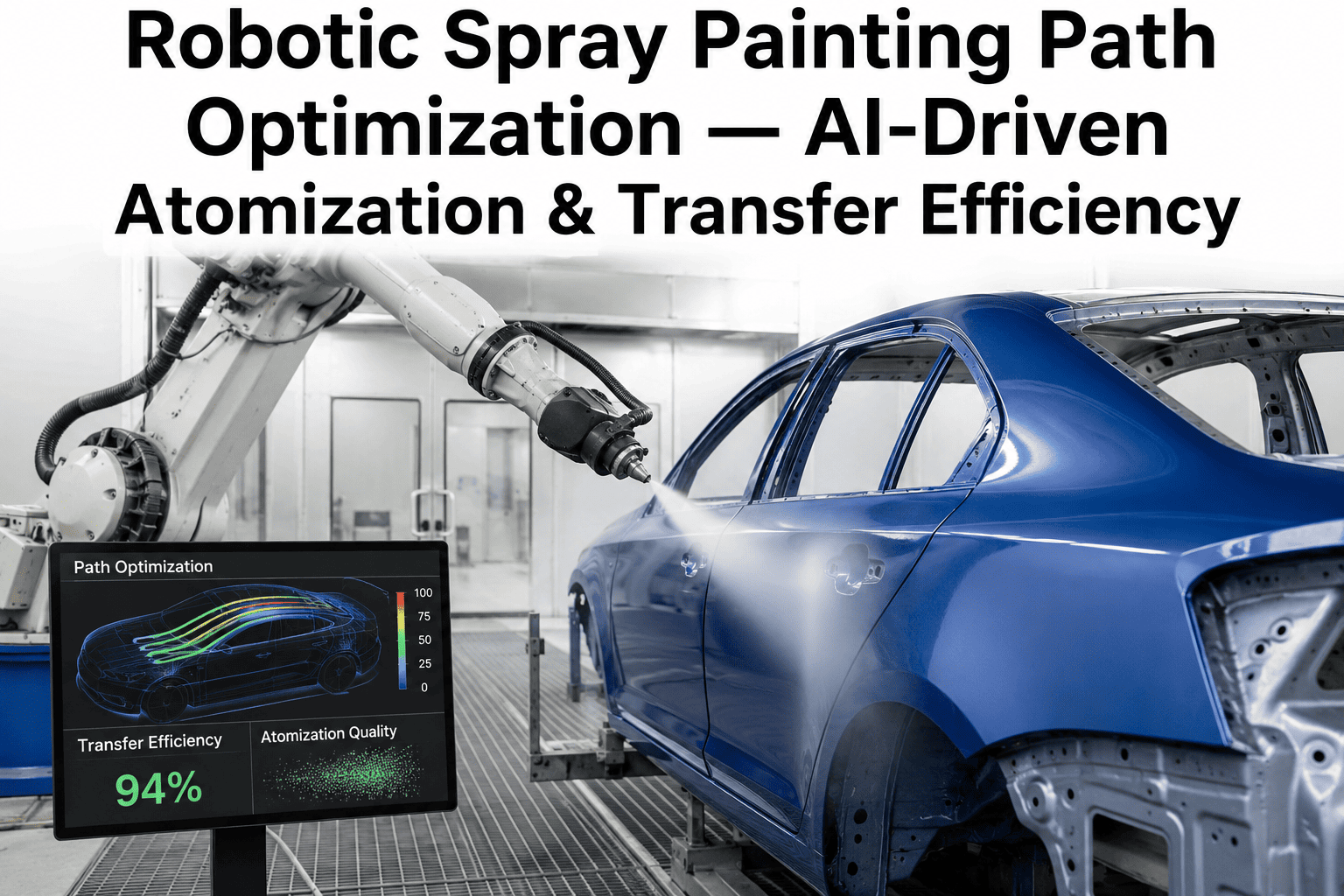
Two robots spraying the same body panel, running the same program, the same paint, the same day — and one of them wastes fifteen percent more material than the other because its path takes a fraction of a second longer to decelerate through a curve. Nobody notices this on the shop floor because both robots are producing acceptable panels. But transfer efficiency, the percentage of atomized paint that actually lands on the body instead of overspraying into the booth exhaust, is one of the largest hidden cost levers in any paint shop, and it is decided entirely by path geometry, atomization timing, and bell speed working together. Plants that optimize this with AI are cutting paint consumption meaningfully without touching appearance quality — if that gap exists somewhere in your paint shop right now, book a session with an iFactory robotics engineer to find out where.
iFactory Paint Shop Intelligence
Robotic Spray Painting Path Optimization: AI-Driven Atomization & Transfer Efficiency
Paint transfer efficiency is decided by path speed, bell rotation, and trigger timing working in sync across every curve of a body panel. This guide breaks down what drives material waste in robotic painting, how AI models optimize path and atomization together, and what changes when transfer efficiency becomes a tracked, tunable metric instead of a fixed program nobody revisits.
15%
Typical paint consumption reduction from path optimization
65-85%
Typical transfer efficiency range across unoptimized robot programs
0
Appearance quality tradeoff required when optimization is done correctly
6 wk
Typical time to validated path optimization recommendations
Why Two Identical Robot Programs Rarely Perform Identically
A robotic spray program is written once, validated against a sample body, and then typically runs unchanged for years. But bell wear, atomization component drift, and even paint batch viscosity variation quietly shift the ideal path speed and trigger timing away from the values the program was originally tuned for. Two robots on the same line, painting the same panel, can end up with meaningfully different transfer efficiency simply because one has drifted further from its original calibration than the other.
Transfer efficiency is the percentage of atomized paint solids that actually deposit on the target surface rather than overspraying past it into the booth's exhaust and filtration system. Every percentage point lost to overspray is paint purchased, atomized, and then thrown away — and it compounds across every body, every shift, every day the program runs uncorrected.
The Business Case for AI Path Optimization
- Path speed and bell rotation tuned together rather than independently, since transfer efficiency depends on both simultaneously
- Continuous atomization monitoring catches component drift before it silently erodes transfer efficiency over months
- Material savings are realized without altering film build or appearance, since optimization targets waste, not coverage
Request a Transfer Efficiency Audit →
The Five Moments in Every Spray Pass That Decide Efficiency
Every robotic spray pass moves through the same five moments, and each one has its own opportunity to waste paint or place it precisely. Path optimization means tuning all five together rather than treating them as fixed constants.
1
Approach
Robot accelerates into position before the trigger fires. Approach speed sets the baseline velocity the rest of the pass inherits.
2
Trigger On
Fluid flow begins fractionally before the gun reaches the panel edge, compensating for atomization lag so coverage starts precisely at the target line.
3
Atomization Ramp
Bell speed and shaping air stabilize to the target droplet size. Ramp timing that lags path speed produces uneven early-pass coverage.
4
Path Traverse
Constant velocity across the panel is the single largest lever on transfer efficiency — deceleration through curves is where most overspray waste concentrates.
5
Trigger Off & Retreat
Fluid shutoff timed against panel edge prevents both undercoverage at the boundary and wasted material past it.
Fixed Robot Programs vs. AI-Optimized Path Control
| Decision Area |
Fixed Program, Set-and-Forget |
AI-Optimized Path Control |
| Program Tuning |
Validated once at commissioning, rarely revisited unless a defect appears. |
Continuously monitored against live transfer efficiency data and re-tuned as conditions drift. |
| Bell Wear Detection |
Discovered only when appearance quality visibly degrades. |
Atomization signal drift flagged well before it affects visible finish quality. |
| Material Consumption |
Tracked in aggregate at the purchasing level, with no per-robot or per-panel visibility. |
Transfer efficiency tracked per robot, per panel type, isolating exactly where waste concentrates. |
| Cross-Robot Consistency |
Robots on the same line can drift apart in efficiency without anyone noticing. |
Comparative benchmarking across robots surfaces underperformers immediately. |
| New Model Onboarding |
Paths manually re-tuned from scratch for each new body geometry, often over-conservatively. |
Optimization models transfer learned efficiency principles to new geometries, accelerating tuning. |
See live transfer efficiency benchmarking across every robot on your line
Book a Demo
Where Transfer Efficiency Typically Concentrates or Leaks
Flat Panels
88% typical efficiency
Constant velocity is easiest to maintain, making flat panels the highest-efficiency zone on most bodies.
Body Curves
70% typical efficiency
Deceleration through curved transitions is the single largest source of overspray waste on a typical body.
Recessed Areas
62% typical efficiency
Restricted gun angle in recessed geometry forces compensating passes that reduce overall efficiency.
Panel Edges
75% typical efficiency
Trigger timing precision at edges determines whether material lands on the panel or past its boundary.
Deployment Timeline: From Baseline to Optimized Path
Week 1-2
Baseline transfer efficiency measured per robot and per panel type
Paint usage, atomization signals, and path telemetry captured across the current program without any changes made yet.
Week 3-4
AI models identify optimization opportunities per body zone
Path speed, bell rotation, and trigger timing modeled together to find efficiency gains without appearance risk.
Week 5-8
Optimized paths validated in production, appearance quality confirmed
Changes staged and validated against full quality inspection before wider rollout across all robots.
Month 3-6
Full-line optimization with ongoing drift monitoring active
Every robot continuously benchmarked, with automated alerts when transfer efficiency drifts below target.
Frequently Asked Questions
Will path optimization change how the finished paint job looks?
No, when done correctly. Optimization targets the portion of atomized paint that overspray wastes, not the film build that determines appearance and coverage. Every path change is validated against full quality inspection before it is rolled out permanently, so appearance and film build specifications remain exactly where they need to be while material waste is reduced.
Does this require reprogramming our existing robot controllers?
The platform typically works alongside your existing robot controller rather than requiring a full reprogram, adjusting path parameters within the controller's existing programming interface. Integration details vary by robot manufacturer, and our team reviews your specific controller platform during the initial assessment, which you can arrange through
iFactory support.
How do you measure transfer efficiency without disrupting production?
Transfer efficiency is calculated by comparing metered paint flow at the gun against measured film build on the finished panel, using data already flowing from existing flow meters and inline thickness gauges where available. No additional production stoppage is required, and baseline measurement typically runs alongside normal operations for one to two weeks before any optimization changes are proposed.
Can this identify when a bell or atomizer needs maintenance?
Yes. Because atomization signal quality is tracked continuously as part of the efficiency model, gradual degradation in droplet formation or bell rotation stability is flagged well before it becomes visible as an appearance defect, giving maintenance teams lead time to service components proactively rather than reactively.
What kind of material savings should we realistically expect?
Results vary by how far current programs have drifted from optimal tuning, but plants moving from an unoptimized fixed program to AI-tuned path control commonly see material savings in the range of eight to fifteen percent without any appearance quality tradeoff. A savings estimate specific to your current transfer efficiency baseline can be modeled when you
book a session with our robotics team.
Every Percentage Point of Overspray Is Paint You Already Paid For
See Exactly Where Your Robots Are Wasting Material
iFactory's path optimization platform benchmarks every robot's transfer efficiency, isolates where material waste concentrates, and tunes path and atomization together to recover it — without touching appearance quality. Baseline measured in two weeks. Optimized paths validated within eight.