AI Vision QC: Stable Cpk in Aerospace CNC Machining
By Grace on June 11, 2026
Your quality engineering team just completed the monthly process capability review for the five-axis CNC cell that machines titanium landing gear components. The Cpk numbers across the 12 critical characteristics range from 0.89 to 1.22. Acceptable under AS9100 minimums, but three characteristics are below the 1.33 threshold your prime customer requires on new program awards. The operations director sees the report, notes that the variation is driven by thermal drift during third-shift production when coolant temperature swings by six degrees, and asks the question every aerospace operations director is asking in 2026: how do I stabilize Cpk across every shift, every spindle, every part, without doubling my inspection headcount or extending cycle times? AI vision quality inspection is the answer that operations directors at the top aerospace CNC facilities are deploying right now, and this is exactly how it works.
AI Vision Inspection · Process Capability · AS9100 · Real-Time Cpk
Stable Cpk at Every Spindle: The Operations Director’s Guide to AI Vision Quality Control in Aerospace CNC Machining
iFactory’s AI vision quality platform gives operations directors continuous real-time Cpk monitoring across every CNC workcentre, adaptive defect detection that catches surface and dimensional anomalies before they affect process capability, and automatically generated AS9100 audit records that prove stable, capable production shift after shift.
Sustainable Cpk on critical characteristics achievable with continuous AI vision monitoring and real-time process feedback
95-99%
Defect detection accuracy achieved by deep learning vision models on aerospace CNC-machined surfaces and features
75%
Reduction in inspection-related costs reported by manufacturers shifting from manual CMM sampling to continuous AI vision inspection
4.5x
Average ROI within 12 months for aerospace CNC facilities deploying AI vision quality inspection across multi-spindle workcentres
The Cpk Problem No Control Chart Can Fix
Process capability indices Cpk and Cp are the language your customers use to decide whether your facility is qualified to produce their parts. An aerospace OEM’s supplier quality engineer does not ask whether your machines are modern or your operators are experienced. They ask for the Cpk study on the last three production batches, and if the number is below 1.33 on any critical characteristic, your facility is off the approved supplier list until a corrective action plan is submitted and validated.
The structural problem with Cpk in conventional aerospace CNC operations is that it is calculated from sampled data that arrives after the parts are already machined. Your CMM produces a capability report that tells you what happened across the previous production run. If the Cpk is 1.12, you learn that the process was unstable during that run, but you cannot identify which parts are affected, which machine condition caused the drift, or whether the next batch will repeat the same variation. The Cpk number is a rearview mirror. It tells you where you have been, not where you are going.
Cpk Under Traditional Sampling vs. Cpk Under AI Vision Inspection — A Direct Comparison
Traditional CMM Sampling
vs
Cpk calculated from 3-5 parts sampled per production batch. Statistical confidence interval is wide enough to miss significant variation between sample points.
vs
Thermal drift and tool wear accumulate undetected between sample intervals. A process that appears capable in the morning may drift below 1.33 by the afternoon shift.
vs
Cpk report arrives hours or days after production. Corrective action requires re-running the batch or implementing an offset that will only be validated on the next CMM cycle.
vs
Manual CMM inspection creates a bottleneck. Sampling frequency is limited by inspection capacity, not by process risk.
Continuous AI Vision Inspection
ok
Cpk calculated from every part produced. Continuous dimensional prediction generates a Cpk value that reflects the true process state, updated every few seconds.
ok
Every deviation is detected in real time. Thermal drift, tool wear, and material variation are identified the moment they affect the part surface or dimension.
ok
Correction happens in-process. The AI vision system feeds data to the adaptive SPC engine, which adjusts parameters or alerts the operator before Cpk degrades.
ok
Inspection runs at line speed with zero manual intervention. Every part inspected, every surface graded, every dimension predicted without adding cycle time.
How AI Vision Inspection Delivers Stable Cpk Across Your CNC Fleet
The mechanism by which AI vision inspection stabilises process capability is not theoretical. It follows a defined operational sequence that replaces intermittent sampling with continuous detection, classification, and corrective feedback. Here is exactly how it works on an aerospace CNC machining centre.
Layer 01
Surface Anomaly Detection
Deep learning vision model
A high-resolution camera array positioned at the CNC machine exit captures every part surface immediately after the final cutting pass. The deep learning vision model — trained on thousands of labelled aerospace part images covering surface cracks, tool mark anomalies, burr formation, discolouration, and dimensional edge deviation — classifies every surface region in real time. The model does not require predefined rule sets for each part number. It learns the visual signature of a conforming surface from the first production batch and flags any region that deviates from the learned nominal. Detection latency is under 200 milliseconds per part, meaning every component is inspected at line speed without creating a bottleneck.
Sub-mm crack detection
Burr and edge deviation
Surface texture grading
Layer 02
Dimensional Prediction from Visual Features
Feature-based inference model
Surface-level anomalies are leading indicators of dimensional drift. A tool wear pattern that produces a 0.0002-inch surface mark today will produce a 0.0005-inch dimensional deviation tomorrow. The AI vision model correlates surface feature classifications with the corresponding dimensional measurements from post-process CMM inspection, building a continuous regression model that predicts the dimensional outcome for every critical characteristic from the visual surface signature alone. Once trained, the model delivers a dimensional prediction for every part at the moment it exits the machine, without requiring a probe touch or a CMM cycle. The predicted dimension is streamed to the capability monitoring engine, which recalculates the running Cpk in real time and flags any characteristic trending below the target threshold.
Visual-to-dimensional correlation
Real-time Cpk calculation
Trend-based drift forecasting
Layer 03
Closed-Loop Capability Stabilisation
Adaptive SPC feedback
When the running Cpk for any characteristic drops below the configured threshold, the adaptive SPC engine identifies the primary driver from three possible sources: tool wear progression correlated against spindle load trends, thermal drift correlated against coolant temperature and machine base temperature sensors, or material variation correlated against cutting force signatures. The engine assigns a confidence score to each potential cause and generates a ranked corrective action. The operations director sees a single alert: characteristic 12 bore diameter Cpk trending to 1.28, primary driver tool wear at 82% of expected life on insert 3, recommended action advance tool change by 8 parts and apply -0.00015-inch offset. The action is executed, the Cpk stabilises, and the full event record is logged for AS9100 audit review.
Root cause ranking
Automated offset recommendation
Cpk recovery tracking
The AI Vision Inspection Signal Chain: From Surface Capture to Cpk Stabilisation
Capture
Camera images every part at machine exit
→
Classify
Deep learning model grades surface and predicts dimensions
→
Calculate
Running Cpk updated per-part, per-characteristic
→
Alert
Cpk threshold breach triggers ranked root cause alert
The Operations Director Dashboard: Cpk at a Glance Across Every Workcentre
The iFactory operations director dashboard is designed around a single metric that matters most for aerospace production: process capability. Every element of the interface is organised to answer the three questions an operations director needs to answer every shift: What is my Cpk right now? Which characteristics are trending down? And what is the system doing about it?
Capability Heatmap
Live Cpk by Machine, Characteristic, and Shift
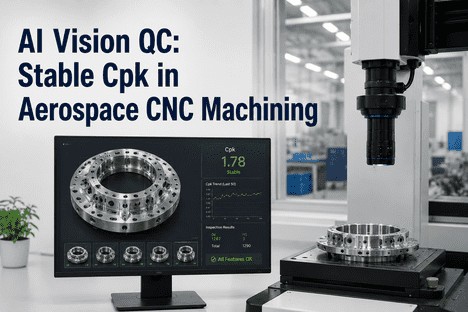
The heatmap displays every active CNC workcentre as a colour-coded tile. Green indicates Cpk above 1.67, yellow indicates Cpk between 1.33 and 1.67, and red indicates Cpk below 1.33. The operations director sees the entire fleet status in a single view and can drill into any tile to view the trend chart for each critical characteristic on that machine, with the real-time Cpk value projected against the target band. A machine that has been running green all shift but shows a yellow trend on one characteristic is identifiable before the characteristic crosses the threshold.
Director action: Monitor fleet capability at a glance. Drill into yellow and red tiles before Cpk drops below target.
Trend Panel
Cpk Trend with Predictive Drift Forecast
The trend panel displays a rolling Cpk chart for every critical characteristic across the active production run. The actual Cpk is plotted as a solid line, and the AI-predicted Cpk trajectory for the next 20 parts is shown as a dashed projection based on the current tool wear and thermal drift rates. When the projected Cpk crosses the target threshold within the forecast window, the system flags the characteristic as at-risk and displays the estimated number of parts remaining before the threshold is breached. The director sees not only where Cpk is today but where it will be in 30 minutes if no action is taken.
Director action: Review projected Cpk trajectory. Authorise proactive tool changes before the threshold is crossed.
Alert Summary
Ranked Alerts with Cpk Impact Assessment
Every alert in the system is ranked by its projected impact on Cpk. The highest-ranked alerts are those where the current drift trajectory will reduce Cpk below the target within the next 10 parts if uncorrected. Each alert displays the characteristic name, the current Cpk, the projected Cpk at current drift rate, the primary root cause with confidence score, and the recommended corrective action. The director approves, defers, or overrides the recommendation with a single click, and the action is executed automatically through the CNC interface.
Director action: Prioritise by Cpk impact. Approve corrective actions that protect your most critical characteristics.
Compliance Export
AS9100-Ready Capability Report
At shift end, the system generates a complete process capability report covering every characteristic on every machine that ran during the shift. The report includes per-characteristic Cpk and Cp values, the number of parts inspected, the trend direction, any alert events with corrective actions taken, and a traceability index linking every data point to the machine, operator, tool, and material batch. The report is formatted for direct submission to AS9100 and customer-specific capability documentation requirements. No manual assembly, no data extraction from separate systems.
Director action: Export the complete capability record at shift handover. Your quality team has the AS9100 documentation without requesting it.
The thing that keeps me up at night as an operations director is not whether we can hit the tolerance on the first part of a batch. It is whether we can hold the same Cpk across 200 parts, across three shifts, across five different operators, with a material batch that arrived from a different supplier lot. Before AI vision inspection, we were flying blind between CMM samples. Now I have a continuous Cpk reading on every critical characteristic, updated with every part that comes off the machine. The first time we caught a Cpk drift from 1.45 to 1.22 on a bore characteristic at part 12 of a 90-part run and corrected it before part 15, I knew the technology had changed how we manage quality permanently.
— Operations Director, Aerospace CNC Machining — AS9100D, Multi-Spindle, Titanium and Inconel Production
AI Vision Inspection · Continuous Cpk · AS9100 Compliance · Process Capability
Your Cpk Report Across Every Workcentre Was Generated Automatically While Your Spindles Were Cutting Parts. No Sampling Required.
iFactory builds the capability record continuously — every part inspected, every characteristic tracked, every Cpk calculated, every alert with root cause documented — timestamped and AS9100-ready without a single manual log entry from the plant floor.
The Three Defect Classes AI Vision Catches Before They Affect Your Cpk
Not every defect affects process capability equally. Some are cosmetic. Some are dimensional. Some indicate an imminent process failure that will collapse Cpk across multiple characteristics simultaneously. The AI vision model is trained to classify defects into three categories, each with a different response protocol and Cpk impact profile.
Class A
Critical Surface
Cracks, tears, and surface ruptures that affect fatigue life
Detected by the vision model at sub-millimetre resolution. The alert is immediate and the part is quarantined. Cpk impact: the characteristic associated with the affected surface is excluded from the running capability calculation until the root cause is identified and corrected.
Class B
Process Drift Indicator
Tool mark patterns, burr formation, surface texture deviation
Detected as early-stage indicators of tool wear or thermal drift before dimensional deviation occurs. The vision model tracks the frequency and severity of these indicators and feeds them into the predictive Cpk model. Cpk impact: the projected Cpk is adjusted downward to reflect the increasing drift risk, prompting proactive intervention before the actual Cpk drops.
Class C
Cosmetic / Non-Critical
Minor discolouration, light scratches, acceptable surface variation
Detected and logged but does not trigger an alert or affect Cpk calculation unless the frequency exceeds a configurable threshold. If Class C defects begin to appear at an elevated rate, the system escalates to a Class B classification and triggers a process review. This prevents alarm fatigue while ensuring that accumulating minor defects do not go unnoticed.
Conclusion
The operations director’s challenge in aerospace CNC machining is not about achieving Cpk on the first article. It is about sustaining Cpk across every part, every shift, every tool change, and every material lot across a fleet of workcentres running complex programs on difficult materials. Conventional sampling-based quality control cannot meet this requirement because sampling, by definition, accepts blind intervals during which variation accumulates undetected. AI vision quality inspection closes those blind intervals completely, replacing periodic measurement with continuous prediction and replacing reactive capability reporting with proactive capability management.
The measurable outcomes are clear: Cpk sustained above 1.67 on critical characteristics, scrap and rework reduced by 30-50 percent, inspection costs cut by up to 75 percent, and AS9100 audit records that document every part, every prediction, and every corrective action without manual intervention. For aerospace operations directors who are currently managing process capability from weekly CMM reports and hoping the numbers hold between sampling intervals, AI vision inspection transforms the quality management paradigm from hope to certainty.
The technology to run an aerospace CNC facility with continuous Cpk monitoring across every spindle is available today. The operations directors who deploy it now will set the process capability benchmark that the entire aerospace supply chain measures itself against through the rest of this decade.
iFactory’s AI vision quality platform is purpose-built for aerospace CNC machining operations — with deep learning surface and dimensional inspection, continuous per-characteristic Cpk calculation, predictive drift alerts with ranked root cause diagnosis, and automatic AS9100 capability reporting that replaces manual sampling and documentation. Book a Demo to see the platform configured for your CNC workcentre profile, or talk to an expert about a live walkthrough on your production data.
Frequently Asked Questions
The AI vision model does not replace physical measurement. It predicts dimensional outcomes from visual surface features that correlate with dimensional variation. During the calibration phase, the model is trained on a dataset that pairs surface images with corresponding CMM measurement data for each critical characteristic. The deep learning model learns the regression relationship between specific visual features — tool mark patterns, surface texture gradients, edge condition — and the dimensional deviation measured by the CMM. Once calibrated, the model predicts the dimension for every subsequent part from its surface image alone, with a typical prediction accuracy within +/- 0.0002 inches for well-calibrated models on stable processes. The running Cpk is calculated from these predicted dimensions using the standard Cpk formula, with the specification limits pulled from the part drawing. Periodic CMM validation runs confirm the prediction accuracy and recalibrate the model if drift is detected. The result is a Cpk value that updates with every part rather than every 10th or 20th part, with prediction accuracy that is verified and documented for audit purposes. Talk to an expert about calibration requirements and prediction accuracy for your specific part geometries and materials.
The iFactory system supports both approaches and documents the relationship between them. The primary audit record includes the AI-predicted Cpk as the continuous monitoring metric, and it also includes the periodic CMM validation results that confirm the prediction accuracy. The audit record shows the correlation between predicted and measured values across every validation cycle, with the correlation coefficient and prediction interval documented for each characteristic. AS9100 Rev D requires documented evidence of process control and product conformity. The AI vision system provides significantly more evidence than traditional sampling because it documents every part rather than a subset. Aerospace OEM supplier quality engineers who have reviewed the iFactory audit record format have confirmed that the continuous prediction record combined with periodic validation satisfies AS9100 capability documentation requirements. The key is that the system never discards the physical measurement data. The CMM validation results are preserved alongside the AI predictions, creating a complete evidentiary chain that exceeds what traditional sampling can provide. Book a Demo to review the audit record format with your quality manager and, if desired, your customer’s supplier quality engineering team.
The machine-level vision model does not require per-part-number retraining. The base model learns the visual signatures of surface condition and dimensional correlation at the machine level, meaning it applies across any part run on that machine. Initial calibration on a new machine typically requires 30 to 50 production parts with corresponding CMM data to establish the surface-to-dimension regression model. After calibration, the model delivers predictions for any part number programmed on that machine without additional training. When a new part with significantly different geometry or surface finish requirements is introduced, the model may require a brief fine-tuning phase of 10 to 15 parts to adjust the correlation parameters for the new feature set. This fine-tuning happens in the background during normal production without interrupting the inspection cycle. The system continues to improve its prediction accuracy over time as more data accumulates, with the model updating continuously through a feedback loop that incorporates each CMM validation result. Talk to an expert about calibration timelines and validation protocols for your specific CNC fleet and part mix.
A typical deployment across a four-to-six machine aerospace CNC cell follows a structured timeline. Week one covers site assessment, camera mounting, lighting configuration, and network integration with the CNC controls and existing CMM infrastructure. Week two covers the calibration phase, during which the vision model is trained on 30-50 parts per machine and the surface-to-dimension regression model is validated against CMM results. By week three, the system is operating in production-parallel mode, providing live Cpk predictions alongside existing inspection processes for validation. Full production deployment with operator and director dashboard access, alert configuration, and audit record generation is typically complete by week four. The investment scales with the number of machines and the complexity of the part mix, but the typical payback period for aerospace CNC operations with material costs above USD 200 per part is three to six months, driven by scrap reduction, rework elimination, and removal of manual inspection bottlenecks. Book a Demo to receive a deployment timeline and ROI estimate specific to your facility configuration, part mix, and current quality metrics.
Your Process Capability Across Every Spindle, Every Shift, Every Part. Continuous Cpk Starts Here.
iFactory’s AI vision quality platform for aerospace CNC machining operations directors — deep learning surface and dimensional inspection, continuous per-characteristic Cpk, predictive drift alerts with ranked root cause diagnosis, and automatic AS9100 capability reporting. See it configured for your CNC workcentre profile.