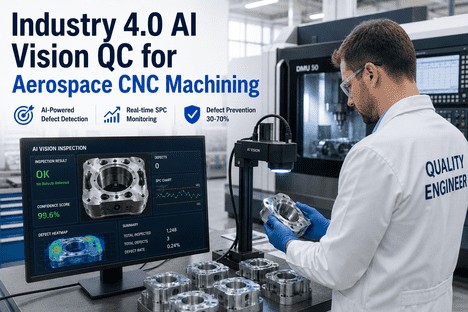
Industry 4.0 AI Vision QC for Aerospace CNC Machining

By Grace on June 9, 2026

industry-4-0-ai-vision-qc-aerospace-cnc-machining

You are mid-shift. The CNC cell has been running a titanium bracket programme for four hours without a single alarm. The operator's visual check shows nothing unusual. But between parts 22 and 38, a surface finish deviation has been quietly building on the bore feature — well within your in-process gauge limit, invisible to the periodic CMM sample, and perfectly positioned to become a customer NCR three weeks after shipment. This is not a hypothetical. For aerospace quality engineers still running conventional inspection cycles, it happens every quarter. AI vision inspection for aerospace CNC machining exists specifically to close this gap — catching what gauges miss, flagging what the CMM batch check will find too late, and giving quality engineers the predictive signal they need to intervene before the first nonconforming part reaches the customer.

AI Vision Inspection · Adaptive SPC · AS9100 Traceability · Defect Prevention
Industry 4.0 AI Vision QC for Aerospace CNC Machining
iFactory gives aerospace quality engineers a live AI inspection layer for every CNC cell — detecting dimensional drift, surface defects, and process deviations in real time, before they become escapes, NCRs, or audit findings.
95%+
Defect detection accuracy achieved by validated ML-powered vision systems across aerospace and precision manufacturing sectors
30–70%
Reduction in defect escape rates reported by aerospace manufacturers deploying AI vision inspection with adaptive SPC
$6.63B
Projected global AI defect detection market value by 2034, growing at 11.9% CAGR from $3.71B in 2025
20–30%
Improvement in machining efficiency when AI systems dynamically adjust parameters using real-time sensor and vision data

Why Conventional Inspection Fails the Aerospace Quality Engineer

Statistical process control charts, periodic CMM sampling, and first-off verification have served aerospace machining operations for decades — and they remain valuable tools in the right context. The problem is not that these methods are wrong. The problem is that they were designed for a different inspection problem: verifying that a batch was acceptable after machining. In a flight-critical supply chain where nonconformance costs routinely exceed the value of an entire production run, after-the-fact verification is structurally insufficient.

The inspection gap is widest in the middle of a tool run. First-off checks confirm setup. End-of-batch CMM confirms the final parts. But between those two points — across the 40, 60, or 100 parts that represent the productive core of the run — conventional inspection relies on periodic samples, operator awareness, and in-process gauges that measure a single dimension and trigger an alarm only when a tolerance has already been breached. By the time that alarm fires, the escape is no longer preventable. It is only containable.

Human visual inspectors, however experienced, compound this problem. Research consistently shows that even trained inspectors miss 20 to 30 percent of defects due to attention fatigue, lighting inconsistency, and the inherent limitation of evaluating parts at production speed. In aerospace CNC machining, where critical features include bore geometry, surface finish on sealing faces, thread form, and edge condition on flight-critical brackets, that miss rate is not acceptable at any point in the run.

AI vision inspection changes the geometry of the inspection problem. Instead of sampling at the boundary of the run, it inspects every part. Instead of reacting to a breach, it detects the trend that precedes the breach. And instead of a result that exists only in an inspection record, the AI vision finding is linked to the process context — the programme version, tool life count, material billet, and machine state — that turns a quality result into a corrective signal.

The Four Defect Categories AI Vision Catches That Conventional Methods Miss

Surface Finish Deviation
Chatter marks, feed lines, and tool drag patterns on sealing faces, bore walls, and mating surfaces are invisible to in-process gauging and inconsistently caught by manual visual inspection. AI vision with structured lighting detects Ra and Rz deviations at part speed, correlating surface condition with tool life position to predict the finish trajectory across the remainder of the run.

Edge Condition Defects
Burrs, microchipping on cutting edges, and incomplete chamfer formation on flight-critical brackets are among the highest-frequency escape categories in aerospace CNC — and among the hardest to catch manually on complex 5-axis part geometries. AI vision models trained on part-specific geometry detect these conditions on every part, in every orientation, without the access constraints that limit human inspection on complex profiles.

Dimensional Drift Trend
Slow dimensional shift driven by thermal expansion, ballscrew wear, or progressive tool deflection does not produce a visible defect on any individual part — it produces a trajectory. AI vision combined with adaptive SPC tracks this trajectory across every part in the run, firing a predictive alert when the trend indicates a breach within the next 10 to 20 parts, giving the quality engineer time to intervene before the first nonconforming part is produced.

Material and Process Anomalies
Hard inclusions, porosity, and billet inconsistencies in titanium and nickel alloy workpieces change the cutting response mid-run in ways that neither the programme nor the tooling specification anticipates. AI vision monitors the part surface for the anomaly signatures — inconsistent reflectance zones, irregular chip formation patterns, localised finish variation — that indicate a material event has occurred, allowing the quality engineer to hold and investigate before the affected parts reach the next operation.

How AI Vision Inspection Actually Works in a CNC Machining Environment

The engineering behind aerospace AI vision inspection is distinct from general-purpose machine vision in three important ways: the models are trained on part-specific geometry, the lighting is configured for the specific defect signature types on the material in question, and the inspection result is correlated with the machine controller data stream rather than evaluated in isolation. These three factors are what separate an AI vision system that delivers genuine quality control from one that generates noise.

Component
Camera and Lighting Configuration
High-resolution industrial cameras capture the part at fixed inspection stations, with lighting geometry chosen specifically for the defect types being targeted. Backlighting reveals edge condition and geometry. Diffuse dome lighting eliminates shadow artifacts on polished bores. Photometric stereo — multiple directional light sources sequenced at millisecond intervals — reconstructs surface texture to detect chatter and feed line patterns invisible under flat illumination. Lighting is not a generic setup; it is configured per part family and validated against known-good and known-defective samples before the inspection model is trained.
Component
Deep Learning Defect Classification
Convolutional neural network architectures — typically ResNet-based classifiers or YOLO-family detectors — analyse each part image against defect categories established during model training. Unlike rule-based vision systems that require hand-coded acceptance criteria for each feature, the deep learning model learns what acceptable and unacceptable conditions look like from labelled example images. This means the model handles the natural variation in part surface appearance that defeats threshold-based rules, and it can be retrained as new defect types emerge or new material batches introduce different surface characteristics.
Component
Process Context Correlation
Every vision finding is tagged with the machine state data at the moment of inspection — spindle load, axis position, programme version, tool life count, and cycle number. This correlation is what transforms an inspection result into a causal signal. A surface finish deviation on part 47 that correlates with an elevated spindle load reading points to a cutting tool issue. The same deviation without the spindle load correlation points to a fixturing or material event. Correlation reduces false alarm rate and accelerates root-cause identification, which is the difference between a quality engineer who responds to findings and one who prevents them.
Component
Edge Computing and Real-Time Output
AI inference runs on industrial-grade edge compute with GPU acceleration, processing images at production speed without cloud latency. The result is available to the quality engineer's dashboard within milliseconds of the part leaving the inspection station — not minutes later when the production context has already changed. Edge processing also means production data stays within the facility network, which is a prerequisite for most aerospace customers' cybersecurity and data sovereignty requirements.

We were running a fixed visual check at first-off and end-of-batch on a nickel alloy turbine bracket. The AI vision system picked up a progressive edge condition change from part 31 onward in the run — a micro-burr pattern on the inlet boss radius that our operators were not catching because it required a specific oblique lighting angle to see. We moved the tool change to part 30 on hard-batch material. In three months, we had zero edge condition NCRs on that feature. Previously, we were averaging two per quarter. The system paid for itself before the end of the first production block.

— Quality Engineer, Tier 1 Aerospace Machining, Turbine Structural Programme

Adaptive SPC: The Statistical Engine Behind AI-Native Defect Prevention

AI vision inspection generates a per-part quality result. Adaptive SPC is what turns that stream of results into a predictive quality control system. The distinction matters, because inspection without statistical process control produces findings — it does not produce foresight.

Conventional SPC in aerospace CNC machining runs on control limits set during the initial process capability study — often completed at qualification, months or years before current production. As material batches vary, tools accumulate wear across different cycles, and machines age at different rates, the actual process distribution shifts continuously. Static limits become either too tight — generating false alarms that operators learn to dismiss — or too wide, letting real drift build unchallenged until the CMM batch check finds it. Adaptive SPC solves this by recalculating control limits dynamically against the current rolling production window, typically the last 20 to 50 parts. The algorithm distinguishes between common-cause variation — which is the inherent process spread and should update the limits — and assignable-cause events, which should trigger an alert and not update the limits. Every limit change is logged with a timestamp and statistical basis, creating an auditable record that demonstrates limits are always current through AS9100 audit reviews.

Adaptive vs Static SPC: How the Quality Signal Changes Across the Tool Run
Scenario
Static SPC Response
Adaptive SPC Response
New tool installed
Limits remain at worn-tool baseline — too wide for new-tool capability, early drift undetected
Limits tighten to new-tool baseline within first 20 parts — drift detected earlier and more sensitively from the start of the run
Tool end of life
Drift approaches tolerance. No alert until breach. Up to 80 parts potentially affected before CMM detects the shift.
Trend alert fires 15–25 parts before tolerance boundary. Quality engineer schedules change while all parts remain in spec.
New material batch
Material-driven variation triggers false alarms. Operators become desensitised. Genuine drift events dismissed with the noise.
Limits adjust to the new material baseline. False alarm rate stays below 5%. Real drift events remain clearly distinguishable.
AS9100 audit review
Limit rationale from original capability study must be re-justified. Process changes since qualification create documentation gaps.
Every limit adjustment logged with timestamp and statistical basis. Auditor sees a self-evidencing quality record with no documentation gaps.

Cpk, Traceability, and AS9100: What AI Vision Inspection Changes for the Quality Engineer

For aerospace quality engineers, the value of AI vision inspection is not only in the defects it catches — it is in the compliance infrastructure it generates as a by-product of every inspection cycle. The three areas where the change is most material are process capability measurement, AS9100 traceability, and FAIR submission.

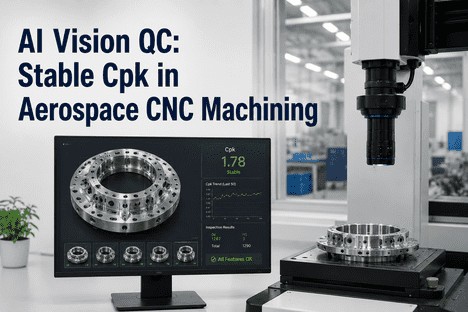
Process capability (Cpk) in a conventional operation is a snapshot — calculated at qualification from a sample run under controlled conditions and then used to justify the ongoing process for months or years. In a live AI vision inspection environment, Cpk is a continuous calculation, updated with every part, reflecting the actual current capability of the process rather than the capability it demonstrated at qualification. When a material batch change, tooling lot change, or machine event shifts the process distribution, the quality engineer sees it in the Cpk trend before it reaches the customer. This is what it means to move from documented capability to live capability.

AS9100 Clause 8.5.2 requires traceability linking every part to the production context in which it was made. In a conventional operation, this record is assembled manually — pulling machine logs, tool records, inspection reports, and material certifications after the fact when a customer escape or audit request demands it. The AI vision inspection record is generated automatically at the time of machining: serial number, per-feature result, SPC value, AI vision finding with image evidence, programme version, tool lot and life count, material billet, and supervisor disposition. The traceability record exists before the part leaves the cell, not after an investigation begins.

Get a Free Cpk and Compliance Audit for Your CNC Cell
iFactory's quality engineers review your current Cpk data, inspection gaps, and AS9100 traceability structure — and show you exactly where AI vision inspection would close the compliance and defect prevention gap in your operation.

The Quality Engineer's Dashboard: Turning AI Inspection Data Into Production Decisions

An AI vision system that generates data the quality engineer cannot act on in the moment it is produced is a reporting tool, not a quality control system. The operational interface is what determines whether inspection intelligence becomes a production decision or a post-shift report. iFactory's quality engineer dashboard is structured around the five questions that define the quality engineer's decision loop throughout every shift.

Decision 01
Which cell has an active quality risk right now?
The live floor view displays every CNC cell as a colour-coded status: green for in control, amber for trending toward a quality limit, red for breach or confirmed finding. The quality engineer sees the priority order for the entire floor without walking the floor — and receives a mobile alert at the same moment the dashboard updates, so response time is never limited by physical location.
Decision 02
How many parts remain before the next quality intervention?
The tool life and process trend panel shows each monitored tool tracked against its quality trend data — not a fixed life count, but a predicted intervention point based on observed drift rate in the current batch. The quality engineer can schedule a tool change or compensation adjustment at the point data indicates risk, before any part is out of spec.
Decision 03
Where is quality risk concentrated across machines and shifts?
The Pareto panel cross-references quality findings by feature, machine, tool lot, and shift — surfacing systemic patterns that isolated part-level findings cannot reveal. The same surface finish deviation appearing across three machines on the same bore feature points to a tooling specification issue. Concentrated on one machine and one shift, it points to a machine condition or setup factor. Both patterns are escalation-ready data for engineering review before the pattern produces its next NCR.
Decision 04
What is the live Cpk for this feature and this run?
The process capability panel displays the real-time Cpk for every monitored feature, updated with every part inspection result. This is not the qualification-era Cpk from the process capability study — it is the current capability of the process in this batch, with this material, at this point in the tool's life. When Cpk falls below threshold, the quality engineer knows before the CMM batch check, not after.
Decision 05
Can I produce the AS9100 record for any part on this shift in seconds?
Every part processed through the AI vision system generates a complete quality record: serial number, per-feature inspection result, SPC value at time of machining, AI vision finding with image evidence, supervisor disposition, programme version, tool lot and life count, and material billet. The record is linked, searchable by serial number, and exportable for any part in any batch — not assembled manually after a customer escape, but generated automatically as part of the inspection cycle. AS9100 Clause 8.5.2 traceability and AS9102 FAIR submission support is built into the data stream, not added on top of it.

Multivariate Machine Learning: Beyond Single-Feature Inspection

Single-feature AI vision inspection — one model, one defect type, one camera angle — is where most implementations begin. It is also where most of the value visible to quality engineers in the first 90 days is delivered. But the structural advantage of AI-native quality control in aerospace CNC machining is multivariate: the ability to monitor multiple features simultaneously, correlate their trends, and identify the combined signature of a process event that no single feature trend would reveal in isolation.

A thermal drift event in a 5-axis cell, for example, produces a dimensional change on every feature simultaneously — but at different rates and in different directions depending on the axis geometry. A single-feature SPC chart on the bore diameter will show a trend. A multivariate model monitoring bore diameter, perpendicularity, and surface finish together will identify the thermal signature before any single feature reaches its alert threshold, because the pattern across all three features is more diagnostic than any one feature alone.

This is the quality control architecture that Industry 4.0 makes possible in aerospace CNC machining — not inspection that is faster than manual, but inspection that is structurally different: multivariate, predictive, and causally connected to the machine and process context that produced the result.

Conclusion

The quality engineer in aerospace CNC machining is accountable for outcomes that the conventional inspection model was never designed to support at scale. Manual checks and CMM batch sampling verify that a sample of parts was acceptable. They cannot verify that every part on every shift, through every tool interval, with every material batch, was in spec — and in a flight-critical supply chain, that is the question that matters.

AI vision inspection for aerospace CNC machining answers it, continuously, on every part, without adding headcount or slowing cycle time. The surface finish deviation that would have shipped undetected is caught at part 31. The dimensional drift that would have affected 60 parts before the CMM check fires an alert at part 8. The traceability record that would have taken three hours to assemble for a customer investigation is generated automatically before the part leaves the cell.

What changes for the quality engineer is concrete: from reactive containment to predictive intervention; from qualification-era Cpk to live process capability; from manually assembled traceability to automated compliance evidence. The economics are equally concrete: one prevented NCR cycle, one avoided customer hold, or one contained escape that stays within a single batch instead of triggering a full-quarter review covers a deployment cost many times over. With AI defect detection accuracy consistently exceeding 95 percent in validated production deployments, and the global AI inspection market growing toward $6.63 billion by 2034, the question is no longer whether AI vision inspection is proven in aerospace CNC machining. The question is how quickly your operation deploys it before the next preventable NCR lands on your desk.

iFactory deploys in 90 days, validates against your own production data before it generates a single compliance record, and is live with AS9100 traceability, adaptive SPC, and real-time quality alerts before the end of the first production block. The gap between operations running AI-native quality control and those still relying on static SPC and periodic CMM sampling widens every quarter.

Frequently Asked Questions

Validated machine learning vision systems in aerospace and precision manufacturing consistently achieve defect detection accuracy above 95 percent, with some controlled-environment deployments reaching 98 to 100 percent. Manual inspection, by comparison, misses 20 to 30 percent of defects due to attention fatigue and lighting inconsistency — a gap that widens on complex 5-axis geometries and in high-volume production where inspection speed competes with accuracy. The critical advantage is consistency: AI vision performs identically on shift 1 and shift 3, on part 10 and part 800, without the natural variability that human inspection introduces. For aerospace quality engineers, this means the inspection result is a reliable input to process control rather than a variable that itself needs to be managed. Talk to an expert about accuracy benchmarks for your specific part families and defect categories.

For feature categories where AI vision coverage is validated, yes. AS9100 Rev D Clause 8.5.1 requires in-process verification but does not specify CMM as the technology. The AI vision-generated part record — containing per-feature inspection results, SPC values, vision findings with images, and supervisor disposition — constitutes an in-process verification record that satisfies clause requirements when the coverage and accuracy are documented. The standard deployment pattern is to retain CMM at first-off and tool change verification, where dimensional measurement is most critical, and reduce mid-run and end-of-batch CMM sampling frequency on features with validated AI vision coverage. This reallocation of CMM capacity to its highest-value applications is one of the measurable productivity gains of AI vision deployment. Book a demo to discuss the compliance documentation approach for your quality plan.

Initial model training on a new part family typically takes 7 to 14 days, covering image collection, labelling of accepted and rejected conditions by feature category, model training, and validation against known good and known defective samples. The model then runs in shadow mode alongside existing inspection for a further 15 to 30 days, during which the quality team validates AI findings against CMM and manual results and flags edge cases for retraining before the system becomes the primary inspection record. Modern few-shot learning approaches are significantly reducing the labelled data requirement — meaning models can reach production accuracy faster on new parts than was possible even two years ago. Talk to an expert about the specific training timeline for your part families and production volume.

Adaptive SPC handles material batch variation by distinguishing between common-cause shifts — where the process distribution has moved but remains stable at a new baseline — and assignable-cause events, where a sudden step change or accelerating trend indicates a problem requiring intervention. When a new titanium billet at the upper end of hardness specification changes the surface finish distribution, the algorithm recognises this as a common-cause shift and updates the control limits to reflect the new baseline, eliminating the false alarm burst that static SPC generates. A true quality event — a progressive tool wear trend or a thermal drift — produces a trend signature that the algorithm classifies as assignable cause, triggering an alert without adjusting the limits. The quality engineer sees genuine quality signals, not material variation noise. Book a demo to see how adaptive SPC is configured for your specific alloy families.

Aerospace manufacturers deploying AI vision inspection with adaptive SPC report defect escape reductions of 30 to 70 percent within the first production block, with the range reflecting the gap between the existing inspection coverage and the full-part AI vision coverage that replaces it. Operations with high CMM sampling frequency and tight existing control see the lower end of the range, as there is less inspection gap to close. Operations relying primarily on first-off verification and manual visual checks see the larger reductions, because AI vision is covering parts and features that previously received no in-process inspection at all. The 90-day deployment timeline is structured to produce a measurable quality outcome — documented as part of the shadow mode validation — before the system generates its first AS9100 compliance record. Talk to an expert about the expected outcome range for your specific operation and NCR history.

The Inspection Data to Prevent Your Next NCR Is Already Being Generated. iFactory Makes It Actionable.
iFactory's AI vision inspection platform gives aerospace quality engineers real-time defect detection, adaptive SPC, live Cpk monitoring, and AS9100 traceability on every part — deployed in 90 days, validated against your own production data before it generates a single compliance record.

Share This Story, Choose Your Platform!