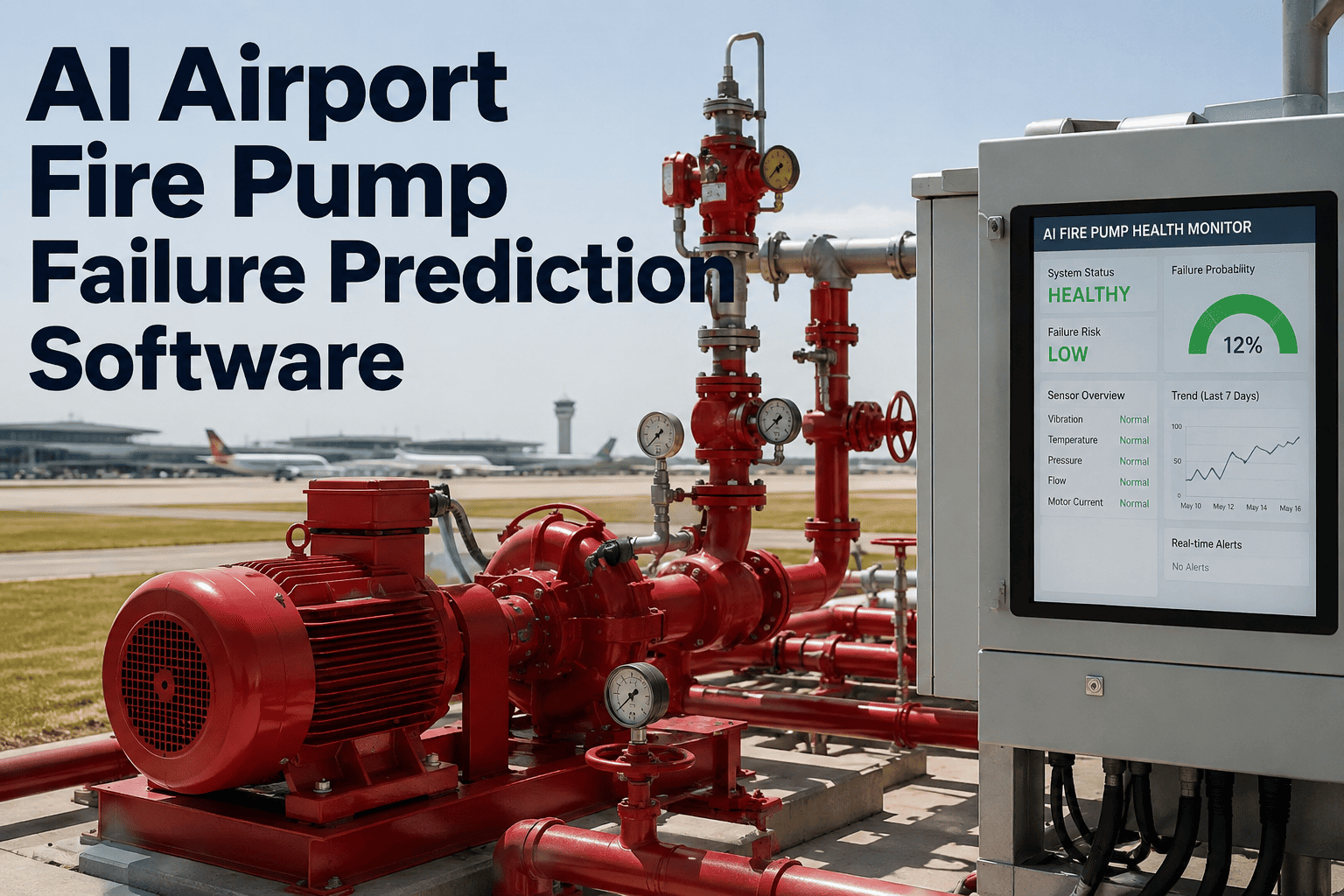
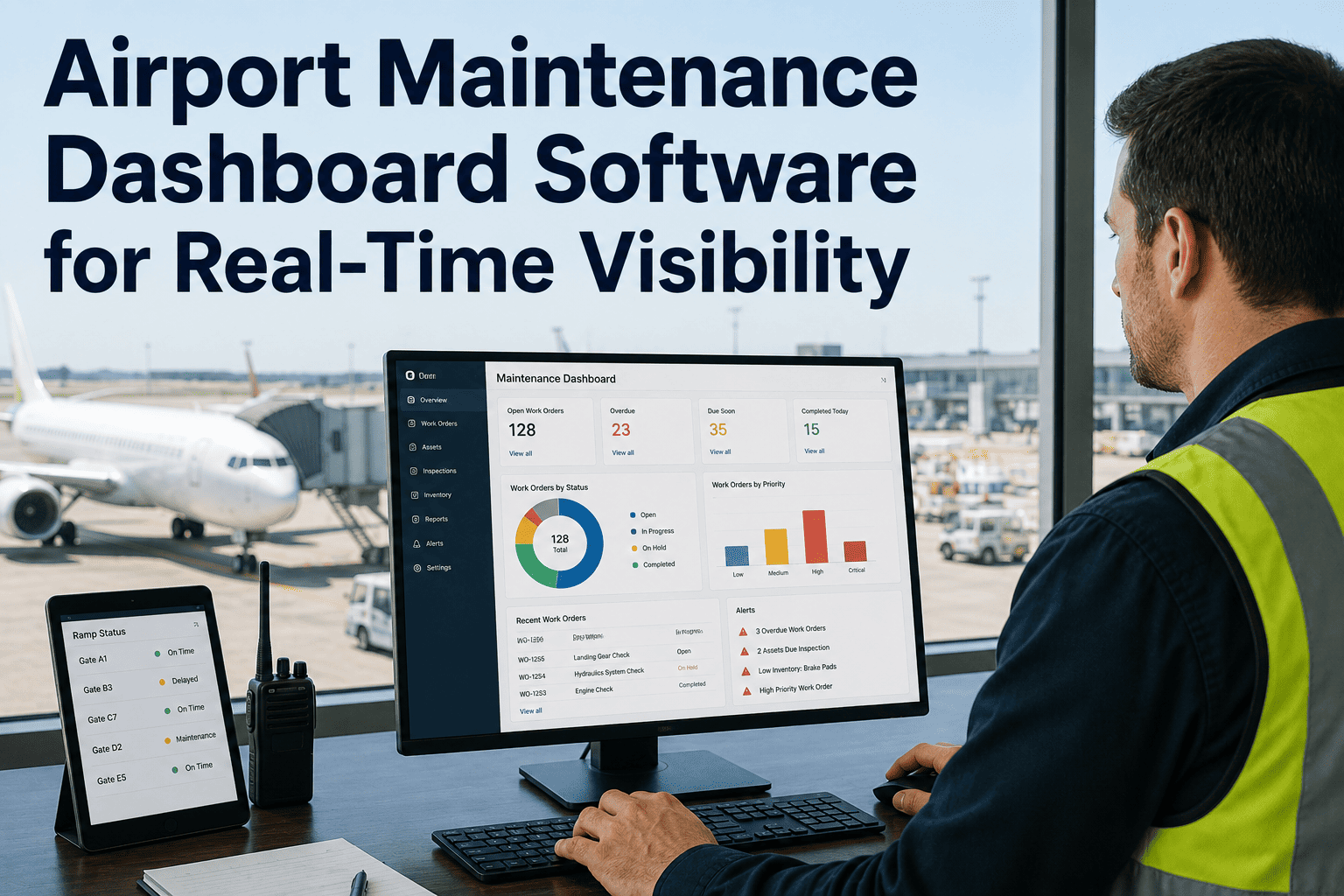
Airport compressed air systems operate behind every baggage carousel, pneumatic gate mechanism, and instrument air supply across a terminal, yet most facilities learn about an impending compressor failure only when the unit trips offline and the cascade of operational disruptions has already begun. The gap between the first detectable change in equipment behavior and the actual breakdown is often weeks or even months, but without continuous monitoring tied to automated alerts, that window remains invisible to the maintenance team. iFactory connects to your existing compressor asset health data and maintenance history to surface early failure signals before they become terminal events, and you can book a demo to see how your own compressor data would feed into a predictive monitoring workflow.
AIRPORT MAINTENANCE · PREDICTIVE ANALYTICS · COMPRESSED AIR SYSTEMS
One Compressor Trip Sets Off a Chain Reaction No Airport Can Afford
From baggage handling to gate operations to flight dispatch, compressed air is the hidden utility that keeps an airport moving. When a compressor fails without warning, the cost climbs every minute.
THE HIDDEN COST MULTIPLIER
What an Unplanned Compressor Shutdown Actually Costs an Airport
The direct repair cost of a failed compressor is only the starting point. The real financial impact comes from the operational cascade that follows: delayed flights, passenger rebooking, carrier penalty clauses, and reputational damage that affects future route decisions. Understanding the full cost structure is the first step toward justifying a predictive monitoring investment.
$75-150
Per Minute
Average cost of a single flight delay at a major hub airport
$25K-80K
Per Event
Emergency compressor repair including overtime labor and expedited parts
$12K-18K
Per Hour
Baggage handling system downtime cost including manual sorting labor
3-5x
Multiplier
Unplanned maintenance costs versus equivalent planned maintenance scope
COST ESCALATION TIMELINE AFTER UNPLANNED COMPRESSOR FAILURE
Min 0
$0
Compressor trips, standby unit picks up load if available
Min 5
$60K
Baggage system pressure drops, carousel stops, manual sort begins
Min 15
$180K
Gate holds issued, boarding bridges lose pneumatic assist
Min 45
$540K
First flight delays officially recorded, carrier notifications sent
Min 120
$1.2M+
Cascading delays across terminal, connection missed, media attention
FAILURE MODE ANATOMY
Five Compressor Failure Modes That Evade Calendar-Based Inspections
Calendar-based maintenance intervals are set for average operating conditions, but real-world airport compressor duty cycles vary dramatically with seasonal demand, terminal expansion phases, and fleet age mix. The failure modes that cause the most disruptive unplanned outages are the ones that develop gradually between scheduled service windows, invisible to anyone not watching the right data streams continuously.
Bearing Degradation
Rolling element bearings in the compressor drive train are the single most common failure point. Vibration amplitude increases gradually over weeks as raceway spalling progresses, but the change is too slow for a monthly walkaround inspection to detect. By the time an operator hears the change, the bearing is typically in advanced failure and a catastrophic seizure is imminent within hours or days.
Detection Lead Time With Continuous Monitoring
6-8 Weeks
Motor Winding Insulation Breakdown
Electric motor windings degrade through thermal cycling, voltage unbalance, and moisture ingress over the life of the compressor. Insulation resistance drops incrementally, and winding temperature runs progressively hotter under the same load. A sudden ground fault or phase-to-phase short can destroy the motor entirely, requiring a rewind or replacement that takes weeks to source for large-frame airport compressor motors.
Detection Lead Time With Continuous Monitoring
4-6 Weeks
Valve Plate Failure
Compressor valve plates endure millions of stress cycles and are subject to fatigue cracking, especially when inlet air quality is poor or the unit frequently cycles between loaded and unloaded states. A cracked valve plate reduces compression efficiency gradually, then fails abruptly, often sending metal fragments downstream into the discharge piping and aftercooler. Pressure pulsation measurements and discharge temperature trends are the earliest indicators.
Detection Lead Time With Continuous Monitoring
3-4 Weeks
Oil Seal and Gasket Breakdown
Seals and gaskets throughout the compressor lubrication and air path degrade with heat, pressure cycling, and chemical exposure from synthetic lubricants. Oil carryover into the compressed air stream increases gradually, contaminating downstream pneumatic equipment and instrument air filters. Monitoring oil consumption rate and downstream particulate counts provides a leading indicator before the seal fails completely and causes a sudden pressure loss event.
Detection Lead Time With Continuous Monitoring
2-3 Weeks
Aftercooler Fouling and Heat Exchanger Degradation
The aftercooler removes heat from compressed air before it enters the distribution system. Over time, tube fouling from oil, scale, and particulate buildup reduces heat transfer efficiency, causing discharge temperatures to rise and placing additional thermal stress on downstream components. The failure is not a single event but a progressive efficiency loss that increases energy consumption and shortens the life of every downstream pneumatic device in the terminal.
Detection Lead Time With Continuous Monitoring
1-2 Weeks
SIGNAL DETECTION MATRIX
How Equipment Data Signals Escalate in the Weeks Before Failure
Each failure mode produces a distinct pattern of changes in measurable equipment parameters. The challenge is not that the data does not exist, but that no one is watching it continuously and comparing it against a known-healthy baseline. The matrix below shows how five key data streams change at different time horizons before a typical bearing-related compressor failure, the most common unplanned event in airport compressed air systems.
See How Predictive Monitoring Would Have Caught Your Last Unplanned Failure
iFactory ingests your compressor runtime data, vibration readings, maintenance logs, and work order history to build a baseline and flag drift. Book a demo and bring your last failure event to discuss.
MAINTENANCE STRATEGY COMPARISON
Why Predictive Monitoring Outperforms Both Reactive and Calendar-Based Approaches
Airport maintenance teams generally operate under one of two paradigms: fix it when it breaks, or service it on a fixed calendar interval regardless of actual condition. Neither approach accounts for the unique duty cycle, load pattern, and degradation trajectory of each individual compressor unit in the fleet. Predictive monitoring introduces a third option that uses actual equipment behavior to determine when maintenance is needed, and the operational differences are significant across every dimension that matters to an airport maintenance manager.
| Dimension |
Run-to-Failure |
Calendar-Based PM |
iFactory Predictive Monitoring |
| Failure Detection |
Only after the unit has already tripped offline |
Only during scheduled inspection, which may miss fast-developing issues |
Continuous automated detection against per-unit baseline, updated in real time |
| Lead Time Before Failure |
Zero, response begins after the event |
Depends on inspection interval, typically 30-90 days gap |
Weeks to months of advance warning based on signal trend analysis |
| Maintenance Scheduling |
Emergency response, overtime labor, expedited parts at premium cost |
Fixed schedule regardless of condition, often over-maintaining healthy units |
Condition-triggered work orders aligned with actual degradation state |
| Unplanned Downtime |
High and unpredictable, directly impacts terminal operations |
Reduced but still occurs between intervals on fast-degrading units |
Dramatically reduced as drift is caught and addressed before functional failure |
| Spare Parts Strategy |
Large emergency inventory or expensive same-day sourcing |
Predictable but potentially wasteful if parts are replaced prematurely |
Parts ordered based on predicted failure window, reducing both stockouts and excess |
| Fleet-Wide Visibility |
No visibility until each unit fails independently |
Limited to completion status of scheduled tasks per unit |
Dashboard view of health status across all compressors ranked by risk level |
| Cost Over 5 Years |
Highest total cost due to emergency premiums and operational disruption |
Moderate, with significant spend on unnecessary preventive replacements |
Lowest total cost by targeting maintenance only where and when it is needed |
IMPLEMENTATION ROADMAP
Building a Compressor Failure Prediction Capability in Six Steps
Transitioning from a calendar-based or reactive maintenance model to predictive monitoring does not require a complete infrastructure overhaul on day one. The most successful airport implementations follow a structured sequence that builds confidence in the data before expanding coverage across the full compressor fleet and integrating with existing work order systems.
01
Audit Existing Data Sources and Metering Infrastructure
Most airport compressor installations already have more instrumentation than is being actively used for predictive purposes. The first step is cataloging what sensors, PLC data points, and SCADA tags are available on each compressor unit, including vibration sensors, temperature probes, pressure transducers, motor current monitors, and runtime hour meters. This audit typically reveals that 60-70% of the data needed for basic failure prediction is already being collected but not analyzed.
02
Connect Data Streams to a Central Monitoring Platform
Establish secure data connections from existing SCADA systems, PLCs, and any standalone condition monitoring devices to a centralized platform where the data can be stored, normalized, and analyzed continuously. This step does not require replacing existing control systems but rather adding a parallel data path that pulls readings at a frequency sufficient for trend analysis, typically every one to fifteen minutes depending on the parameter.
03
Establish Per-Unit Health Baselines
Every compressor in the fleet has a unique operating signature based on its age, duty cycle, maintenance history, and installation conditions. The platform builds an individual baseline for each unit by analyzing a period of stable operation, then measures all future readings against that unit-specific norm rather than a generic manufacturer specification. This prevents false alerts on units that naturally run warmer or vibrate more due to their specific installation context.
04
Configure Alert Thresholds and Escalation Rules
Define watch and critical thresholds for each monitored parameter on each unit, with automated alert routing to the appropriate maintenance personnel based on severity level. A watch-level alert on vibration trend might trigger a notification to the maintenance planner for scheduling review, while a critical-level alert on multiple parameters simultaneously might trigger an immediate page to the on-call technician and an automatic work order creation in the CMMS.
05
Validate Predictions Against Actual Outcomes
During the initial deployment period, every alert generated by the system is reviewed against actual equipment condition discovered during subsequent inspection or repair. This validation phase typically lasts three to six months and serves two purposes: it calibrates the alert thresholds to reduce false positives, and it builds maintenance team confidence in the system by demonstrating concrete examples where the platform caught a developing issue that would have been missed under the previous maintenance approach.
06
Integrate With CMMS and Expand Fleet Coverage
Once the prediction accuracy is validated on the initial pilot units, the monitoring capability is extended to the remaining compressor fleet and integrated with the airport CMMS so that condition-triggered alerts automatically generate work orders with the relevant data context attached. This integration closes the loop between detection and action, ensuring that a predicted failure does not get lost in a email inbox but becomes a tracked, prioritized maintenance task with full diagnostic context.
FREQUENTLY ASKED QUESTIONS
Questions Airport Maintenance and Engineering Teams Ask First
Does our existing SCADA system already provide enough data for compressor failure prediction, or do we need to install new sensors?
Most airport compressor installations have discharge pressure, discharge temperature, motor current, and runtime hours available in SCADA, which is sufficient to build a useful first-layer predictive model for the most common failure modes. Vibration data, which is the strongest leading indicator for bearing degradation, may require adding accelerometers if they are not already installed, but this can be done incrementally on the highest-criticality units first.
Book a demo to review what your existing infrastructure already supports.
How does the system avoid generating so many alerts that our maintenance team starts ignoring them, which is what happened with our last monitoring project?
Alert fatigue is the most common reason predictive monitoring programs fail, and it is almost always caused by setting thresholds too tight or using generic manufacturer specifications instead of unit-specific baselines. iFactory builds each baseline from that specific compressor's actual operating data, so the thresholds reflect real behavior rather than theoretical limits, and alerts are configured with a watch level and a critical level so the team only gets interrupted for conditions that genuinely require immediate attention.
Contact our support team to discuss alert tuning methodology.
We have multiple compressor types and brands across different terminal buildings. Can one platform handle that heterogeneity?
The platform is designed around the data signals rather than the equipment brand, so it handles mixed fleets by building independent baselines for each unit regardless of manufacturer. A centrifugal compressor in Terminal A and a rotary screw unit in Terminal B are monitored against their own individual norms, and the fleet dashboard ranks all units by relative health deviation so the maintenance team can prioritize across the entire airport rather than managing each building separately.
Book a demo to see a mixed-fleet dashboard in action.
What is the realistic timeline from connection to first actionable failure prediction at an airport?
Data connection and baseline establishment typically takes two to four weeks for units where SCADA data is already available. The first watch-level alerts usually appear within four to six weeks as the system accumulates enough readings to distinguish normal variation from a genuine trend. Full validation with adjusted thresholds and CMMS integration typically completes within three to six months depending on how many failure-adjacent events occur naturally during that period to provide calibration data points.
Contact our support team to discuss a realistic timeline for your specific compressor fleet.
How does this integrate with our existing airport CMMS without requiring us to switch platforms?
Integration is handled through standard APIs and data export formats that work with the major airport CMMS platforms, so the existing system remains the system of record for work orders, parts inventory, and labor scheduling. iFactory pushes condition alerts and diagnostic context into the CMMS as work order attachments or automated task creation, rather than replacing any existing workflow. The maintenance team continues to use the tools they know, but now those tools receive richer, more timely information about what needs attention and why.
Book a demo to discuss integration with your specific CMMS platform.
Stop Learning About Compressor Failures From the Emergency Work Order
iFactory connects to your existing airport compressor data, builds per-unit health baselines, and surfaces failure signals weeks before they become operational disruptions. Book a demo and bring your last unplanned compressor event to the conversation.