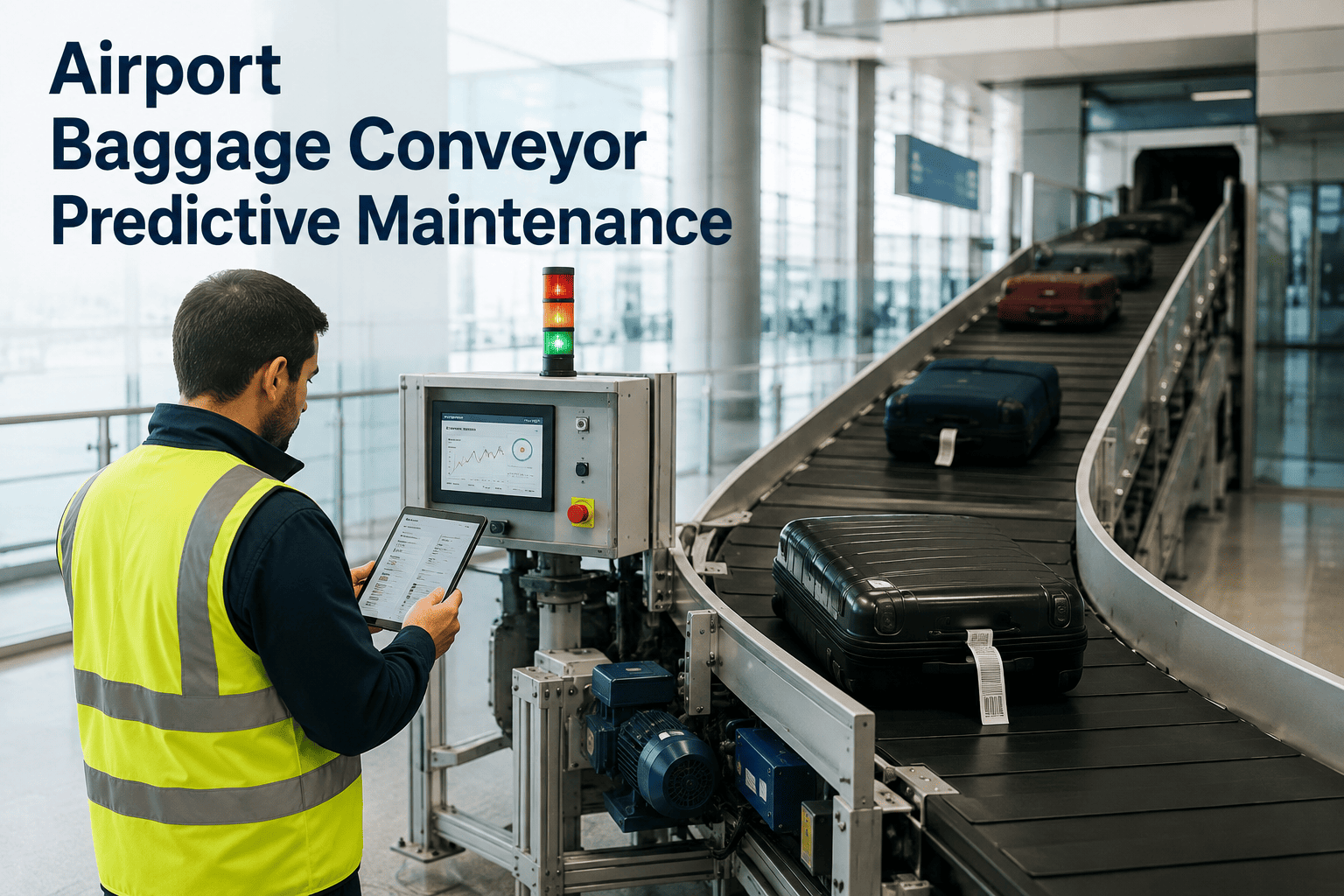
At 6:45 AM, the first departure bank of the day sends close to a thousand bags down the same belt line, and if one drive motor overheats or one roller bearing seizes at that exact moment, the backup does not stay contained in the baggage hall. It shows up at the jet bridge, in the check-in queue, and in the on-time performance report that airport leadership reviews before their coffee is cold. Ground handling teams usually already know which conveyor sections tend to act up, but knowing after years of recurring complaints is not the same as knowing before the belt actually stops mid-bank. iFactory's AI-powered predictive maintenance platform reads the early mechanical signals inside a baggage handling system and gives maintenance teams a chance to intervene during a quiet overnight window instead of a peak departure rush, and you can book a demo to see how it maps against your own BHS layout.
When One Baggage Belt Jams, the Whole Terminal Feels It
iFactory monitors the motors, bearings, belts, and sensors inside your baggage handling system around the clock, flagging degradation days or weeks before it becomes a stalled conveyor during a peak departure bank.
A Stopped Conveyor Is Never Just a Maintenance Ticket
Baggage handling systems run in one of the least forgiving operating environments in any facility: near-continuous duty cycles, dust and debris from outdoor tug traffic, tight connection windows measured in minutes, and almost no slack time to pull a section offline for repair. When a conveyor segment fails mid-bank, the consequence is rarely isolated to that one belt. It cascades into missed connections, gate holds, overtime for ramp and ground crews, and service-level exposure with the airlines that depend on that belt line moving on schedule.
Six Points Along the Belt Line Where Baggage Conveyors Actually Fail
Most BHS failures are not sudden. They build for days or weeks inside a handful of predictable components, and the belt line below shows where those failure points typically sit relative to each other along a standard conveyor run.
1. Drive Motors and Gearboxes
Continuous duty cycles push winding insulation and gearbox lubrication past their rated limits, and overheating rarely announces itself until the motor trips offline mid-shift.
2. Belt Tracking and Mistracking
A belt that slowly walks off its idlers wears unevenly at the edges, loses tension, and eventually jams against the frame during a high-throughput bank.
3. Roller and Idler Bearings
Bearings are the quietest failure point in the entire system, running normally for months before a seized roller drags the belt to a stop without warning.
4. Photo-Eye and Jam Sensors
Dust, humidity, and debris from outdoor ramp traffic coat optical sensors, triggering false stops or, worse, missing a real jam building at a merge point.
5. PLC and Control Faults
Encoder drift and intermittent communication dropouts between zone controllers create stop-start behavior that looks minor until it compounds during a peak bank.
6. Belt Splices and Tears
Mechanical fastener splices fatigue under repeated flex cycles, and a splice separation mid-shift usually means a full line stoppage rather than a quick fix.
What Your BHS Was Already Telling You Before It Stopped
Ground crews often describe a failed conveyor as sudden, but the underlying sensor data almost never is. These four patterns typically show up in the days or weeks before a full failure, and they are exactly what an AI monitoring layer is built to catch first.
Rising Motor Temperature Trend
A gradual upward drift in operating temperature across shifts, even within normal single-reading limits, often precedes a winding or bearing failure by one to three weeks.
Vibration Signature Drift
Small shifts in vibration frequency at roller and gearbox mounting points signal early bearing wear long before it produces an audible noise on the ramp.
Belt Tracking Sensor Alerts
An increasing frequency of minor tracking corrections is usually the first measurable sign of idler misalignment or tension loss along a belt run.
Increased Jam-Clear Cycles
A rising count of short stop-and-clear events at the same transfer point points to a mechanical issue building at that junction, not operator error.
How AI Predicts a Baggage Conveyor Failure Before It Stops the Line
The monitoring layer runs continuously in the background of normal operations, so ground ops and maintenance teams see it only when there is something worth acting on.
Continuous Sensor Data Collection
Vibration, temperature, motor current, and tracking sensor readings are captured continuously from motors, gearboxes, and roller assemblies across the belt line.
Motor Current Signature Analysis
Subtle changes in the electrical current draw pattern reveal winding degradation and developing bearing faults well before a thermal alarm would trigger.
Vibration and Thermal Pattern Monitoring
iFactory tracks how each component's vibration and heat signature trends over time against its own established baseline, not a generic industry threshold.
AI Anomaly Detection Against Baseline
When a reading pattern diverges meaningfully from normal operating behavior, the AI models classify the likely failure mode and estimate a probable time-to-failure window.
Automated Alert and Work Order Generation
A prioritized alert routes to the maintenance team with the specific component and failure mode flagged, so the repair can be scheduled into an off-peak window.
Every Missed Signal Eventually Becomes a Ground Ops Problem
iFactory catches the motor temperature drift, the bearing vibration signature, and the tracking sensor pattern long before they turn into a stalled belt during your busiest departure bank.
Reactive BHS Maintenance vs iFactory Predictive Monitoring
The table below lays out what changes for a maintenance team once condition data replaces guesswork as the basis for scheduling belt line repairs.
| Factor | Reactive / Manual Inspection | iFactory Predictive Monitoring |
|---|---|---|
| Failure Visibility | Discovered when the belt stops or an operator reports noise | Flagged days to weeks ahead based on trending sensor data |
| Repair Timing | Emergency repair during whatever shift the failure occurs | Scheduled into an overnight or low-traffic maintenance window |
| Peak-Bank Risk | Failures cluster during highest-throughput departure banks | Component addressed before it reaches a critical operating window |
| Spare Parts Planning | Rush orders and premium freight for unplanned failures | Parts staged in advance based on predicted failure timing |
| Technician Dispatch | Reactive callouts, often outside scheduled shift coverage | Planned dispatch aligned with the flagged component and time window |
Results Reported After Predictive Monitoring Replaces Manual Inspection
These figures reflect outcomes tracked at facilities that layered AI-based condition monitoring onto baggage handling systems previously maintained on a fixed inspection schedule or a run-to-failure basis.
Rolling Out Predictive Monitoring Without Disrupting Flight Operations
A BHS rollout has to work around live flight schedules, so iFactory phases the deployment to start with the highest-failure-frequency segments rather than the entire terminal at once.
Frequently Asked Questions About Predictive BHS Maintenance
Stop Finding Out About Belt Failures From the Ramp, Not the Data
iFactory gives your maintenance team a live view of every motor, bearing, and belt segment across the baggage handling system, with alerts that arrive before the failure does. Book a demo and see it running against your own conveyor layout.