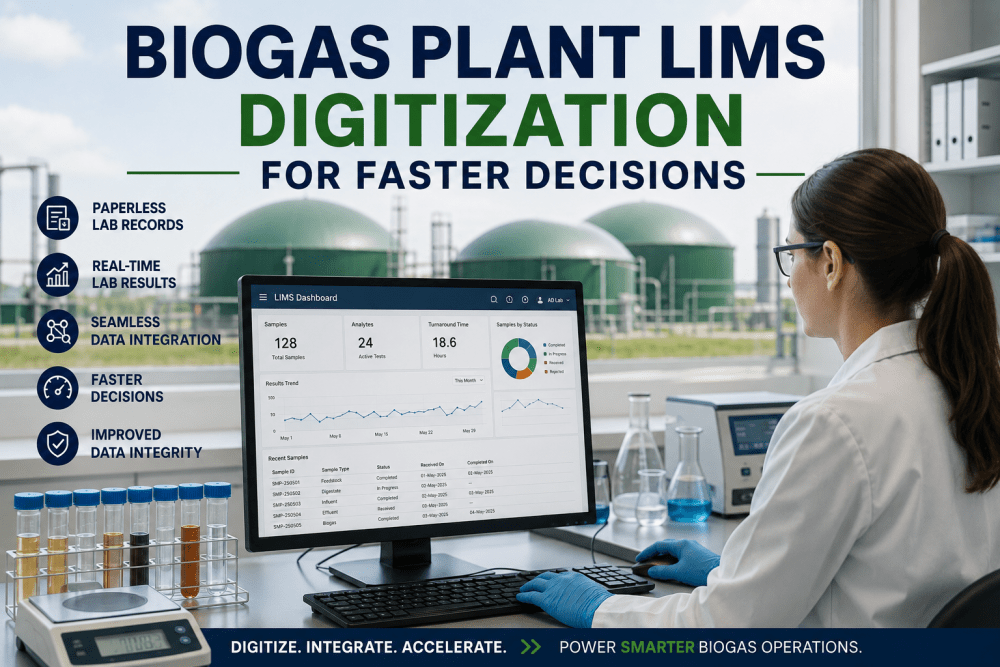
Every hour a biogas plant lab runs on paper logbooks and disconnected spreadsheets, the facility is losing data that directly impacts methane yield, digestor health, and gate fee revenue. Lab technicians record pH, VFA alkalinity, and NH4-N results on clipboards that take days to reach operations decision-makers by which time the digestor has already drifted out of its optimal zone. LIMS digitization closes that gap by transforming lab data from a retrospective record into a real-time operational signal that accelerates corrective action and protects plant profitability. Book a Demo to see how iFactory's digital LIMS connects your AD plant lab to operational decisions in real time.
Is Your AD Plant Lab Still Running on Paper Logbooks and Manual Data Entry?
iFactory's digital LIMS platform connects biogas plant lab instruments, sample workflows, and digestor analytics into a single system — delivering real-time results, automated compliance records, and yield-optimizing insights to every decision-maker on your operations team.
Why LIMS Digitization Is the Missing Link in Biogas Plant Optimization
Biogas plants generate more lab data per operating day than most manufacturing facilities — pH, volatile fatty acids, total alkalinity, ammonium nitrogen, trace elements, and biogas composition are all measured multiple times per shift across feedstocks, in-process digestor zones, and final digestate. When that data lives on paper forms or in isolated spreadsheets, the correlation between feedstock variability, digestor chemistry, and methane yield remains invisible to operators who could act on it. A digitized LIMS changes this by capturing every lab result in a structured, timestamped database that feeds real-time dashboards, trend analyses, and automated alerts tied directly to digestor performance.
The impact extends beyond operational speed. Regulatory compliance for biogas plants — including feedstock acceptance records, digestate quality certification, and emissions monitoring — depends on lab data that must be complete, accurate, and retrievable on demand. Paper-based systems consistently fail audit scrutiny, creating compliance exposure that can delay permit renewals or trigger enforcement actions. Digital LIMS solves both problems simultaneously. Book a Demo to explore iFactory's biogas LIMS digitization framework.
Real-Time Lab-to-Operations Data Flow
Digital LIMS eliminates the latency between sample analysis and operational action. Lab results for pH, VFA, alkalinity, and NH4-N appear in operator dashboards within seconds of instrument validation — enabling feed rate adjustments, micronutrient dosing, and feedstock blend changes before digestor conditions drift out of specification.
Feedstock Acceptance Traceability
Every incoming feedstock truck carries variability that affects digestor performance. Digital LIMS captures acceptance test results — TS, VS, COD, NH4-N — against supplier, haulage date, and feedstock type, building a historical database that enables operators to predict digestor response based on feedstock characteristics and optimize gate fee pricing.
Automated Compliance Documentation
Biogas plants face reporting obligations across digestate quality, feedstock acceptance, and emissions monitoring. Digital LIMS auto-generates compliance reports from verified lab data — eliminating the manual compilation cycle that consumes days of lab manager time before every regulatory submission or customer audit.
Yield Analytics and Trend Intelligence
Lab data accumulated over weeks and months in a digital LIMS becomes a strategic asset for yield optimization. Trend analysis across feedstock batches, seasonal digestor performance, and micronutrient dosing effectiveness reveals correlations that drive continuous improvement in methane output and operational cost reduction.
Paper Lab vs. Digital LIMS: The Operational Gap in Biogas Plant Labs
The difference between paper-based and digitized lab operations in a biogas plant is not incremental — it is structural. The comparison below maps the specific failure points where manual lab processes create operational latency, compliance exposure, and yield loss, against the outcomes delivered by an integrated digital LIMS built for AD plant environments. Book a Demo to benchmark your current lab workflow against iFactory's digital LIMS capability model.
| Lab Process Area | Paper-Based Operation | Digital LIMS (iFactory) | Operational Impact | Risk Level |
|---|---|---|---|---|
| Sample Logging and Tracking | Manual logbook entries; sample ID errors | Barcode-scanned sample lifecycle tracking | Zero sample misidentification events | High |
| Result Data Capture | Handwritten values transcribed to spreadsheets | Direct instrument capture with validation rules | Transcription errors eliminated; data integrity 100% | High |
| Operations Notification | End-of-shift paper report or verbal handoff | Real-time dashboard alert on result validation | Digestor corrective action accelerated by hours | High |
| Trend Analysis | Manual spreadsheet charts; retrospective only | Automated trend dashboards with anomaly flags | Digestor drift detected before yield impact | Medium |
| Compliance Reporting | Manual data compilation from multiple sources | Auto-generated digestate and emissions reports | Reporting labor reduced by 65% per cycle | Medium |
| Feedstock Data Correlation | Disconnected records; no historical query | Searchable feedstock database with yield linkage | Gate fee decisions informed by performance data | Lower |
5-Step LIMS Digitization Roadmap for Biogas Plant Laboratories
Digitizing a biogas plant lab does not require replacing instruments or re-engineering workflows from scratch — it requires a structured integration of existing lab equipment, sample management processes, and data reporting into a unified digital platform. The roadmap below guides quality and lab managers through a deployment sequence that delivers measurable improvements in lab throughput and operational response time within the first month of operation. Book a Demo to review iFactory's pre-built biogas LIMS templates with our solutions team.
Lab Instrument and Workflow Audit
Catalog every instrument in your lab — pH meters, titrators, spectrometers, gas chromatographs,TS/VS analyzers — and document current sample workflows from collection point through analysis, data recording, and result communication. Identify instruments with digital output capability (RS-232, USB, Ethernet) that can connect directly to the LIMS and prioritize those with the highest sample throughput
Sample Taxonomy and Specification Configuration
Define the complete sample taxonomy for your facility — feedstock acceptance, in-process digestor zones (primary, secondary, pasteurization), digestate, biogas composition, and environmental monitoring points — with specification limits, test methods, and alert thresholds configured for each sample type in the digital LIMS platform.
Instrument Integration and Data Validation
Connect digital-output instruments to the LIMS gateway, configure automated data capture with validation rules that flag out-of-range results and instrument drift, and establish manual entry workflows for instruments without digital output that enforce structured data entry and prevent common transcription errors.
Dashboard and Alert Configuration
Deploy operations-facing dashboards that display real-time lab results against digestor performance metrics, configure threshold-based alerts that notify operators and managers when critical parameters — VFA, alkalinity, NH4-N — approach action limits, and establish escalation rules for out-of-spec conditions that require immediate operational response.
Compliance Report Automation and Validation
Configure automated extraction of lab data into digestate quality certifications, feedstock acceptance summaries, and emissions monitoring reports that meet your facility's regulatory obligations. Validate report outputs against historical manual submissions to ensure completeness and accuracy before decommissioning paper-based reporting.
Industry Expert Perspective: Why Lab Digitization Determines AD Plant Profitability
We asked Dr. Jennifer Cross, former Head of Laboratory Operations at a top-25 European biogas operator and current anaerobic digestion technology advisor, to assess where LIMS digitization stands across the AD industry and what plant managers should prioritize.
Dr. Cross has observed the transition from paper-based to digital lab operations across more than 40 AD facilities in Europe and North America. Her assessment is clear: the plants that digitize their lab workflows first gain a compounding advantage in both yield performance and regulatory compliance that paper-based facilities cannot close.
"Lab data in a biogas plant has a half-life of hours, not days," she explains. "A VFA reading taken at 8 AM that does not reach the operator until the end-of-shift report at 4 PM has already lost most of its operational value. By the time the operator sees the upward trend, the digestor has been accumulating VFA stress for an entire shift — and the corrective action required is more aggressive, more costly, and more likely to cause secondary issues than if the same intervention had been applied when the trend first crossed the threshold."
Her primary recommendation for plant managers evaluating LIMS investment is to prioritize data flow over feature breadth. "Start with the highest-frequency tests — pH, VFA, alkalinity — and build the digital workflow that gets those results to operators in real time. The complexity of full LIMS deployment can wait until your team sees the value of instant data flow and demands more. Plants that over-scope their initial deployment often stall; plants that start with the highest-impact tests and iterate see 90% adoption within weeks."
Digitize Your Biogas Plant Lab and Accelerate Every Operational Decision
iFactory's digital LIMS platform connects biogas plant lab instruments, sample workflows, and digestor analytics into a single real-time system — eliminating paper latency, automating compliance, and feeding yield-optimizing insights to every operator on every shift.
Three Business Outcomes LIMS Digitization Delivers Across Biogas Operations
Beyond eliminating paper transcription errors and manual reporting delays, a digitized lab creates structural improvements in how biogas plants manage feedstock variability, protect digestor health, and demonstrate compliance to regulators and off-take partners. The outcomes below represent the measurable impact that AD plant operators achieve after transitioning from paper-based lab workflows to an integrated digital LIMS platform.
Real-time lab data flow reduces the interval between sample collection and operator corrective action from hours to minutes. Plants using digital LIMS consistently respond to VFA and alkalinity drift within the same shift rather than the following day — preventing the yield loss that accumulates when digestor conditions operate outside optimal ranges for extended periods.
Accumulated feedstock acceptance data linked to digestor performance enables operators to predict how different feedstock mixes will affect methane yield and process stability. This historical intelligence supports gate fee pricing decisions, feedstock blend optimization, and supplier qualification programs that directly improve plant revenue and operational predictability.
Automated generation of digestate quality certifications, feedstock acceptance summaries, and emissions monitoring reports from verified lab data eliminates the pre-audit scramble that consumes lab manager hours. Digital LIMS maintains a complete, searchable audit trail of every lab result, sample chain of custody, and instrument calibration record — ready for regulator or customer inspection at any moment.
Critical LIMS Implementation Mistakes Biogas Plant Operators Must Avoid
Even well-managed biogas plants make predictable and costly mistakes when digitizing lab operations — errors that not only delay the benefits of digitization but can create new data integrity problems, operator resistance, and compliance gaps that paper-based workflows previously avoided. These failure patterns are preventable when LIMS deployment follows a structured approach grounded in lab operational reality. Book a Demo to discuss how iFactory's deployment methodology eliminates these risks from the start of your digitization program.
Recreating paper-based lab workflows in digital form — rather than redesigning them to leverage automation, validation, and real-time communication — limits the value of digitization to faster typing. LIMS deployment must include a workflow redesign phase that eliminates unnecessary steps and builds automation into the sample-to-report cycle.
Failing to audit instrument communication capabilities before deployment leads to partial digitization where some instruments push data automatically while others require manual entry — creating a hybrid workflow that undermines adoption and retains the transcription errors the LIMS was intended to eliminate.
Configuring LIMS alerts without a defined escalation path — who receives the alert, by what channel, and at what threshold — results in critical results being buried in email inboxes while the digestor continues to drift. Alert rules must be designed in partnership with operations teams who define the response workflow for each out-of-spec condition.
Digital LIMS adoption fails most often not because of technology limitations but because lab technicians and operators were not adequately trained in the new workflows or did not understand how the system benefits their daily work. Structured training programs and visible quick wins in the first weeks of deployment are essential for sustained adoption.
Configuring LIMS report templates and data retention rules after deployment rather than during the specification phase creates a documentation gap that can trigger non-compliance findings during audits. Compliance requirements — digestate quality, emissions monitoring, feedstock records — must be mapped to LIMS output templates before the system goes live.
Transitioning from paper-based or spreadsheet lab records without migrating historical data into the new LIMS creates a break in the analytical history that undermines trend analysis and compliance documentation. Historical lab data — particularly VFA, pH, and alkalinity records — must be structured and imported to preserve the longitudinal dataset that drives yield optimization.
The Lab Digitization Decision That Determines Your Biogas Plant's Next Decade of Performance
The gap between paper-based and digitized lab operations in biogas plants is not closing — it is widening with every regulatory update, every feedstock price shift, and every yield improvement that digital plants capture while paper-based facilities remain blind to the same opportunities. Plant managers who continue to rely on manual lab workflows are not only accepting slower operational response and higher compliance labor costs — they are making a structural decision to cap their facility's methane yield potential at a level that digital peers will exceed by an increasing margin each year.
LIMS digitization transforms the biogas plant lab from a cost center that generates retrospective records into a profit center that feeds real-time operational intelligence to every decision-maker in the facility. The instruments are already on your bench. The samples are already being collected. The only question is whether the data those samples contain reaches your operators in time to act on it — or whether it sits on a clipboard until the digestor has already drifted past the point of optimal recovery.
Biogas Plant LIMS Digitization — Frequently Asked Questions
What specific lab tests in a biogas plant benefit most from LIMS digitization?
The highest-impact tests for LIMS digitization are those that directly influence operational decisions within the same shift: pH, volatile fatty acids (VFA), total alkalinity (TA), and ammonium nitrogen (NH4-N) from in-process digestor samples. These parameters drive feed rate adjustments, micronutrient dosing, and feedstock blend changes that must happen in real time to maintain optimal digestor conditions. Feedstock acceptance tests — total solids (TS), volatile solids (VS), and chemical oxygen demand (COD) — also deliver significant value from digitization by enabling gate fee optimization and feedstock blending decisions informed by historical performance data.
How does LIMS digitization improve biogas plant regulatory compliance?
Biogas plants face compliance obligations across digestate quality certification (trace elements, pathogen indicators, nutrient content), feedstock acceptance record-keeping, and emissions monitoring. Digital LIMS automates the extraction of lab data into compliance-ready report formats, maintains a complete audit trail of every sample from collection through analysis and reporting, and enforces data integrity controls that satisfy regulatory requirements for record accuracy and retrievability — eliminating the manual compilation cycle that creates compliance risk in paper-based operations.
Can iFactory's LIMS integrate with existing lab instruments and digestor SCADA systems?
Yes — iFactory's digital LIMS platform supports direct instrument integration via RS-232, USB, Ethernet, and OPC-UA protocols for pH meters, titrators, spectrometers, gas chromatographs, and TS/VS analyzers commonly found in biogas plant labs. The platform also integrates with digestor SCADA and process control systems to correlate lab results with operational parameters — temperature, feed rate, mixing status, gas production — enabling the lab-to-operations data flow that drives faster corrective action and yield optimization.
What is the typical implementation timeline for a biogas plant LIMS digitization project?
iFactory's structured deployment methodology delivers the first phase of LIMS digitization — real-time pH, VFA, and alkalinity data flow from lab to operator dashboards — within 4–6 weeks from project kickoff. Full deployment including all instrument integrations, sample type configurations, compliance report automation, and historical data migration is typically completed within 10–14 weeks for a single-site facility. Multi-site deployments follow a phased rollout with an additional 4–6 weeks per additional facility as configuration templates are replicated across sites.
How does LIMS digitization impact gate fee revenue and feedstock acceptance decisions?
Digital LIMS transforms feedstock acceptance from a compliance checkbox into a strategic decision tool by accumulating a searchable historical database of feedstock test results — TS, VS, COD, NH4-N — linked to the digestor performance and methane yield outcomes that followed each feedstock batch. Plant managers can use this data to adjust gate fee pricing based on feedstock quality, reject loads that historically correlate with process instability, and optimize feedstock blends to maximize methane output. Plants with more than 12 months of digital LIMS data consistently report improved gate fee margins and digestor stability compared to paper-based operations managing the same feedstock volume.
Launch Your LIMS Digitization Pilot with iFactory Today
Biogas plant operators across North America and Europe are using iFactory's digital LIMS platform to connect lab instruments, sample workflows, and digestor analytics into a single real-time system — eliminating paper latency, automating compliance, and feeding yield-optimizing insights to every operator on every shift.