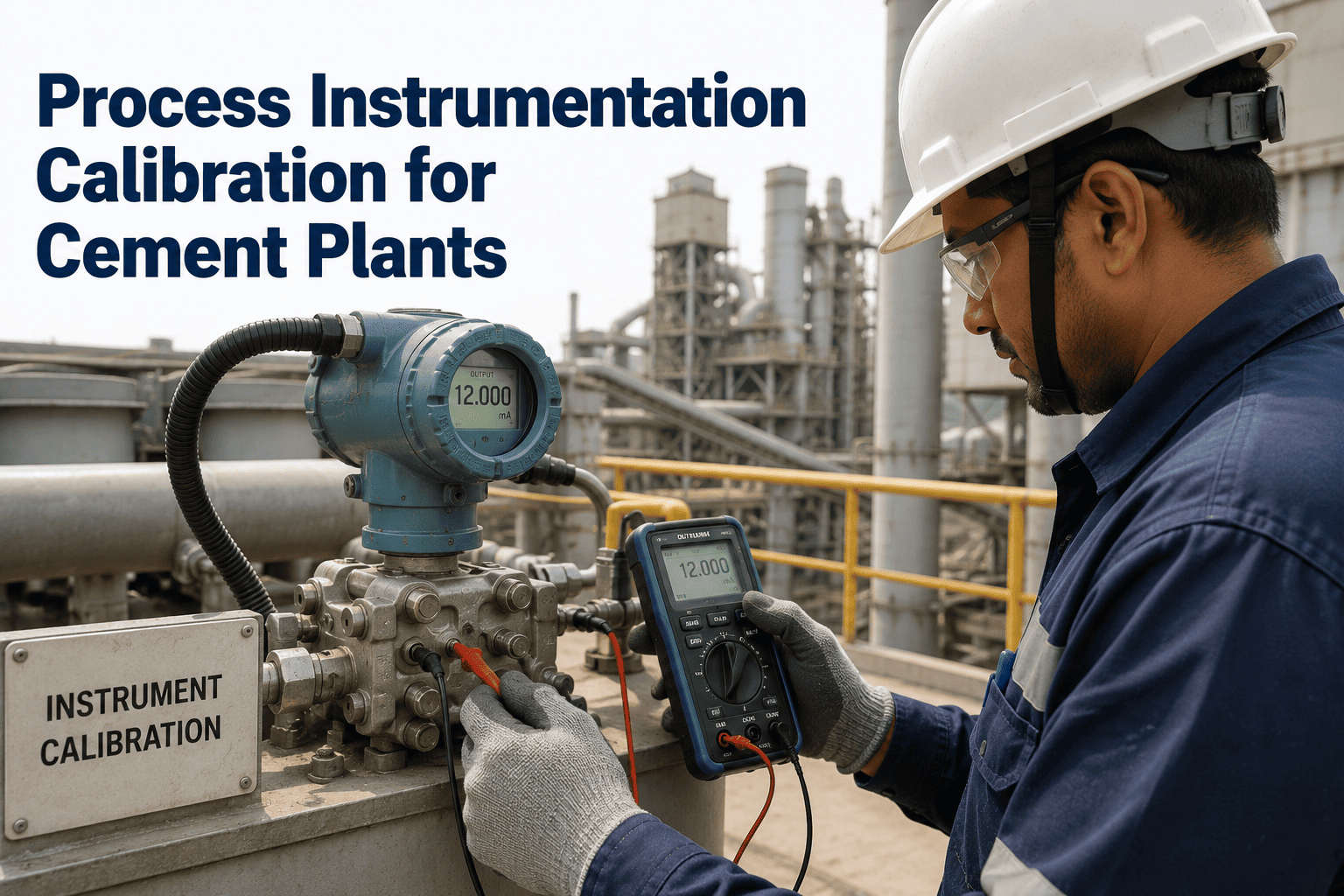
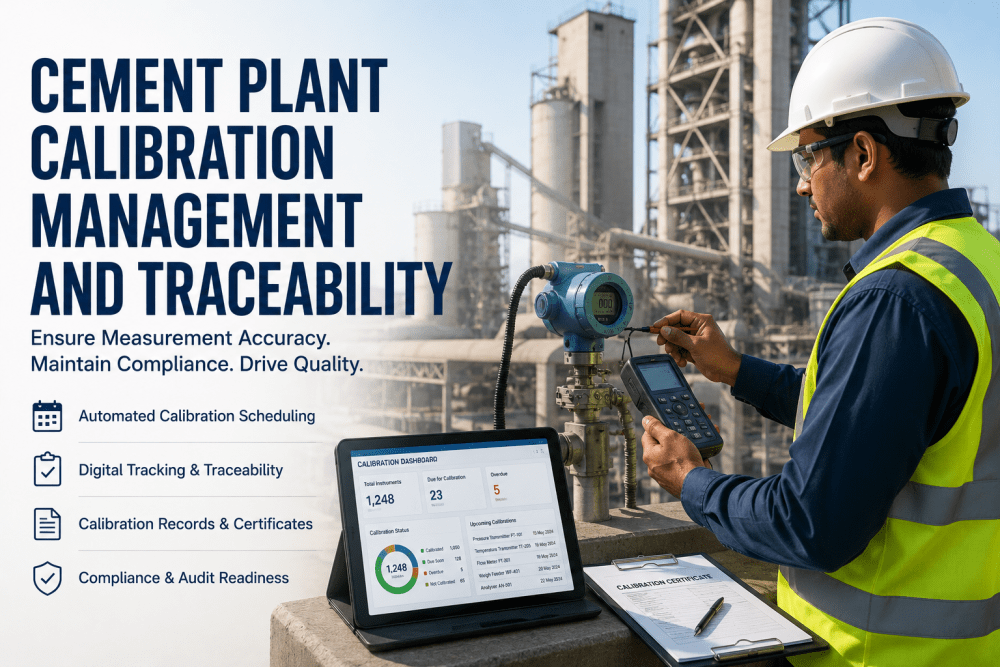
Cement plants operate between 300 and 500 field instruments per production line — pressure transmitters, temperature sensors, gas analyzers, flow meters, level transmitters, weigh feeders, and position sensors — each generating the real-time data that drives process control, emissions compliance, quality assurance, and production optimization. Yet instrumentation and calibration management remains one of the most systematically neglected reliability disciplines in U.S. cement manufacturing. The typical cement plant operates with 15–25% of its field instruments outside calibration tolerance at any given time. Most of these drift events go undetected until a process upset, a quality excursion, or — in the worst case — a Title V emissions permit violation triggers an investigation that traces back to an instrument that should have been recalibrated two months earlier. This checklist is built for cement plant electrical and instrumentation engineers, reliability managers, and maintenance planners who need a field-ready framework to evaluate every aspect of their instrumentation program — from instrument registry completeness and calibration scheduling to accuracy verification, replacement cycle planning, and CMMS integration.
Eliminate Process Variability at the Source.
Start With a Systematic Instrument Audit.
A complete, field-tested checklist covering instrument inventory management, calibration scheduling, accuracy verification, gas analyzer certification, weigh feeder calibration, and CMMS integration — designed for U.S. cement plants targeting zero unplanned deviations and full regulatory compliance.
Why Instrumentation and Calibration Management Matters in Cement Manufacturing
Instrument drift is the silent root cause behind many of the most expensive operational events in cement manufacturing. A 0.5% drift in a kiln feed weigh feeder causes a detectable clinker chemistry shift within hours. A 2% error in a CEMS NOx analyzer can generate a false exceedance report that triggers a regulatory investigation lasting weeks. A drifting oxygen analyzer on the kiln inlet drives combustion control into a sub-optimal zone, increasing fuel consumption by 1–3% without any operator awareness. These are not hypothetical scenarios — they are documented failure patterns that iFactory's Calibration Scheduling and Instrument Registry module identifies and eliminates through systematic calibration management and instrument analytics. The sections below provide a field-ready checklist framework that covers every critical instrument category in a modern cement plant, from the preheater tower to the finish mill and loadout.
Section 1: Instrument Inventory and Classification Registry
An accurate, complete instrument registry is the foundation of any calibration management program. Without a comprehensive inventory that captures instrument type, manufacturer, range, accuracy class, location, and process service, calibration scheduling is guesswork — and the instruments most critical to compliance and quality are just as likely to be overlooked as the least important ones. This section should be completed as a walk-down of every process area in the plant, from raw material receiving to clinker loadout and cement shipping.
Section 2: Pressure and Temperature Instrument Calibration Verification
Pressure transmitters and temperature sensors represent the largest population of field instruments in any cement plant. Pressure transmitters monitor kiln draft, preheater pressure drop, cooler under-grate pressure, and compressed air systems — all critical for process control and safety. Temperature sensors — RTDs and thermocouples — measure kiln burning zone temperature, preheater exit gas temperature, clinker cooler temperature profile, and finish mill bearing temperatures. Calibration drift in either category can go undetected for months if the instruments do not have redundant cross-checks or if their readings are within the DCS alarm limits but outside the accuracy required for process optimization.
Section 3: Gas Analyzer and CEMS Calibration Verification
Continuous emissions monitoring systems (CEMS) are the most compliance-critical instrumentation in any cement plant. Under 40 CFR Part 60 and Part 63, CEMS analyzers measuring CO₂, NOₓ, SO₂, CO, O₂, and particulate matter must meet rigorous calibration drift specifications and must undergo daily automated calibration checks, quarterly cylinder gas audits (CGA), and annual relative accuracy test audits (RATA) by an independent third party. A CEMS calibration failure that goes undetected for even a single operating day can result in a Notice of Violation from the EPA or state air agency, with penalties ranging from $15,000 to $50,000 per day per violation. This section covers the critical checkpoints that plant instrument technicians must verify between the required third-party audits.
Section 4: Flow Meter, Level Transmitter, and Weigh Feeder Verification
Flow meters, level transmitters, and weigh feeders are the instruments that directly impact cement plant production accounting, inventory management, and raw material proportioning. A weigh feeder calibration error of just 0.5% on a kiln feed system operating at 200 tons per hour results in a discrepancy of 24 tons per day in clinker production accounting — and a corresponding error in the specific heat consumption and emission factor calculations that rely on accurate feed rate data. Level transmitters on raw material and cement silos drive inventory valuation and production scheduling decisions; an error of 2% on a 10,000-ton cement silo represents 200 tons of product that cannot be accurately accounted for in the plant's ERP system.
Section 5: Calibration Scheduling, Records Management, and CMMS Integration
The most technically accurate calibration in the world provides no value if it is performed on the wrong instrument, at the wrong interval, or without documented results that can be produced during an audit. Calibration management is fundamentally a data management discipline — and the CMMS is the tool that transforms calibration from a reactive, event-driven activity into a scheduled, documented, and continuously improving process. This section covers the systems-level checkpoints that determine whether a plant's calibration program is operating effectively or merely going through the motions.
| Criticality Class | Instrument Examples | Recommended Interval | Calibration Accuracy Target | Priority |
|---|---|---|---|---|
| Safety / Regulatory | CEMS analyzers, SIL pressure switches, safety relief device indicators | 3–6 months | ±1% of span or better | Critical |
| Quality | Kiln feed weigh feeders, online XRF analyzers, clinker cooler temperature sensors | 6–12 months | ±0.25–0.5% of span | High |
| Process Control | Pressure transmitters, RTDs, DP transmitters, flow meters, level transmitters | 12 months | ±0.5–1.0% of span | Medium |
| Monitoring | Indication-only pressure gauges, panel meters, non-critical temperature indicators | 24–36 months | ±2% of span | Standard |
Audit Findings Prioritization and Corrective Action Workflow
After completing the field inspection across all five sections, use this structured workflow to sequence corrective actions based on regulatory exposure, production impact, and the cost of deferred action. The most effective calibration programs do not attempt to address every finding simultaneously — they prioritize by risk and resource availability, closing the highest-impact items first while building a sustainable schedule for the remainder.
Classify and Rank All Findings
Categorize each finding: Regulatory/Safety Violation (immediate action required), Quality Impact (next available outage), Drift Trend Requiring Investigation, Documentation Gap, or Inventory Deficiency. Safety and compliance items must be resolved before the next production shift regardless of other priorities.
Quantify Process and Financial Impact
Estimate the annualized cost impact for each out-of-tolerance finding — including energy waste from sub-optimal combustion control, quality excursion risk from inaccurate weigh feeders, production accounting discrepancies from level transmitter errors, and regulatory penalty exposure from CEMS drift.
Generate Calibration Work Orders in CMMS
Create corrective calibration work orders in iFactory AI for all findings — each work order should reference the specific instrument, the as-found reading, the required accuracy, the calibration procedure, and the assigned technician. Safety-critical instrument work orders should be tagged for expedited completion.
Execute Calibration, Document Results, and Verify
Complete instrument calibration with full documentation in the CMMS — record as-found and as-left values, attach calibration certificate or standard ID, and update the instrument's next calibration due date. For instruments found out of tolerance, verify that the DCS or control system value has been updated to reflect the corrected calibration.
Analyze Drift Trends and Update Calibration Intervals
Review calibration drift data quarterly to identify instrument types, manufacturers, or plant areas with higher than expected drift rates. Adjust calibration intervals dynamically — extend intervals for instrument populations with consistent zero-drift performance and shorten intervals for populations showing progressive degradation patterns.
Want iFactory AI to turn your instrumentation audit findings into tracked, closed-loop calibration work orders automatically? Book a Demo and see how instrument-to-work-order workflows operate in a live cement plant environment.
Expert Review: What Instrumentation and Controls Engineers Look for in Cement Plant Calibration Programs
Expert Perspective: Instrumentation & Calibration Management Assessment
Based on ISA-87.00.01 (Cement Plant Instrumentation) Standards, ISO 10012 Measurement Management Systems, and 40 CFR Part 60/63 CEMS Compliance RequirementsISA-87.00.01 — the Cement Industry Instrumentation Standard — establishes the minimum requirements for instrument selection, installation, and maintenance in cement manufacturing facilities. Yet in the field, the most common finding across U.S. cement plants is not an instrument technology problem. It is a calibration management discipline problem. Plants invest heavily in high-accuracy smart transmitters with HART and Foundation Fieldbus digital communications — then calibrate them on a schedule determined by the last plant manager's preference rather than by drift trend data, manufacturer recommendations, or criticality-based intervals.
The ISA-87 committee's guidance, reinforced by the Cement Industry Environmental Consortium (CIEC) and the Portland Cement Association (PCA) best practice documents, is clear: calibration intervals must be established based on the instrument's criticality to process control, product quality, and regulatory compliance — and must be adjusted dynamically as drift data accumulates. A pressure transmitter on the kiln inlet that has been found within tolerance for five consecutive annual calibrations does not need the same interval as a weigh feeder load cell that has drifted 0.15% between each of the last three calibration events. But most plants calibrate both on the same fixed 12-month cycle, wasting resources on the stable instrument while missing the progressive degradation of the critical one.
The other consistent finding across U.S. cement plant calibration programs is the documentation gap. Plants that perform technically excellent calibrations — with properly certified standards, correct accuracy ratios, and meticulous as-found/as-left recording — routinely fail to produce the documentation during a regulatory audit because the records exist in a technician's binder, a spreadsheet on a laptop, or — most commonly — not at all. A calibration that cannot be documented for an auditor is, from a compliance standpoint, a calibration that never happened. iFactory AI's Calibration Scheduling and Instrument Registry module eliminates exactly this gap by linking every calibration work order to the instrument asset record, storing the as-found and as-left data in a searchable format, and generating audit-ready calibration history reports on demand.
Frequently Asked Questions
Conclusion: Instrument Calibration Is Not a Compliance Activity — It Is a Process Control Strategy
Too many U.S. cement plants treat instrument calibration as a periodic compliance exercise — something to be completed once a year to satisfy the insurance auditor or the regulatory inspector, then forgotten until the next annual cycle. This mindset misses the fundamental operational reality: instrument drift is process variability, and process variability is the enemy of every performance metric that a cement plant's management team tracks — energy efficiency, production rate, product quality, emissions compliance, and equipment reliability.
A pressure transmitter that drifts by 0.5% over a year does not become wrong all at once on the day it exceeds tolerance. It becomes slightly wrong every day — driving the kiln draft control loop slightly off target, consuming slightly more fuel, producing slightly more variability in clinker quality, requiring slightly more frequent operator intervention to maintain the process within acceptable bounds. The cumulative cost of these small, undetected errors across 300–500 instruments per production line is vastly larger than the cost of a properly scheduled, well-documented calibration program managed through a CMMS like iFactory AI.
iFactory AI's Calibration Scheduling and Instrument Registry module was built for exactly this operating model — connecting every instrument in your cement plant to a dynamic calibration schedule driven by criticality, manufacturer recommendations, and real drift data. Every calibration becomes a documented event with an audit trail. Every instrument analytics report identifies drift trends before they cause process upsets. Every CEMS calibration record is one click away during an EPA inspection. Book a Demo with iFactory AI to see how your plant's instrumentation program can move from reactive compliance to proactive process control.
Ready to Automate Your Cement Plant Instrumentation and Calibration Program?
iFactory AI's Calibration Scheduling and Instrument Registry turns your instrumentation checklist into a continuous digital management program — with automated calibration work orders, instrument drift analytics, CEMS compliance tracking, and closed-loop corrective action management for every instrument in your plant.