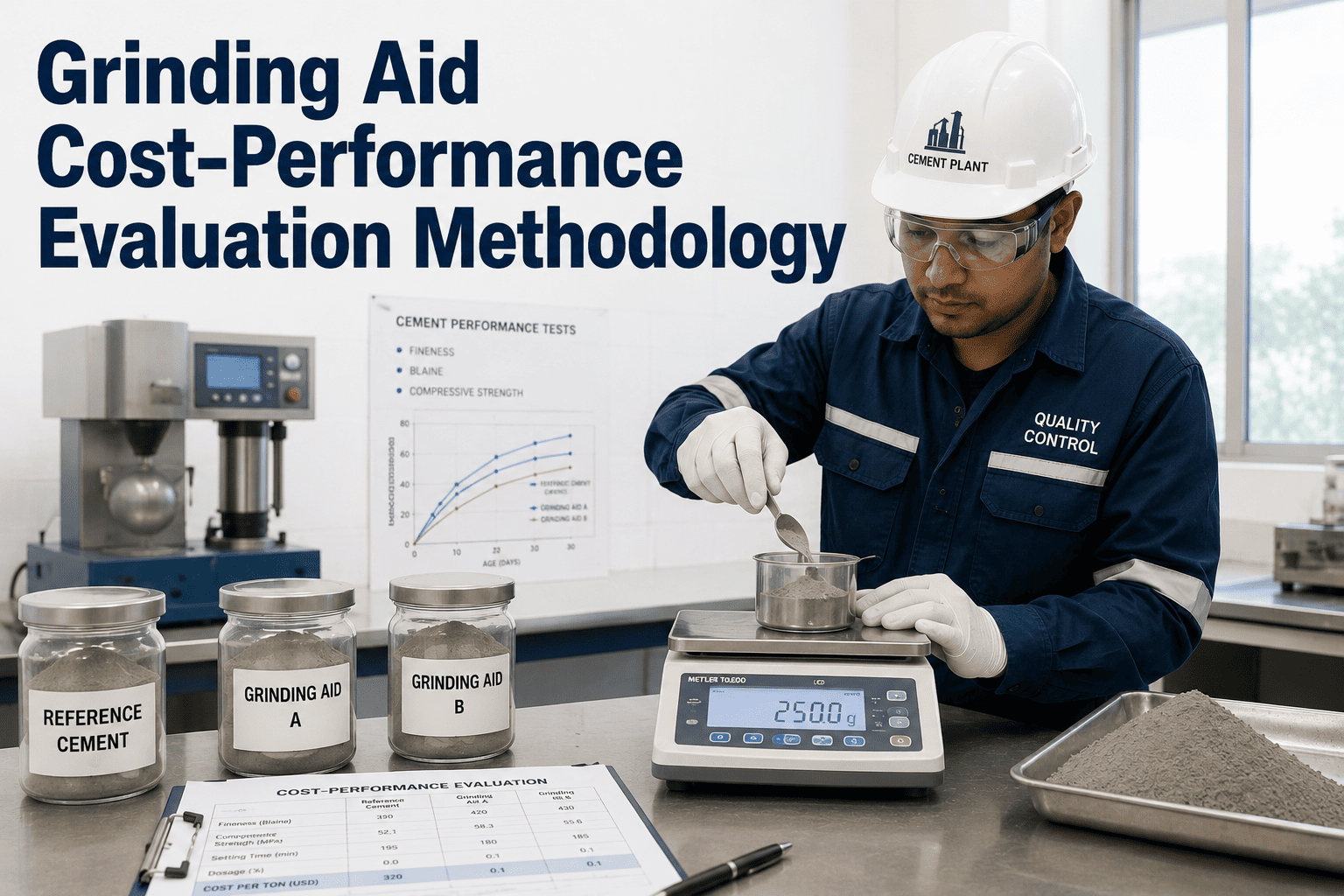
Most cement plants still pick a grinding aid the same way they'd pick a supplier for gloves — lowest price per liter wins the bid. That approach quietly costs plants far more than the additive line item ever shows, because dosage rates, strength retention, and mill throughput all move together and none of them show up on the purchase order. A proper evaluation looks at total grinding cost per tonne of cement produced, not the cost of the drum sitting in the warehouse. Book a demo to see how plants are running this evaluation with live mill data instead of quarterly spreadsheets.
Price Per Liter Is the Wrong Number
A grinding aid that costs 20% more per liter can still lower total grinding cost if it cuts dosage, raises mill output, or protects 28-day strength. This methodology walks through how to test and score that trade-off properly.
Three Numbers the Invoice Never Shows
A grinding aid's real cost is spread across dosage, mill output, and cement performance — not the unit price alone.
A Five-Step Evaluation That Holds Up
Run each candidate aid through the same sequence so results are comparable across suppliers and dosages.
Establish the Baseline
Run the mill without any aid, or on the current product, for a defined period and record dosage, output, Blaine fineness, and strength at 1, 7, and 28 days.
Fix the Test Window
Hold clinker source, gypsum ratio, and mill feed rate constant during the trial window so the aid is the only variable that changes.
Trial at Multiple Dosages
Test the candidate aid at two or three dosage points rather than one, since suppliers often quote their lowest recommended rate to win the trial.
Track Output and Power Draw
Record tonnes-per-hour and mill motor power together, since an aid that raises output but also raises specific power consumption may not net out positive.
Verify Strength at 28 Days
Early strength gains can mask 28-day retention issues, so no evaluation is complete until the full curing cycle is checked against baseline.
Total Grinding Cost Per Tonne
Once dosage, output, and strength are measured, the total cost calculation replaces the price-per-liter comparison entirely.
| Cost Factor | Price-Per-Liter View | Total Grinding Cost View |
|---|---|---|
| Additive spend | Unit price only | Unit price × actual dosage per tonne |
| Mill throughput | Ignored | Power and time cost per tonne produced |
| Strength retention | Not tested | Rework or blend-adjustment cost avoided |
| Supplier comparison | Cheapest quote wins | Lowest cost per tonne of finished cement wins |
Stop Comparing Drums. Start Comparing Tonnes.
A live view of dosage, mill output, and quality data turns a quarterly grinding aid trial into an ongoing cost control tool instead of a one-time procurement exercise.
What to Watch Beyond Fineness
Fineness gains are the easiest number to chase and the easiest one to be misled by.
Pack-Set Behavior
Some aids improve grindability but increase cement pack-set in silos, creating a handling cost the mill trial never captures.
Air Entrainment
Amine-based aids can entrain air, which lowers strength at a given water-cement ratio unless the mix is adjusted for it.
Consistency Across Clinker Lots
An aid that performs well on one clinker source may behave differently as raw mix composition shifts through the quarter.
Dosage Drift Over Time
Operators often creep dosage upward for perceived output gains without re-checking whether strength retention still holds.
Where Grinding Aid Trials Go Wrong
Most flawed evaluations fail for the same handful of reasons, not because the aid itself was misjudged.
Comparing Different Clinker Batches
Running the baseline on one clinker lot and the candidate aid on another introduces a variable that has nothing to do with the additive itself.
Ignoring Seasonal Humidity Shifts
Ambient humidity changes cement flowability and pack-set independently of the aid, which can be mistaken for an additive effect if the trial spans a season change.
Using Supplier-Recommended Dosage Only
Testing only at the dosage the supplier suggests skips the chance to find a lower dosage that delivers the same fineness at a lower total cost.
Stopping Data Collection at 7 Days
A strong 7-day strength result can still diverge from the 28-day figure, so ending the trial early risks approving an aid that underperforms at full cure.
Turning Trial Data Into a Procurement Decision
Once total grinding cost per tonne is calculated for each candidate, the procurement conversation shifts from price negotiation to value comparison.
Annualize the Savings
Multiply the total cost difference per tonne by annual cement output to show the full-year financial impact of switching or adjusting dosage.
Account for Switching Risk
Include a buffer for the ramp-up period when a new aid is first introduced at scale, since dosage tuning at full production can differ from trial conditions.
Set a Monitoring Checkpoint
Schedule a follow-up review at 90 days after rollout to confirm the trial's dosage and strength results are holding at full production scale.
Grinding Aid Evaluation — Common Questions
What plant metallurgists and procurement teams ask before running a formal trial.
Q: How long should a grinding aid mill trial run?
A trial needs enough time to stabilize mill conditions and collect a full 28-day strength curve, which typically means the trial itself runs one to two weeks per dosage point, followed by a month of strength monitoring before results are conclusive. Shorter trials tend to overweight early fineness gains and miss strength or handling issues that show up later. Plants running multiple dosage points in parallel can compress this timeline with proper mill segregation. Our support team can help structure a trial calendar around your production schedule.
Q: Can total grinding cost be calculated without changing suppliers?
Yes, and it's worth doing even for an incumbent aid, since dosage and output can drift over months without anyone re-running the baseline math. Re-baselining the current product against fresh mill and strength data often reveals that a dosage reduction is possible without touching output or strength at all. This is frequently the fastest cost win available, since it requires no supplier negotiation. A live dashboard makes this recalculation continuous rather than a one-time audit.
Q: What role does mill type play in the evaluation?
Ball mills, vertical roller mills, and roller presses respond differently to the same grinding aid chemistry, so results from one mill type cannot be assumed to transfer to another on the same site. Vertical mills in particular are more sensitive to changes in material bed behavior caused by certain aid formulations. Any total cost comparison should be run separately per mill type rather than blended across a plant with mixed grinding technology. This is one of the more common mistakes in multi-mill evaluations.
Q: Should strength data come from the plant lab or an external lab?
Plant lab data is sufficient for day-to-day dosage tuning, but a subset of samples should go to an accredited external lab for verification, especially before a permanent supplier change is approved. Internal lab variability can mask small but real strength differences between aid candidates. Cross-checking a sample set keeps the total cost calculation defensible if it's later used to justify a procurement decision. This step is often skipped under time pressure and shouldn't be.
Q: How often should the grinding aid evaluation be repeated?
Clinker composition, gypsum source, and mill wear all change over time, so a full re-evaluation on an annual basis is reasonable for most plants, with lighter dosage checks quarterly. Plants running frequent clinker source changes may need to shorten this cycle further. Book a demo to see how an ongoing data view replaces the need for a full manual re-trial each cycle.
Evaluate on Total Cost, Not on the Quote
A grinding aid decision made on price per liter alone is a decision made on incomplete information. Bring dosage, output, and strength data together in one view and see what the real cost per tonne actually is.