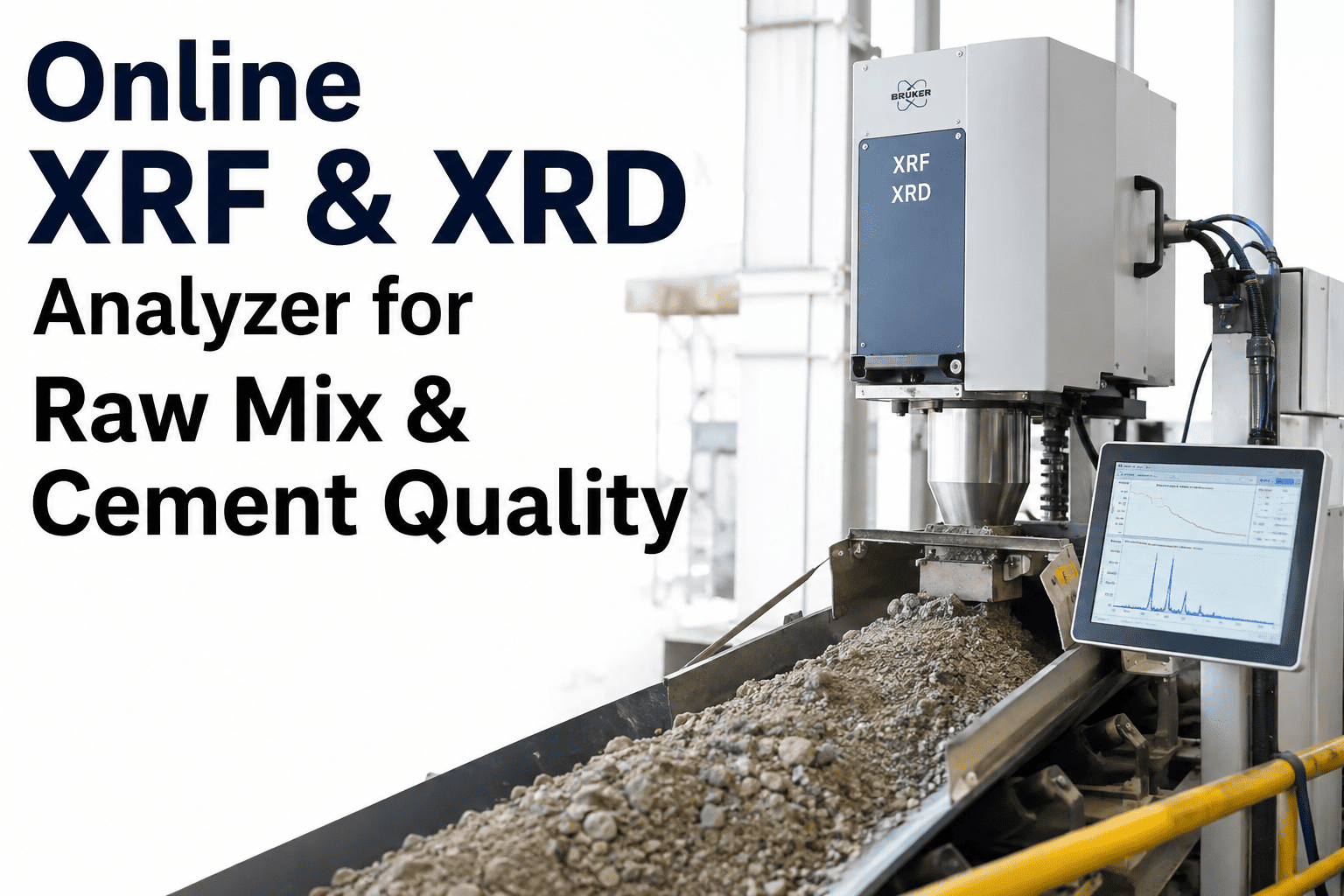
Most cement plants that run laboratory XRF and XRD analysis already own the right instruments — they're just using them on the wrong schedule. A lab-grade X-ray fluorescence unit sitting in the quality building can characterize raw mix chemistry with excellent precision, but if it only sees a sample once every few hours, its precision is wasted on a signal that's already stale by the time the result reaches the raw mill operator. Moving that same measurement capability online, sampling continuously from the raw mix stream itself, turns a periodic snapshot into a live feedback loop that corrects proportioning before an out-of-spec blend ever reaches the kiln. Plants making that shift are discovering that the analytical technology was never the bottleneck — the sampling frequency was.
CEMENT · ONLINE XRF & XRD ANALYSIS
Real-Time Raw Mix Chemistry, Not Hourly Snapshots
iFactory connects online XRF and XRD analyzers to automated proportioning adjustments, keeping LSF, silica ratio, and alumina ratio inside target continuously.
The Two Technologies
XRF and XRD Measure Different Things — And a Complete Quality Picture Needs Both
XRF and XRD are frequently mentioned together, but they answer fundamentally different questions about the material passing through the plant, and understanding that distinction matters when deciding what to monitor continuously versus periodically.
X-Ray Fluorescence
Measures elemental composition — the relative amounts of calcium, silicon, aluminum, iron, and other elements present in raw mix or clinker. This is the data behind LSF, silica ratio, and alumina ratio, the core chemistry targets that proportioning control depends on.
X-Ray Diffraction
Measures mineralogical phase composition — how those elements are actually structured into compounds like alite, belite, and free lime. This is the data that connects raw chemistry to actual burning behavior and finished strength potential, information elemental analysis alone can't provide.
A plant relying on XRF alone can control chemistry ratios precisely while still missing mineralogical issues that only XRD reveals, such as unexpected free lime behavior at a chemistry profile that should theoretically burn well. The two technologies are complementary rather than substitutes for each other.
Why Online Changes the Equation
What Continuous Analysis Adds That Periodic Lab Testing Cannot
The analytical precision of a lab and an online analyzer using comparable technology is often similar — the real difference is temporal resolution, and that difference compounds in ways that matter more than raw measurement accuracy. Book a demo to see the resolution difference against your own raw mix variability.
Sampling Resolution
Online analyzers sample continuously or at intervals of minutes rather than hours, capturing short-duration chemistry excursions that periodic lab sampling structurally cannot see.
Closed-Loop Correction
Continuous data feeding directly into proportioning control allows automated or semi-automated correction, rather than requiring a manual response cycle built around lab turnaround time.
Trend Visibility
A continuous data stream reveals gradual drift patterns — a slowly shifting quarry face, for example — that look like noise in sparse periodic data but form a clear trend in continuous data.
Reduced Lab Dependency for Routine Decisions
Routine proportioning decisions no longer wait on lab turnaround, freeing lab capacity for the calibration, reference testing, and specialized analysis that genuinely require a laboratory setting.
The Correction Loop
How Online Analysis Closes the Loop From Quarry to Kiln Feed
The value of online XRF and XRD isn't just measurement — it's what that measurement enables downstream, and the correction loop it supports is what actually stabilizes raw mix chemistry over time.
1
Continuous sampling pulls representative material from the raw mix stream at frequent, fixed intervals.
2
Online XRF analysis reports elemental chemistry within minutes, feeding LSF and ratio calculations in near real time.
3
Proportioning control adjusts feeder rates automatically or flags operators when chemistry drifts outside target range.
4
Periodic XRD verification confirms that chemistry corrections are translating into the expected mineralogical and burning behavior.
Implementation Considerations
What to Plan for Before Deploying Online Analyzers
Online analyzers deliver most of their value when the surrounding sampling and integration infrastructure is designed correctly around them, not treated as an afterthought.
Sample Point Selection
The sampling location needs to represent the actual blended stream feeding the kiln, not an isolated point vulnerable to local segregation or uneven material flow.
Calibration Discipline
Online analyzers require periodic calibration against certified reference materials to maintain accuracy, a discipline that needs clear ownership within the quality team.
Control System Integration
Analyzer output needs a direct path into proportioning control logic; a continuous data stream that operators must manually interpret loses much of its speed advantage.
Environmental Protection
Dust, vibration, and temperature swings around raw mill areas require analyzer housing and sample handling systems built specifically for that operating environment.
SEE YOUR RAW MIX DATA CONNECTED
Turn Continuous Chemistry Data Into Automatic Proportioning Correction
Our team will walk through how online XRF and XRD data connects to your proportioning control and finished quality outcomes.
Lab vs. Online
Laboratory Analysis and Online Analysis, Compared
Neither approach fully replaces the other, but understanding where each one is strongest clarifies how they should work together in a well-designed quality program.
| Factor | Laboratory XRF/XRD | Online XRF/XRD |
|---|
| Sampling frequency | Hourly or less frequent | Continuous or every few minutes |
| Result turnaround | Requires sample transport and prep | Near real time |
| Best suited for | Reference testing, calibration, specialized analysis | Routine proportioning control |
| Operator accessibility | Centralized in quality lab | Feeds directly into process control |
| Precision per sample | Typically highest achievable | High, tuned for process control speed |
Common Challenges
Where Online Analyzer Projects Typically Run Into Friction
Most challenges with online analyzer deployments trace back to a handful of recurring issues rather than the underlying measurement technology itself.
Poor Sample Representativeness
An analyzer reading a non-representative sample point produces precise but misleading data, which is why sample point selection deserves as much engineering attention as the analyzer itself.
Disconnected Control Logic
Analyzer data that arrives in a dashboard nobody actively monitors provides little more value than periodic lab testing; the correction loop needs to be built into daily operating practice.
Inconsistent Calibration Practice
Analyzer drift left uncorrected erodes trust in the data over time, which is why a defined calibration schedule with clear ownership matters as much as the initial installation.
Frequently Asked Questions
Online XRF and XRD Analysis — FAQs
Do online analyzers need to fully replace lab-based XRF and XRD equipment?
No — most plants run both, with online analyzers handling continuous process control and lab equipment continuing to serve as the reference standard for calibration and specialized testing. The lab instrument's role shifts from routine monitoring toward verification and the deeper analysis that a continuous process analyzer isn't designed to perform, rather than being eliminated entirely.
How often does an online analyzer need calibration compared to a lab unit?
Calibration frequency depends on the specific analyzer technology and manufacturer guidance, but online analyzers generally require more frequent verification than lab units because they operate continuously in a harsher process environment rather than a controlled lab setting. A documented calibration schedule against certified reference materials, with clear ownership assigned to a specific role, is standard practice for maintaining accuracy over time.
Can online XRF alone tell us whether the raw mix will burn well, or do we need XRD too?
Online XRF gives strong visibility into elemental chemistry ratios like LSF, silica ratio, and alumina ratio, which correlate with burnability, but it can't directly confirm mineralogical phase behavior the way XRD can. Plants aiming for the most complete quality picture typically pair continuous XRF for chemistry control with periodic XRD verification to confirm that chemistry targets are translating into the expected burning and strength outcomes.
Book a demo to see how this pairing fits your specific process.
What's the typical payback period for investing in online analyzer technology?
Payback varies significantly based on current raw mix variability, kiln fuel efficiency sensitivity to chemistry swings, and the scale of the operation, so there's no universal figure that applies across every plant. Plants with historically high raw mix variability and correspondingly high fuel and rework costs from chemistry excursions tend to see the fastest payback, since online analysis directly targets the source of that variability.
Does online analyzer data integrate with existing proportioning control systems, or does it require new control hardware?
Most modern online analyzers are designed to integrate with existing plant control systems through standard industrial communication protocols, meaning a full proportioning control system replacement usually isn't necessary. The integration effort typically centers on configuring the data flow and control logic between the analyzer and existing feeder controls rather than replacing the underlying control hardware itself.
CEMENT · ONLINE XRF & XRD ANALYSIS
Stop Correcting Raw Mix Chemistry After the Kiln Already Sees It
iFactory connects online XRF and XRD data to real-time proportioning control, built for plants moving from periodic lab checks to continuous chemistry management.