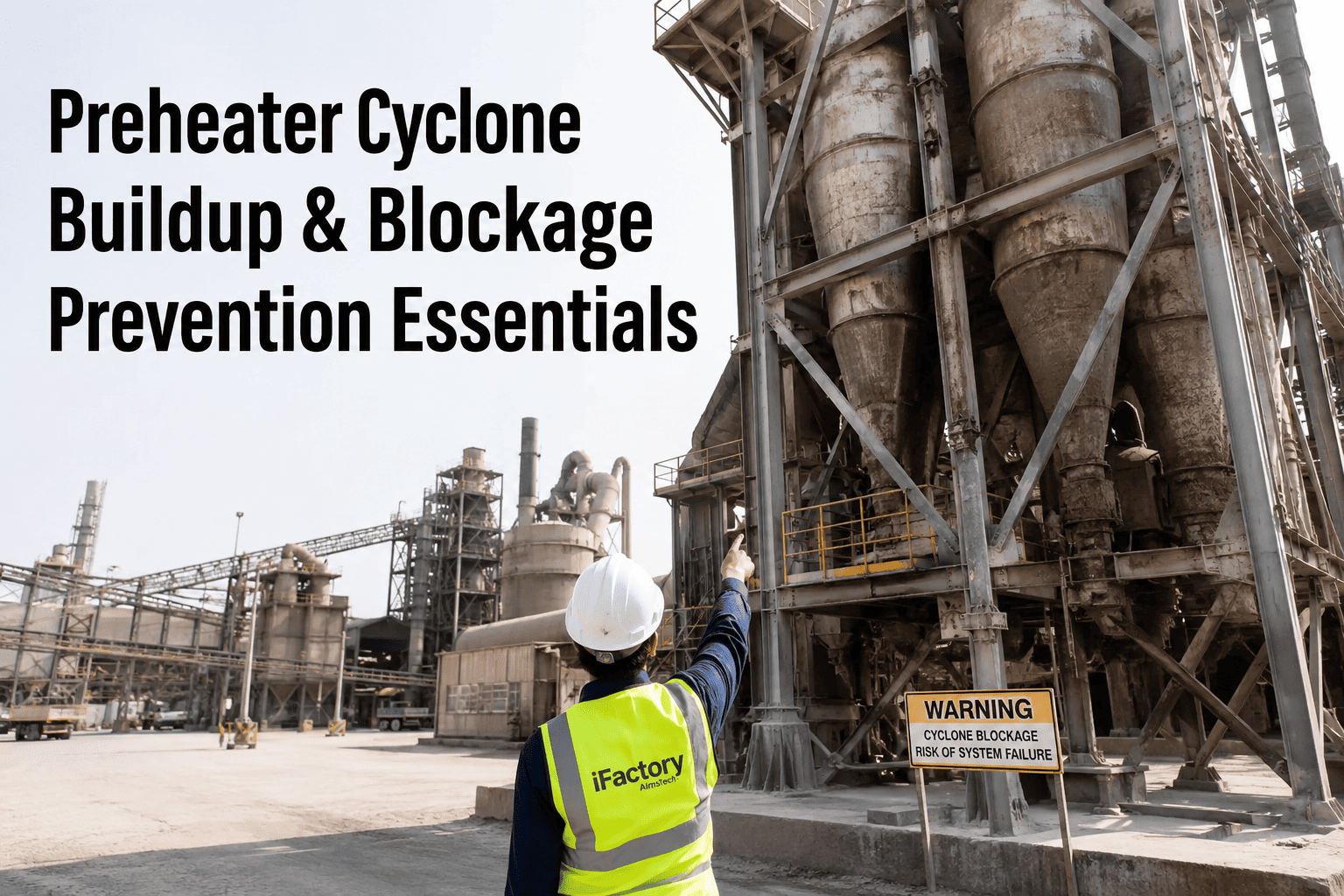
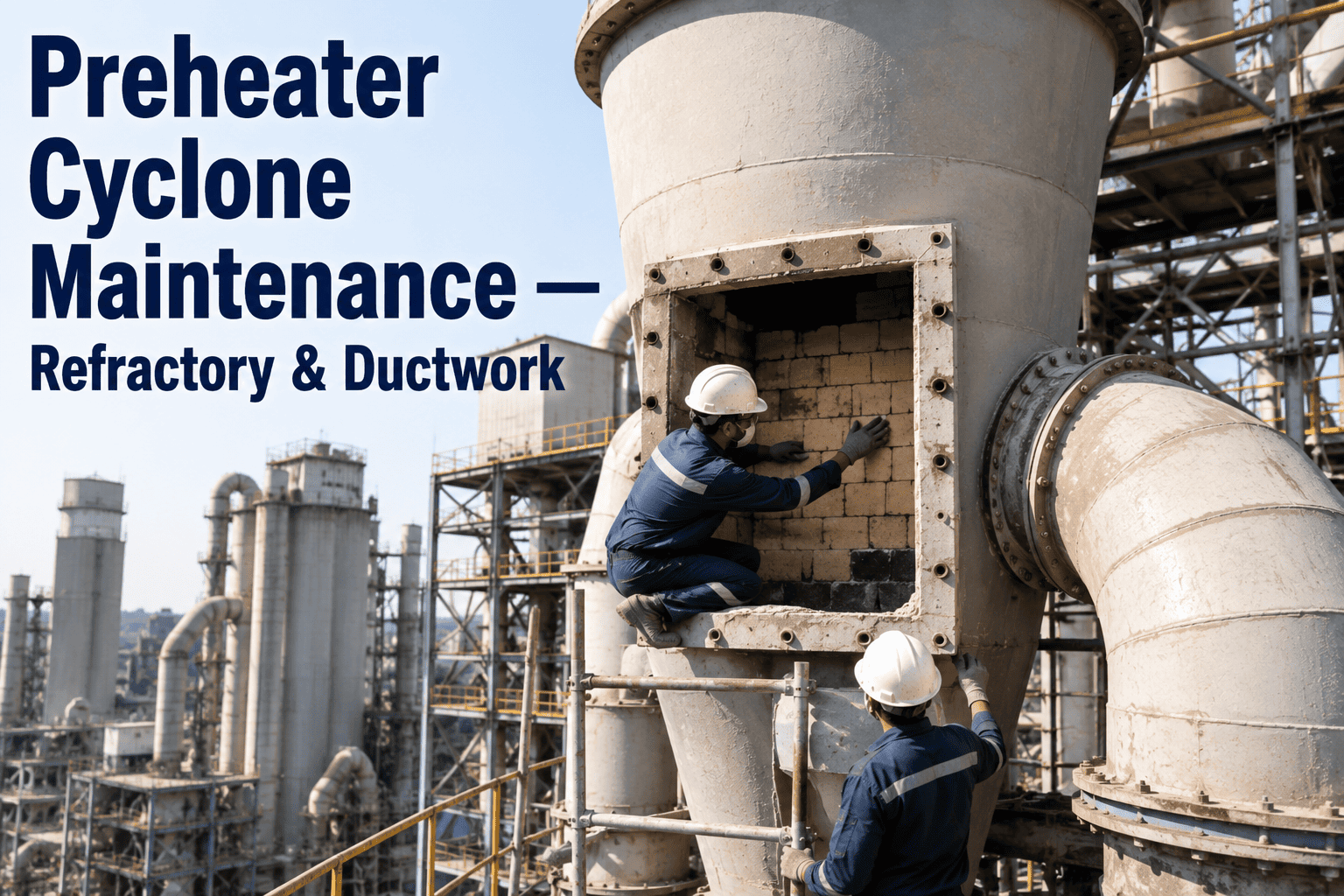
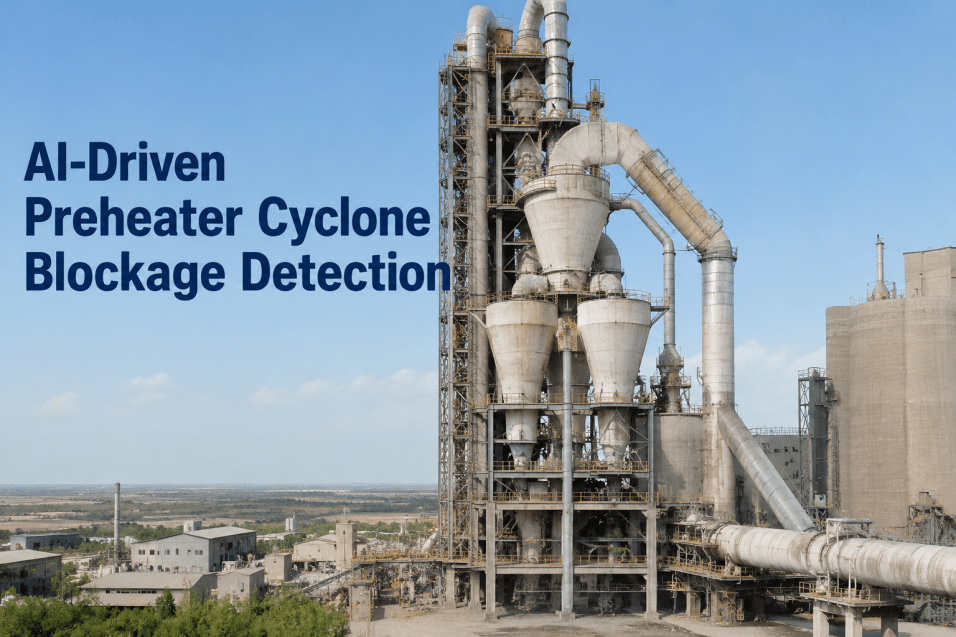
A preheater cyclone blockage rarely announces itself. Alkali, sulfur, and chloride compounds condense on cyclone walls a few tenths of a millimeter at a time, and by the time an operator on a routine walkthrough notices a temperature reading that looks slightly off, the buildup has often narrowed the cone opening enough that the next few hours decide whether this becomes a planned poke-hole clearing or an unplanned kiln stop. Most plants still catch these events the same way they did twenty years ago — periodic gauge checks and operator instinct — even though the pressure and temperature data needed to see a blockage forming days earlier is already flowing through the DCS. This article walks through how blockages form, which signals catch them early, and the operational adjustments that keep them from forming at all. Book a free preheater monitoring assessment to see your own cyclone data analyzed.
Quick Answer
Cyclone blockages form when alkali, sulfur, and chloride compounds condense on cyclone walls, most commonly in stages four and five of the preheater tower, restricting raw meal flow and forcing an emergency shutdown if left undetected. Continuous differential pressure and temperature gradient monitoring can flag a developing blockage four to eight hours before it becomes critical — the difference between a scheduled clearing and a costly emergency stop.
See Your Preheater's Blockage Risk Before the Next Shift Change
iFactory connects to your existing differential pressure transmitters and temperature sensors — no new hardware required for most towers — and flags buildup trends before they restrict flow.
The Physics of a Preheater Blockage
A dry-process preheater tower runs raw meal downward through five or six cyclone stages while kiln exhaust gases rise upward at 300°C to 900°C. That counter-current design is what makes the tower thermally efficient — and what makes it vulnerable to blockage.
1
Volatile Compounds Vaporize in the Kiln
Alkalis, sulfur, and chlorides in the raw meal and fuel vaporize at kiln burning zone temperatures and travel upward with the exhaust gas stream into the preheater tower.
2
Compounds Condense on Cooler Cyclone Walls
As the gas rises and cools through each cyclone stage, those vaporized compounds condense onto the cooler cyclone walls, cone, and riser duct surfaces — most commonly concentrating in stages four and five where temperatures fall into the condensation range.
3
Buildup Accumulates Layer by Layer
Each thermal cycle adds another thin coating layer. Left unmonitored, this buildup grows for days or weeks without any single measurement crossing a fixed alarm threshold, which is exactly why periodic manual checks miss it until it is already substantial.
4
Flow Restricts, Then Collapses
Once buildup narrows the cone or riser duct enough, material flow becomes erratic, pressure drop across the stage climbs sharply, and a full blockage can develop within hours — forcing an emergency shutdown to clear it manually.
Early Warning Signals to Monitor
None of these signals require new instrumentation on most towers. They require watching the trend, not just the instantaneous reading, and comparing it against how that specific stage normally behaves.
01
Differential pressure across each cyclone stageA rising pressure drop at a stage that has been stable is the single clearest indicator of buildup narrowing the flow path. Compare each stage against its own recent baseline rather than a single fixed plant-wide threshold.
02
Temperature gradient between stagesA widening or narrowing gap between the expected and actual temperature at a given stage signals that gas and material flow are no longer moving through the cyclone the way the design intended.
03
O2 profile and false air infiltrationInfiltration above roughly two percent at expansion joints or meal pipe seals often accompanies developing buildup and independently degrades preheater efficiency, so it is worth tracking alongside pressure and temperature.
04
Hot spot growth rate on the shellA shell hot spot growing faster than roughly five degrees Celsius per week indicates refractory thinning at that location, which frequently correlates with the same conditions that promote coating buildup nearby.
05
Kiln feed fluctuation patternsIrregular or surging material discharge at the kiln inlet, especially when it recurs on a pattern rather than as a one-off event, is often the first visible symptom of a partial blockage upstream in the tower.
Turn Your Pressure and Temperature Data Into an Early Warning System
iFactory analyzes differential pressure, temperature gradients, and O2 infiltration across every cyclone stage continuously — not on a two-to-four hour manual reading cycle — and flags the trend before it becomes an alarm.
Operational Adjustments That Prevent Blockage Formation
Detection buys time. Prevention reduces how often you need that time in the first place. The table below compares the reactive approach most plants still run against the preventive practices that measurably reduce blockage frequency.
| Practice Area |
Preventive Approach |
Common Reactive Approach |
| Raw mix chemistry control |
Alkali and sulfur input tracked and managed proactively, bypass system tuned to circulating load |
Bypass adjusted only after buildup is already visible |
| Air distribution and damper tuning |
Regular tuning against current fuel blend and raw meal chemistry |
Fixed damper settings left unchanged between campaigns |
| Air cannon sequencing |
Sequenced based on where buildup is actually forming |
Fixed timer cycle regardless of actual coating condition |
| Fuel blend management |
Alternative fuel chlorine and sulfur content screened before feed |
Fuel quality checked after a blockage is traced back to it |
| Inspection scheduling |
Poke-hole and manway inspections targeted at trending stages |
Every port checked blindly on a fixed rotation |
When a Blockage Is Forming: Response Checklist
1
Confirm the trend across at least two independent signalsA pressure rise alone can be a transient. A pressure rise combined with a widening temperature gradient at the same stage is a much stronger confirmation that buildup is developing rather than a sensor drifting.
2
Identify the specific stage and locationPinpoint whether the trend points to the cone, the riser duct, or the dip tube, since the corrective action and the safest clearing method differ depending on where the buildup is forming.
3
Adjust air cannon sequencing toward the affected stageIncreasing cannon frequency or targeting the specific cone showing buildup can dislodge early-stage coating before it hardens into a structural blockage requiring manual clearing.
4
Schedule a planned poke-hole clearing if the trend continuesIf air cannon adjustment does not reverse the pressure trend within a few hours, schedule a manual clearing during a planned window rather than waiting for the flow to restrict enough to force an emergency stop.
5
Log the event against raw mix and fuel chemistry at the timeRecording which raw mix batch and fuel blend were running when the buildup formed builds the historical pattern needed to catch the same conditions earlier the next time they recur.
Our Numbers
4–8 hrs
Advance Warning Before Critical Blockage
5–6
Cyclone Stages Monitored Continuously
65%
Fewer Unplanned Preheater-Related Kiln Stops
$60K–$250K
Typical Cost Avoided Per Prevented Incident
Zero
New Hardware Required for Most Towers
2%
False Air Infiltration Threshold Flagged
We had pressure transmitters and thermocouples on every stage already — what we didn't have was anyone watching the trend across all of them at once, all the time. iFactory started flagging stage four pressure drift a full shift before it would have shown up on our operator's four-hour check. We cleared it with a targeted air cannon sequence during a planned window. The blockage that would have followed that trend used to cost us a full day of production and a crew working in a 60°C tower to clear it manually.
Preheater Systems Engineer
4,200 TPD Cement Line — Western India
Frequently Asked Questions
QWhy do cyclone blockages tend to form in stages four and five specifically?
Stages four and five typically sit in the temperature range where alkali, sulfur, and chloride compounds shift from vapor to solid phase and condense on the cyclone walls. Earlier stages run too hot for condensation to occur, while later stages have already lost most of the volatile load to the stages above them. This does not mean other stages are immune, particularly when raw mix chemistry or fuel blend shifts change where in the tower the condensation temperature falls, which is why continuous monitoring across every stage matters rather than watching only the stages that have caused problems historically.
QCan we detect developing blockages with the sensors we already have, or do we need new hardware?
Most preheater towers already have differential pressure transmitters and temperature sensors at each stage, which is enough instrumentation to build continuous trend monitoring without adding hardware. What is usually missing is the analysis layer that compares live readings against each stage's own recent baseline and correlates pressure, temperature, and O2 data together, rather than watching each sensor in isolation against a fixed threshold.
Book a sensor coverage review for your specific tower configuration.
QHow does raw material and fuel chemistry influence blockage frequency?
Alkali, sulfur, and chloride content in both the raw meal and the fuel blend directly determine how much volatile material is available to condense in the tower. Alternative fuels with variable chlorine content are a particularly common driver of unexpected blockage events, because the condensation load can change significantly between fuel loads even when the raw meal chemistry stays constant. Screening fuel chemistry before it is fed, and tracking circulating alkali load against the bypass system's capacity, reduces how often the tower sees a condensation spike large enough to build a blockage quickly.
QWhat is the difference between a normal coating layer and a developing blockage?
Every preheater tower runs with some baseline coating on cyclone walls, and a thin, stable layer is normal rather than a problem to chase. A developing blockage is distinguished by a coating that keeps growing rather than reaching equilibrium — showing up as a differential pressure trend that keeps climbing week over week rather than plateauing, or a temperature gradient that keeps widening rather than stabilizing at a new baseline. The trend direction over days matters far more than any single instantaneous reading.
QIs it safe to keep running the kiln while a blockage is being cleared with air cannons?
Early-stage buildup can often be addressed with an adjusted air cannon sequence while the kiln continues running normally, since the goal is dislodging a thin coating layer before it hardens. Once a blockage has progressed to the point of restricting material flow, continuing to run risks an uncontrolled material collapse or a sudden flow surge into the kiln, and a planned shutdown for manual clearing becomes the safer option.
Talk to an expert about setting the right escalation threshold for your tower.
Catch the Blockage Before the Shift Log Does
iFactory continuously analyzes differential pressure, temperature gradients, and O2 infiltration across every cyclone stage, flagging buildup trends hours before they force a shutdown. On-premise, connected to sensors you already have.
Continuous Stage Monitoring
4–8 Hour Early Warning
No New Hardware
Air Cannon Sequencing