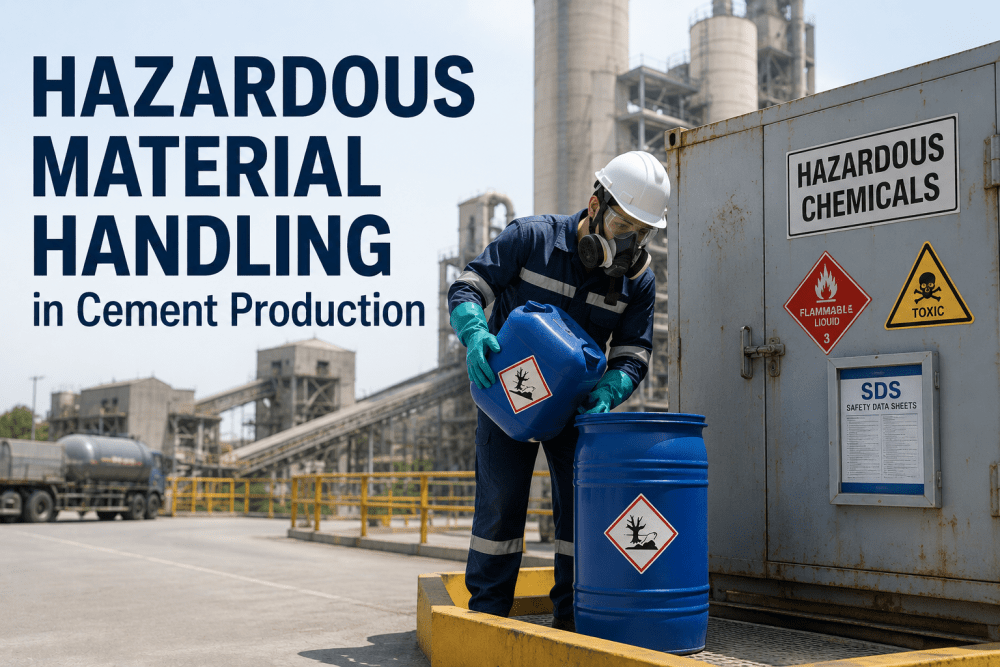
Every ton of raw meal, clinker, and cement that moves through a plant passes through a chute, a hopper, or a length of duct at some point, and every one of those surfaces is being worn away a little more with each ton that slides across it. The material chosen to line that surface is one of the few maintenance decisions in a cement plant where the difference between a good choice and a poor one is measured directly in years of service life, not marginal percentage improvements. A liner mismatched to its abrasion, impact, and temperature conditions can wear through in months, while the right material in the same location can run a decade with proper installation. Getting that match right at every transfer point across the plant is a bigger reliability lever than most maintenance teams treat it as. See how iFactory tracks liner performance by location to guide your next material selection.
MATERIAL HANDLING · CEMENT · WEAR-RESISTANT LININGS
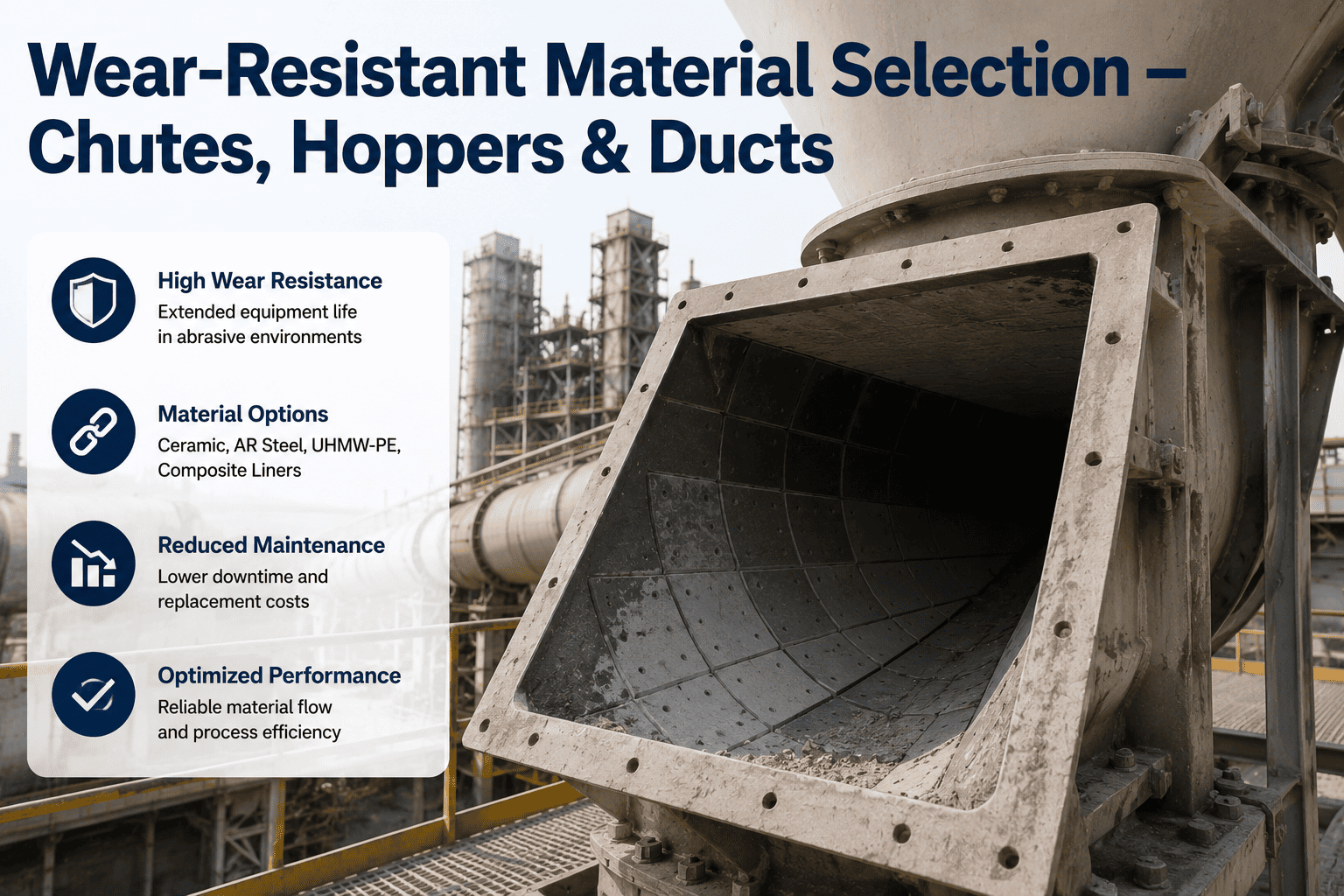
Wear-Resistant Material Selection — Match the Liner to the Location, Not the Catalog Default
iFactory tracks liner material, installation date, and wear rate at every chute, hopper, and duct transfer point, turning scattered replacement history into a clear guide for which material actually performs best in each specific location.
WHY THE DEFAULT CHOICE FAILS
The Cost of Lining Every Transfer Point With the Same Material
It is common practice for a plant to standardize on a single wear liner material across most of its chutes and hoppers, usually whichever product the original equipment vendor specified or whatever the maintenance stores already keeps in inventory. That approach simplifies procurement, but it ignores that abrasion severity, impact energy, temperature, and moisture vary enormously from one transfer point to the next. A raw meal transfer chute handling fine, dry, low-velocity material has almost nothing in common wear-wise with a clinker transfer point handling coarse, hot material dropping at high impact energy, yet both frequently end up lined with the same generic wear plate simply because that is what is on the shelf. The result is liners that fail early in high-severity locations, forcing frequent unplanned repairs, while the same material sits over-specified and underutilized in low-severity locations where a cheaper option would have performed just as well for longer.
10–20x
longer service life reported for ceramic chute liners compared to manganese steel liners in high-abrasion applications.
3–5x
better wear resistance typically reported for advanced ceramic linings compared to chrome carbide overlay plate.
350°C
approximate upper service temperature for many chemically bonded ceramic lining systems used in hot clinker and fly ash handling.
One Size
rarely fits all — the same liner material applied plant-wide typically over-serves some points and under-serves others.
MATERIAL OPTIONS COMPARED
Four Wear-Resistant Material Families and Where Each One Belongs
Selecting the right liner starts with understanding what each material family is genuinely good at, since abrasion resistance, impact tolerance, temperature rating, and installed cost trade off differently across the four options most commonly specified in cement plant material handling.
Alumina Ceramic Tile
Exceptional resistance to sliding abrasion from fine, dry materials such as raw meal and cement, best suited to low-to-moderate impact locations where the primary wear mechanism is surface sliding rather than heavy particle drop.
Cast Basalt Lining
Strong all-around abrasion resistance at a lower cost than ceramic tile, commonly used for chute and pipe lining in bulk conveying and pneumatic transport where moderate abrasion is continuous but impact energy is limited.
Ceramic-Rubber Composite
Combines a ceramic wear face with a rubber backing that absorbs impact energy, making it well suited to hopper and chute locations where coarse material drops with significant force rather than sliding gently across the surface.
Chrome Carbide Overlay Plate
A weldable steel wear plate suitable for high-impact, high-temperature locations near the kiln and cooler where ceramic tile's brittleness under heavy impact would be a liability rather than an advantage.
THE SELECTION PROCESS
Matching Material to Location in Four Steps
A structured selection process treats every chute, hopper, and duct as its own decision rather than applying a single plant standard everywhere, using the specific wear conditions at each location to guide the material choice.
STEP 01
Characterize the Wear Mechanism
Classify each transfer point by its dominant wear mechanism — sliding abrasion, impact wear, or a combination of both — since ceramic tile, cast basalt, and composite liners each respond very differently to these two failure modes.
STEP 02
Assess Temperature & Material Properties
Record the operating temperature range, particle size, and moisture content of the material passing through each location, since these factors rule out certain liner materials outright regardless of their abrasion resistance rating.
STEP 03
Weigh Installed Cost Against Expected Life
Compare candidate materials on a cost-per-year-of-service basis rather than upfront installed cost alone, since a more expensive ceramic liner frequently costs less over a five-year period than repeated wear plate replacements.
STEP 04
Track Actual Performance After Installation
Record the installed material, installation date, and eventual replacement date for every liner, building a location-specific performance history that improves every future material decision at that same transfer point.
GENERIC VS TRACKED SELECTION
What Changes When Liner Selection Is Backed by Location History
Stop Guessing Which Liner Lasts Longest — Track It
iFactory records liner material, install date, and replacement history at every transfer point, so your next material selection is based on your plant's own wear data instead of a generic vendor recommendation.
REAL SELECTION SITUATIONS
Where Getting the Match Right Actually Saved a Repeat Failure
01
A Ceramic Tile Chute Failing From Impact, Not Abrasion
A clinker transfer chute lined with alumina ceramic tile keeps cracking within months of each replacement. Reviewing the wear mechanism reveals the failure is impact-driven from coarse clinker dropping directly onto the tile, not sliding abrasion, and switching to a ceramic-rubber composite liner resolves the repeat cracking by absorbing that impact energy instead of resisting it rigidly.
02
A Cast Basalt Duct Section Underperforming Its Expected Life
A pneumatic conveying duct lined with cast basalt wears through well ahead of its typical expected life at that material velocity. Tracking reveals the actual conveying velocity at that section runs higher than the material's rated tolerance, prompting a switch to a higher-grade ceramic lining rated for the actual operating conditions rather than the nominal design velocity.
03
Over-Specifying a Low-Severity Hopper
A raw meal storage hopper feeding a low-velocity screw conveyor has been lined with the same premium ceramic composite used throughout the high-abrasion clinker circuit. Performance tracking shows this location's wear rate is minimal regardless of liner grade, allowing the next replacement to use a lower-cost basalt lining without any meaningful reduction in service life.
04
Building a Plant-Specific Material Standard From Real Data
After two years of tracking liner performance by location, the plant replaces its single generic wear plate standard with a location-specific material guide, cutting unplanned chute repairs significantly by matching each transfer point to the material that has actually performed best there historically.
INSTALLATION METHODS
How a Liner Is Attached Matters Almost as Much as What It Is Made Of
The same wear-resistant material can perform very differently depending on how it is secured to the substrate, and choosing the wrong attachment method for the operating temperature and impact environment is one of the more common reasons a liner fails well before its rated service life.
Adhesive Bonding
Room-temperature or high-temperature inorganic adhesive bonds tiles directly to the substrate, a fast and low-cost installation method best suited to lower-impact locations operating below roughly 200°C where bond integrity is not challenged by thermal cycling.
Stud Welding
Ceramic tiles are mechanically anchored with welded studs through pre-formed holes, combining mechanical self-locking force with adhesive for locations handling high-temperature or high-impact material where bonding alone would not reliably hold.
Bolted Panel Systems
Modular composite or ceramic panels bolt onto a frame or the equipment shell directly, allowing individual panels to be replaced without disturbing the surrounding liner, which reduces both repair time and material waste on large chute surfaces.
Direct Weld Overlay
Chrome carbide wear plate is welded directly to the substrate, forming a permanent bond suited to high-impact, high-temperature zones but requiring the full plate section to be cut out and replaced rather than allowing a localized spot repair.
DIAGNOSING EARLY FAILURES
Reading a Failed Liner to Find the Actual Root Cause
When a liner fails well ahead of its expected life, the failure pattern itself usually points toward whether the root cause is a material mismatch, an installation defect, or a process condition that changed after the liner was specified.
A
Cracked or Chipped Tiles Concentrated at One Zone
Localized cracking, rather than uniform wear, points toward an impact source concentrated at that specific zone, such as an oversized lump in the feed stream repeatedly striking the same location, and the fix is typically a material change or a feed screening improvement rather than a plant-wide liner upgrade.
B
Liner Detaching Intact From the Substrate
A liner that comes loose while still largely intact, rather than worn through, points toward an installation or bonding defect rather than a material selection problem, and the response should focus on installation quality control rather than switching materials again.
C
Uniform Wear Reaching End of Life Faster Than Expected
Even, uniform thinning that simply progresses faster than the material's rated life suggests either a change in the material being conveyed or an underestimate of the actual abrasion severity at that location when the material was first specified.
FREQUENTLY ASKED QUESTIONS
What Maintenance Teams Ask Before Standardizing a Liner Selection Process
How do we determine whether a transfer point's dominant wear mechanism is impact or sliding abrasion?
The physical geometry of the transfer point is usually the strongest indicator — a chute where material free-falls a significant distance before striking the liner is impact-dominated, while a chute where material slides continuously along a shallow angle is abrasion-dominated. Reviewing the failure pattern on a worn liner also helps, since cracking and chipping point toward impact wear while smooth, gradual thinning points toward sliding abrasion.
Book a demo to review your specific transfer point geometry and wear patterns.
Is ceramic lining always the better choice given its longer reported service life?
No. Ceramic tile is brittle and performs poorly under heavy impact loading, where a chrome carbide overlay plate or a ceramic-rubber composite will outlast it despite a lower headline abrasion resistance rating. The right material depends on matching the liner's actual mechanical properties to the dominant wear mechanism and impact energy at that specific location, not simply choosing whichever material has the best abrasion resistance number on a data sheet.
Contact support for guidance on material selection for high-impact locations.
How is liner performance data tracked across different transfer points consistently?
Each transfer point is recorded as its own location record, capturing the installed material, installation date, and the date and reason for eventual replacement, whether that is normal wear-through, cracking, or spalling. Over successive replacement cycles, this builds a location-specific performance history that becomes the primary reference for the next material decision at that point, rather than relying on institutional memory that is lost when a planner changes roles.
Book a demo to see how location-level liner history is recorded and reported.
What role does installation quality play compared to material selection itself?
Installation quality can significantly affect service life regardless of material choice — a ceramic tile installed with inadequate bonding or a composite liner installed without proper edge sealing will fail early even if the material itself was the correct choice for that location. This is why tracking should capture installation details alongside the material specification, since a pattern of early failures across multiple locations using the same material may point to an installation process issue rather than a material mismatch.
Talk to support about tracking installation quality alongside material performance.
Can this help justify a higher upfront material cost to plant management?
Yes, this is one of the more direct benefits of location-tracked performance data. Presenting the actual cost per year of service life for a premium ceramic liner against the repeated replacement cost of a cheaper wear plate at the same location gives maintenance planners a documented, plant-specific justification for the higher upfront spend, rather than relying on a general industry claim that may not reflect the plant's own operating conditions.
Book a demo to see a cost-per-service-year comparison built from tracked liner data.
Turn Every Liner Replacement Into a Data Point for the Next Decision
iFactory builds a location-by-location wear liner performance history across your plant, so material selection stops being a guess and starts being a documented, repeatable decision.