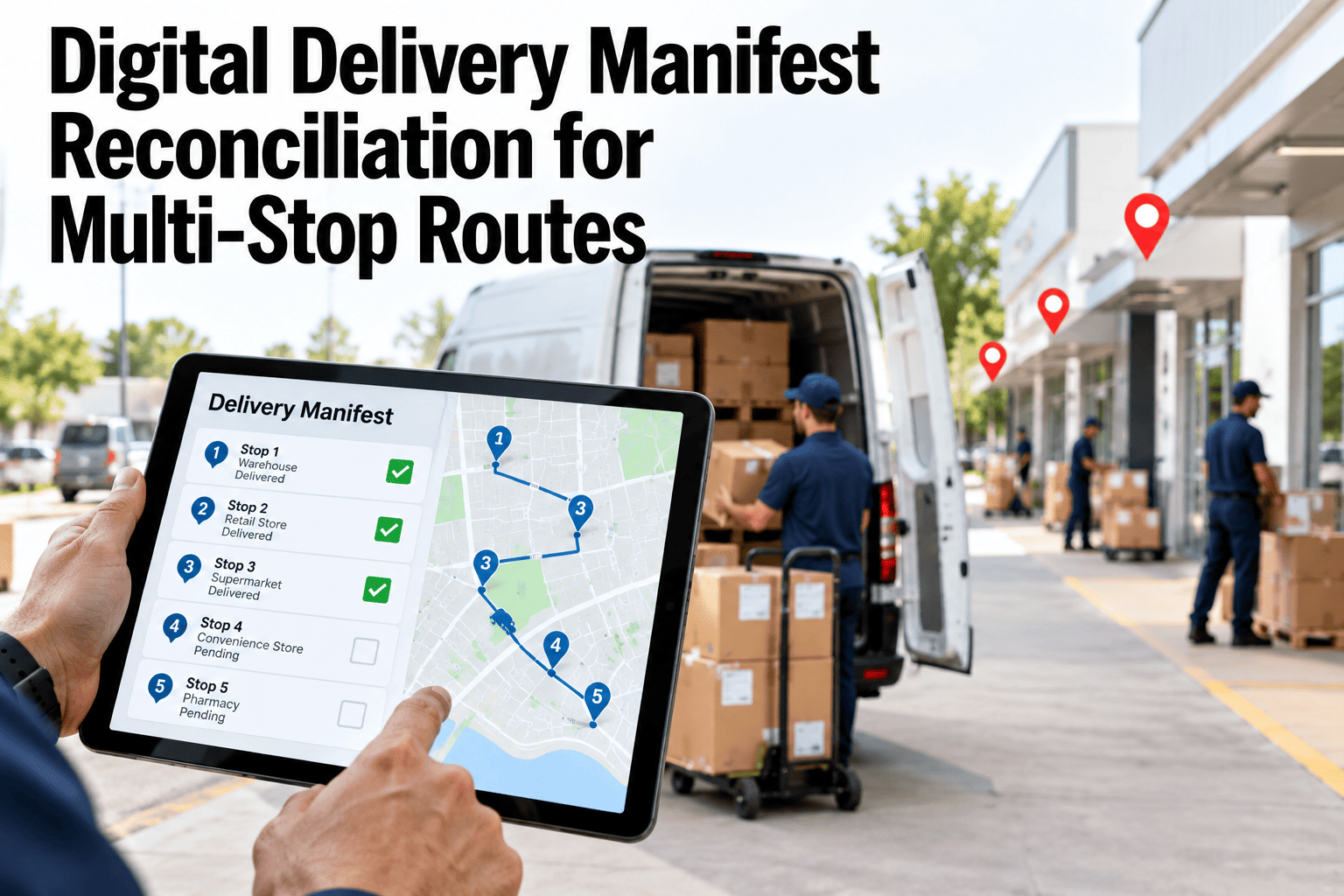
A delivery route is not finished when the truck returns. It is finished when what left the warehouse, what reached each customer, what came back and what went missing all add up. On paper manifests that check happens at the end of a long day, by someone reading handwriting against a system printout, and discrepancies are argued about days later. A digital manifest reconciled against completed stops turns the check into a routine that closes each route accurately. Delivery and dispatch teams that want to test their own manifest workflow can talk through how a manifest closeout would work for their routes in a short session.
Close Every Route With the Numbers Balanced
A practical guide to matching manifests against completed stops, so quantities, returns and shortages reconcile before the route is signed off.
The Equation Every Route Must Balance
Reconciliation is simple arithmetic applied to every line on the manifest. The quantities that left must equal the quantities accounted for.
Manifest-to-Stop Matching
Matching starts at loading and ends at the last stop. Four steps keep the manifest and the route in step.
Planned Against Delivered, Stop by Stop
Most stops match. A few do not, and those few cause nearly all the disputes. The columns show eight illustrative stops.
Find Where Your Routes Stop Balancing
Bring one week of manifests and delivery confirmations. We will walk through where quantities drift, who owns each gap and what a clean closeout would look like for you.
Returns and Shortages: Codes, Evidence and Owners
Every variance needs a reason, evidence and an owner, or it will be re-argued each month. The table sets out a starting design.
| Variance | Evidence | Owner | Usual Outcome |
|---|---|---|---|
| Customer refused | Reason, photo, signature | Customer service | Return to stock or credit |
| Short at delivery | Count at the stop | Warehouse | Re-send or credit |
| Damaged in transit | Photo and note | Carrier or driver | Claim and replacement |
| Wrong item loaded | Scan or picking record | Warehouse | Correct and re-deliver |
| Unresolved | Gap in the record | Dispatch lead | Investigate before closing |
Route Closeout: Six Checks Before Sign-Off
A short checklist keeps closeout consistent across supervisors and shifts.
How Much Time Reconciliation Takes
Manual closeout takes time that grows with the number of routes. The bars show an illustrative supervisor day, and teams can compare their own closeout hours with a clean digital flow in a short walkthrough.
What to Ask When Evaluating Software for This
Features differ. These questions separate tools that reconcile from tools that only record.
A Composite Scenario: A Week of Closeouts
A distribution team moved from paper manifests to a digital closeout with an exception queue. The figures below are illustrative.
Expert Review: Reconciliation That Holds Up
Reconciliation fails when it is treated as paperwork. This review sets out how experienced delivery operations leaders judge a process.
Frequently Asked Questions
What is the difference between a manifest and proof of delivery?
A manifest lists what should be delivered, by stop and quantity. Proof of delivery records what actually happened at each stop, often with a signature, photo or scan. Reconciliation compares the two. Our team can talk through how your documents map to a clean reconciliation flow.
How soon after the route should reconciliation happen?
As close to the end of the route as possible, ideally the same day. Memory fades and evidence is easiest to collect while the driver is still available. Same-day closeout also lets shortages be re-sent and credits be raised without delay, which protects customer relationships and cash flow.
How should multi-stop partial deliveries be handled?
Record the delivered quantity at each stop, with a reason code for the remainder. The remainder is then either returned, rescheduled or credited, and each outcome is tracked. See a partial delivery worked through in a short walkthrough using your own manifest layout.
What if drivers lose signal on the route?
The workflow should allow stops to be completed offline and synchronised later. Without that, drivers fall back to paper and the benefit disappears. When evaluating tools, ask how offline data is stored, how conflicts are resolved and how long a device can work without a connection.
How do we measure whether reconciliation has improved?
Track the share of routes closing with no exception, the average time to close and the age of open variances. Add the value of unresolved discrepancies at month end. Ask for a sample reconciliation scorecard to use in operations reviews.
Give Every Route a Closeout You Can Trust
Talk through your manifests, stops and exception handling with a delivery operations specialist, and see what a balanced closeout would take.