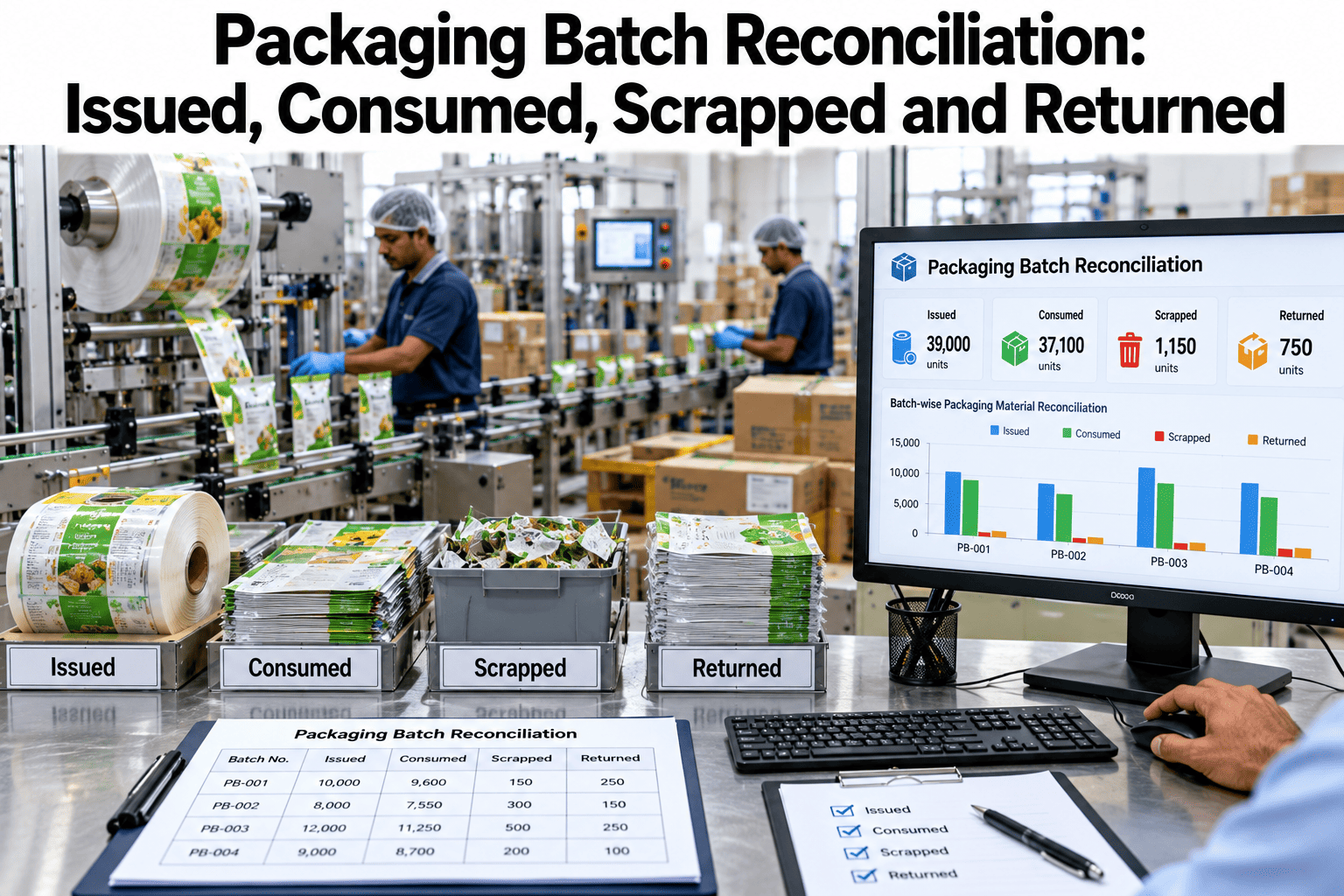
At the end of a packaging run, the material that was issued to the line rarely matches the material that actually went into finished product. Some was consumed as planned, some became scrap from startup waste or a jam, some sat unused and was returned to stores, and a smaller amount is simply unaccounted for because nobody tracked it closely enough to know where it went. That gap, multiplied across hundreds of batches a year, is a material cost line that most plants estimate rather than actually know. Packaging operations that want a clearer picture of where their material actually goes can walk through a batch reconciliation review on their own production records.
Know Exactly Where Every Roll, Carton, and Label Went
iFactory AI reconciles issued, consumed, scrapped, and returned packaging material batch by batch, so the gap between what left the store and what became product is a known number, not a guess.
Four Numbers That Should Always Add Up
Batch reconciliation is simple in concept: issued quantity should equal consumed plus scrapped plus returned, within a small, explainable tolerance. In practice, one of these four numbers is usually the weak link.
Issued
Quantity released from stores to the line for a specific batch, usually the most accurately recorded of the four.
Consumed
Quantity that actually became part of finished, shippable product, calculated or measured at the line.
Scrapped
Startup waste, changeover waste, and reject material, often under-logged because it happens continuously in small amounts.
Returned
Unused material sent back to stores, which depends on operators actually completing the return transaction.
The four numbers also carry different levels of built-in accuracy depending on how they are captured. Issued quantity is typically a single transaction logged by a storekeeper and tends to be reliable. Scrap, by contrast, is often estimated at shift end from a bin fill level rather than weighed or counted precisely, which introduces exactly the kind of rounding error that compounds into a meaningful unaccounted gap over a full production run.
Consumed quantity looks like the simplest of the four to calculate, since it is often derived rather than measured directly, finished unit count multiplied by the material specification per unit. That calculation is only as accurate as the specification itself, and a specification that has not been updated since a minor format change can quietly introduce a consistent bias into every batch's reconciliation without ever triggering an obvious anomaly.
Returned quantity depends entirely on operator discipline in a way the other three numbers do not. Issuing material and logging scrap both tend to happen because the physical material has to go somewhere and someone has to account for it operationally. A return, by contrast, is an extra step at the end of a batch, often during a changeover when time pressure is highest, which is exactly why it is the transaction most likely to be skipped.
Where the Gap Comes From
A composite root-cause breakdown across several packaging lines, grouped by the source of unaccounted material. Bar length shows an illustrative share of the reconciliation gap traced to that source.
Under-logged scrap and incomplete returns together account for more than half the typical gap, and neither one is a material loss at all. It is a recording gap. Closing it does not require buying less material; it requires capturing transactions that are already happening but not being logged consistently.
Batch mix-ups at issue are a smaller share but tend to be the most disruptive when they occur, since they can cause an entire batch's material consumption to be charged against the wrong work order. This is most common on lines running frequent small-batch changeovers, where a storekeeper is pulling from multiple similar-looking rolls or cartons in quick succession without a scan-based check against the active batch. A mix-up discovered days later during a cost review is far harder to correct cleanly than one caught at the point of issue.
Genuine loss or shrinkage, the smallest category, is also the one least within a plant's direct control, covering things like material degradation during storage or minor handling damage that never reaches the line at all. Because it is the smallest and least actionable category, it is usually treated as an accepted baseline rather than a target for active reduction once the larger, more fixable categories have been addressed.
See Your Own Reconciliation Gap, Traced to Its Source
Book a 30-minute session and iFactory AI will map issued, consumed, scrapped, and returned quantities against your own batch records.
Why This Matters Beyond the Material Cost Line
Reconciliation accuracy affects more than the direct cost of unaccounted material. It touches inventory accuracy, cost accounting, and traceability all at once. Teams can see how reconciliation accuracy compares across their own lines in a short review.
Inventory accuracy is the quieter cost of poor reconciliation, since it compounds silently over time. A system record that does not match physical stock because returns were never logged eventually requires a full physical count to correct, and that correction effort itself is a cost that a reconciliation gap creates without anyone attributing it back to the original cause.
The timing of when a gap is discovered also changes how expensive it is to resolve. A variance caught within the same week a batch ran can usually be traced to a specific shift and explained with confidence. The same variance discovered during a quarterly audit, mixed in with dozens of other batches, often has to be written off as unexplained shrinkage simply because nobody can reconstruct what happened months earlier.
Building a Case for Transaction-Level Tracking
Like most process investments, a reconciliation upgrade needs to connect to costs a plant already tracks closely to win budget approval.
Material cost accuracy
A tighter reconciliation gap means standard cost assumptions reflect what actually happens on the floor.
Reduced physical count effort
Fewer inventory corrections are needed when transactions are captured accurately as they happen.
A Composite Line: Reconciliation Accuracy Before and After Transaction Tracking
Twenty-four packaging batches across a composite line compared on reconciliation accuracy before and after transaction-level material tracking was introduced. Each cell represents one batch, illustrative data.
The improvement came mostly from capturing scrap at the point it was generated, using a simple scan or weigh-in step at the waste bin, rather than relying on an operator's end-of-shift estimate written from memory.
What a Reconciliation Record Actually Needs
A reconciliation that holds up to scrutiny needs more than a final number. It needs a transaction trail.
| Transaction | Captured At | Typical Method |
|---|---|---|
| Material issue | Stores, at batch start | Barcode or RFID scan against the batch work order |
| Consumption | Line, continuously or at batch end | Counted output multiplied by material use per unit |
| Scrap | Line, at point of generation | Scan or weigh-in at the waste collection point |
| Return | Stores, at batch end | Barcode or RFID scan of unused material back into inventory |
Five Practices for Tighter Reconciliation
Plants that have closed most of their reconciliation gap tend to converge on a similar set of practices.
Scan scrap at the bin
Capturing scrap weight or count at the collection point removes reliance on end-of-shift estimation.
Require returns before batch close
Making the return transaction a required step to close a batch prevents it from being skipped under time pressure.
Set a tolerance, not a target of zero
A small, explainable tolerance band keeps teams from chasing noise while still flagging genuine variance.
Reconcile by batch, not by shift
Batch-level reconciliation ties variance to a specific product and material lot, which shift-level totals obscure.
Review outliers weekly, not quarterly
Frequent review catches a developing pattern, such as one line's scrap creeping up, before it becomes a quarter-end surprise.
Signals Worth Watching
A short list of readings tells a packaging manager where reconciliation accuracy is slipping.
Find Out Which Batches Are Leaking Material Unaccounted
A short session with iFactory AI on your own batch records shows exactly where reconciliation accuracy is weakest.
Where iFactory AI Fits
iFactory AI joins stores, line, and return transaction data into one batch-level reconciliation record, flagging variance automatically rather than at shift end.
Transaction-Level Capture
Issue, consumption, scrap, and return events are captured as they happen, not reconstructed from memory at shift end.
Automatic Variance Flagging
Batches outside the set tolerance are flagged automatically for review, rather than discovered during a periodic audit.
Batch-to-Material Traceability
Every consumed, scrapped, and returned quantity is linked to the specific batch and material lot involved.
Trend Analysis by Line
Reconciliation accuracy is tracked over time by line and material type, surfacing developing patterns early.
Connecting Stores, Line, and Finance Teams
Reconciliation data touches stores, production, and finance, and each team typically needs a different slice of the same record.
Stores teams need to know whether material issued against a batch was actually consumed or returned, since that drives their own inventory accuracy. Line supervisors need scrap data broken down by cause, startup, changeover, or reject, so they can act on the specific driver rather than a single aggregate scrap percentage. Finance needs batch-level material cost accuracy to close the loop between standard cost assumptions and what actually happened on the floor, which matters directly for margin reporting on a per-SKU basis.
A shared reconciliation record also changes how material cost variance gets investigated. Instead of a finance team flagging an unexplained cost overage weeks after the fact, with little hope of tracing it back to a specific batch, a flagged variance can be investigated the same week, while the people who ran that batch still remember what happened.
Comparing Reconciliation Approaches by Operation Size
The right level of reconciliation rigour depends on batch volume and material complexity, which differ considerably between a single-line operation and a multi-plant packaging network.
| Operation Type | Typical Starting Point | Recommended Next Step |
|---|---|---|
| Single-line, low SKU count | Manual shift-end reconciliation | Add scan-based scrap capture at the bin |
| Multi-line, moderate SKU count | Partial automation on high-value materials only | Extend transaction capture across all material types |
| Multi-plant network | Inconsistent practices across sites | Standardise transaction capture and tolerance rules network-wide |
Multi-plant networks face a specific challenge worth naming directly: a reconciliation tolerance that works well at one site can look either too strict or too loose at another, simply because material handling practices differ. Standardising the transaction capture method first, then calibrating tolerance by site, avoids forcing every plant into an identical number that fits none of them well.
Frequently Asked Questions
What tolerance should we set for an acceptable reconciliation gap?
Tolerance varies by material type and batch size, but most plants start with a small percentage of issued quantity and tighten it over time as transaction capture improves. Setting it too tight initially generates excessive false flags that train teams to ignore alerts, while setting it too loose lets genuine variance slip through unnoticed. Support can help calibrate a starting tolerance for your material mix.
Does this require new scanning hardware on the line?
In most cases, existing barcode or RFID infrastructure already used for stores transactions can be extended to scrap and return points with minimal additional hardware, since the goal is capturing a transaction that is already happening, not introducing a new physical process.
Can this integrate with our existing ERP inventory system?
Yes. Reconciliation data is typically built on top of existing ERP issue and return transactions rather than replacing them, adding the missing scrap capture and automated variance flagging layer. A short walkthrough can show how this connects to your current ERP setup.
What data do we need to get started?
Historical issue and return transaction records, current scrap logging method, and per-unit material consumption standards form the core. Most packaging operations already generate this data across ERP and shop-floor systems that simply need to be connected and, in the case of scrap, captured more consistently at the source rather than estimated after the fact.
How does this help during a recall or traceability investigation?
Batch-level reconciliation records give a clean, auditable trail of exactly which material lots went into a specific batch, which supports faster and more precise traceability during a recall or customer complaint investigation than reconstructing the picture from separate stores and production logs. Ask support how reconciliation records support traceability investigations.
Turn a Material Cost Guess Into a Known Number
iFactory AI reconciles every batch's issued, consumed, scrapped, and returned material automatically. Book a walkthrough on your own production records.