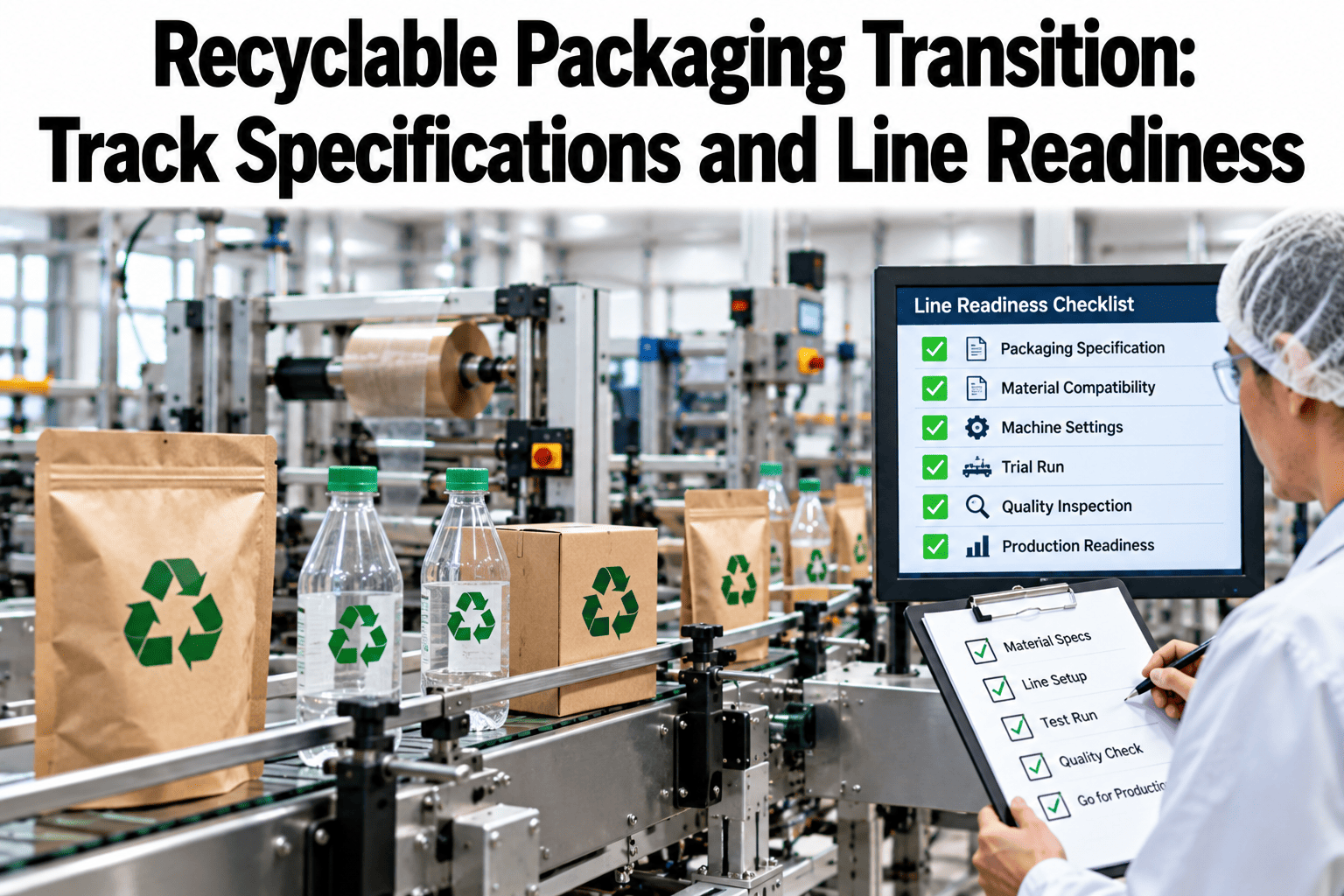
Switching from a conventional multi-layer film to a recyclable mono-material structure sounds like a materials decision until it reaches the packaging line, where seal temperatures, print adhesion, and machine settings tuned for years around the old film suddenly stop working the same way. A specification change that looks like a single line item in a sustainability roadmap can touch dozens of SKUs, each running on different equipment with different tolerances. Packaging teams managing their own transition can walk through a line readiness review against their own SKU list.
Know Which Lines Are Actually Ready Before the Film Changes
iFactory AI tracks material specification changes, machine compatibility, and trial results together, so a recyclable packaging transition does not stall at the line.
Four Things That Change With the Film
A recyclable mono-material structure behaves differently from the multi-layer film it replaces in ways that only show up once it is running on real equipment.
Seal temperature window
Mono-material films often need a narrower, sometimes higher, seal temperature range to reach the same bond strength.
Print adhesion
Ink and coating adhesion can differ on a new substrate, especially at high print speeds or dense colour coverage.
Machine tension handling
Stiffness and stretch characteristics differ, which can affect web tracking and tension control on older equipment.
Barrier performance
Shelf-life-critical barrier properties need validation against the specific product, not just the film data sheet.
These four changes rarely arrive one at a time. A film reformulated for recyclability often shifts seal temperature and stiffness together, which means a line that only retunes seal settings can still see tracking issues from the stiffness change, and a transition plan that treats each variable separately tends to under-budget the actual tuning effort required per line.
The product inside the pack adds another variable that is easy to overlook when a transition plan focuses purely on the film itself. A barrier property validated against a dry, shelf-stable product may not translate directly to a high-moisture or high-fat product, since the interaction between contents and film is part of what determines real shelf life. This is why barrier validation is usually run against the actual product rather than against the film data sheet alone, and why a film approved for one SKU cannot be assumed safe for another without its own check.
Equipment age plays a larger role than most transition plans initially assume. A newer line with digitally controlled, finely adjustable seal bars tends to adapt to a new film's narrower temperature window with minor recalibration, while an older line with coarser mechanical controls may need a more involved retrofit or a wider acceptable tolerance band built into the specification itself.
Where Transitions Stall
A composite breakdown across several packaging transitions, grouped by the stage where a SKU most often got stuck. Bar length shows an illustrative share of stalled transitions at that stage.
Seal validation is the single largest stall point, and it is also the one most teams discover latest, often only after a trial run has already consumed scheduled line time. Moving seal validation earlier in the sequence, against lab-representative samples before a full line trial, catches most of these failures at a far lower cost.
Trial scheduling delays deserve more attention than they usually get in a transition plan, because they are rarely about the trial itself taking long. More often, a line simply has no open slot for weeks because production schedules are set well in advance and a transition trial has to compete for the same time as regular output. Reserving a small, recurring trial window on each line ahead of time removes this bottleneck for most of a transition's duration, and it tends to be a far cheaper fix than any technical change to the film itself.
Print quality rework often traces back to a mismatch between ink system and the new substrate's surface energy, which can require a corona treatment adjustment or a different ink formulation rather than a print-speed change. Catching this early, during the same off-line pre-screening used for seal strength, avoids discovering it mid-trial when line time is already committed.
See Which of Your SKUs Are Actually Line-Ready
Book a 30-minute session and iFactory AI will map your SKU portfolio against seal, print, and machine compatibility status.
What a Readiness Record Actually Needs
A SKU is not "ready" or "not ready" as one flag. Readiness is a set of specific checks, each tied to a piece of evidence.
| Check | Evidence Required | Typical Owner |
|---|---|---|
| Specification approval | Signed-off material spec against the new film | Packaging engineering |
| Machine compatibility | Line-specific tension, seal, and speed settings confirmed | Line engineering |
| Seal integrity | Seal strength test results at target line speed | Quality |
| Print validation | Adhesion and colour consistency at production speed | Quality |
| Trial run sign-off | Full-speed trial completed with results documented | Production and quality |
Why a Spreadsheet Falls Behind Fast
Most transitions start on a shared spreadsheet tracking SKU status. It works until the portfolio and the line count both grow. Teams comparing approaches can see how a live readiness view compares to a manual tracker on their own SKU count.
The gap between a spreadsheet and reality tends to widen specifically at handoff points between teams. A quality technician who completes a seal test and logs it in a lab system has no reason to also update a separate packaging spreadsheet, and a packaging manager relying on that spreadsheet has no way to know the update is missing until someone notices a discrepancy, often during a status meeting rather than when it would actually help.
The problem compounds as the number of concurrent transitions grows. A team managing three or four SKU transitions at once can sometimes keep a spreadsheet roughly current through sheer attention, but a plant running a full-portfolio transition across dozens of SKUs and several lines at the same time reaches a scale where manual updates simply cannot keep pace with the rate of status changes happening across the organisation.
Building a Case for a Connected Readiness System
Like most process investments, a connected readiness system needs to tie back to costs a packaging operation already tracks closely.
Lost line time recovered
Fewer failed trials from catching compatibility issues before a line is scheduled recovers production time directly.
Faster transition timeline
Removing status lag and stalled approvals shortens the overall time to complete a multi-SKU transition.
A Composite Portfolio: Transition Pace Before and After a Shared Readiness View
Thirty SKUs across a composite packaging operation compared on weeks-to-ready before and after a shared, connected readiness view replaced manual tracking. Each cell represents one SKU, illustrative data.
The time saved came mostly from removing the lag between a check clearing and that status reaching the people scheduling trial runs. When a seal test passed on a Tuesday, the line that had been waiting for that result could be scheduled the same week instead of at the next status meeting.
Five Practices for a Smoother Transition
Teams that have run several film transitions tend to converge on a similar set of practices that reduce stalls and rework.
Sequence by line, not by SKU
Grouping SKUs by the line they run on lets one line trial validate settings for several SKUs at once.
Pre-screen seal strength off-line
Lab-representative seal testing before a full line trial catches most failures at lower cost and less lost line time.
Pilot on the hardest line first
Starting with the oldest or most sensitive line surfaces compatibility issues early, before they become a bottleneck later.
Track settings by machine, not by memory
Documented seal temperature and tension settings per machine prevent re-discovering the same tuning on every changeover.
Close the loop with approval owners
Automatic notification when a check clears keeps sign-offs from becoming the next bottleneck after testing is done.
Signals Worth Watching
A short list of readings tells a packaging manager where a transition is quietly losing time.
Find Out Where Your Transition Is Actually Stalling
A short session with iFactory AI on your own SKU data shows exactly which lines and checks are holding readiness back.
Where iFactory AI Fits
iFactory AI joins specification, trial, and approval data into one live readiness record, by SKU, by line, and by check.
Live Readiness Tracking
Every SKU's status updates automatically as seal, print, and trial checks clear, replacing manual spreadsheet tracking.
Machine-Level Settings Library
Validated seal and tension settings are stored by machine, so a second SKU on the same line does not re-discover them.
Stall Detection
SKUs sitting idle at a stage longer than expected are flagged automatically, before a status meeting catches it manually.
Approval Routing
Sign-off owners are notified automatically when a check clears, keeping approvals from lagging behind testing.
Keeping Engineering, Quality, and Production Aligned
A packaging transition touches several teams at once, and each one tends to care about a different slice of the same readiness record.
Packaging engineering owns the specification and machine compatibility work, and needs to know which lines still require tuning before a trial is worth scheduling. Quality owns seal and print validation, and needs test results tied cleanly to the specific film lot and line used. Production needs a clear, current view of which SKUs are actually ready to run, so a changeover is not scheduled against a SKU that still has an open check. A shared readiness record lets each team see their own relevant piece without waiting on a status meeting to reconcile three separate trackers.
This shared view also helps when a transition timeline needs to be renegotiated with a customer or a sustainability reporting deadline. Instead of an estimate based on gut feel, a packaging manager can point to the exact number of SKUs at each readiness stage and give a defensible date for full completion.
Planning the Sequence Across a Multi-Site Operation
A transition rarely runs on a single line. Operations with multiple plants and multiple film types need a sequencing approach that avoids duplicating validation work unnecessarily.
| Scenario | Risk of Skipping Validation | Recommended Approach |
|---|---|---|
| Identical equipment, same film, different site | Low, if equipment settings are documented | Reuse validated settings with a confirmation trial |
| Different equipment model, same film | Moderate, mechanical differences can matter | Run a reduced trial focused on known sensitivities |
| Same equipment, different film supplier | Moderate to high, formulations vary by supplier | Full seal and print validation for the new source |
| New equipment and new film together | High, no prior reference point exists | Full validation sequence from specification through trial |
Documenting settings by equipment model, not just by site, is what makes the first row of this table possible at scale. A site that logs its line 3 as simply "line 3" loses the ability to compare it against an identical machine at another plant, while a record that captures the actual equipment model enables genuine settings reuse across a multi-site operation.
Coordinating sequence across sites also reduces duplicate trial cost in a way that is easy to underestimate. If two plants with matching equipment run their validation trials independently and in parallel, simply because neither team knew the other was starting the same work, that duplicated effort consumes line time and material that a shared, visible sequence plan could have avoided entirely.
Frequently Asked Questions
How many trial runs does a typical SKU need before it is ready?
Most SKUs clear readiness in one to two full-speed trials once off-line seal pre-screening has already ruled out gross incompatibility. SKUs on older or more sensitive equipment sometimes need an additional trial to fine-tune tension or temperature settings, particularly where mechanical seal bar adjustment is coarser than on newer, digitally controlled equipment. Support can review a typical trial count for your equipment mix.
Can this handle multiple film suppliers in the same transition?
Yes. Readiness records are tracked per specification, which accommodates multiple approved film sources for the same SKU, each with its own validation results, so a line is not blocked waiting on a single supplier's material availability.
Does this replace our existing change control or document management system?
No, it works alongside existing change control systems rather than replacing them, pulling specification and approval status from those systems into one readiness view rather than duplicating the underlying documentation. A short walkthrough can show how this connects to your current change control process.
What data do we need to get started?
Current SKU and line lists, specification approval records, and historical seal and print test results form the core. Machine-level settings data adds depth but is not required to start, and can be built up incrementally as each line clears its first validation. Most packaging operations already hold this data across separate quality and engineering systems that have simply never been joined together.
How does this support sustainability reporting commitments?
A live readiness record gives an accurate, current count of SKUs that have actually transitioned to recyclable packaging, rather than an estimate, which supports more precise reporting against public sustainability commitments and timelines. Ask support how readiness data can feed your sustainability reporting process.
Move Through Your Packaging Transition With a Clear View
iFactory AI turns specification, trial, and approval data into one live readiness record so your transition does not stall at the line. Book a walkthrough on your own SKU portfolio.