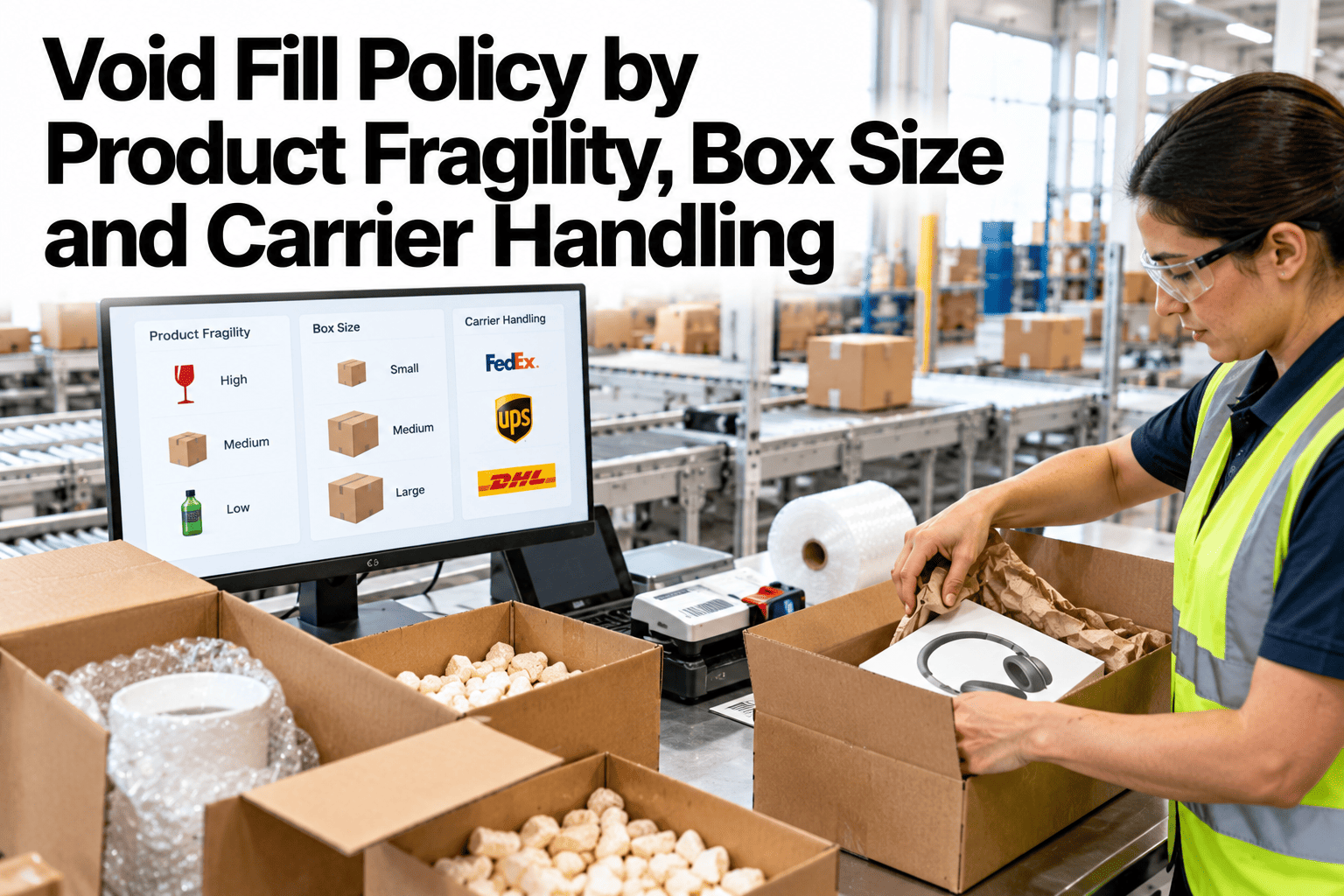
Every fulfilment operation makes hundreds of void fill decisions per shift. Without a written policy those decisions depend on whoever is packing the box, and the result is inconsistent protection, wasted material and damage claims that could have been avoided. A void fill policy assigns each product to a fragility tier, matches that tier to a cushioning standard and a box clearance rule, and gives the packer a single instruction set per SKU family. The policy removes guesswork, cuts material spend and makes damage rates auditable. Operations teams building their first formal void fill policy can book a session with iFactory AI to see how the platform automates pack-profile assignment and tracks compliance from sensor and scan data.
Void Fill Policy by Product Fragility, Box Size and Carrier Handling
Standardize pack-out decisions across fragility tiers, box clearances and carrier handling profiles to reduce damage claims and material waste.
Why Void Fill Needs a Written Policy
A fulfilment centre without a void fill policy relies on packer judgement. That judgement varies by shift, by experience level and by how rushed the line is running. The consequences show up in three places.
Damage claims
Products packed with insufficient cushioning or in oversized boxes arrive damaged. Carrier claims run $15 to $40 per incident when labour, replacement product and return shipping are included. A fulfilment operation shipping 10,000 parcels per month at a 5 percent damage rate spends $7,500 to $20,000 per month on avoidable claims.
Material waste
Packers who are unsure about the right amount of fill default to over-packing. Extra air pillows, extra paper and oversized boxes add material cost and dimensional weight surcharges. Over-packing by one box size tier adds $0.30 to $0.80 per parcel in dimensional weight charges alone on most carrier rate cards.
Packer variability
Without a standard, two packers filling the same SKU will choose different box sizes, different fill materials and different cushioning depths. That variability makes damage root-cause analysis impossible because the pack configuration changes from parcel to parcel. A policy eliminates that variable.
A written void fill policy turns each of these from an unpredictable cost into a controlled process with measurable compliance. Teams that want to see their current damage and material data analysed against a policy framework can book a packaging analytics session with iFactory AI.
Fragility Tier Classification
The foundation of a void fill policy is a fragility classification system that groups products by how much shock they can survive. Four tiers cover the range from rugged to ultra-fragile, and each tier carries a different set of packaging requirements.
Rugged
Textiles, soft goods, non-breakable plastics, clothing, rubber products, sealed metal containers
Moderate
Small appliances, hardcover books, tools, non-fragile electronics in retail packaging, boxed food products
Fragile
Consumer electronics, glass bottles, ceramics, monitors, assembled furniture with glass panels, precision instruments
Ultra-fragile
Laboratory glassware, optical equipment, fine art, medical devices, semiconductor components, crystal
Every SKU in the fulfilment catalogue should be assigned to one of these tiers. The assignment is based on the product's physical properties, not its value. A $5 ceramic mug and a $500 ceramic vase both belong in Tier 3. The tier drives every downstream packaging decision. iFactory AI assigns fragility tiers automatically from product master data and historical damage records, then updates them as new data comes in.
Box Clearance Rules by Fragility Tier
Box clearance is the space between the product and the inner wall of the carton on each side. Too little clearance leaves no room for cushioning. Too much clearance wastes material and creates space for the product to shift during transit. The policy sets a clearance range per tier.
Enough to prevent abrasion. No cushioning required, just positional fill to stop movement.
Room for 15 to 25 mm of cushioning material on each face, plus a small movement margin.
Accommodates 25 to 40 mm of foam or multi-layer wrap on each face. Product must not contact any carton wall.
Double-wall carton with 40 to 50 mm of molded or die-cut foam. Inner packaging may include a second inner box.
Box clearance drives carton selection. The policy should map each SKU family to the smallest standard carton that provides the required clearance. A carton selection table in the WMS or pack station software eliminates manual box choice. Teams that want to map their SKU catalogue to optimal carton sizes can contact iFactory support for a carton optimisation review.
Void Fill Material Selection Matrix
Each void fill material has a different cost, protection level, packing speed and environmental profile. The policy specifies which materials are approved for each fragility tier and which are prohibited.
| Material | Cost per package | Pack speed | Protection level | Best for tiers | Limitations |
|---|---|---|---|---|---|
| Air pillows | $0.01 to $0.05 | Fast (8 sec) | Moderate cushion, good immobilisation | Tier 1, Tier 2 | Puncture risk, no surface protection |
| Kraft paper | $0.02 to $0.10 | Moderate (15 sec) | Good immobilisation, light cushion | Tier 1, Tier 2 | Compresses under stacking, messy disposal |
| Bubble wrap | $0.08 to $0.25 | Moderate (15 sec) | Good surface protection, moderate cushion | Tier 2, Tier 3 | Higher material cost, not recyclable curbside |
| Foam sheets | $0.15 to $0.40 | Moderate (18 sec) | High cushion, good surface protection | Tier 3, Tier 4 | Storage volume, cost per unit |
| Molded pulp inserts | $0.30 to $0.80 | Fast (6 sec) | Excellent immobilisation, moderate cushion | Tier 3, Tier 4 | SKU-specific tooling required |
| Molded foam | $0.50 to $2.00 | Fast (5 sec) | Maximum cushion and immobilisation | Tier 4 | Highest cost, tooling investment |
The policy should specify a primary and an alternate material for each tier. If the primary material is out of stock, the packer switches to the alternate without stopping the line. A policy that names only one material per tier creates a stockout bottleneck. iFactory AI tracks material consumption per pack station and triggers reorder alerts before stock drops below the minimum days of supply. Packaging teams ready to build their material matrix can book a material planning session to map materials against their SKU fragility tiers.
Build Your Void Fill Policy
iFactory AI maps your SKU catalogue to fragility tiers, assigns carton sizes and tracks packer compliance from scan and sensor data. Book a 30-minute session scoped to your operation.
Carrier Handling Profiles and What They Mean for Pack Design
Different carriers and service levels subject parcels to different handling intensities. A parcel shipped ground through a hub-and-spoke network experiences more handling events than a parcel shipped express with direct routing. The void fill policy should account for the carrier profile the parcel will travel through.
Ground economy
Multiple sort facility transfers, conveyor drops of 0.6 to 1.0 metres, stacking loads up to 130 kg. Parcels may be handled 8 to 12 times between origin and destination. This profile demands the full cushioning spec for the product's fragility tier.
Ground standard
Fewer sort facility transfers than economy, conveyor drops of 0.4 to 0.8 metres, stacking loads up to 110 kg. Parcels are handled 5 to 8 times. Cushioning can be reduced by one step within the tier range, for example 30 mm instead of 40 mm for a Tier 3 product.
Express or next-day
Direct routing with fewer sort events, conveyor drops under 0.5 metres, typically 3 to 5 handling events. The reduced handling profile allows the lower end of the tier's cushioning range, but the product should still meet the minimum clearance spec.
LTL freight
Forklift handling, dock drops, cross-dock transfers and potential weather exposure. LTL parcels experience vibration, compression and side impacts that small-parcel networks do not. Palletised loads need edge protection and stretch wrap in addition to individual carton cushioning.
The policy should include a carrier-handling adjustment table that allows the packer or pack station software to move one step up or down within the tier's cushioning range based on the shipping method selected for the order. iFactory AI reads the carrier and service level from the order management system and adjusts the pack profile automatically before the packer sees the instruction.
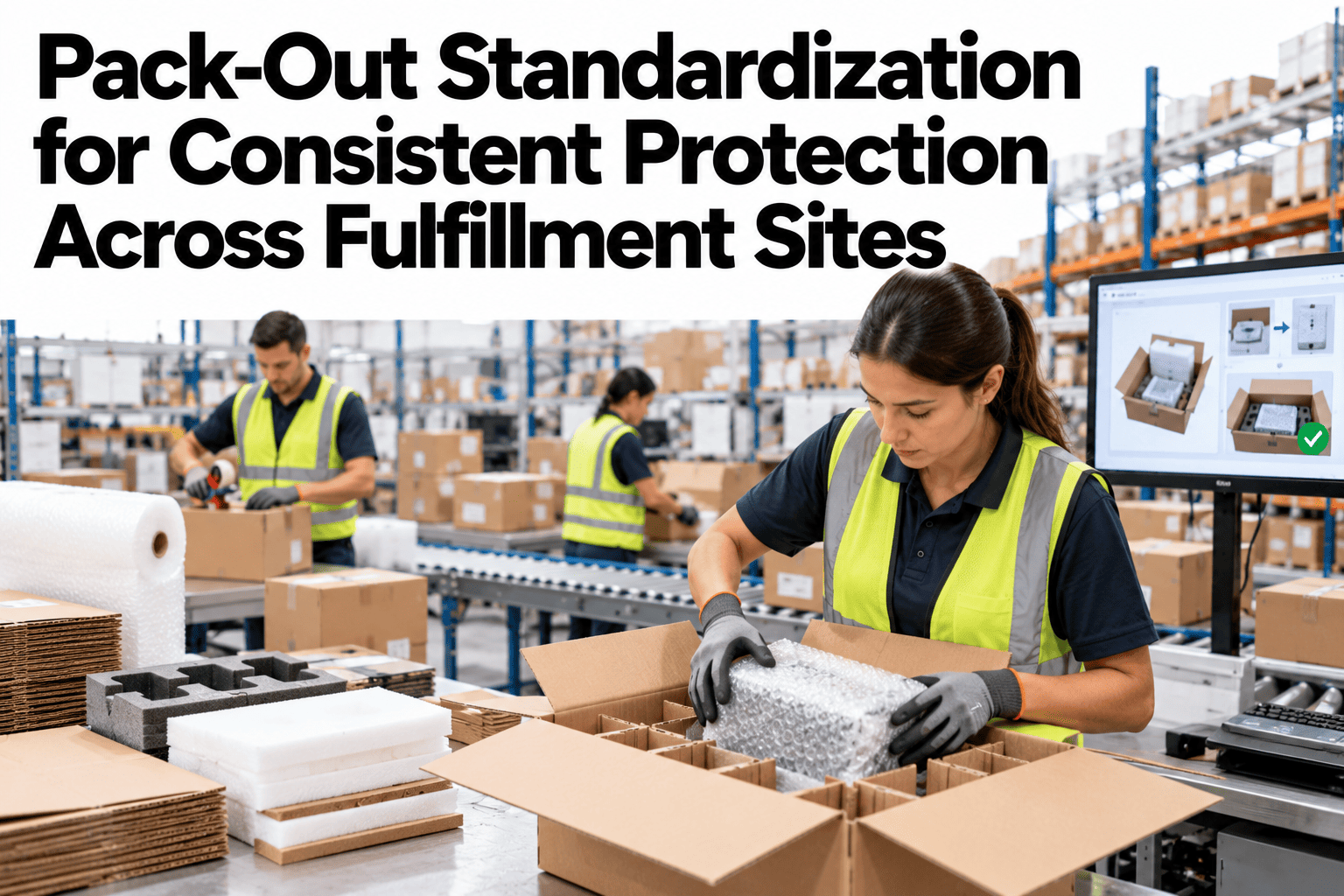
Packer Guidance: Station Instructions and Visual Aids
A void fill policy that lives in a binder on a shelf does not get followed. The policy needs to be embedded in the pack station workflow so the packer sees the right instruction at the right time without looking it up.
Scan-triggered pack profile
When the packer scans the product barcode, the pack station display shows the assigned carton size, void fill material and cushioning depth. The packer does not choose. The system chooses based on the SKU's fragility tier and the order's carrier profile. If the assigned carton is out of stock, the system shows the next-size-up carton and adjusts the fill quantity.
Visual laminated cards
Each pack station has a laminated card showing the four fragility tiers with colour coding, the approved materials per tier and photo examples of correct pack-outs. The card is a reference, not the primary instruction. It covers exceptions and unfamiliar SKUs that might not be in the system yet.
Weight verification
A scale at the pack station compares the packed weight against the expected weight for the SKU plus the assigned fill material. A weight that falls outside the tolerance band, typically plus or minus 10 percent, triggers a repack alert. Under-weight means missing cushioning. Over-weight means excess material or the wrong carton.
Exception escalation
When a product does not have an assigned tier, the packer flags it as unclassified. Unclassified products default to Tier 3 cushioning until a packaging engineer reviews and assigns the correct tier. The policy must define this default so the packer is never stuck deciding.
iFactory AI is smart manufacturing and industrial software delivered as a pre-configured NVIDIA AI server. For packaging operations it integrates with WMS, barcode scanning and pack station scales to deliver scan-triggered pack profiles, weight verification and exception tracking. Deployment to a working system typically takes six to twelve weeks. Operations teams ready to scope the integration can book a scoping session with the iFactory team.
Audit Sampling and Compliance Measurement
A policy without measurement is a suggestion. The void fill policy must include an audit programme that measures compliance and feeds back into process improvement. The audit has three layers.
In-line weight check
Random open-box inspection
Damage-rate correlation
The three layers work together. The weight check catches gross errors in real time. The open-box inspection catches qualitative errors the scale cannot detect, such as cushioning placed on only three sides instead of six. The damage-rate correlation catches systemic problems that pass both line checks but still result in damage. iFactory AI aggregates all three audit layers into a single compliance dashboard with drill-down by packer, SKU family, carrier and shift. Teams that want to see their audit data structured this way can schedule a compliance review with iFactory AI.
Void Ratio Targets and Right-Sizing
Void ratio is the percentage of the carton's internal volume that is not occupied by the product. A high void ratio means the box is too large for the product. A low void ratio means there is not enough room for cushioning. The policy sets a target void ratio range for each fragility tier.
Minimal void needed. The box should be close to the product dimensions with just enough clearance for positional fill. Void above 35 percent means the carton should be downsized.
Room for cushioning material on the top, bottom and two long sides. Void above 45 percent means excess fill is being used or the carton is oversized.
Substantial cushioning on all six faces. The EU packaging regulation sets a 50 percent empty space cap for e-commerce parcels, making this range the compliance boundary for European shipments.
Maximum cushioning with possible double-box construction. The inner box occupies part of the void, so the outer box void ratio includes the inner box volume as fill rather than empty space.
Right-sizing the carton is the highest-leverage action in a void fill policy. A carton that is one size too large adds material cost, dimensional weight charges and packing time. A cartonisation algorithm that matches the product dimensions plus the tier clearance to the smallest available carton eliminates manual size selection. iFactory AI integrates with cartonisation systems and tracks void ratio per pack-out to flag cartons that are consistently over or under the target range.
Frequently Asked Questions
How do I assign fragility tiers to thousands of SKUs without testing every one?
Start with product category defaults. Assign all textiles to Tier 1, all retail-packaged electronics to Tier 2, all glass and ceramics to Tier 3 and all laboratory or precision items to Tier 4. Then refine based on damage data, which you can review in a tier classification walkthrough. SKUs with damage rates above the category average move up one tier. iFactory AI automates this classification from product master data and updates tiers as damage records accumulate. Book a demo to see automatic tier assignment applied to your catalogue.
What is the right void fill material for a mixed-SKU order with items from different fragility tiers?
The policy should default to the highest fragility tier in the box. If one item is Tier 2 and another is Tier 3, the entire box is packed to Tier 3 standards. Alternatively, the Tier 3 item can be individually wrapped to its tier spec and the remaining void filled to Tier 2 standards, an approach you can see compared in a mixed-order packing demo. The second approach uses less material but requires a more skilled packer. Book a session to model mixed-tier pack profiles for your order mix.
How does the EU 50 percent empty space regulation affect void fill policy?
The EU Packaging and Packaging Waste Regulation sets a maximum of 50 percent empty space for e-commerce parcels. Void fill material does not count as product, so it occupies space that counts toward the 50 percent limit. Operations shipping to the EU need to right-size cartons aggressively and use dense cushioning materials that provide protection in less volume — contact support for a region-specific breakdown. Book a compliance review to audit your void ratios against EU thresholds.
How often should the void fill policy be reviewed and updated?
Review the policy quarterly using damage-rate trends, material cost changes and carrier service updates. Major triggers for an immediate review include a new carrier contract, a new product category launch, a change in damage rate above 1 percentage point and any new regulatory requirement. iFactory AI flags these triggers automatically from connected data sources — book a demo to see the trigger logic. Contact support to set up policy review triggers in your iFactory dashboard.
Can iFactory AI integrate with our existing WMS and pack station hardware?
Yes. The turnkey NVIDIA AI server connects to WMS platforms via standard API integrations, reads barcode scan events from pack station hardware and ingests weight data from station scales. Most integrations are configured during the six to twelve week deployment window. The platform supports common WMS platforms and custom integrations where needed — contact support to check your specific stack. Book a scoping call to map your integration requirements.
Standardize Every Pack-Out Decision
iFactory AI assigns fragility tiers, selects cartons, tracks packer compliance and correlates damage rates — all from a turnkey AI server deployed to your operation.