Ask ten different plant and IT leaders which AI use case should get funded first, and expect ten different answers — a computer vision line, a demand forecasting model, a predictive maintenance system, a warehouse routing engine. Every one of them sounds reasonable in isolation, which is exactly the problem: without a shared scoring method, use case selection becomes a matter of whoever presents most persuasively rather than whoever carries the strongest financial case. A structured prioritization matrix fixes that, and it is the first thing the iFactory team works through with any FMCG manufacturer before recommending where to start.
USE CASE SELECTION
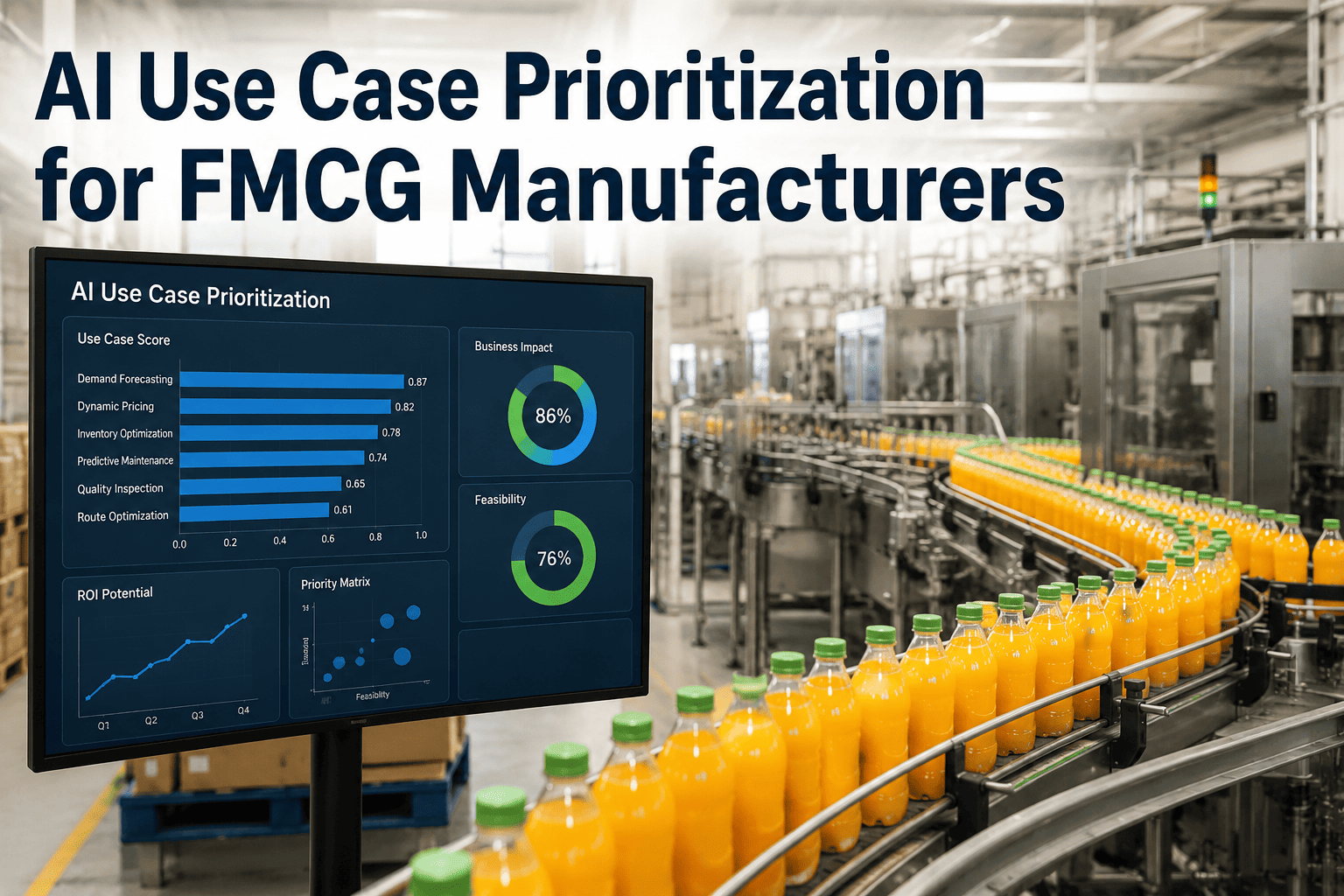
AI Use Case Prioritization for FMCG Manufacturers
A scoring framework that weighs financial value, implementation effort, data readiness, and organizational appetite — so your AI budget goes toward the use case most likely to succeed first, not the one that presents best in a slide deck.
4
scoring dimensions determine whether a use case belongs in a first wave rollout
Why FMCG Manufacturers Default to the Wrong First Use Case
Most FMCG manufacturers have no shortage of AI ideas — the problem is almost never a lack of options. The problem is a selection process that weighs visibility over value, so the use case that gets funded first is often the one that photographs well for a board deck rather than the one carrying the strongest combination of financial upside, feasible data foundations, and organizational readiness to act on the output. A prioritization matrix forces those factors into the open before a single dollar is committed.
The Four Scoring Dimensions
Every candidate use case is scored against the same four dimensions, each weighted independently, so a use case with high financial upside but low data readiness does not automatically rank above one with moderate upside and a much shorter path to production.
DIMENSION 1
Financial Value
The estimated dollar impact if the use case performs as expected — waste reduced, downtime avoided, or labor hours reallocated, sized against your actual volumes.
DIMENSION 2
Implementation Effort
The realistic technical lift required — integration complexity, hardware needs, and the number of systems the use case depends on to function.
DIMENSION 3
Data Readiness
How complete, consistent, and accessible the underlying data already is — the single biggest predictor of how long a pilot will actually take.
DIMENSION 4
Organizational Appetite
Whether the team that will act on the output is bought in, trained, and staffed to actually change behavior once the system goes live.
The Prioritization Matrix — Value Against Effort
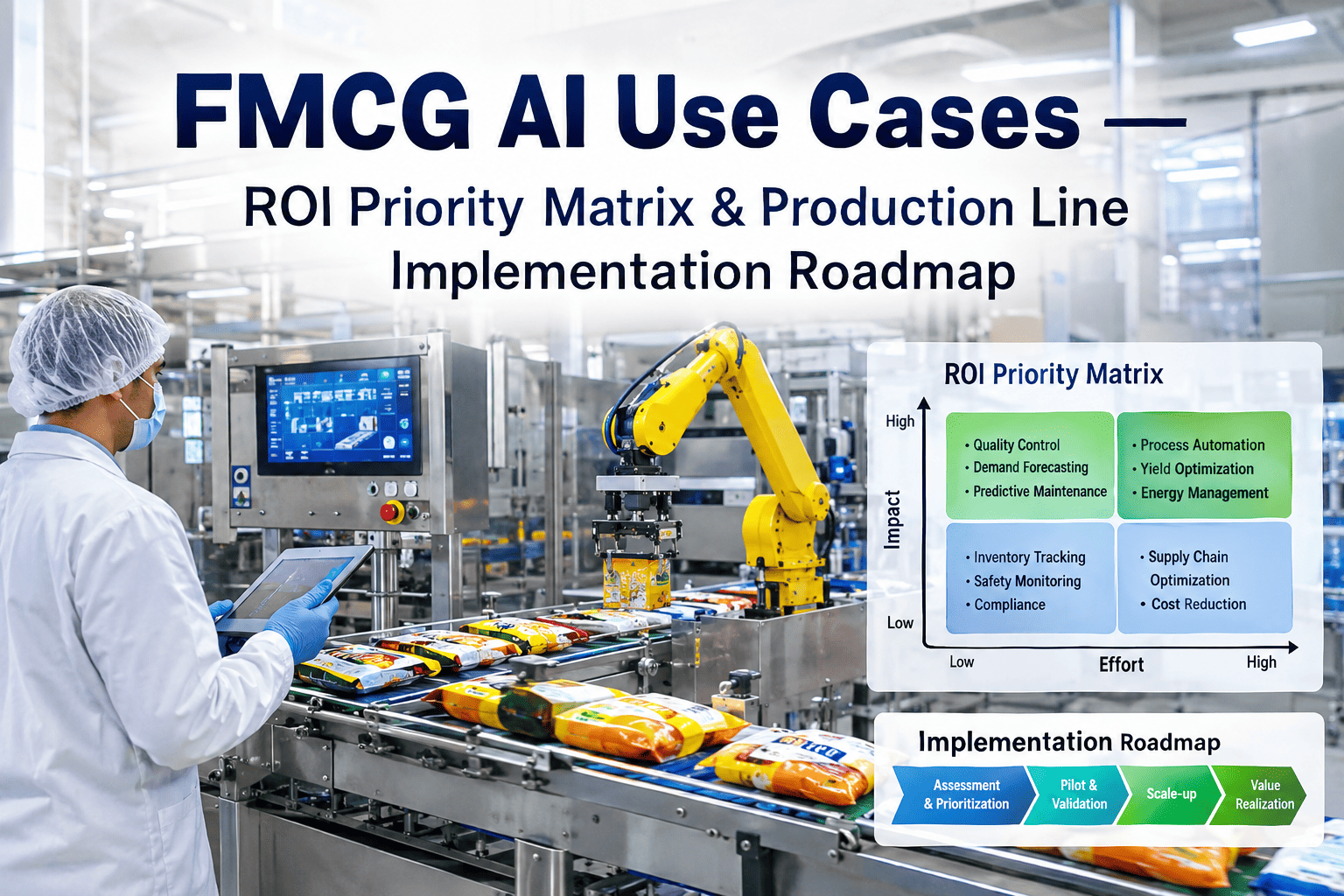
Plotting every candidate use case against financial value on one axis and implementation effort on the other produces four natural quadrants. The goal of a first wave rollout is almost always to start in the top-left quadrant — high value, low effort — even when a higher-value, higher-effort use case is more exciting to discuss in a leadership meeting.
Quick Wins
High Value / Low Effort
Predictive maintenance on known failure-prone equipment · Automated quality inspection on an existing camera line
Strategic Bets
High Value / High Effort
Network-wide demand forecasting · Multi-plant production scheduling optimization
Fill-In Projects
Low Value / Low Effort
Basic dashboard automation · Single-line reporting tools with limited scope
Reconsider
Low Value / High Effort
Full-facility digital twin builds before any single use case has proven value · Broad AI platforms with no defined first application
Score Your Own Use Case List Against This Matrix
iFactory runs a structured prioritization workshop with your operations, IT, and finance stakeholders to score every candidate use case and build a defensible first-wave rollout plan.
Common FMCG Use Cases Ranked by Typical Readiness
While every manufacturer's specific scores will differ based on their own data maturity, the table below reflects how a set of common FMCG AI use cases tend to rank when scored against the four dimensions above, based on patterns observed across multiple plant deployments.
| Use Case | Typical Financial Value | Typical Effort | Typical Data Readiness |
|---|
| Predictive maintenance on rotating equipment | High | Moderate | Moderate to High |
| Computer vision quality inspection | High | Moderate | High (existing cameras) |
| Demand forecasting across SKU portfolio | High | High | Moderate |
| Warehouse pick-path optimization | Moderate | Moderate | High |
| Energy consumption optimization | Moderate | Low | High |
| Full production scheduling automation | High | High | Low to Moderate |
Scoring Your Own Use Case List — A Working Method
A simple, repeatable scoring approach beats a sophisticated one that nobody actually uses consistently. Score each candidate use case from 1 to 5 on each of the four dimensions, weight financial value and data readiness slightly higher than the other two, and sum the results. The steps below walk through the practical sequence most FMCG teams follow.
1
List every candidate use case without filtering
Gather ideas from plant floor teams, IT, and leadership without pre-judging feasibility — filtering happens in scoring, not at collection.
2
Score financial value against real volumes
Size the dollar impact using your own scrap rates, downtime hours, or labor costs rather than industry averages from a vendor deck.
3
Audit data readiness for each candidate
Check whether the underlying data already exists, is accessible, and is consistent enough to support a model without months of cleanup.
4
Rate organizational appetite honestly
Confirm the team that will act on the output is willing and staffed to change their workflow — not just willing to attend a kickoff meeting.
5
Rank and select the first wave
Choose one or two quick-win use cases to prove the model works organizationally before committing to a strategic bet with a longer timeline.
A Director of Manufacturing on Getting Prioritization Right
"
We had a list of nine potential AI use cases at one point, gathered from every plant and department that wanted in on the initiative, and the honest instinct was to start with the one our CEO had personally mentioned in an all-hands meeting. It was also, by a wide margin, the hardest one on the list from a data readiness standpoint. Running the actual scoring exercise was uncomfortable in the room, because it meant telling leadership that their preferred use case should be third or fourth in line rather than first. But it turned out to be the right call — the quick win we started with instead was live and showing measurable results within ten weeks, and that early proof point is what actually built the internal credibility to fund the harder, higher-value project later. If we had started with the ambitious one first and it had taken eight months to show anything, I don't think we would have gotten a second use case funded at all.
— Director of Manufacturing Operations, Regional FMCG Producer · Oversaw AI Rollout Across 5 Plants
Frequently Asked Questions
How many use cases should be scored in an initial prioritization exercise?
Most FMCG manufacturers find a workable list lands between six and twelve candidate use cases — enough to surface real trade-offs between value, effort, and readiness, without the exercise becoming so large that it stalls in analysis. Fewer than six often means the organization has not gathered enough input from different plant and department stakeholders, while more than fifteen tends to slow the scoring process down without meaningfully improving the outcome. A focused list of realistic candidates produces a clearer first-wave decision than an exhaustive one.
Should financial value or data readiness carry more weight in the scoring?
Both matter, but data readiness deserves particular attention because it is the factor most likely to be underestimated during scoring — teams often assume data is "mostly there" and discover significant gaps only once a pilot is underway. A common practical approach weights financial value and data readiness roughly equally and slightly higher than implementation effort and organizational appetite, since a high-value use case with poor data readiness will typically take far longer to reach production than the value estimate alone would suggest.
Is it ever right to start with a "strategic bet" instead of a quick win?
In some cases, yes — organizations with a mature data foundation, strong executive sponsorship, and prior AI deployment experience can sometimes move directly to a higher-value, higher-effort use case successfully. But for a first AI initiative, starting with a quick win is generally the stronger path because it builds the internal proof points, trust, and organizational muscle needed to support a more ambitious project later. The credibility earned from an early, visible success is often what unlocks funding and patience for the harder use case down the line.
How often should the use case list be re-scored?
A full re-scoring exercise once or twice a year is typical for most FMCG manufacturers, particularly after a first-wave use case reaches production and data readiness across other areas of the business has likely improved as a byproduct. New candidate use cases that emerge between formal reviews can be scored individually against the same framework rather than waiting for the next full cycle, so the prioritization list stays current without requiring a full re-run every time a new idea surfaces.
Can iFactory help score use cases specific to our own plant and product mix?
Yes — this is typically the first working session in any new engagement. iFactory facilitates a structured scoring workshop with your operations, IT, and finance stakeholders in the room, using your actual volumes, defect rates, and data landscape rather than generic industry benchmarks, so the resulting first-wave recommendation is grounded in your specific facility rather than a template. To schedule a prioritization workshop,
book a demo with our team, or
reach out to support with questions first.
Stop Guessing Which AI Use Case to Fund First
A structured prioritization matrix turns a list of competing AI ideas into a defensible, ranked rollout plan — grounded in your actual volumes, data readiness, and organizational appetite, not whichever idea sounds best in a meeting.