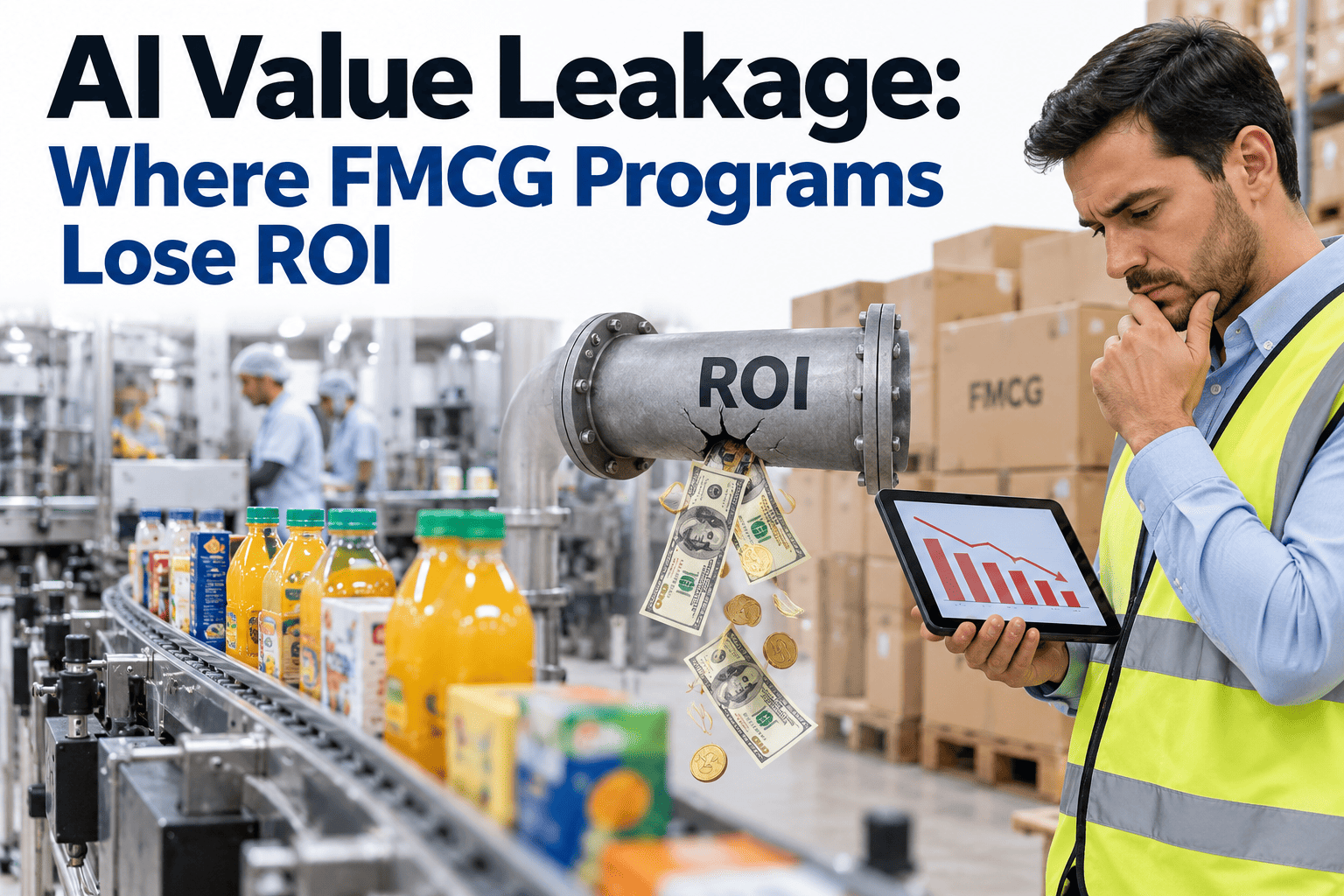
A demand forecasting model with 94% accuracy sitting inside an FMCG supply chain does not automatically produce a single dollar of value — the value only exists if a planner actually changes an order quantity because of that forecast, and that single step is where most AI programs quietly lose the majority of their projected return. Value leakage is the gap between what a model technically outputs and what actually changes in a business decision, and it happens in predictable, recurring places: a recommendation nobody reviews, a planner who overrides the model back to their own judgment, a report that reaches someone a week after the decision window closed. None of these are model problems. All of them are recoverable. If your AI program's dashboard looks impressive but your KPIs haven't moved, book a demo to find out where your specific leakage is happening.
The Model Was Right. Nobody Acted On It.
Most FMCG AI programs don't lose value in the model — they lose it in the five-step gap between a model's output and a planner's actual decision. iFactory's value leakage framework finds exactly where that gap is costing you, and recaptures it monthly.
The Five-Step Path From Model Output to Business Value
Value leaks at a specific, identifiable step along the path from a model producing a number to that number actually changing a business outcome. Mapping this path explicitly is the first step in finding where your specific program is losing value.
Model Produces Output
A forecast, a recommended reorder quantity, a predicted maintenance window — the model generates a specific, actionable number.
Output Reaches the Right Person
The recommendation is delivered through a channel and at a time the responsible decision-maker will actually see it before the decision window closes.
Person Trusts the Recommendation
The planner or engineer believes the recommendation is credible enough to act on rather than defaulting back to their own prior judgment or experience.
Decision Is Actually Changed
The person takes a different action than they would have without the recommendation — placing a different order, scheduling a different maintenance window.
Changed Decision Produces Measurable Value
The changed action flows through to an actual business outcome — reduced waste, improved OEE, lower inventory — that can be measured against a baseline.
Where the Value Actually Leaks, Stage by Stage
Each stage in the path above has a specific, common failure mode, and each failure mode has a specific, proven intervention that recaptures the lost value without touching the underlying model.
| Leakage Stage | Common Failure Mode | Recapture Intervention |
|---|---|---|
| Output reaches the right person | Recommendation buried in a dashboard nobody checks during the decision window | Push notification timed to the actual decision cutoff |
| Person trusts the recommendation | Planner defaults to their own judgment due to unfamiliarity with the model | Explainability layer showing the specific factors behind each recommendation |
| Decision is actually changed | Recommendation requires a manual multi-step process to act on | One-click action embedded directly in the existing planning workflow |
| Changed decision produces value | No feedback loop confirming whether the changed decision actually helped | Closed-loop reporting showing outcome against the recommendation that drove it |
Find Your Specific Leakage Points
Bring your current AI program's projected versus actual value gap and we'll help map exactly where along the five-step path the value is being lost.
Five Interventions That Recapture Leaked Value
None of these interventions involve retraining the model or improving its underlying accuracy. All of them target the human and workflow gap between a correct model output and an actual business decision.
Timing notifications to arrive specifically before the decision cutoff, not simply when the model finishes running, closes the single most common leakage point.
Showing the specific factors behind a recommendation, rather than a bare number, meaningfully increases the rate at which planners act on it instead of overriding it.
Reducing the steps between seeing a recommendation and acting on it — ideally to a single click inside the existing workflow tool — removes a friction point that silently kills adoption.
Logging every instance a recommendation is overridden, along with the stated reason, surfaces patterns — a specific category, a specific planner — worth investigating directly.
Showing the planner the actual outcome that resulted from following a recommendation builds the trust that increases adoption on every subsequent recommendation.
Recovering $1.2M in Projected Value That Had Gone Missing
A beverage manufacturer's demand forecasting AI program projected $1.8M in annual working capital reduction from improved inventory accuracy, based on a model that genuinely achieved a meaningful improvement over the prior forecasting method during validation. Eight months into deployment, finance could only trace roughly $600,000 of actual realized value, and the operations team had no clear explanation for the gap beyond "adoption has been slower than expected."
A leakage audit tracing the five-step path revealed the model's recommendations were reaching planners through a weekly email digest, often two to three days after the optimal reorder decision window for fast-moving SKUs had already closed. Planners had, reasonably, learned the recommendations often arrived too late to be useful and had stopped checking them closely, defaulting back to their prior manual process. Switching to a real-time alert timed to each SKU's specific reorder cutoff, with no change to the underlying model, recovered the majority of the missing value within the following quarter — the $1.2M gap wasn't a modeling problem, it was a five-day-late email.
Metrics That Make Leakage Visible Before It Compounds
Leakage is invisible unless someone is specifically measuring it. These four metrics, tracked from launch and reviewed monthly, surface a developing leakage problem long before an annual value review would catch it.
| Metric | What It Reveals | Healthy Signal |
|---|---|---|
| Recommendation acknowledgment rate | Whether outputs are actually being seen by the intended person | Above 90% within the decision window |
| Override rate with reason logged | Whether recommendations are trusted enough to act on | Declining or stable, with documented reasons |
| Time from output to action | Whether the decision window is being met | Consistently within the required cutoff |
| Realized vs. projected value | Whether changed decisions are producing the expected outcome | Trending toward, not away from, the original projection |
Who Should Own Leakage Recovery
Value leakage tends to fall into an ownership gap — the data science team that built the model considers their job done at deployment, while the operations team using the recommendations doesn't see model adoption as their responsibility to actively manage. Closing this gap requires an explicit owner.
A named individual, typically a senior operations or supply chain leader, accountable for the realized value of the program, not just its technical deployment.
A standing review of the four leakage metrics above, with clear accountability for investigating any metric trending in the wrong direction.
A defined path for the program owner to escalate adoption issues to the specific team or manager whose planners are showing low acknowledgment or high override rates.
Frequently Asked Questions
How do we know if we have a value leakage problem versus a genuine model accuracy problem?
The clearest signal is a gap between the model's validated performance during testing and the actual business outcome after deployment, despite the model's technical accuracy remaining stable. If the model still performs well against historical data but the business metric it's supposed to move hasn't shifted, the issue almost always sits somewhere in the adoption and decision path rather than the model itself. Tracking override rates and time-to-action on recommendations is usually the fastest way to confirm this distinction. Our team can help run this diagnostic on your specific program — book a demo to walk through it.
How often should we measure value leakage once a program is live?
A monthly review cadence is generally sufficient to catch leakage trends early without creating excessive reporting overhead, tracking override rate, time-to-action, and realized-versus-projected value against baseline each cycle. Weekly review can be useful during the first two to three months of a new deployment when adoption patterns are still forming, tapering to monthly once the program stabilizes. Waiting for an annual or even quarterly review often means months of leaked value have already accumulated before anyone notices the pattern. For a specific reporting cadence recommendation, contact our support team.
Is a high override rate always a sign of a problem?
Not necessarily — some override rate is expected and even healthy, since planners sometimes have legitimate context the model doesn't account for, such as a known customer relationship issue or an unannounced promotional change. The concern is a consistently high override rate with no clear pattern or documented reasoning, which suggests either a trust gap or a genuine model blind spot rather than legitimate case-by-case judgment. Tracking the stated reason for each override, not just the rate itself, is what turns this into a useful diagnostic rather than a vanity metric. For guidance on setting a healthy override rate benchmark for your specific use case, schedule a session with our team.
Can value leakage happen even with strong initial adoption at launch?
Yes, and this is actually a common pattern — initial adoption is often strong due to launch enthusiasm and close attention from leadership, then gradually erodes over subsequent months as the novelty fades and planners revert to old habits, particularly if early recommendations weren't consistently useful. This is exactly why leakage needs to be measured on an ongoing basis rather than only validated once at launch and assumed to hold steady. A declining trend in adoption metrics over time is often the earliest warning sign of value leakage developing. For a framework to track adoption trend over time, reach out to support.
Do these leakage interventions require significant additional investment beyond the original AI program?
Generally no — most leakage interventions are workflow and notification design changes rather than new technology investments, meaning the cost of closing the gap is typically small relative to the value being recovered. Real-time alerting, explainability displays, and closed-loop feedback reporting are usually achievable as configuration changes to the existing platform rather than requiring a new model or a new system entirely. This is part of why leakage recovery tends to have an exceptionally fast payback compared to the original AI investment itself. For a cost estimate specific to closing the gaps in your program, book a demo to review your options.
Stop Losing Value You Already Paid For
Your model is probably not the problem. See where your specific program is leaking value between output and decision, and what it takes to recapture it.