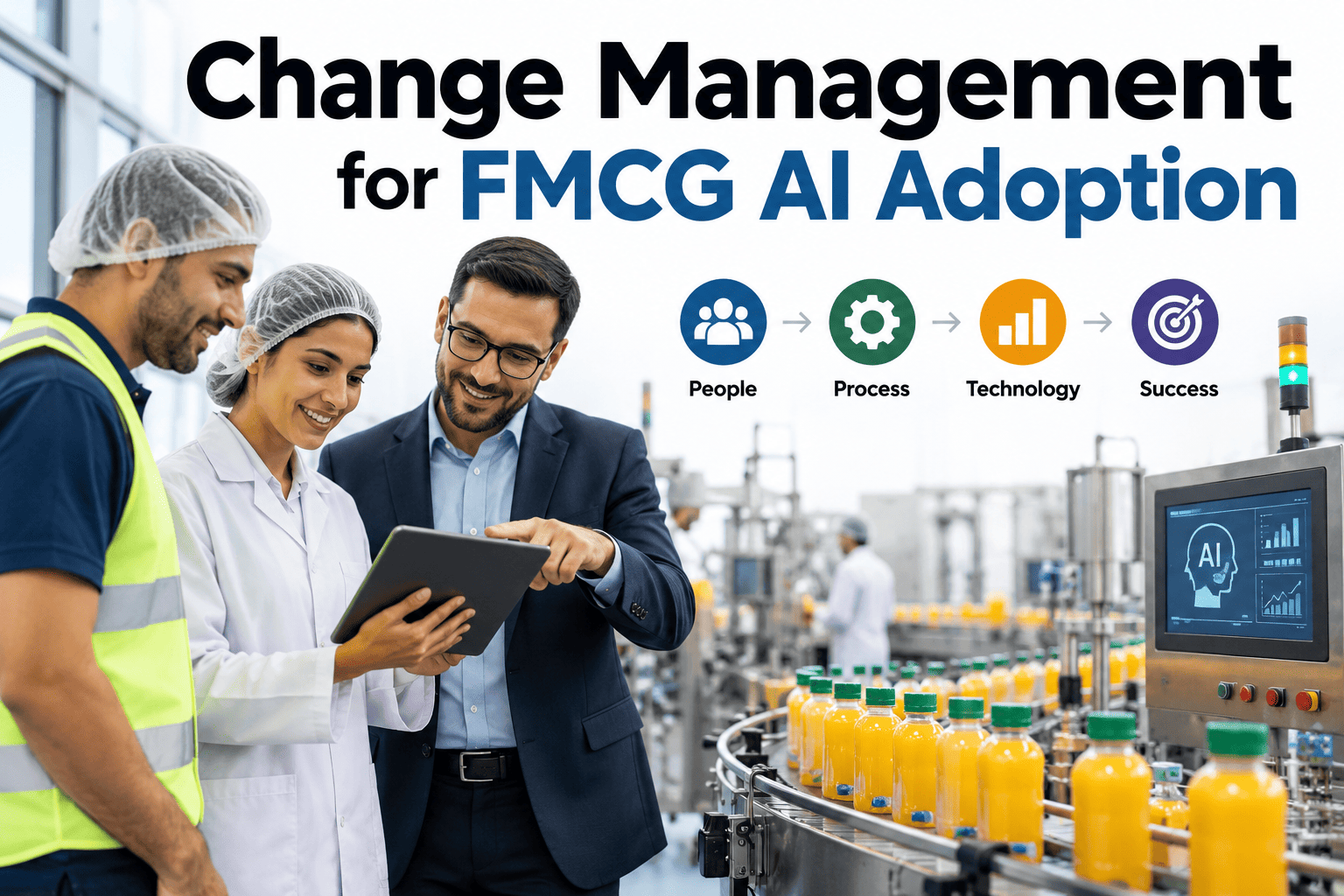
A demand planner with fifteen years of experience does not stop trusting their own judgment because a new algorithm tells them to order differently — trust has to be earned through the same process any new colleague would go through, not assumed because the recommendation came from a model with impressive validation statistics. This is the part of AI adoption that technology rollouts consistently underestimate: the model can be technically excellent and still fail in production because nobody addressed the actual human workflow it's asking people to change. Change management for FMCG AI adoption is not a training deck delivered once at launch — it's planner trust built deliberately, a super-user network that gives peers credibility a vendor can't, and a workflow redesign that makes the new recommendation the path of least resistance instead of an extra step layered on top of the old one. If your AI rollout has great model performance and disappointing adoption numbers, book a demo to see how a structured adoption approach changes that.
The Model Doesn't Need to Convince Anyone. Your Planners Do.
AI adoption in FMCG succeeds or fails on trust, workflow fit, and peer credibility — not model accuracy. iFactory's approach builds all three deliberately instead of assuming a training session will get planners to change how they've always worked.
Why Planners Quietly Ignore Recommendations They Never Rejected
Adoption failure in AI programs rarely looks like open resistance — it looks like a planner who nods along in the training session, has the tool open on their screen, and then quietly reverts to their spreadsheet the moment nobody is watching. This pattern is predictable and comes from a specific set of unaddressed concerns, not a general resistance to technology.
A model with no visible history of being right in this specific planner's category or region reads as an unproven outsider, regardless of its aggregate validation statistics.
A bare recommendation with no visible reasoning behind it asks for blind trust, which experienced planners are reasonably reluctant to extend to a new system.
When the new tool sits alongside the old process rather than replacing it, checking both takes longer than just using the familiar one and ignoring the new recommendation.
A training session delivered by IT or a vendor lacks the credibility of a respected peer who has actually used the tool and can vouch for it from experience.
Building Planner Trust Deliberately, Not Assuming It
Trust in an AI recommendation is built the same way trust in a new colleague is built — through a track record, transparency, and low-risk opportunities to verify credibility before high-stakes reliance is expected.
Introduce the model's recommendations first on lower-risk SKUs or decisions, letting planners see it perform well before it's asked to influence their highest-stakes calls.
Displaying the specific factors behind a recommendation — a promotional lift, a seasonal pattern, a supply constraint — gives planners something to evaluate rather than blindly accept.
Showing planners how often the model's recommendations were right, specifically within their own category or region, builds credibility faster than aggregate company-wide statistics.
Planners who feel safe overriding a recommendation when they have good reason to are more likely to trust and use it the rest of the time than planners who feel forced to comply.
Build an Adoption Plan for Your Specific Planning Team
See how iFactory structures trust-building, super-user networks, and workflow redesign around your team's actual planning process.
The Super-User Network: Peer Credibility a Vendor Can't Provide
A rollout led entirely by IT or an outside vendor lacks something a peer champion has by default — genuine standing with the team being asked to change. A structured super-user network converts a handful of respected team members into internal advocates before the wider rollout begins.
Early Access and Input
Super-users get access to the tool weeks before the wider team, with a genuine channel to influence configuration decisions rather than just previewing a finished product.
Peer-Led Training
Training delivered by a colleague who has actually used the tool in their own daily work carries more credibility than the same content delivered by IT or an outside trainer.
First-Line Support
A super-user sitting near the team answers the small daily questions that would otherwise go unasked, preventing minor confusion from becoming a reason to quietly stop using the tool.
Workflow Redesign: Before and After
The single biggest lever in adoption is often not trust or training at all — it's whether following the AI recommendation is genuinely easier than the old process, or simply an additional step layered awkwardly on top of it.
| Workflow Element | Before Redesign | After Redesign |
|---|---|---|
| Where the recommendation appears | Separate dashboard, checked manually | Embedded directly in the existing order entry screen |
| Steps to act on a recommendation | Read, switch systems, manually re-enter | One-click accept within the same workflow |
| Reasoning visibility | Number only, no context | Key factors shown alongside the number |
| Override process | Undocumented, informal | One click with an optional reason code |
What Changed Adoption From 22% to 81% in One Quarter
A packaged foods company's initial rollout of an AI-driven replenishment recommendation tool achieved only 22% planner adoption after three months, despite the model showing strong validated accuracy during the pilot phase. Planners had access to the tool, had completed the required training, and still overwhelmingly continued using their existing manual process for the majority of their orders.
An adoption review found the recommendation lived in a separate application requiring planners to re-enter data manually into their actual ordering system, effectively doubling their workload rather than reducing it. The fix involved three changes: embedding the recommendation directly into the existing order entry screen, recruiting three respected senior planners as super-users who ran informal peer training sessions, and displaying the specific demand signals behind each recommendation rather than a bare number. Within one quarter, adoption climbed to 81%, without any change to the underlying forecasting model — the model had been right all along, but nobody had made it easy or credible enough to actually use.
Frequently Asked Questions
How many super-users do we need for a typical FMCG planning team?
A common ratio is roughly one super-user for every ten to fifteen planners, chosen specifically for their existing peer credibility rather than simply their technical aptitude or job title. A super-user who is respected by colleagues but only moderately technical is often more effective than a highly technical employee without the same standing on the team, since the goal is peer trust transfer, not technical support capacity alone. Involving super-users early enough to genuinely shape configuration decisions, not just preview a finished tool, also meaningfully increases their effectiveness as advocates. Our team can help identify the right super-user profile for your specific team structure — book a demo to discuss it.
How long does it typically take to see meaningful adoption after launch?
The first 90 days after launch are the critical window where planners either build the habit of checking and acting on recommendations or quietly revert to their prior process, and adoption trends established during this window are difficult to reverse later without a deliberate re-intervention. Plants that actively manage this window with structured trust-building, embedded workflow design, and super-user support typically see adoption climb steadily through the period, while plants that treat launch as a one-time training event often see an initial spike followed by a decline back toward the old process. For a realistic adoption timeline specific to your rollout plan, contact our support team.
Should we mandate use of the AI recommendations, or rely entirely on voluntary adoption?
A pure mandate without addressing underlying trust and workflow friction tends to produce compliance without genuine engagement — planners technically click through the recommendation without meaningfully considering it, which defeats the purpose. The more durable approach combines making the recommendation genuinely easy to act on with visible leadership expectation that it should be the default starting point for a decision, while preserving an easy, judgment-free override path for legitimate exceptions. This balance tends to produce both higher compliance and higher genuine trust than either pure mandate or pure voluntary adoption alone. For guidance on setting this expectation appropriately for your team culture, schedule a session with our team.
What should we do if a specific planner or team continues to resist adoption despite these interventions?
Persistent resistance from a specific individual or team, even after trust-building and workflow improvements, usually signals either an unaddressed legitimate concern worth investigating directly or a specific category where the model genuinely underperforms in a way that hasn't been acknowledged. Rather than treating this as a compliance problem to be enforced, a direct conversation about the specific reasoning behind the resistance often surfaces useful information — sometimes about the model, sometimes about a workflow gap specific to that team's unique process. Escalating straight to a mandate without this conversation risks losing valuable signal about where the program genuinely needs improvement. For a structured approach to these conversations, reach out to support.
How do we measure whether our change management effort is actually working?
Track acknowledgment rate, override rate with documented reasons, and time-to-action as leading indicators, since these shift well before the ultimate business outcome metric does and give an early signal of whether the adoption effort is on track. A rising acknowledgment rate combined with a stable or declining override rate over the first 90 days is a strong signal that trust and workflow design are working as intended. Waiting to measure only the final business outcome metric means losing months of opportunity to intervene if adoption is actually stalling. For a specific adoption measurement framework, book a demo to review it together.
Make the Right Decision the Easy Decision
Your model doesn't need better statistics — it needs planners who trust it and a workflow that makes using it the path of least resistance. See how iFactory builds both.