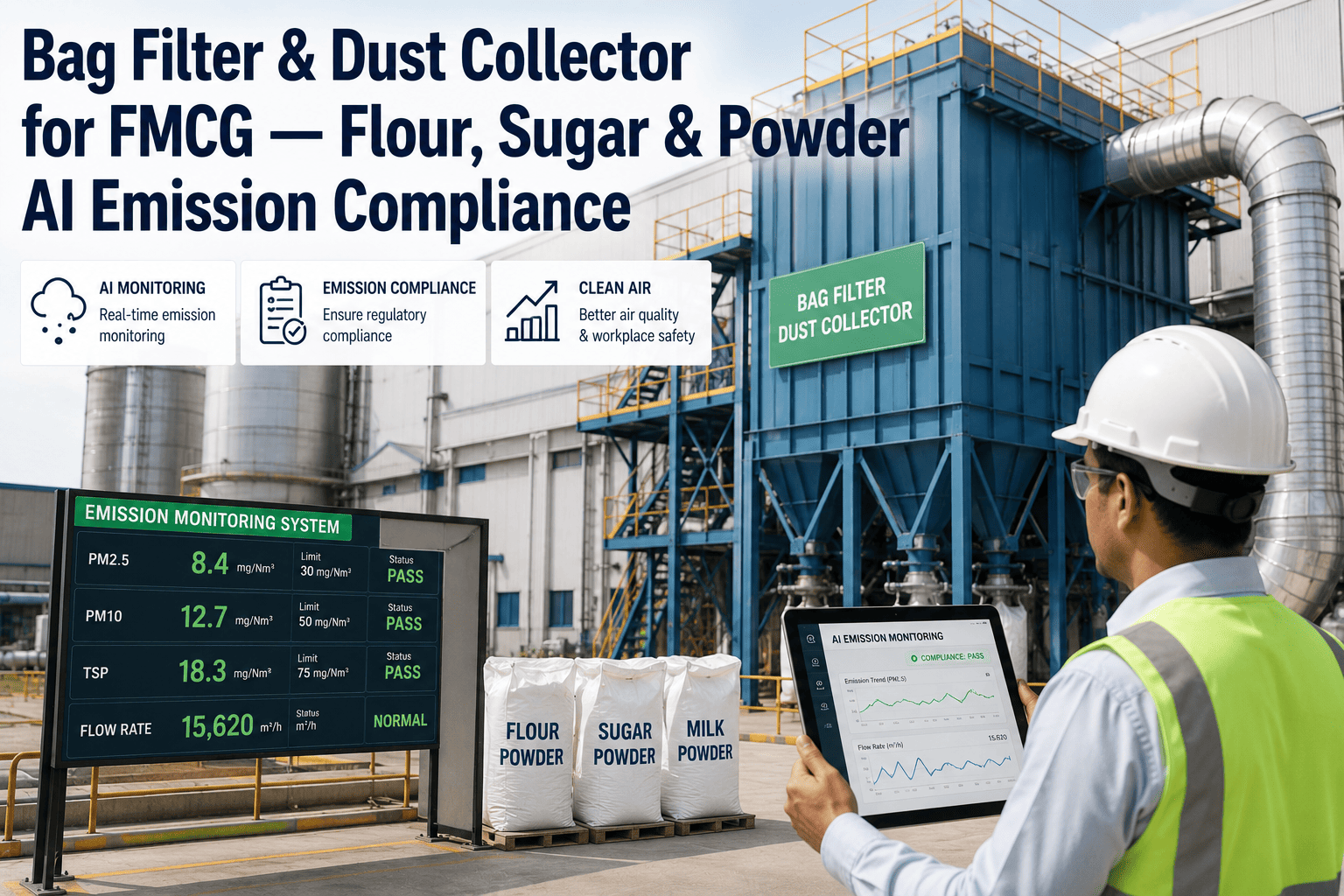
Bag Filter & Dust Collector for FMCG — Flour, Sugar & Powder AI Emission Compliance

By James Smith on August 24, 2026

bag-filter-dust-collector-fmcg-flour-sugar-powder-ai

Flour and sugar dust are combustible, and a dust collector's bag filters are the one piece of equipment standing between routine powder handling and both a workplace exposure violation and a genuine explosion hazard. Most maintenance teams check pressure drop across the filter bank on a fixed schedule, replace bags on a fixed calendar, and hope the interval matches how the system is actually degrading — which it usually doesn't, because dust loading varies by product run, humidity, and how the upstream process is behaving that week. See how AI tracking of bag condition, pressure drop, and emission trends keeps dust collection systems ahead of both compliance limits and combustible dust risk.

Processing Equipment · Maintenance

A Fixed Bag Replacement Schedule Was Never Going to Match Real Dust Loading

AI monitoring of bag filter condition, pressure drop, and emission compliance for flour, sugar, and powder dust collection — built to catch degradation before it becomes an exposure or combustible dust risk.

Why Calendar-Based Bag Replacement Falls Short

Two Ways a Fixed Schedule Gets It Wrong

Replacing Too Early
Bags pulled on a conservative fixed interval when they still have significant remaining service life waste maintenance labor and filter media cost across every collector running on the same calendar-based schedule.
Replacing Too Late
A high-dust-load run or a period of elevated humidity can degrade bag performance faster than the standard interval assumes, leaving a collector running past its effective filtration capacity before the next scheduled change.

Both failure modes trace back to the same root issue — a calendar doesn't know what a specific collector actually experienced since its last bag change. Pressure drop across the filter bank is the variable that actually reflects real degradation, and it moves at a pace set by production conditions, not by a maintenance planning cycle.

What Continuous Tracking Watches

Three Signals, One Combined Condition Score

Pressure Drop Trend
Differential pressure across the filter bank tracked continuously against the collector's own historical baseline, not a generic industry threshold.
Emission Monitoring
Downstream particulate readings correlated against pressure drop to catch a bag failure signature before it shows up as an emission compliance violation.
Cleaning Cycle Behavior
Pulse-jet or shaker cleaning cycle frequency and effectiveness tracked over time to flag bags that are no longer recovering fully between cleaning cycles.
Replace Bags Based on Condition, Not Calendar

Stop Guessing at the Interval Between Bag Changes

iFactory tracks pressure drop, emissions, and cleaning cycle performance continuously, so maintenance teams replace bags when the data says to, not when the calendar says to.

Beyond Emission Compliance

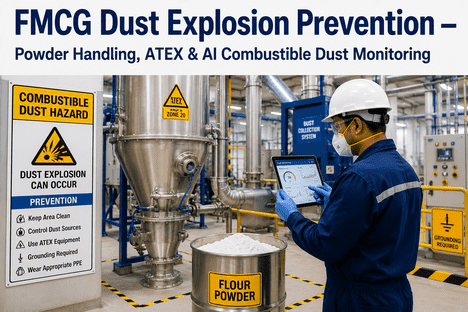
Why Flour and Sugar Dust Carry a Combustible Dust Dimension

Powder TypePrimary Compliance ConcernCombustible Dust Consideration
FlourWorkplace exposure limitsIgnitable dust cloud in confined ductwork
SugarParticulate emission limitsHistorically implicated in major dust explosions
Powdered Dairy/ProteinProduct loss and exposureFine particle accumulation in collection ductwork
Starch & AdditivesEmission complianceHigh surface-area-to-mass ignition sensitivity

A failing bag doesn't just risk an emission compliance violation — it can also allow dust accumulation to build in ductwork and collection housings in ways that raise combustible dust risk under NFPA guidelines. Continuous condition tracking treats these as connected risks rather than separate checklist items, since the same pressure drop and cleaning cycle degradation that signals a coming compliance issue is often the same signal that indicates dust accumulation is building somewhere it shouldn't.

What Changes for Maintenance Teams

What Condition-Based Monitoring Actually Changes

01
Fewer Emergency Bag Changes
A gradual pressure drop trend gives maintenance a planning window to schedule a bag change during normal downtime, instead of an unplanned stop when a bag fails outright.
02
Lower Filter Media Spend
Bags that still have usable service life aren't replaced early just because a fixed schedule says it's time, reducing filter media cost across a multi-collector plant.
03
Stronger Emission Compliance Record
Continuous emission and pressure drop logging gives EHS documentation that shows proactive management rather than relying on periodic stack testing alone.
04
Reduced Combustible Dust Exposure
Catching cleaning cycle degradation early reduces the chance of dust accumulation building in ductwork and housings between scheduled inspections.
Getting It Running

What Onboarding a Dust Collector Involves

Most industrial dust collectors already have differential pressure gauges and, in many cases, an existing connection to a local PLC or building automation system, which means the monitoring layer typically works from data the collector is already generating rather than requiring new instrumentation. Onboarding starts with pulling historical pressure drop and cleaning cycle data alongside maintenance records of past bag changes, which lets the system learn what a normal degradation curve looks like for that specific collector, product, and dust loading pattern before it starts flagging deviations.

Where a collector doesn't already have continuous pressure monitoring, a differential pressure transmitter is typically the only added instrumentation needed, since emission and cleaning cycle behavior can often be inferred from pressure trends and existing cleaning cycle controller logs. Once baseline data is established, the system runs alongside existing maintenance schedules rather than replacing them outright, giving maintenance teams a data-backed reason to adjust the interval rather than asking them to abandon a compliance-driven schedule without evidence to support the change.

Common Questions

Frequently Asked Questions

Does this replace our required stack emission testing?
No — periodic stack testing required under a facility's air permit continues on its normal schedule. Continuous pressure drop and emission trend monitoring supplements that testing with visibility into the periods between tests, helping catch a degrading bag well before the next scheduled compliance test would reveal it. Talk to support about how the two fit together for your specific permit requirements.
Can this work on collectors that don't currently have pressure sensors?
Yes, in most cases — adding a differential pressure transmitter is a relatively straightforward retrofit on most standard dust collector housings, and that single sensor typically provides enough signal to build a useful condition trend even without other existing instrumentation.
How does this account for different dust loading between product runs?
The baseline model is built from historical data specific to that collector, which includes the range of dust loading conditions it has already experienced across different product runs, so normal variation between runs is distinguished from an actual degradation trend rather than being flagged as a false alarm every time production conditions shift.
Does this help with combustible dust housekeeping requirements?
Indirectly, yes — by catching cleaning cycle degradation and pressure drop trends that indicate dust accumulation is building somewhere in the ductwork or housing, the system gives maintenance an earlier signal to inspect and clean areas that combustible dust housekeeping programs are specifically concerned with. Book a demo to see how this fits into an existing combustible dust program.
Can one system monitor multiple dust collectors across a plant?
Yes — each collector is modeled individually against its own historical baseline since dust loading, product type, and collector design vary across a plant, but all connected collectors report into a single view so maintenance teams can prioritize attention across the full plant rather than checking each collector separately.
Manage by Condition, Not Calendar

Give Your Dust Collection System a Continuous Condition Signal

iFactory tracks pressure drop, emissions, and cleaning cycle behavior across every collector, catching degradation before it becomes a compliance or combustible dust issue.
Share This Story, Choose Your Platform!