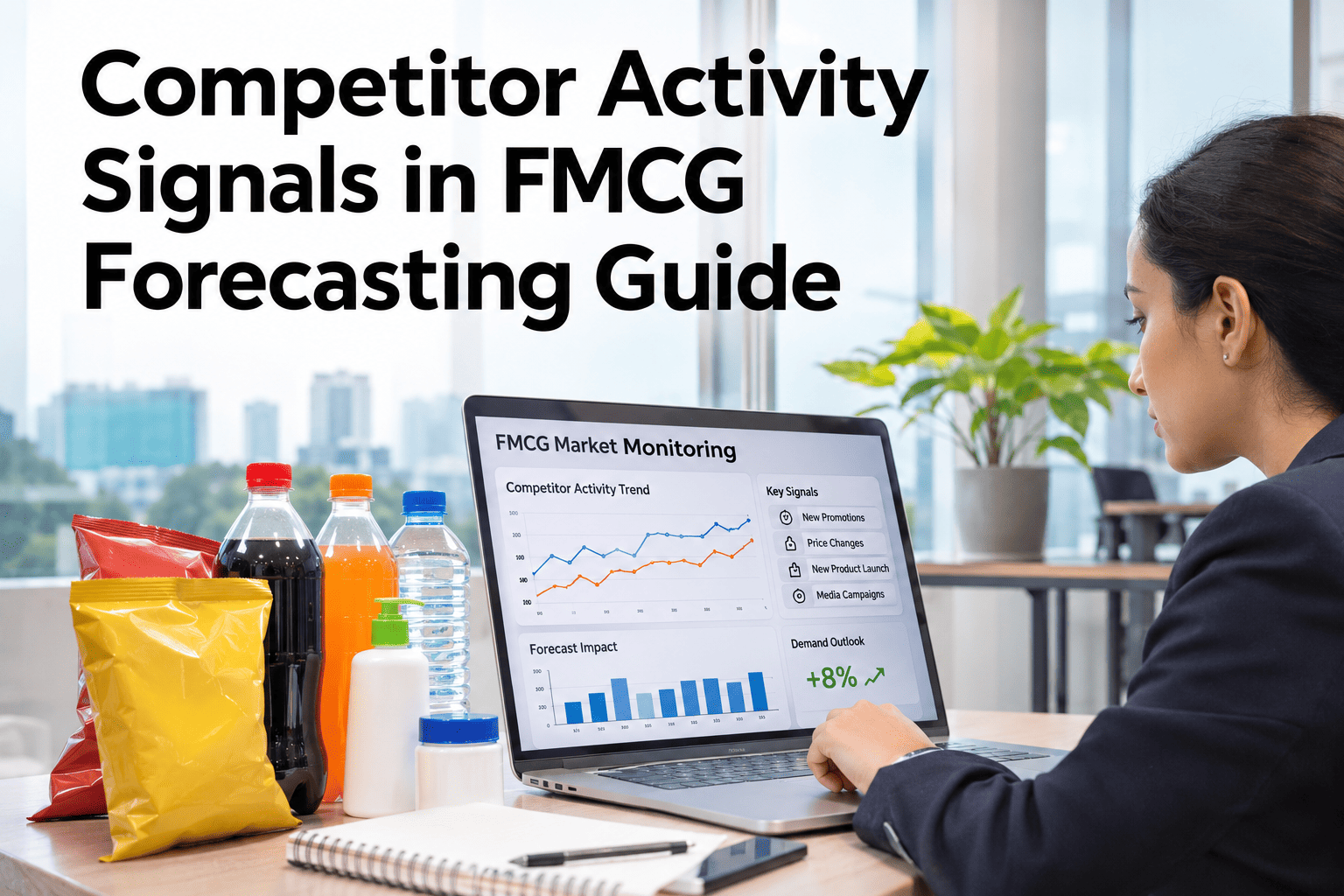
Competitor activity signals in FMCG forecasting are the price changes, promotions and stockouts of rival SKUs that shift demand for your own brand. They matter most where shoppers can easily substitute: in a study of about 65,000 SKUs, competitor price-change features improved forecast accuracy only modestly on average, with the gain concentrated in categories with strong substitution. Used sparingly, they sharpen a baseline instead of replacing it. The art is knowing which categories react, and how long the reaction lasts. Demand teams can see which of their categories react to competitor moves in a short session.
When a Rival Moves, Know Whether Your Demand Moves With It
iFactory AI, an on-premise industrial AI platform, feeds competitor price, promotion and stockout signals into its ML forecast ensemble only where they add value.
What Are Competitor Activity Signals in Forecasting?
They are observed rival moves used as model inputs. A model that ignores a major competitor promotion will produce a forecast that looks sterile and detached from the market. The evidence says to use them with care.
Which Competitor Signals Move Your Demand?
Each signal has a direction, a likely duration and a planning response. Teams can ask for a signal playbook to adapt to their categories.
| Signal | Likely Effect | Where It Matters Most | Forecast Response |
|---|---|---|---|
| Rival price cut | Volume drains from your brand | Close substitutes | Add price-gap feature, review your price |
| Rival promotion | Short dip, then a return | Impulse categories | Flag event weeks, expect recovery |
| Rival out of stock | Demand shifts to you | Brand-loyal-light categories | Lift the near-term plan with a cap |
| Rival launch | Share pressure builds | Crowded segments | Watch trend, avoid early panic |
| Private label price move | Strongest brand switching | National brands | Track the gap each week |
Find Out Which Rival Moves Actually Hit Your Volume
Share your price and promotion history by category. iFactory AI's team will test which competitor signals improve your forecast and which add noise.
Why Does Your Own Activity Often Matter More?
A major study found the promoted brand's own activities play a far larger role in cross-price effects than a competitor's similar activities (Horvath and Fok, Marketing Science, 2013). Model your own moves first.
Which Brands Feel Competitor Moves Most?
The same research found that the national brand and private label asymmetry has the strongest influence on cross-price promotional effects. Switching is not symmetric.
How Do You Capture Competitor Signals Responsibly?
Use public or licensed data, and have legal review how it is collected. Common sources differ in speed and cost.
| Source | Frequency | Watch For |
|---|---|---|
| Syndicated market data | Weekly | Delay and cost, not store level |
| Shelf price audits | Weekly or monthly | Limited coverage |
| Public online prices | Daily | Terms of use and data quality |
| Retailer feeds | Daily | Rival data is usually not shared |
How Do You Turn Signals Into Model Features?
The study above used price-gap percentage, cumulative competitor discount impact and market concentration as features. Plants can see competitor features built from their own data in a short walkthrough.
How Long Does a Competitor Effect Last?
Effects fade, and some reverse. Cross-brand post-promotion dips tend to occur under certain conditions (Horvath and Fok, 2013), so give each signal a lifespan.
How Do You Avoid Overreacting to a Rival?
Preemptive switching happens, and promotions can hurt a competitor in later periods too (Horvath and Fok, 2013), so reactions need limits.
Where Does iFactory AI Fit in Competitor Signal Forecasting?
iFactory, an on-premise AI platform for manufacturing, loads your competitor feeds into the forecast ensemble and keeps only the signals that improve accuracy.
Signal Features
Price gaps and rival events become model inputs per category.
Value-Added Test
Each signal is backtested and removed if it does not help.
Guardrails
Caps and fade rules stop large swings from one data point.
Planner Alerts
Big rival moves are flagged for review with their evidence.
Expert Review: Judging a Competitor Signal Plan
Frequently Asked Questions
Do competitor prices improve FMCG demand forecasts?
Modestly on average. A study of about 65,000 SKUs found competitor price-change features helped, with the gain concentrated in categories with strong substitution (Duangphaichoom, 2026). Test the gain on your categories with our team.
What happens to my demand when a competitor runs out of stock?
Some shoppers switch to your brand, since about 26 percent buy another brand when their first choice is missing (Gruen and Corsten, via Progressive Grocer). The effect varies by category and loyalty. Size the shift for your range in a short session.
Are competitor promotions as important as my own?
Usually not. Research found the promoted brand's own activities play a much larger role in cross-price effects than a competitor's similar activities (Horvath and Fok, 2013). Ask support to model your own events first before adding rivals.
How do we collect competitor data responsibly?
Use licensed syndicated data, shelf audits or public prices, and have legal review the terms of use before any automated collection. Keep a record of every source. Plan a compliant data feed with our team.
Does iFactory AI scrape competitor websites?
iFactory AI uses the competitor and price feeds you provide, such as syndicated data or your own audits, and tests whether each one improves the forecast. See how feeds are tested in a short demo.
Forecast With the Market in View, Not in the Dark
See iFactory AI test competitor signals on your categories and keep only those that improve accuracy. Book a walkthrough using your own price and promotion history.