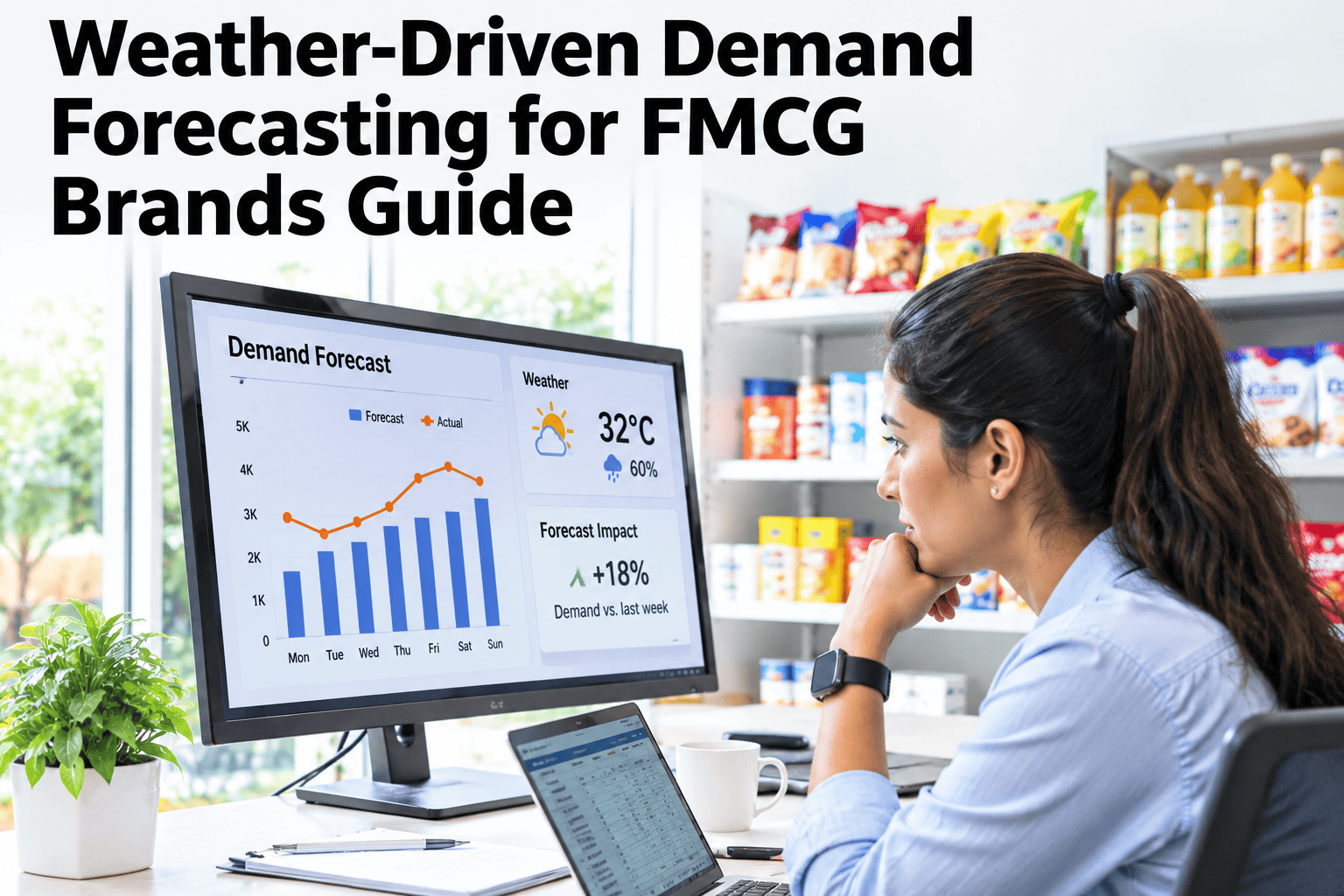
Weather-driven demand forecasting adds temperature, rain and wind as model inputs for FMCG categories where the weather changes what shoppers buy. Machine learning (ML) is the usual tool, because the effect has lags, thresholds and interactions that simple rules miss. The gain is real but modest: in one ice cream study across five European countries, forecasts improved by 3.8 percent on average and by up to 5.8 percent where local weather was easiest to model. Weather forecasts also lose quality fast beyond about a week. Demand teams can test weather signals against their own sales history in a short session.
Turn the Weather Forecast Into a Demand Signal Your Planners Can Trust
iFactory AI, an on-premise industrial AI platform, feeds local weather into its ML forecast ensemble and shows where weather adds value and where it does not.
What Is Weather-Driven Demand Forecasting?
It is forecasting that treats weather as a causal driver, next to price, promotion and calendar. It adds a time-sensitive signal that seasonality alone cannot give (ToolsGroup, 2016). Three facts set expectations.
Which FMCG Categories React to Weather?
Classic examples are ice cream, packaged water, soft drinks and soup. Trigger points are local, so learn them from your own sales. Teams can ask for a category sensitivity check across their range.
| Category | Weather Driver | Example Trigger | Caution |
|---|---|---|---|
| Soft drinks | Temperature | Sales rise sharply above about 20°C (Campaign) | Threshold varies by market |
| Soup | Cold spells | Sales rise as it falls below about 15°C (Campaign) | Figure is from older UK data |
| Ice cream | Heat and sun | Sensitive in summer, much less in winter (RELEX) | Water ices can overtake cream in heat |
| Packaged water | Heat and events | Heatwaves lift near-term demand | Interacts with promotions |
See Which of Your SKUs Really Follow the Weather
Share two years of SKU sales and your regions. iFactory AI's team will test weather signals and show which products gain and which do not.
How Do Weather Signals Enter the Forecast?
Raw weather is not enough. Numeric and category signals are correlated, so features need care: no rain on a clear day, no snow in warm air (Solvoyo).
Why Do Lags Matter for Weather Demand?
Weather does not turn into demand at once everywhere. Ice cream can react immediately, while products like air conditioners may take days (ToolsGroup, 2016). ML can learn the lag per product and area instead of assuming one.
How Far Ahead Can You Trust Weather in the Plan?
Use weather where its forecast is dependable, and fall back to climate norms beyond it. This is an example split to adapt to your own lead times and regions.
| Horizon | Weather Input | Use |
|---|---|---|
| 0 to 3 days | Short-range forecast | Replenishment and dispatch changes |
| 4 to 7 days | Forecast with wider uncertainty | Production and allocation tuning |
| Beyond a week | Seasonal norms and scenarios | Capacity and inventory build |
Why Does Weather Need to Be Local, Not National?
Daily store-level forecasting typically needs daily weather for each store region, not a national average (Cleverence). A heatwave in one region and rain in another cancel out in a national figure.
How Do You Prove Weather Adds Value?
Run a backtest with and without weather, on the same history and horizon. Teams can review a weather backtest scorecard built on their own range.
What Happens When Weather Meets a Promotion?
A sunny weekend lifts ice cream, and a promotion on the top brand may cannibalize unpromoted lines (RELEX). A joint model separates the two effects, so one is not counted as the other.
Which Weather Modelling Mistakes Cost the Most?
Where Does iFactory AI Fit in Weather-Driven Forecasting?
iFactory, an on-premise AI platform for manufacturing, runs an ML forecast ensemble with demand sensing on the plant's own server.
Local Weather Features
Weather is mapped to each region and turned into model features.
Sensitivity Ranking
SKUs are ranked by how much weather really moves them.
Forecast Ensemble
Weather-aware models run beside statistical baselines.
Daily Replan
Refreshed weather adjusts the near-term plan each day.
Expert Review: Judging a Weather Forecasting Plan
Frequently Asked Questions
How much does weather data improve FMCG forecast accuracy?
The gain is real but modest. One ice cream study across five European countries reported a 3.8 percent average improvement and up to 5.8 percent where local weather mattered most (ToolsGroup, 2016). Measure the gain on your own SKUs with our team.
Which FMCG categories are most sensitive to weather?
Ice cream, soft drinks, packaged water and soup are classic examples, and sensitivity varies by season and market (RELEX; Campaign). Rank your own SKUs rather than assuming. Ask support for a sensitivity ranking approach.
How far ahead is weather useful for demand planning?
Short-term weather forecast quality degrades fast beyond about five to seven days (Solvoyo), so use weather for near-term moves and seasonal norms beyond that. Set horizons for your lead times in a short session.
Do we need ML to use weather in forecasting?
Practically yes. Weather effects have lags, thresholds and interactions with promotions, which ML can learn per product and area without hand-built rules (ToolsGroup, 2016). See ML and statistical baselines compared on your data.
Does iFactory AI send our sales data outside the plant?
No. iFactory AI runs on an on-premise server, so sales history and models stay in your environment while a weather feed supplies the outside signal. Review the data flow with our team.
Plan for the Heatwave Before It Arrives
See iFactory AI rank your weather-sensitive SKUs and feed local weather into the daily replan. Book a walkthrough using your own sales history.