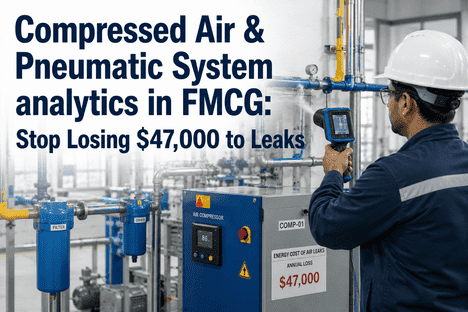
Compressed air systems are the second-largest industrial utility in FMCG production facilities behind only electrical power and they are also one of the most frequently overlooked sources of occupational safety risk. Every shift in a food, beverage, or personal-care plant uses compressed air for pneumatic actuators on filling lines, CIP valve manifolds, packaging equipment, conveying systems, and manual blow-off stations for cleaning. Yet the same 100 PSI compressed air that powers production can cause catastrophic injury if a hose coupling fails, a pressure relief valve is blocked, or an operator uses an unregulated air nozzle for personnel cleaning. OSHA 29 CFR 1910.242(b) explicitly limits compressed air used for cleaning to 30 PSI when dead-ending (chip guarding), and ASME B19.1 provides the safety standard for all compressed air systems. iFactory's Safety and Compliance and Inspection Management modules give FMCG EHS and maintenance teams the digital infrastructure to manage compressed air system safety from pressure relief device testing schedules and pneumatic hose inspection workflows to air quality verification for food contact applications and lockout/tagout procedures for stored pneumatic energy. Book a demo to see iFactory's compressed air safety platform configured for your FMCG facility's pneumatic systems.
Is Your FMCG Facility's Compressed Air System Operating Within Safety Standards?
iFactory AI delivers integrated safety management for compressed air and pneumatic systems — pressure relief testing, hose inspection workflows, air quality monitoring, and LOTO procedures for stored pneumatic energy — in one platform purpose-built for FMCG production environments.
The Case for Systematic Compressed Air Safety Management Across FMCG Production
A typical FMCG facility operates 200–600 horsepower of compressed air capacity distributed across reciprocating, rotary screw, and centrifugal compressors feeding 8,000–15,000 feet of distribution piping. The pneumatic system powers hundreds of actuators, valves, blow-off stations, and air tools across multiple production lines running 16–24 hours per day. The safety risks in this system are not hypothetical. OSHA records show that compressed air accounts for an average of 80–100 serious injuries per year in U.S. manufacturing — including pneumatic hose whip injuries, eye injuries from blow-off debris, hearing loss from unattenuated exhaust noise, and injuries from unexpected pneumatic actuator motion during maintenance. Each of these injury modes is preventable through systematic safety management pressure relief device testing at ASME-recommended intervals, pneumatic hose inspection and replacement programs, air nozzle compliance verification, noise exposure monitoring, and documented lockout/tagout procedures for pneumatic energy isolation. When a compressed air line ruptures at 100 PSI within 12 inches of an operator's body, the energy released can cause subcutaneous air embolism, soft tissue avulsion, or fatal arterial gas injection. When a pneumatic actuator on a CIP valve manifold cycles unexpectedly during maintenance because the compressed air isolation valve was not locked out, the resulting pinch or crush injury can cause traumatic amputation. These events are rare but when they occur, they are catastrophic. iFactory's Safety and Compliance module enables FMCG facilities to manage compressed air safety with the same rigor applied to electrical safety and chemical hazard communication closing the gap between the risk profile of compressed air systems and the management attention they typically receive.
Five Compressed Air and Pneumatic Safety Risk Domains in FMCG Facilities
Compressed air safety in FMCG production spans five primary risk domains: pressure system integrity (the compressor, receiver tank, distribution piping, and point-of-use components), pneumatic energy isolation (lockout/tagout for maintenance), blow-off and cleaning safety (OSHA 1910.242(b) compliance), pneumatic hose and coupling management (whip prevention and replacement schedules), and noise exposure (compressor rooms and pneumatic tool exhaust). Each domain presents distinct hazard profiles and requires a different safety management approach.
Pressure System Integrity — Compressor, Receiver, and Distribution Piping Safety
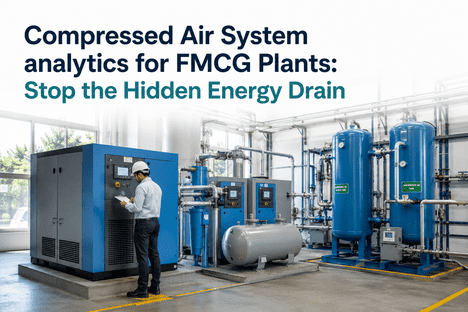
The compressed air pressure system begins at the compressor package and extends through the receiver tank, dryers, filters, distribution piping, and point-of-use connections to every pneumatic device on the plant floor. ASME B19.1 (Safety Standard for Compressed Air Systems) and ASME Boiler and Pressure Vessel Code Section VIII govern the design, testing, and maintenance of these components. Pressure relief devices (PRVs) on receiver tanks must be tested at intervals specified by the manufacturer or at minimum annually. Distribution piping must be inspected for corrosion, mechanical damage, and support integrity. Point-of-use connections — including quick-disconnect couplings, regulators, and lubricators — must be maintained to prevent leaks that create both safety hazards and energy waste. iFactory's Inspection Management module schedules PRV testing, piping walkdown inspections, and point-of-use FRL (filter-regulator-lubricator) audits with pre-built checklists that document compliance with ASME B19.1 and facility-specific pressure system standards.
Pneumatic Energy Isolation — Lockout/Tagout for Compressed Air Systems
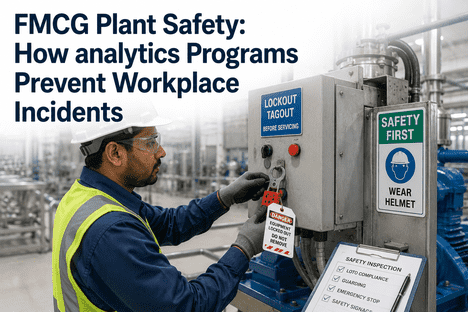
OSHA 29 CFR 1910.147 (Control of Hazardous Energy — Lockout/Tagout) applies to pneumatic systems as a source of stored energy. Compressed air receiver tanks, distribution headers, and downstream piping can retain pressure even after the compressor is shut down and the main isolation valve is closed. Pneumatic actuator circuits — including valve manifolds on CIP skids, filling line actuators, and packaging machine cylinders — can store enough pneumatic energy to cause severe injury if the system is not properly isolated and bled down before maintenance begins. Common LOTO gaps in FMCG pneumatic systems include failure to install lockable isolation valves on branch lines serving individual machines, inadequate bleed-down procedures for downstream piping after main isolation, and missing or undocumented energy isolation verification steps in machine-specific LOTO procedures. iFactory's Safety and Compliance module provides a digital LOTO procedure library with machine-specific energy isolation steps, automated lock-out tag-out recordkeeping, and mobile verification checklists that document each isolation and bleed-down step before maintenance work begins.
Blow-Off and Cleaning Safety — OSHA 1910.242(b) Compliance
OSHA 1910.242(b) requires that compressed air used for cleaning purposes be reduced to less than 30 PSI when the nozzle is dead-ended (blocked from free airflow). This regulation — commonly known as the chip guarding standard — is one of the most frequently cited compressed air violations in FMCG facilities. Compliance requires that every blow-off station on the plant floor be equipped with a pressure-reducing nozzle or an airflow restrictor that limits dead-end pressure to 30 PSI regardless of upstream supply pressure. Common compliance gaps include blow-off stations that use homemade nozzles or modified fittings that bypass the pressure-reducing function, operators who remove nozzle tips to increase airflow for cleaning tasks, and portable blow-off guns that are not tested for dead-end pressure after maintenance or replacement. iFactory's Inspection Management module supports scheduled blow-off station inspections with pass/fail criteria for nozzle compliance, dead-end pressure testing, and ergonomic assessment — with automated work order generation for non-compliant stations.
Pneumatic Hose and Coupling Management — Whip Prevention and Replacement
Pneumatic hose assembly failures are the most common source of compressed air injuries in manufacturing. When a hose coupling fails or a hose ruptures under pressure, the hose end whips with enough force to cause laceration, contusion, or eye injury. OSHA citations for pneumatic hose safety typically cite 1910.242(a) — the general requirement that hand and portable powered tools and equipment be maintained in a safe condition. Key safety requirements include the use of whip-check cables or safety chains at each hose coupling point, hose selection rated for the maximum system pressure with a 4:1 safety factor, regular hose inspection for abrasion, cuts, kinking, and chemical degradation, and replacement schedules based on service life rather than visual condition alone (since internal hose degradation is not visible during external inspection). iFactory's Inspection Management module provides pneumatic hose inspection checklists with visual and functional test criteria, automated replacement scheduling based on installation date and service hours, and corrective work order generation for hoses that fail inspection.
Noise Exposure — Compressor Rooms and Pneumatic Tool Exhaust
Compressed air systems generate noise at multiple points in the system — compressor packages (85–105 dBA inside compressor rooms), pneumatic tool exhaust (90–115 dBA at the operator's ear), and blow-off nozzle airflow (95–110 dBA at the cleaning point). OSHA 29 CFR 1910.95 requires a hearing conservation program when noise exposure reaches an 8-hour time-weighted average of 85 dBA, and engineering or administrative controls must be implemented when exposure reaches 90 dBA. Compressor rooms in FMCG facilities consistently exceed both thresholds, yet many facilities do not conduct area noise monitoring in compressor rooms or job-specific noise dosimetry for maintenance mechanics who spend significant time in compressor rooms. Pneumatic tool exhaust silencers are frequently removed or degraded, and blow-off stations equipped with open pipes (rather than engineered safety nozzles) produce noise levels that can exceed 110 dBA. iFactory's Safety and Compliance module supports noise exposure monitoring schedules with area and personal sampling data management, hearing conservation program documentation, and corrective action tracking for noise control engineering measures.
Regulatory Standards and Industry Guidelines for Compressed Air Safety — Compliance Requirements by System Domain
Compressed air systems in FMCG facilities are governed by a matrix of OSHA regulations, ASME standards, and industry-specific guidelines that cover pressure system design, energy isolation, cleaning safety, hose management, and noise exposure. The table below presents the primary standards applicable to each compressed air system domain, the specific compliance requirements, and the typical inspection or testing frequency required to maintain compliance.
| Safety Domain | Applicable Standard | Key Compliance Requirement | Inspection / Test Frequency |
|---|---|---|---|
| Pressure Vessel Integrity | ASME BPVC Sec. VIII, ASME B19.1 | Receiver tank PRV testing; annual external visual inspection; 5-year internal or hydrostatic test | PRV: Annual | External: Annual | Internal: 5-Year |
| Distribution Piping | ASME B31.1, ASME B19.1 | Piping support integrity; corrosion and mechanical damage inspection; leak detection | Quarterly walkdown; annual comprehensive inspection |
| Pneumatic LOTO | OSHA 1910.147 | Machine-specific LOTO procedures with pneumatic isolation; bleed-down verification; annual procedure review | Annual procedure review; pre-maintenance verification per event |
| Blow-Off Cleaning | OSHA 1910.242(b) | Dead-end pressure at or below 30 PSI; chip guarding; nozzle tip security; pressure-reducing device in place | Monthly station inspection; post-maintenance nozzle testing |
| Hose & Coupling | OSHA 1910.242(a), ASME B19.1 | Whip-check cables at each coupling; hose rated for 4:1 safety factor; visual inspection for damage | Monthly visual inspection; replacement per manufacturer service life |
| Noise Exposure | OSHA 1910.95 | 8-hr TWA noise monitoring; hearing conservation program at 85 dBA; engineering controls at 90 dBA | Area monitoring annually; personal dosimetry when job changes occur |
| Air Quality (Food Contact) | SQF 11.3.4.1, BRC 4.10.1, FSSC 22000 | Compressed air testing for oil aerosol, particulates, moisture, and microbiological contamination at food contact points | Semi-annual or annual air quality testing per GFSI scheme |
Compressed Air Quality Standards for Food Contact Applications in FMCG
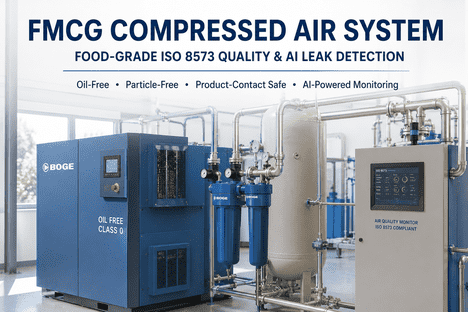
Compressed air that comes into direct or indirect contact with food products — conveying, blowing off product debris, actuating food-contact valves, or packaging atmosphere displacement — must meet specific air quality standards under Global Food Safety Initiative (GFSI) benchmarked schemes. SQF Requirement 11.3.4.1, BRCGS Global Standard for Food Safety Clause 4.10.1, and FSSC 22000 all require that compressed air used in food processing be filtered to remove oil aerosol, particulates, moisture, and microbiological contaminants. The ISO 8573 series provides the international classification framework for compressed air purity, and the British Compressed Air Society (BCAS) Food Grade Compressed Air Code of Practice provides the implementation standard most commonly referenced in GFSI audits. Typical FMCG food contact compressed air quality targets are ISO 8573-1 Class 2.2.1 (oil aerosol content less than 0.1 mg/m³, particulate content less than 1 mg/m³ with maximum particle size of 1 micron, pressure dew point less than -40 degrees Celsius for most applications). iFactory's Inspection Management module supports compressed air quality testing schedules with documentation of test results by sample point location, automated notifications when re-testing is due, and audit-ready reports that demonstrate compliance with each GFSI scheme's compressed air quality requirements.
Deploy a Digital Compressed Air Safety Program Across Your FMCG Facility
iFactory AI integrates pressure system integrity inspections, pneumatic LOTO procedures, blow-off nozzle compliance, hose management, noise monitoring, and food-contact air quality testing into a single digital platform for FMCG EHS and maintenance teams.
A Structured Path to Digital Compressed Air Safety Management at Your FMCG Facility
Deploying a digital compressed air safety management program does not require replacing compressors, modifying distribution piping, or interrupting production. iFactory AI's platform connects through mobile devices and existing facility infrastructure — enabling EHS teams to transition from paper-based inspection forms and spreadsheets to a digital safety management system in a phased approach. The deployment sequence below reflects the program structure developed at FMCG facilities with continuous production requirements.
Compressed Air Asset Inventory and Risk Assessment
iFactory's implementation team conducts an on-site audit of the compressed air system — documenting compressor packages, receiver tanks, distribution piping zones, point-of-use FRL stations, blow-off stations, pneumatic tool locations, and food contact air quality sample points. Each asset is assigned a unique QR-code identifier and linked to the applicable safety standards, inspection checklists, and testing schedules in the iFactory platform. Contact iFactory's team to discuss your facility's specific compressed air asset configuration and deployment scope.
Inspection Checklist Configuration and Baseline Documentation
Pre-built inspection checklists are configured for each compressed air asset category — pressure relief device testing, compressor room walkdown, distribution piping inspection, blow-off station nozzle compliance, pneumatic hose inspection, and air quality sample point testing. The facility's existing PRV test records, piping inspection photos, and air quality test results are uploaded as baseline documentation, and the first round of digital inspections is conducted to establish current-condition benchmarks for each asset.
LOTO Procedure Digitisation and Blow-Off Station Compliance Sweep
Machine-specific LOTO procedures for pneumatic energy isolation are digitised in the platform with step-by-step verification checklists and photo documentation of isolation points. A facility-wide blow-off station compliance sweep is conducted — each station's dead-end pressure is tested, nozzle condition is documented, and non-compliant stations generate corrective work orders. The compliance sweep establishes the baseline for the monthly blow-off station inspection program.
Continuous Monitoring and Compliance Benchmarking
With digital inspection workflows active across all compressed air safety domains, the iFactory platform generates monthly compliance KPI reports — inspection completion rates, PRV testing status, blow-off station compliance percentage, pneumatic hose replacement tracking, and air quality test results. These benchmarks quantify the facility's compressed air safety program performance and guide continuous improvement priorities. Model retraining and checklist refinement occur automatically as new asset types and inspection findings are recorded.
Expert Perspective: What Changes When Compressed Air Safety Is Managed with Digital Workflows
The most significant operational shift that digital compressed air safety management delivers in an FMCG facility is not the inspection capability itself — it is the consistency and auditability of the safety program. In a facility where PRV testing is tracked on a spreadsheet, pneumatic hose inspections are conducted by visual memory, and blow-off station compliance is checked when someone complains about a noisy nozzle — the safety program gaps are invisible until an incident occurs or an OSHA inspector arrives. Digital workflows make every inspection, every test result, every corrective action visible and accountable.
What the digital compressed air safety program changed most fundamentally at our beverage bottling facility was our relationship with blow-off station compliance. We had 47 blow-off stations across three production lines and three packaging lines, and before the digital platform, we did not have a single documented record of dead-end pressure testing for any of them. The OSHA compliance officer who conducted our last inspection did not check blow-off stations — but we knew it was only a matter of time before one of our competitors' facilities got cited for 1910.242(b) violations and OSHA started looking more closely at blow-off stations in food and beverage plants. Within the first two weeks of the digital inspection program, we identified 12 blow-off stations that exceeded the 30 PSI dead-end pressure limit — some by as much as 70 PSI. Six of those stations had homemade nozzles that had been fabricated by the maintenance team to increase airflow for cleaning conveyor chains. The homemade nozzles had no pressure-reducing function and no chip guarding. We replaced all 12 non-compliant nozzles with engineered safety nozzles from the plant's approved supplier list, and we established a monthly inspection schedule for every blow-off station in the facility. The total investment was under $800 for replacement nozzles and about 4 hours of maintenance labor per month for the inspection program. The compliance gap that had existed for years was closed in two weeks for less than the cost of a single OSHA citation for a 1910.242(b) violation — which starts at $13,000 per instance.
The pneumatic hose management program has been equally impactful. Before the digital platform, we replaced pneumatic hoses when they failed — typically after a visible rupture or a coupling blow-off caused an unscheduled production stoppage. The maintenance team would replace the failed hose assembly, document the work order in the CMMS, and move on to the next task. We had no systematic way of tracking how long each hose had been in service, which hoses were approaching the end of their rated service life, or which locations in the plant had the highest hose failure frequency. The digital hose management program changed that completely. Every hose assembly in the facility now has an installation date, a manufacturer-rated service life, a monthly inspection record, and a replacement due date in the platform. Hoses approaching the replacement threshold trigger notifications to the maintenance planner, and replacement work orders are generated automatically with the hose specification, length, and coupling type pre-populated from the asset record. In the first year of the program, we reduced hose-related production stoppages by 65% and eliminated pneumatic hose injuries entirely. That is what a connected compressed air safety program does that a paper-based program cannot. It connects every inspection, every test, every replacement decision to an asset record that tells you what is due, what is overdue, and what is going to fail before it actually fails.
Compressed Air and Pneumatic Safety in FMCG — Frequently Asked Questions
Does iFactory's compressed air safety platform require installing new sensors or modifying the existing compressed air system?
No. iFactory's platform is a digital safety management system that integrates with your existing compressed air infrastructure through mobile inspection workflows, QR-code asset tagging, and read-only connections to compressor SCADA systems (where available). The platform does not require sensors, controllers, or any modification to compressed air equipment. The only hardware typically required is QR-code placards on asset identification tags and a mobile device for inspection data collection. Book a Demo to review your facility's compressed air system configuration with iFactory's FMCG team.
How does iFactory help with OSHA 1910.242(b) blow-off station compliance across multiple production lines?
iFactory's Inspection Management module provides a pre-built blow-off station inspection checklist that includes dead-end pressure testing (with pass/fail at 30 PSI), nozzle condition verification, chip guarding presence, nozzle tip security, and ergonomic assessment. Each station is identified by location and assigned a QR-code placard for mobile inspection access. Non-compliant stations automatically generate a corrective work order with the specific deficiency documented. Monthly inspection completion rates and compliance percentages are tracked as KPIs and reported in the platform's compliance dashboard.
Can iFactory manage compressed air quality testing for SQF, BRC, or FSSC 22000 food safety audits?
Yes. iFactory supports compressed air quality testing schedules and documentation for all GFSI-benchmarked food safety schemes. The platform records test results by sample point location — including oil aerosol content, particulate content, pressure dew point, and microbiological results — and compares each result against the ISO 8573-1 target class specified in the facility's food safety plan. Automated notifications alert the EHS team when re-testing is due at each sample point, and audit-ready reports generate the documentation required for SQF 11.3.4.1, BRC 4.10.1, and FSSC 22000 compliance verification.
How does iFactory support lockout/tagout for pneumatic energy isolation in FMCG facilities?
iFactory's Safety and Compliance module provides a digital LOTO procedure library with machine-specific energy isolation steps that include pneumatic system isolation and bleed-down verification. Each procedure includes a step-by-step checklist with photo documentation of isolation points, lock application positions, and bleed-down valve locations. The platform tracks LOTO procedure review and approval status, maintains an audit trail of every lock-out tag-out event, and supports mobile verification that each pneumatic energy isolation step is completed before maintenance work begins.
How does the platform handle pneumatic hose inspection and replacement scheduling across a large FMCG facility?
iFactory's asset management module treats each pneumatic hose assembly as an individual asset record — with installation date, manufacturer, rated service life, maximum operating pressure, hose diameter, length, and coupling type captured at the point of installation. Monthly inspection checklists include visual inspection for abrasion, cuts, kinking, and chemical degradation, plus functional testing of coupling security and whip-check cable presence. Hose assemblies approaching the manufacturer-rated service life trigger notifications to the maintenance planner, and replacement work orders are generated automatically with the hose specification pre-populated from the asset record — eliminating reliance on visual inspection alone for replacement decisions.
The Case for Digital Compressed Air Safety Management in FMCG Is Both Regulatory and Operational
The regulatory case for digital compressed air safety management is direct: OSHA 1910.242(b) blow-off station compliance citations carry penalties starting at $13,000 per instance, OSHA 1910.147 LOTO violations for pneumatic energy isolation can exceed $15,000 per instance, and ASME B19.1 pressure system compliance gaps can result in citations of similar magnitude when an incident investigation reveals a systemic failure to test PRVs or inspect distribution piping. The operational case is equally compelling: pneumatic hose failures cause production stoppages that cost $5,000–$20,000 per hour in lost production, compressor room noise exposure that drives hearing loss claims and workers' compensation costs, and air quality non-conformances that can trigger GFSI audit findings and customer corrective action requests.
iFactory AI's Safety and Compliance, Inspection Management, and Incident Reporting modules provide FMCG EHS and maintenance teams with the digital infrastructure to manage every aspect of their compressed air safety program from a single platform — digitising pressure system integrity inspections, pneumatic LOTO procedures, blow-off station compliance sweeps, hose management programs, noise exposure monitoring, and food contact air quality testing. The platform is deployable without modifying compressed air equipment, replacing control systems, or interrupting production. The documented reduction in pneumatic-related incidents, the elimination of 1910.242(b) compliance gaps, and the improvement in compressed air safety program audit readiness at iFactory-managed facilities are not the result of adding more EHS staff or implementing more policies. They are the result of having a digital platform that makes every compressed air safety program element visible, connected, and actionable — every shift, every day. Schedule a demo to see how iFactory's platform manages compressed air and pneumatic safety for your FMCG facility.
Deploy a Digital Compressed Air Safety Program Across Your FMCG Facility
iFactory AI delivers integrated safety management for compressed air and pneumatic systems — pressure relief testing, hose inspection workflows, blow-off nozzle compliance, air quality monitoring, and LOTO procedures — in one platform purpose-built for FMCG production environments.