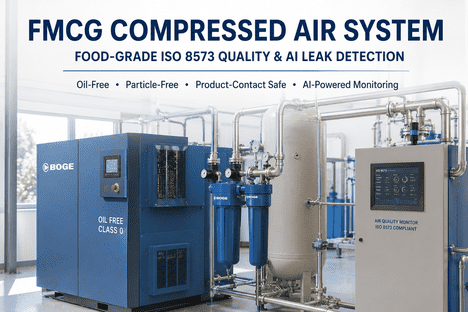
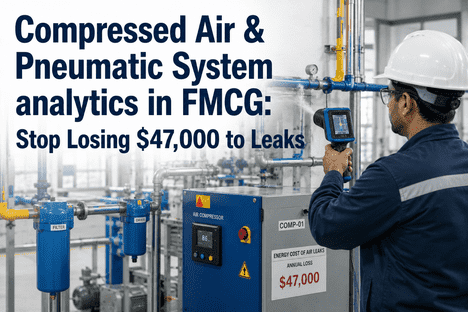
Most Maintenance Managers in FMCG facilities already understand the compressed air paradox: it is the most expensive utility in the plant per unit of energy consumed, yet it receives the least systematic monitoring of any critical system. Compressed air accounts for 10-30% of total industrial electricity consumption, and 20-30% of that compressed air is lost to leaks in the average facility. For food-grade applications where compressed air comes into direct or indirect contact with product, the stakes extend beyond energy waste to food safety compliance. ISO 8573 sets the international standard for compressed air purity across solid particle, water, and oil content — and regulatory frameworks including FSMA, BRCGS, and SQF increasingly require documented evidence of compliance. The gap between the compressed air system your facility operates and the one required for food-grade compliance is rarely a hardware problem. It is a monitoring and verification problem. AI-powered compressed air monitoring changes this by delivering continuous ISO 8573 quality verification, predictive leak detection, and compressor health tracking from a single platform — turning the most overlooked utility in the plant into a managed, compliant, and optimised asset class.
AI Compressed Air Monitoring · ISO 8573 Compliance · Leak Detection Intelligence
The Most Expensive Utility in Your Plant Is Also the Least Monitored. AI Changes That.
iFactory delivers AI-powered compressed air system monitoring as a managed service — continuous ISO 8573 quality verification, automated leak detection, and predictive compressor health tracking integrated directly into your maintenance workflow.
10-30%
Of total industrial electricity consumption goes to compressed air generation — making it the single largest utility cost in most FMCG manufacturing facilities
20-30%
Of all generated compressed air is lost to undetected leaks in the average facility — representing thousands of dollars in annual wasted energy per compressor
$2,500+
Annual energy cost of a single 1/8-inch compressed air leak at 100 PSI — most facilities have dozens of such leaks operating continuously
15-25%
Of energy costs can be saved through systematic leak management and compressor optimisation — the fastest-ROI energy project available to most FMCG maintenance teams
Why Compressed Air Is the Most Undermanaged Critical Utility in FMCG
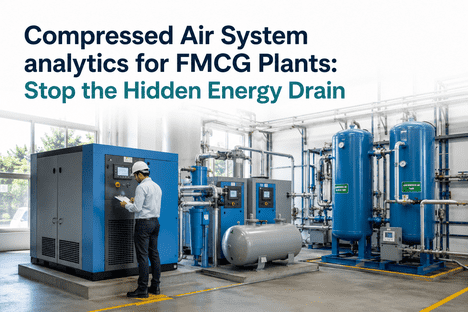
Compressed air systems in FMCG facilities serve a diverse range of applications — pneumatic conveying of ingredients, packaging machine actuation, product contact drying, clean-in-place system operation, and instrumentation control — each with different quality, pressure, and flow requirements. The system is inherently inefficient: approximately 90% of the electrical energy consumed by an industrial air compressor is converted to heat rather than useful pneumatic work, leaving only 10% for the actual compressed air delivered to the point of use. This thermodynamic reality means that every inefficiency in the system — leaks, pressure drops, filter blockages, dryer malfunctions — compounds exponentially in energy cost. A single 1/8-inch leak at 100 PSI with continuous operation costs over $2,500 annually in electricity. A typical FMCG facility with an unmanaged compressed air system is leaking the equivalent of one to three full compressor outputs continuously, every day.
The Monitoring Gap
Most facilities have no real-time visibility into air quality, leak rates, or compressor efficiency
Despite being the most expensive utility in the plant, compressed air systems are typically monitored through manual weekly rounds — checking compressor hours, drain trap function, and filter differential pressure. Air quality at the point of use is rarely measured continuously. Leak rates are estimated through annual ultrasonic surveys rather than tracked in real time. This monitoring gap means that degradation in air quality, compressor efficiency, or system integrity can progress for weeks or months before it is detected through the regular maintenance round.
The Compliance Challenge
ISO 8573 compliance requires documented evidence that most facilities struggle to produce on demand
ISO 8573 specifies purity classes for solid particles, water, and oil in compressed air. For food-contact applications, typical target classes are: solid particles Class 2 (0.1-1.0 mg/m³, maximum particle size 1 micron), water Class 4 (pressure dew point of +3°C), and oil Class 1 (total oil content less than 0.01 mg/m³). Compliance verification historically requires periodic sampling and laboratory analysis. The gap between sampling intervals can be months, during which a filter breakthrough, dryer malfunction, or oil carryover event can go undetected — creating a product safety risk that is only discovered at the next scheduled test or, worse, through a consumer complaint.
The Energy Waste
Unmanaged leaks and compressor inefficiency are the largest avoidable energy cost in most plants
A 200 HP rotary screw compressor operating at full load for 8,000 hours annually consumes approximately $120,000 in electricity at $0.10/kWh. A 20% leak rate wastes $24,000 per year per compressor. For facilities with multiple compressors operating in a networked system, the annual leakage cost can exceed $100,000. Beyond leaks, compressor-specific efficiency degradation — from fouled aftercoolers, worn intake valves, degraded lubricant, and failed condensate drains — compounds energy waste while simultaneously degrading air quality and increasing the risk of unscheduled downtime.
ISO 8573 — The Food-Grade Compressed Air Standard Most Facilities Are Not Continuously Monitoring
ISO 8573 is the international standard for compressed air quality, structured in a series of parts that address purity classes (Part 1), test methods for oil aerosol content (Part 2), test methods for humidity (Part 3), solid particle content (Part 4), and gaseous contaminants (Part 5-7). For FMCG applications, the critical compliance framework is ISO 8573-1, which defines purity classes for solid particles, water, and oil. The standard is referenced by major food safety schemes including BRCGS Issue 9 and FSSC 22000 Version 6, both of which require documented risk assessment and monitoring of compressed air used in product-contact applications.
Without AI — Periodic Compliance Testing
Quarterly or bi-annual laboratory sampling at point of use — results reflect conditions at the moment of sampling only
3-7 day lab turnaround between sample collection and compliance result — during which air quality may have changed
No continuous record of air quality between sampling events — audit documentation relies on spot-check data
No correlation between air quality events and production conditions — root cause analysis of contamination incidents is speculative
With AI — Continuous Compliance Monitoring
Real-time particulate, dew point, and oil vapour monitoring at critical points of use — continuous compliance verification, not periodic sampling
Automated alerting when any purity parameter approaches the ISO 8573 class threshold — intervention before noncompliance occurs
Immutable audit trail with time-stamped quality data — compliance documentation generated on demand for any date range
Correlation between air quality deviations and production events — root cause identification for contamination incidents in hours instead of weeks
How AI Transforms Compressed Air System Management in FMCG
AI-powered compressed air monitoring operates across three integrated dimensions — quality compliance, leak detection, and compressor health — each delivering measurable operational and compliance outcomes that are unachievable through periodic manual monitoring.
1. Quality Compliance
Continuous ISO 8573 verification at every critical point of use
AI monitoring integrates particulate counters, dew point transmitters, and oil vapour sensors at the points of use that matter most for product-contact applications — packaging machine air knives, pneumatic conveying lines, clean-in-place system air supplies, and instrumentation air headers. The platform displays real-time purity class for each monitored point against the target ISO 8573 class (typically Class 1.4.1 for food contact). When any parameter approaches or exceeds the class threshold, the system generates an alert with the affected point of use, the parameter that has shifted, and the recommended corrective action — filter change, dryer regeneration, or compressor maintenance. The continuous record provides audit-ready compliance documentation for every hour of operation.
Real-time purity class
Parameter deviation alerts
Audit-ready compliance log
2. Leak Detection
Automated identification and quantification of system leakage
AI leak detection uses a combination of flow monitoring across system zones and acoustic emission sensing to identify leaks in real time. The platform establishes a baseline flow profile for each system zone during normal operation and flags deviations that indicate new or expanding leaks. Acoustic sensors detect the ultrasonic signature of compressed air escaping through orifices — a frequency range inaudible to the human ear but reliably identifiable by machine learning models trained on thousands of leak signatures. Each detected leak is located by zone, estimated by flow rate and annual energy cost, and prioritised by repair urgency. The economic impact is displayed in real terms: the total leak-related energy cost for the facility, the savings achievable at current repair rates, and the return on investment for each leak repair.
Real-time leak rate estimation
Zone-level acoustic detection
Cost-per-leak prioritisation
3. Compressor Health
Predictive maintenance for every compressor in the system
AI compressor health monitoring tracks vibration signatures, bearing temperatures, discharge pressure profiles, lubricant condition indicators, motor current draw, and cooling system performance for each compressor unit. Machine learning models trained on historical compressor failure data identify the characteristic signatures of developing faults: bearing wear progression, valve failure onset, lubricant degradation, aftercooler fouling, and motor winding deterioration. The platform predicts remaining useful life for each critical compressor component and recommends intervention timing based on the optimal balance between maintenance cost and failure risk. This transforms compressor maintenance from calendar-based or reactive to condition-based predictive, eliminating both the cost of unnecessary maintenance and the production impact of unplanned compressor failure.
Vibration & temperature trending
Remaining useful life prediction
Failure mode classification
Your Compressed Air System Is Leaking Money and Compliance Risk. AI Finds Both Before They Cost You.
iFactory's AI managed service delivers continuous ISO 8573 quality verification, automated leak detection with cost impact, and predictive compressor health monitoring — live across your facility without internal data science or sensor engineering investment.
The Economic Case for AI Compressed Air Monitoring
The financial impact of AI-powered compressed air monitoring is measurable across three categories — energy savings from leak reduction, cost avoidance from prevented compressor failures, and risk elimination from continuous food-grade compliance verification. The combined return typically delivers a full system payback within six to twelve months for facilities with multiple compressors and product-contact compressed air applications.
Typical Annual Savings from AI Compressed Air Monitoring in an FMCG Facility
Leak reduction energy savings (20-30% baseline leak rate reduced to under 5%)
$18,000 - $45,000
Prevented compressor failure costs avoided annually
$8,000 - $25,000
Extended compressor service life (reduction in unplanned overhaul frequency)
$5,000 - $15,000
Production loss avoidance from air supply failure during production runs
Variable (facility-specific)
Compliance risk elimination (cost of a single noncompliance incident)
Priceless
We had three 200 HP rotary screw compressors supplying air to a packaging hall, a conveying system, and a clean-in-place station. Our annual ultrasonic leak survey was finding about $35,000 in leakage annually, but the facility was still consuming far more energy per CFM than the benchmark for our industry. We installed continuous flow monitoring and acoustic sensors across the system. Within the first week, the AI platform identified that 40% of our total leakage was concentrated in a section of the conveying line that had never been surveyed because it was classified as a different system zone on the P&ID. The annual leak cost in that zone alone was over $18,000. We repaired it in two days. The compliance dashboard also caught a dew point excursion in the packaging hall that our quarterly sampling would have missed for another six weeks. That single detection probably prevented a product moisture contamination issue that would have cost far more than the entire monitoring system.
— Maintenance Manager, Multinational FMCG Facility — 3 Compressors, 8 Product Lines
Conclusion — AI Compressed Air Monitoring Is the Highest-ROI Utility Project Most Maintenance Managers Have Not Yet Started
Compressed air is the most expensive utility in the FMCG plant, the least monitored critical system, and the source of both significant energy waste and product safety risk when unmanaged. The technology to close these gaps exists and is proven: continuous ISO 8573 quality verification eliminates compliance blind spots between sampling intervals, automated leak detection with economic impact quantification enables data-driven repair prioritisation, and predictive compressor health monitoring prevents the unplanned failures that halt production lines.
For Maintenance Managers responsible for both utility cost and food safety compliance, the decision to deploy AI compressed air monitoring is not a technology project. It is an operational and financial decision that delivers measurable return from month one — in energy saved, failures prevented, and compliance risk eliminated.
iFactory delivers AI-powered compressed air monitoring as a managed service — continuous quality verification, automated leak detection, and predictive compressor health tracking integrated into a single platform, live across your facility without requiring internal data science or sensor engineering capability. Book a Demo to see how iFactory's compressed air monitoring maps to your facility's compressor configuration and ISO 8573 target classes, or talk to an expert about configuring a pilot on your highest-priority compressed air zone.
Frequently Asked Questions
Stop Managing Compressed Air on Manual Rounds. Start Monitoring It With AI That Finds Leaks, Verifies Quality, and Predicts Failures.
iFactory's AI managed service delivers continuous compressed air quality monitoring, leak detection with cost quantification, and predictive compressor health tracking — live across your facility without internal data science or sensor engineering investment.