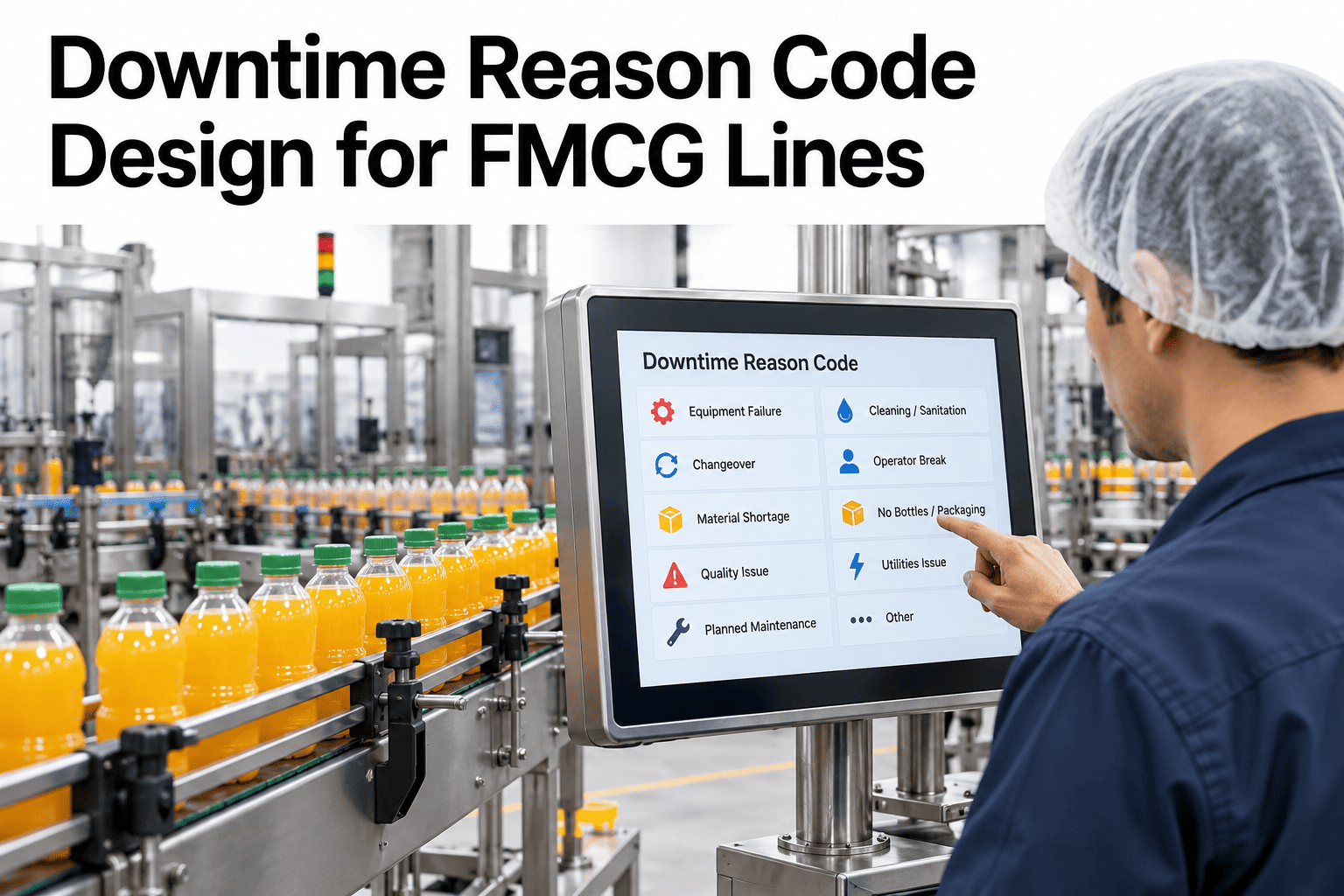
A downtime reason code list is a balancing act most plants get wrong in one of two directions. Too few codes and every stop gets lumped under a vague label that tells an analyst nothing useful. Too many and an operator facing a stopped line has to scroll through a list long enough to make them give up and pick whatever's closest, usually "other." An 80-code structure, organized into a small number of top-level categories with specific sub-codes underneath, is the range most CPG lines settle on once they've tried both extremes. Operations and continuous improvement teams can see how iFactory AI structures a reason code library sized for fast operator entry before the next code list revision.
Downtime Reason Code Design for FMCG Lines
An 80-code taxonomy that keeps operators fast and analysts satisfied, without drop-down fatigue on the floor.
Why Both Extremes Fail the Same Way
A code list that's too short and one that's too long both end up producing bad data, just through different mechanisms.
Every stop gets forced into a broad category, so the Pareto chart shows categories, not causes.
Operators under time pressure scroll past relevant codes and default to whatever's quickest to find.
A short list of categories with focused sub-codes lets operators find the right one in seconds.
The goal is not a specific number, it's a structure an operator can navigate quickly and consistently under real shift conditions.
A Two-Level Structure That Scales
An 80-code library works because it's organized in two tiers, not presented as one long flat list.
| Level | Typical Count | Purpose |
|---|---|---|
| Top-level category | Roughly 6 to 10 categories | Fast first choice, narrows the search immediately |
| Sub-code | Roughly 6 to 12 per category | Specific enough for meaningful root cause analysis |
| Combined total | Around 60 to 100 codes | Detailed enough for analysts, fast enough for operators |
See a Right-Sized Structure Built for Your Own Lines
Book a 30-minute session and iFactory AI will walk through structuring a two-tier reason code library sized to your equipment and current stop patterns.
Designing for the Person Entering the Code, Not Just the Analyst Reading It
A code list designed purely for analytical completeness tends to be unusable on the floor. The two needs have to be balanced, not optimized for one at the expense of the other.
Building the List From Real Stop History
A code list designed from a blank sheet tends to miss the stops that actually happen. Starting from historical data gets the structure closer to right on the first pass.
Pull stop history
Review several months of actual downtime events and free-text notes.
Group into categories
Cluster recurring causes into a manageable set of top-level categories.
Define sub-codes
Add specific sub-codes under each category based on recurring patterns.
Test with operators
Have actual operators try finding codes for sample stops before finalizing.
Keeping "Other" From Taking Over
An "other" category is necessary, but its size is one of the clearest signals of whether the code list is actually working.
A small, stable percentage of total stops, reviewed periodically for new patterns.
A signal the code list is missing something real happening on the line.
The list needs a structural review, not just a tweak.
The code libraries that stay useful over time are the ones built from real stop history and revisited on a set schedule, not designed once in a conference room and left untouched for years. Equipment changes, new SKUs and process adjustments all introduce new stop causes that an original code list, however well designed, could not have anticipated, and a growing "other" category is the clearest early warning that the list has fallen behind reality. Review the list against actual usage data at least annually, and treat a rising "other" share as a prompt to investigate, not a number to ignore.
Where iFactory AI Fits
iFactory AI structures reason code libraries from real stop history, and tracks code usage over time to flag when the list needs revisiting.
History-based structure
Code categories and sub-codes are built from actual stop patterns, not a generic template.
Fast-entry design
The two-tier structure is organized for quick navigation under real shift time pressure.
"Other" monitoring
The uncategorized share is tracked continuously, flagging when the list needs review.
Ask in plain language
Ask which reason codes are rarely used or overused and receive a direct answer.
Frequently Asked Questions
Why 80 codes specifically, and not more or fewer?
Eighty is not a strict target, it's roughly where many CPG lines land when balancing enough granularity for meaningful root cause analysis against a list operators can actually navigate quickly during a stop, organized as 6 to 10 top-level categories with several sub-codes each. You can watch a two-tier code structure built on sample stop data in a live session.
How do we build a code list that actually matches what happens on our lines?
Start from several months of real stop history, including any free-text notes operators have left, group recurring causes into categories, then test the resulting structure with actual operators before finalizing it. To build this for your own lines, request a code design session with the iFactory AI team, or ask support what stop history data is needed.
What should we do if "other" keeps growing as a category?
Treat a rising "other" share as a signal the code list is missing a real pattern happening on the line, and investigate which stops are landing there before the category grows large enough to hide a genuine root cause. A short product tour of "other" category monitoring shows how this is tracked.
How often should the code list be revised?
At least annually, and sooner if equipment changes, new SKUs are introduced, or the "other" category starts growing, since a code list that was well designed at launch can still fall behind as the line itself changes. See how code usage is tracked to flag revision needs in a guided walkthrough.
Should every line in the plant use the same code list?
A shared top-level structure across lines supports plant-wide comparison, while sub-codes can be tailored to equipment-specific failure modes, which keeps the list both comparable and specific enough to be genuinely useful. Schedule a walkthrough of multi-line code standardization to see how this balance is struck.
Give Operators a Code List They'll Actually Use Correctly
iFactory AI structures reason code libraries from real stop history, sized for fast, accurate entry. Book a walkthrough to see it built around your own lines.