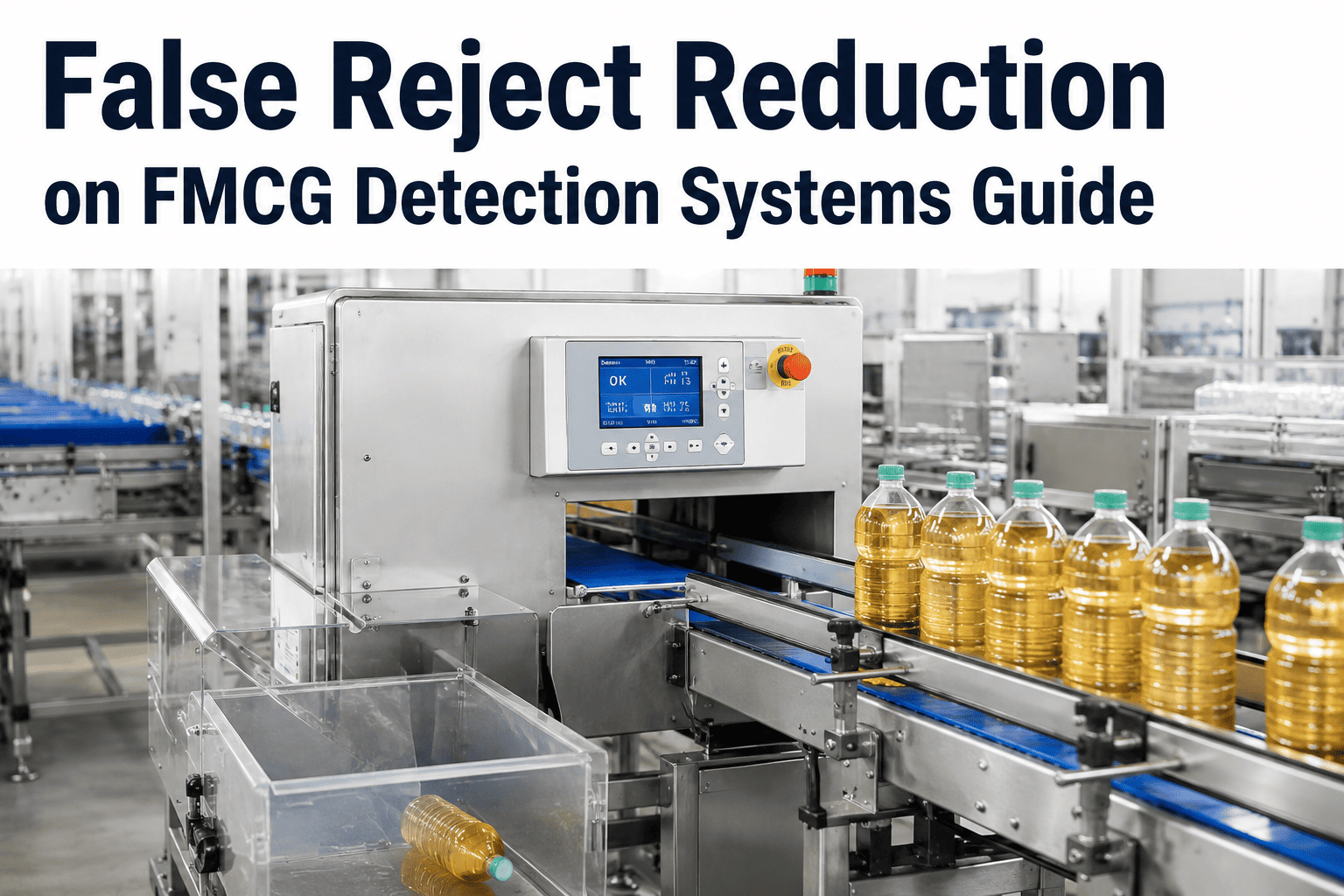
A snack food plant running two X-ray lines and one multi-frequency metal detector was rejecting 4.1% of conforming product every shift — nearly three times the 1-2% threshold most QA teams treat as normal. Operators had quietly turned sensitivity down twice that year just to keep the line moving, and nobody had documented why. When the plant finally traced the pattern, the cause wasn't a faulty detector at all — it was uncompensated product effect from a reformulated high-moisture coating that the detection settings had never been revalidated against. Within three weeks of correcting phase angle and rebuilding product-specific reference profiles, false rejects fell from 4.1% to 1.3%, and the plant recovered 61 hours of reprocessing labor a month, all without touching true-positive contamination sensitivity, and you can see exactly how at ifactoryapp.com/support.
Every false reject is product you already paid to make, thrown away for nothing.
False rejects on X-ray and metal detection lines don't just waste product — they hide the real signal your QA team needs to catch genuine contamination. Here's how leading FMCG plants are cutting false reject rates 50-70% without lowering true sensitivity.
False rejects are a data problem wearing an equipment costume
Most plants treat a rising false reject rate as a hardware issue and call the equipment vendor for recalibration. But the underlying cause is almost always a mismatch between the detection system's reference settings and what's actually moving through the aperture that day — a new supplier's foil laminate, a reformulated high-salt marinade, a seasonal moisture shift in raw material, or a changeover that reused yesterday's product code. Detection hardware rarely drifts on its own; the product changes underneath it, and nobody updates the profile.
High-moisture, high-salt, or mineral-dense foods generate an electromagnetic signal that mimics stainless steel. A 5% moisture shift in formulation can reduce effective stainless steel detection by 30-50% if phase settings aren't revalidated.
Metalized film and foil-lined pouches disrupt the same electromagnetic field the detector uses to find contaminants, forcing operators to either drop sensitivity or accept a wall of false alarms.
Phase angle compensation must be validated per product-packaging combination. A mismatched product code silently suppresses genuine metal signals behind product-effect noise while still triggering false rejects on conforming units.
Conveyor speed inconsistency changes dwell time inside the detection field. Even small speed variance compromises detection accuracy for both metal detectors and X-ray systems in ways operators rarely suspect first.
What a healthy false reject rate actually looks like
Industry guidance is consistent: running 20-30 conforming units at normal line speed should produce a false reject rate under 1-2%. Anything above that signals product effect drift, a formulation change, or an unauthorized sensitivity reduction operators made just to keep throughput moving. Below is how that threshold plays out in real production terms across common FMCG categories.
| Product category | Typical false reject rate before tuning | Target after reference-profile correction | Primary driver |
|---|---|---|---|
| High-moisture ready meals | 3.5% - 5.0% | 0.8% - 1.2% | Product effect / phase drift |
| Foil-lined snack pouches | 2.8% - 4.2% | 0.9% - 1.4% | Metalized packaging interference |
| High-salt cured meats | 4.0% - 6.1% | 1.0% - 1.5% | Conductivity mimicking metal signal |
| Frozen multi-SKU lines | 2.2% - 3.6% | 0.7% - 1.1% | Product code / phase mismatch |
| Granola and trail mix | 3.1% - 4.8% | 1.1% - 1.6% | Density variation across clusters |
Four levers that bring false rejects down without touching real sensitivity
The goal is never to loosen the detector until alarms stop — that just hides contamination risk behind a quieter line. The correction has to target the actual mismatch between the reference profile and the product moving through it right now.
Rebuild reference profiles per SKU, not per product family
Two SKUs in the same product family can carry meaningfully different moisture, salt, or fill weight. Grouping them under one shared detection profile is the single most common cause of chronic false rejects in multi-SKU plants.
Revalidate phase angle after every formulation change
Any change to recipe, moisture target, or packaging supplier requires a phase angle revalidation before the next production run — not at the next scheduled calibration window, which could be weeks away.
Trend false reject rate by SKU over time, automatically
A sudden spike in false rejects on one SKU almost always precedes a confirmed contamination event or a documented formulation drift. Catching the trend early turns a future audit finding into a routine adjustment.
Separate operator-adjusted sensitivity from validated sensitivity
When operators quietly lower sensitivity to stop nuisance alarms, that change needs to be visible and reversible — not buried in a machine setting nobody reviews until the next audit finds it.
A detector that alarms constantly gets ignored. A detector tuned to its actual product gets trusted. Book a Demo and see how iFactory AI builds per-SKU reference profiles automatically from your existing detection equipment data.
The operational cost of a high false reject rate
False rejects rarely show up as a single line item on a P&L, which is exactly why they persist for years. They surface instead as reprocessing labor, line stoppages nobody escalates, and a QA team that has learned to distrust its own detection equipment.
What a 20-year food safety engineer sees in this pattern
Priya Ramaswamy — Director of Food Safety Engineering, 19 years across dairy and snack manufacturing, former GFSI lead auditor
"Every plant I've audited with a chronic false reject problem has the same story underneath it: a formulation or packaging change went through R&D and procurement without ever touching the detection validation record. The equipment didn't fail. Nobody told the equipment what changed. When plants start trending false reject rate by SKU and treating a spike as a signal instead of a nuisance, the fix is usually done in under a month, and the false confidence problem — where a quiet detector is mistaken for a clean one — disappears with it."
How iFactory AI rebuilds your detection reference profiles
iFactory connects directly to your existing X-ray and metal detection equipment outputs — no hardware replacement — and reconstructs a validated, per-SKU reference profile from your production and reject history.
Pull equipment logs
iFactory ingests reject event logs, challenge test records, and phase settings directly from your existing metal detector and X-ray controllers across every line.
Map product effect by SKU
AI models separate genuine contamination signals from product-effect noise for every SKU, flagging exactly where reference profiles are outdated or shared incorrectly.
Rebuild validated profiles
New reference settings are generated per SKU-packaging combination and routed to your QA team for sign-off before deployment to the floor.
Monitor and alert on drift
Once live, iFactory trends false reject rate continuously and flags drift before it becomes a formulation-change audit finding six months later.
False rejects are the cheapest fix in food safety with the biggest blind spot
Unlike a missed contaminant, a false reject rarely triggers an investigation — it just gets thrown away, reprocessed, or absorbed as an accepted cost of doing business. That silence is exactly why the problem compounds for years while sensitivity gets quietly turned down in the background, degrading the very protection the equipment exists to provide. Correcting it isn't a hardware project. It's a data reconciliation project between what your detection system was validated against and what's actually moving through it today.
If your false reject rate has been trending upward, or if operators have adjusted sensitivity without a documented reason in the last quarter, that is the signal worth investigating now. Book a Demo to see how iFactory AI rebuilds validated detection profiles from data you already have.
FAQ: False reject reduction on FMCG detection systems
Stop losing conforming product to a detector that needs retuning, not replacing
See how iFactory AI rebuilds validated, per-SKU detection profiles from your existing X-ray and metal detector data — usually within weeks, not a capital project.