Overhead is the cost category every FMCG plant leader knows is too high and almost nobody has actually broken down line by line. Raw material and direct labor costs get scrutinized constantly because they move with volume and show up immediately in margin conversations. Facility costs, IT licensing, administrative overhead, and shared services quietly accumulate in the background, reviewed once a year if at all, which is exactly why they are usually where the easiest 10 to 15 percent in savings is sitting untouched. iFactory's cost reduction work typically starts in exactly this category.
FIXED COST REDUCTION
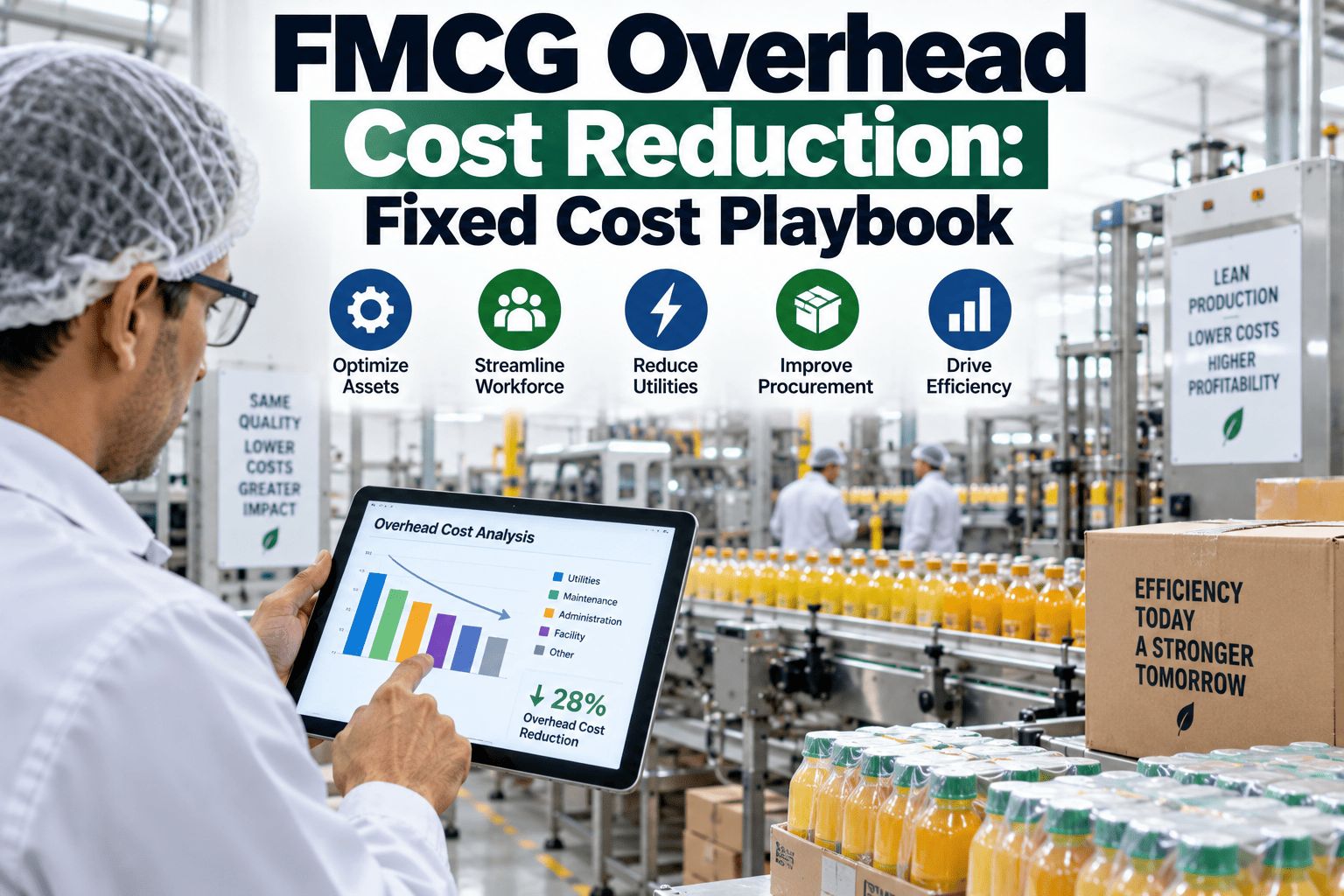
FMCG Overhead Cost Reduction: Fixed Cost Playbook
A structured approach to facility, IT, administrative, and shared services overhead that typically trims 10-15% off plant fixed costs without touching the operational muscle that keeps product moving.
Facility
IT & Systems
Admin
Shared Services
Why Overhead Is the Easiest Cost Category to Under-Manage
Direct costs get line-item scrutiny because they scale directly with production volume, and a spike is immediately visible in a weekly cost report. Overhead does the opposite — it stays relatively flat regardless of volume, which makes a slow, multi-year creep in facility, IT, or admin spend almost invisible until someone finally sits down and compares it against what similar-sized operations actually need to spend in the same categories. That comparison is usually the moment a savings opportunity becomes obvious.
Where Overhead Actually Hides — Four Categories
Every FMCG plant's overhead breaks down into a similar set of categories, though the exact proportions vary. Understanding where cost typically accumulates in each is the first step toward finding savings without cutting into operational capability.
FAC
Facility & Utilities
Energy contracts negotiated years ago, underused square footage, and maintenance contracts that have never been rebid competitively.
IT
IT & Systems Licensing
Software licenses purchased for headcount or use cases that no longer exist, and overlapping tools performing the same function.
ADM
Administrative Overhead
Manual reporting processes, redundant approval layers, and administrative headcount supporting processes that could be automated.
SVC
Shared Services
Centralized functions like finance, HR, and procurement allocated across plants using formulas that no longer reflect actual usage.
Typical Savings Potential by Category
Not every overhead category carries the same savings potential, and prioritizing the effort matters as much as the audit itself. The figures below reflect typical ranges observed across FMCG plant cost reduction engagements, adjusted for each facility's specific starting point.
| Overhead Category | Typical Savings Range | Primary Driver |
|---|
| Facility & Utilities | 8% – 18% | Energy contract renegotiation, space consolidation |
| IT & Systems Licensing | 15% – 30% | License rationalization, tool consolidation |
| Administrative Overhead | 10% – 20% | Process automation, approval layer reduction |
| Shared Services Allocation | 5% – 12% | Usage-based reallocation instead of flat formulas |
Get a Fixed Cost Audit for Your Own Facility
iFactory runs a structured overhead audit across facility, IT, admin, and shared services costs to identify your specific savings opportunities before recommending any cuts.
The Trimming Method — Cutting Without Losing Muscle
The distinction between cutting fat and cutting muscle is what separates a durable cost reduction from one that damages operational capability and gets quietly reversed within a year. The method below is designed specifically to avoid that outcome.
1
Line-Item Audit Against Actual Usage
Every recurring overhead cost is matched against actual current usage — square footage occupied, software seats active, headcount performing manual tasks — rather than historical budget allocations.
2
Benchmark Against Comparable Facilities
Costs are compared against similar-sized FMCG plants to identify categories running meaningfully above typical range, flagging where the deepest opportunity likely sits.
3
Prioritize by Impact and Ease
Opportunities are ranked by savings potential against implementation difficulty, so quick contract renegotiations happen before harder structural changes.
4
Implement With Operational Sign-Off
Every proposed cut is reviewed by the operations team that would be affected, confirming the change targets true overhead and not a cost that quietly supports production capability.
A VP of Operations on Finding the 12% Nobody Expected
"
We genuinely believed our overhead was already lean going into this exercise — we had done a cost-cutting round three years earlier and assumed that work still held. What the line-item audit found was that a meaningful chunk of our IT licensing was for tools tied to a plant management structure we had reorganized away from two years prior, and nobody had ever gone back to cancel the associated licenses. Separately, our facility maintenance contract had never been rebid since it was first signed almost a decade ago, and a competitive rebid alone found real savings without any change in service quality. None of this required cutting a single position or touching anything that actually kept product moving through the plant. It was entirely cost that had accumulated quietly because nobody had a structured reason to go back and check it. The total came to just over 12% of our overhead base, which was considerably more than we expected walking in.
— VP of Operations, Mid-Size FMCG Manufacturer · Led Overhead Reduction Across 4 Plants
Before and After — What a Completed Audit Looks Like
The comparison below illustrates the kind of shift a completed overhead audit typically produces, using representative figures from the categories discussed above to show the pattern rather than a guaranteed outcome for every facility.
Before Audit
100%
Baseline overhead spend across facility, IT, admin, and shared services categories
→
After Implementation
87%
Overhead spend after a typical 10-15% reduction, with no change to production capability
Frequently Asked Questions
How is this different from a standard annual budget review?
A standard budget review typically compares this year's overhead spend to last year's, which is useful for catching sudden increases but does very little to surface costs that have been quietly accumulating for years without any single large jump. A structured fixed cost audit instead compares every line item against actual current usage and external benchmarks, which is what surfaces the kind of gradual creep — an unused software license, an unrebid maintenance contract — that a year-over-year comparison would never flag, since each individual year's change looked small.
Will an overhead reduction effort require layoffs?
Not necessarily, and this is a common misconception about fixed cost reduction work. A significant share of typical savings in the categories above — contract renegotiation, license rationalization, process automation, allocation formula correction — does not involve headcount reduction at all. Where administrative process changes do free up staff time, the more common outcome is redeploying that capacity toward higher-value work rather than immediate reduction, though this depends on each organization's specific circumstances and should be evaluated case by case.
How long does a full overhead audit typically take?
For a single facility, a thorough line-item audit across all four overhead categories typically takes four to six weeks, covering data gathering, benchmarking, and prioritization of opportunities. Multi-plant organizations auditing shared services allocation across several sites simultaneously may need a somewhat longer timeline to gather comparable data consistently across all locations, but the core audit methodology remains the same regardless of scale.
How do we make sure a cost cut doesn't accidentally hurt operations later?
This is precisely why the method above includes operational sign-off as a required step before any cut is implemented, rather than treating the audit's recommendations as automatically final. A cost that looks like pure overhead from a finance perspective sometimes turns out to support operational flexibility or resilience in ways that are not obvious from the numbers alone, so reviewing every proposed change with the team that would be affected is a critical safeguard against cutting something that later needs to be restored at greater cost.
Can iFactory run this audit across multiple plants at once?
Yes — multi-plant overhead audits are common, particularly for shared services allocation, where costs like centralized finance or procurement functions are often spread across facilities using outdated formulas that no longer reflect actual usage at each site. Running the audit across the full network at once also makes benchmarking each individual plant against its peers more meaningful, since the comparison set is internal and directly comparable rather than relying solely on external industry figures. To scope an overhead audit for your facility or network,
book a demo with our team.
Find the Overhead Savings Sitting in Plain Sight
Most FMCG plants are carrying 10-15% more fixed cost than they need to, spread quietly across facility, IT, admin, and shared services line items nobody has re-examined in years. iFactory's audit finds it without cutting operational muscle.