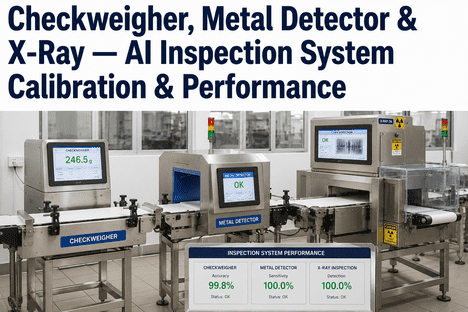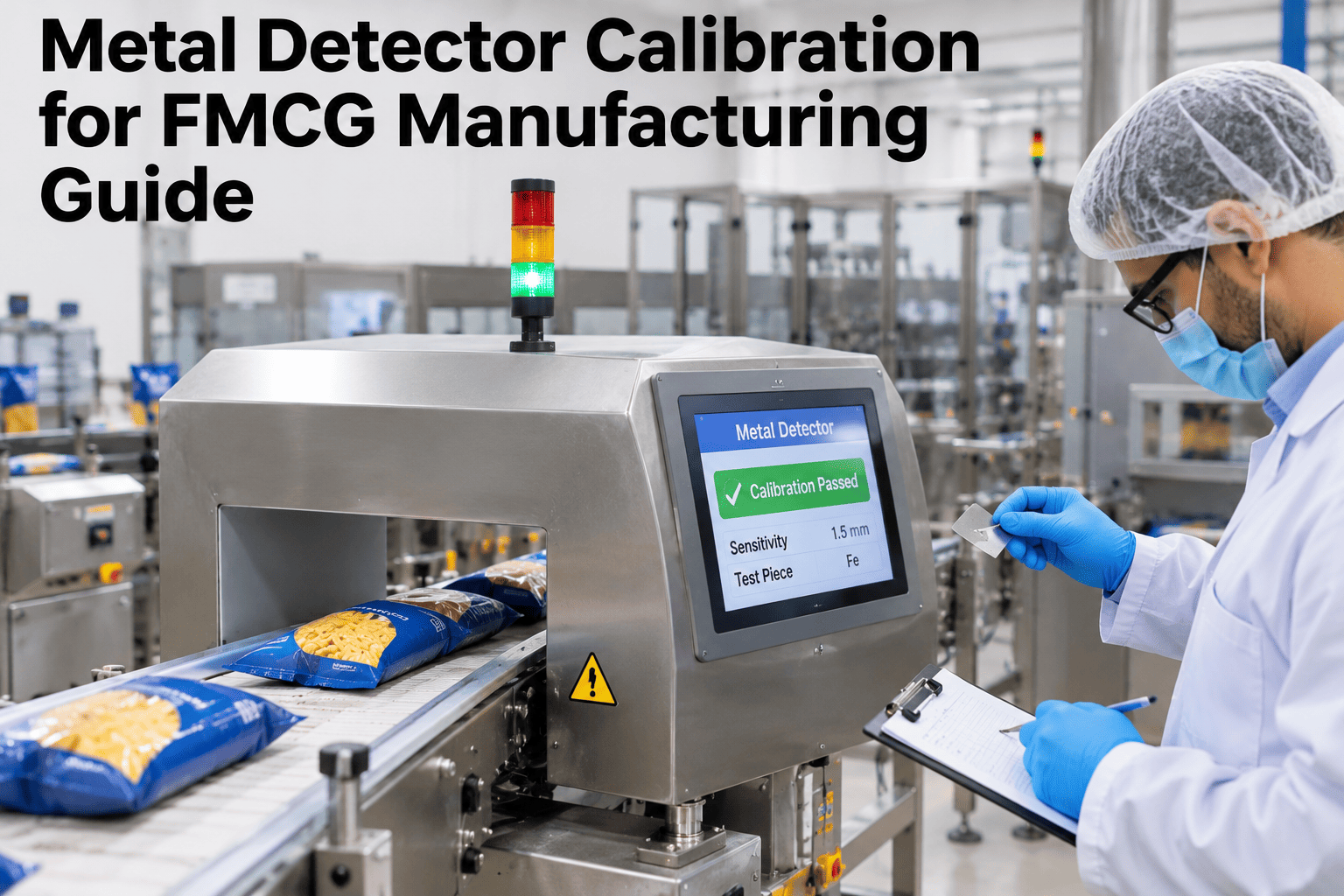
Metal detector calibration for an FMCG plant means teaching the detector to ignore the signal the product itself makes, then proving it still catches ferrous, non-ferrous and stainless steel test pieces at the sensitivity the HACCP (Hazard Analysis and Critical Control Points) plan requires. The right setting is not the most sensitive one, because product effect from moisture and salt can trigger false rejects. Verification then repeats on a set cadence, at every product change and after any repair. Quality teams can watch a calibration and verification record built for their own lines in a short session.
Set the Detector to Ignore Your Product and Still Catch Every Piece of Metal
iFactory AI, an on-premise industrial AI platform, connects inspection equipment to digital test records, so every calibration, verification and product change is proven on file.
What Is Metal Detector Calibration in FMCG Manufacturing?
It is the process of setting detector sensitivity against real product, package and speed, then confirming performance with certified test pieces. Calibration sets the detector up. Verification proves it still works, and auditors ask for both records.
What Is Product Effect and Why Does It Change the Setting?
Product effect is the signal a conductive or moist product makes as it passes the coil. It disturbs the detector's balance, so maximum sensitivity is not a steady production setting (Industrial Monitor Direct). Teams can ask for a product effect review of their range.
| Product Situation | What Happens | Calibration Consequence |
|---|---|---|
| Dry, low-salt product | Small product signal | Higher sensitivity is usually reachable |
| Moist or salty product | Strong product signal, false rejects | Suppress the product response, keep test pieces detected |
| New recipe or moisture level | Product signal shifts | Re-learn and re-verify before first pack |
| Foil-wrapped pack | Foil masks or mimics metal | Plan a different detection layer |
How Do You Learn the Product Effect and Set Sensitivity?
Five steps take a detector from empty belt to a recorded, validated setting.
Check Your Product Effect Plan Before the Next Audit
Share your product list and current test records. iFactory AI's team will show which products need re-learning and where records are thin.
What Size Should the Test Pieces Be?
There is no single size. The size a detector can find depends on aperture, frequency, installation and product conditions (IFSQN forum, 2012), so each plant fixes sizes in its own plan. The sizes below are practitioner examples, not limits.
| Metal | Example A | Example B | Reading It |
|---|---|---|---|
| Ferrous | 1.2 mm | 1 mm | Easiest for the coil to see |
| Non-ferrous | 1.5 mm | 2.2–2.5 mm | Depends on the metal used |
| Stainless steel | 2.0 mm | 3 mm | Usually the hardest to catch |
What Does One Verification Run Include?
Certified test pieces go through actual product, not an empty belt, at leading, center and trailing positions (Oxmaint, 2026). That makes nine passes per product.
How Often Should Detection Be Verified?
The HACCP team sets the frequency for the site (BRCGS Issue 9, clause 4.10.3.4, as cited by Oxmaint). Most plants anchor it to five events.
Which Calibration Mistakes Cause the Most Audit Findings?
What Should Happen When a Test Piece Is Missed?
Quarantine every pack made since the last good test, then fix and retest before restart (Miratag). Teams can see a failed-test workflow in action on a sample line.
Where Does iFactory AI Fit in Detector Calibration?
iFactory, an on-premise AI platform for manufacturing, keeps the proof around the detector, not just the detector.
Digital Test Records
Each pass or fail is time-stamped and linked to the batch.
Drift Trending
Test results are trended so a slipping detector shows before a failure.
Product-Change Prompts
A new SKU prompts re-learning and re-verification before release.
Audit Retrieval
Full history by detector, line or date range, on demand.
Expert Review: Judging a Calibration Program
Frequently Asked Questions
What is the difference between calibration and verification of a metal detector?
Calibration sets the detector's sensitivity against your product and package. Verification is the routine test with certified pieces that proves it still works. Auditors ask for both records separately. See both records kept together in a short demo.
Why not run the detector at maximum sensitivity?
Product effect from moisture and salt can disturb the detector, so the highest setting causes false rejects and is not a steady production setting (Industrial Monitor Direct). The goal is the highest sensitivity that stays quiet on good product. Find that window for your products with our team.
Do all three metal types need testing?
Under BRCGS practice, tests use ferrous, stainless steel and typically non-ferrous pieces, unless the product is in a foil container (IFSQN forum). Stainless is usually the hardest to detect. Ask support to review your test piece plan against your scheme.
When must a metal detector be re-verified after a product change?
Before the first pack of the new product passes, because moisture and density change the product effect. Record the result and sign it before production resumes. Set up product-change prompts with our team.
Can iFactory AI replace the detector or the test pieces?
No. Certified test pieces and approved detectors stay as they are. iFactory AI adds digital records, drift trends and prompts around them. Walk through the record flow on one line.
Prove Every Detector Setting Is Still Valid
See iFactory AI keep calibration, verification and product-change records in one searchable place. Book a session on your own detectors and test logs.