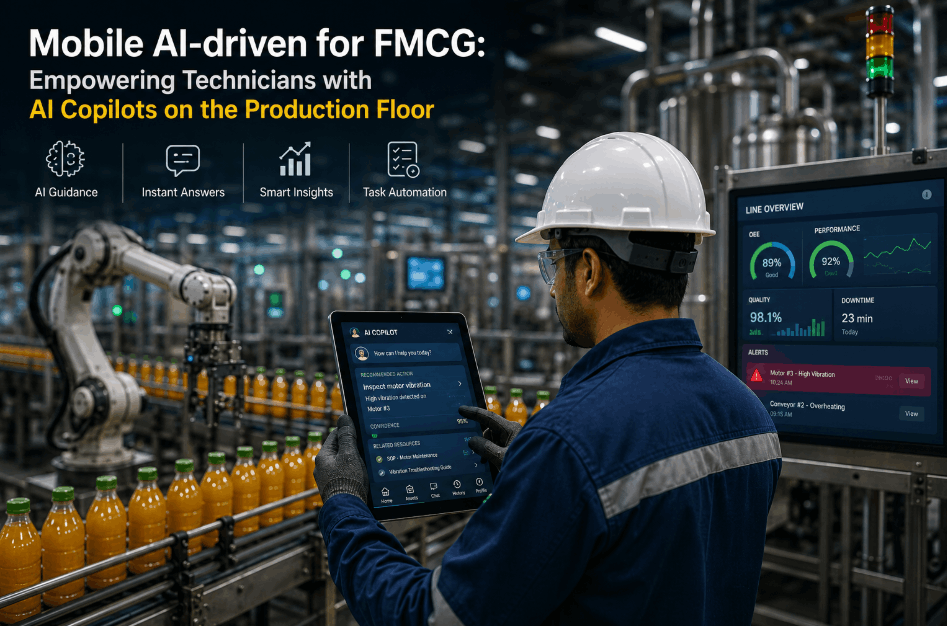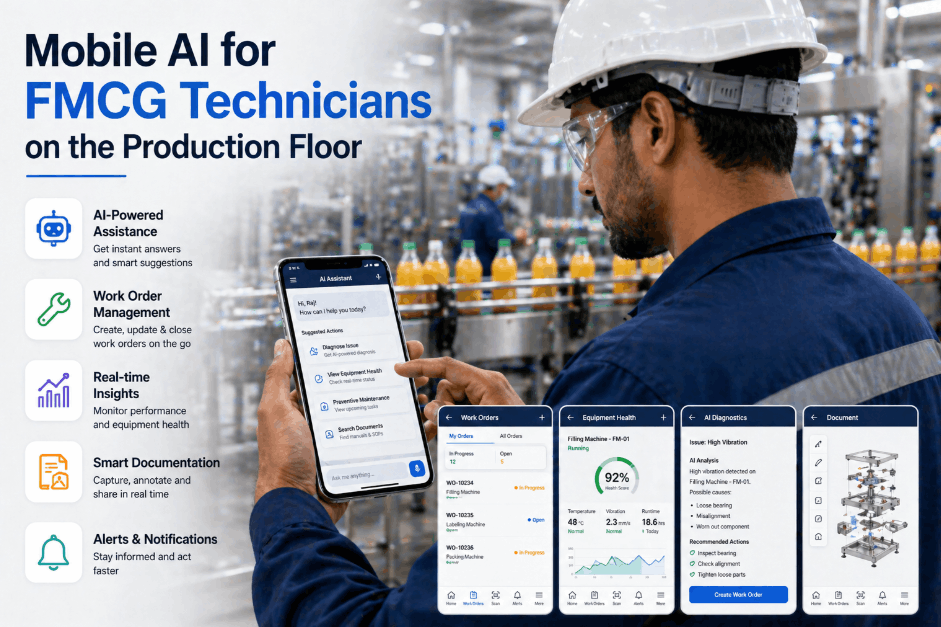
Mobile AI for FMCG technicians has become the defining productivity layer on the modern production floor — replacing the clipboard, the paper work order, and the wall-mounted desktop terminal with intelligent handheld applications that travel with every maintenance technician, quality operator, and food safety auditor across the plant. In fast-moving consumer goods environments, where line speed, sanitation cycles, and changeover frequency leave no margin for workflow friction, the gap between mobile-enabled and paper-bound operations now translates directly into OEE outcomes, FSMA compliance posture, and labor efficiency. If your FMCG technicians are still walking back to a shared desktop to log work orders, capture asset photos, or fill sanitation forms, Book a Demo to see how iFactory mobile AI transforms floor-level execution speed.
Why Mobile AI Apps Are Reshaping FMCG Technician Workflows in 2026
The Operational Reality of Floor-Based Maintenance and Quality Work in High-Speed FMCG Plants
FMCG production floors operate under conditions that conventional desktop maintenance software was never engineered to support. Technicians cover thousands of square feet across packaging halls, blending suites, cold storage zones, and high-care areas where they cannot reasonably leave their station to walk to a shared terminal. Quality operators conduct sanitation verifications, allergen changeover checks, and HACCP critical control point monitoring across multiple lines per shift. Maintenance teams respond to breakdown events where every minute of diagnosis delay cascades directly into lost throughput on lines running at 600 to 1200 units per minute. Mobile AI applications close this floor-to-system gap by putting the full operational intelligence platform on the device the technician already carries — eliminating the productivity loss that comes from disconnected work execution and delayed data capture.
Core Capabilities of Mobile AI Apps Built for FMCG Production Floors
The Functional Stack Every Modern FMCG Technician Mobile Application Must Deliver
A mobile AI app for FMCG technicians is not simply a desktop CMMS rendered on a smaller screen. The functional architecture must be re-engineered around the floor environment — gloves, wet hands, ambient noise, refrigerated zones with weak signal, and fast-paced shift handovers where information capture cannot afford to require five-minute interactions. Teams evaluating their current mobile capability against this baseline can Book a Demo and walk through a live capability gap assessment.
How Mobile AI Apps Work for FMCG Technicians Step by Step
From Asset Scan to Closed Work Order: The Floor-Level Execution Sequence
The operational flow of a modern mobile AI application for FMCG technicians is engineered to compress what used to be a fragmented, multi-touchpoint process into a single connected sequence executed entirely on the technician's device. Each step below represents a workflow stage where mobile AI eliminates friction. To see how this sequence applies to your facility's specific maintenance and food safety workflows, Book a Demo and walk through a live demonstration with your asset and process configuration.
Mobile AI vs Desktop CMMS vs Paper Workflows: Capability Comparison for FMCG
Evaluating Technician Productivity Architecture Against Modern FMCG Floor Demands
The performance divergence between paper-based, desktop-anchored, and mobile-first AI workflows is most visible at the technician level — where every minute of friction multiplies across hundreds of daily transactions per shift. The comparison below maps the practical capability gap across these three architectures on the dimensions that most directly affect FMCG operational performance.
| Capability Dimension | Paper-Based Workflow | Desktop-Only CMMS | Mobile AI Application |
|---|---|---|---|
| Floor-Level Work Order Execution | Manual Forms | Requires Terminal Walk | Direct on Device |
| Offline Operation in Cold Zones | Paper Works Offline | Network Required | Full Offline Sync |
| Asset History Lookup Time | 10-20 Minutes | 3-8 Minutes | Under 2 Seconds |
| Photo Evidence Capture | Separate Camera | Manual Upload | Auto-Tagged In-App |
| AI Diagnostic Assistance | Not Available | Not Available | Real-Time Suggestions |
| HACCP and Food Safety Forms | Paper Logs | Static Templates | Guided Digital Forms |
| FSMA Documentation Latency | Days to Weeks | Hours to Days | Real-Time Capture |
| Voice-to-Text Hands-Free Entry | Not Available | Limited | Industrial Grade |
| PM Compliance Visibility | Manual Reconciliation | Daily Reports | Live Dashboard |
| Shift Handover Automation | Verbal Handover | Manual Reports | Auto-Generated Brief |
Six High-Impact Mobile AI Use Cases on the FMCG Production Floor
Where Handheld AI Applications Generate the Largest Operational Lift in Consumer Goods Manufacturing
Not all mobile AI deployments deliver equivalent operational return. The use cases below represent the highest-leverage applications observed across food and beverage, personal care, and household goods manufacturing — areas where moving from paper or desktop workflows generates measurable improvements within the first operational quarter. Operations leaders prioritizing their roadmap can Book a Demo to map these use cases against their facility's specific cost and risk profile.
Operational Outcomes Measured Across FMCG Mobile AI Deployments
Quantifying the Productivity, Compliance, and Cost Impact of Floor-Level Mobile Applications
The business case for mobile AI in FMCG manufacturing is built on consistent, measurable outcomes observed across deployments in food, beverage, personal care, and household goods environments. The performance ranges below represent typical results within the first two operational quarters following platform deployment, validated across multiple facility scales. Plant leadership teams who want to model these outcomes against their specific operational baseline can Book a Demo for a facility-specific projection workshop.
Mobile AI Deployment Roadmap for FMCG Manufacturing Operations
Sequencing Mobile Application Rollout Across Maintenance, Quality, and Sanitation Teams
A successful mobile AI deployment in an FMCG facility is not a single technology drop. It is a structured sequence of capability additions that build on each other to achieve full floor-level digital execution within a manageable change adoption window. The phased roadmap below reflects the deployment pattern that has consistently delivered the fastest measurable outcomes across multi-line FMCG plants.
Food Safety, FSMA, and GFSI Compliance Through Mobile AI Capture
Building Audit-Ready Documentation as a Byproduct of Floor-Level Technician Activity
For FMCG manufacturers operating under FSMA preventive controls requirements and GFSI-benchmarked schemes such as SQF, BRCGS, or FSSC 22000, mobile AI applications transform the documentation problem from a recurring compliance burden into an automatic operational byproduct. Every sanitation verification, allergen changeover record, CCP monitoring entry, corrective action document, and verification activity log generated through the mobile platform is structured in scheme-aligned formats with full timestamping, signature capture, photo evidence linkage, and asset traceability — eliminating the manual reconciliation work that previously dominated quality team workload before audits.
Frequently Asked Questions
Do FMCG technicians need company-issued devices to use mobile AI applications?
No. Modern mobile AI platforms support both company-managed devices and BYOD models with appropriate MDM policies. Most FMCG facilities standardize on ruggedized handhelds for maintenance teams while supporting tablets and personal devices for quality and supervisory roles.
How does the mobile application work in cold storage zones with limited Wi-Fi connectivity?
Mobile AI applications operate fully offline. Technicians complete work orders and inspections without continuous network access. Data is stored locally and synchronizes automatically once connectivity is restored, with conflict resolution preserving every floor-side entry.
Can mobile AI apps integrate with our existing MES, ERP, and quality management systems?
Yes. Enterprise-grade mobile AI platforms integrate with leading MES, ERP, and QMS platforms through standard APIs and pre-built connectors, enabling closed-loop data flow between floor execution and enterprise planning systems.
How long does deployment of a mobile AI platform take in a typical FMCG facility?
For a single facility, the foundation phase typically takes four to six weeks. Compliance digitalization adds two to four weeks. Full multi-phase deployment including AI activation and system integration completes within three to five months without production interruption.
How does the AI diagnostic assistance feature improve over time?
The AI diagnostic engine continuously learns from facility-specific repair history, fault patterns, and outcome data captured through technician interactions. Diagnostic value typically peaks at the six-to-nine-month operational mark.
What training do FMCG technicians need to use the mobile AI application effectively?
Most technicians reach functional proficiency on core capabilities — scanning, work orders, photo capture, form entry — within a single shift of guided onboarding. Advanced AI capabilities are introduced in follow-up training tailored to each role.